
Summary: The DQ200 is the Volkswagen Group’s seven-speed dry-clutch DSG, sold under the gearbox codes 0AM and 0CW. Its signature failure starts as a loss of hydraulic pressure, not an electronic fault: the housing around the pressure accumulator cracks, the pump runs constantly to make up the loss, and the electronics give out last. Drivers see a flashing PRNDS display, hear the pump buzzing and feel a shock as the car pulls away. We rebuild the mechatronic unit on the bench, reinforce the weak point that started it, and send it back with its own coding.
- What is the DQ200, and how does it differ from the other DSGs?
- How does a DQ200 fault show itself?
- Which fault codes point at the DQ200 mechatronic?
- Why does the DQ200 mechatronic fail? Hydraulic first, electronic second
- Is it the clutch or the mechatronic?
- Should a DQ200 mechatronic be repaired or replaced with a new one?
- What about the DSG gearbox oil?
- Why does a DQ200 mechatronic need to come out at a garage?
- DQ200 and DSG gearbox questions
- Final thoughts
What is the DQ200, and how does it differ from the other DSGs?
The DQ200 is a seven-speed direct-shift gearbox built for engines producing up to roughly 250 Nm. What separates it from every other DSG in the group is the clutch pair: the two clutches run dry, as a manual gearbox’s clutch does, instead of sitting in an oil bath.
Like the rest of the family, it is controlled by a mechatronic unit — the gearbox’s control electronics and its hydraulic valve body, built as a single assembly inside the gearbox casing. On the DQ200 an electric pump charges a pressure accumulator, and that stored pressure is what the unit draws on to work the clutches and change gear.
It is fitted right across the group: the Audi A1, A3, Q2, Q3 and TT; the SEAT Altea, Ibiza, Leon and Toledo; the Škoda Fabia, Octavia, Karoq, Roomster, Superb and Yeti; and the VW Beetle, Caddy, Golf, Passat, Polo, Scirocco and Touran.
That list overlaps heavily with the other DSGs, and the overlap is where most wrong diagnoses begin. A Golf, an Octavia or a Leon might carry a DQ200, a six-speed wet DQ250 or a seven-speed wet DQ381, depending on the engine — and the three fail in different ways.
| Gearbox | Gearbox codes | Gears and clutches | Typical cars | Where failure usually starts |
|---|---|---|---|---|
| DQ200 | 0AM, 0CW | Seven-speed, dry | Polo, Golf, A1, A3, Fabia, Ibiza, Leon | Hydraulic first: pressure is lost at the accumulator housing, and the electronics fail afterwards |
| DQ250 | 02E | Six-speed, wet | Golf, Passat, Touran, A3, TT, Octavia, Leon | Electronic-led: pressure sensing inside the unit, often after oil has reached the electronics |
| DQ381 / DQ380 | 0DE, 0GC | Seven-speed, wet | Golf, Tiguan, T-Roc, Passat, Octavia, Kodiaq, Ateca | Electronic, on the sensor side: clutch position sensing |
| DQ500 | 0BH | Seven-speed, wet, high torque | Audi RS3, TT RS, VW Transporter T6 | Wear and contamination under high torque |
The rest of this page is about the DQ200, with the wet gearboxes brought in where the comparison helps. How the control electronics fit into a DSG more generally is covered in our explainer on VW and Audi DSG gearbox ECU functionality and common issues.
How does a DQ200 fault show itself?
The DQ200 gives a more distinctive set of warning signs than most automatics, because its failure runs through the pump. These are the ones it is known for:
- The PRNDS gear display flashes. The gearbox has detected a fault and is protecting itself, often by restricting which gears it will use. Our guide to a flashing PRNDS light explains what the display is telling you.
- A spanner symbol appears on the instrument cluster alongside it.
- The pump buzzes continuously with the ignition on. This is the most DQ200-specific sign of all: a pump that runs without pause is a pump trying to rebuild pressure the unit can no longer hold.
- The car shocks or judders as it pulls away. Clutch engagement depends on that pressure, so when it runs short, take-up stops being smooth.
- Hydraulic fluid weeps from the gearbox breather. It is the outward sign of the leak inside.
- Drive disappears. With pressure too low, the gearbox logs that the vehicle cannot move and will not take up drive at all.
- A burning smell. The worst case, and the reason not to keep driving on the earlier signs.
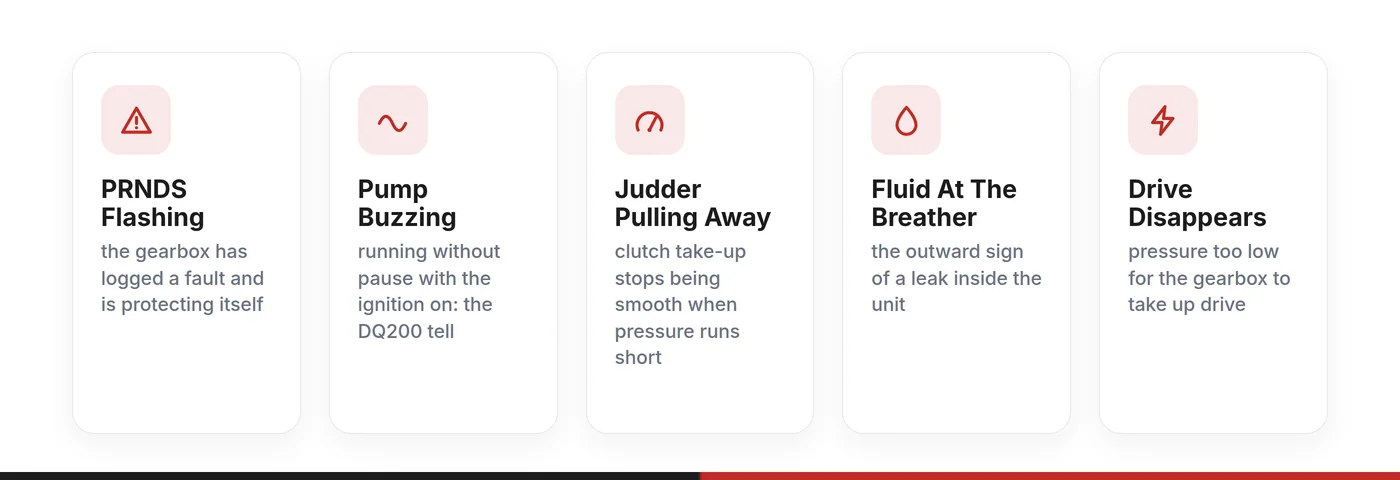
Two of these — the constant pump noise and fluid at the breather — point directly at the mechatronic’s pressure circuit. A judder on its own is less conclusive, which is where the codes come in.
Which fault codes point at the DQ200 mechatronic?
On the DQ200 the codes tell the same story as the symptoms, and in the same order. Insufficient pressure build-up is logged early; pump overload protection comes at the end, once the pump has been working flat out for too long.
| Code | What it means | What it points at |
|---|---|---|
| P189C | Insufficient pressure build-up | The early warning: the unit is not holding pressure |
| P17BF | Hydraulic pump overload protection | The serious end of the chain — the pump has run too long trying to compensate |
| P1895 | Vehicle cannot move | Pressure has fallen below what the gearbox needs to drive |
| P0562 | System voltage low | On this gearbox, commonly logged when the pump circuit fails |
| P0841 | Pressure sensor | A fault in how the unit measures its own pressure |
| P175D | Clutch 1 opens unintentionally | Clutch control lost on one half of the gearbox |
| P1604 | Control unit defective | The electronics side of the mechatronic |
| P173A–P173D | Gear-selector position sensing | Can sit in the unit, and worth checking on the bench |
| P072A–P073C | Gear selection, mechanical | Inside the gearbox itself rather than the mechatronic |
The last two rows are the honest split. Position-sensing codes can be a mechatronic problem; the mechanical gear-selection codes point past the unit into the gearbox.
The wet gearboxes log different headline codes. On the DQ250, P1815 and P1820 are pressure-sensing faults inside the unit, P0746 and P0776 relate to its pressure-control solenoids, and P1604 reports the control unit itself as defective. Low or degraded oil can set these same codes, so the level and condition are worth confirming before anything is removed.
On the DQ381 and DQ380 the documented faults sit on the sensor side: P1735 and P1736 for the clutch 1 and clutch 2 position sensors, and P0805 for the clutch position sensor circuit. They can show as a complete loss of drive, or as a safe mode that caps revs and gearchanges.
There is no defensible standing code list for the DQ500, and we would rather not publish one that looks authoritative and is not — its codes are read in context, on the car and then on the bench. For reading gearbox codes more generally, see our guide to transmission control module fault codes.
Why does the DQ200 mechatronic fail? Hydraulic first, electronic second
The DQ200 is often described as having an electronics problem. That has the order backwards, and the order is what matters when it comes to fixing it.
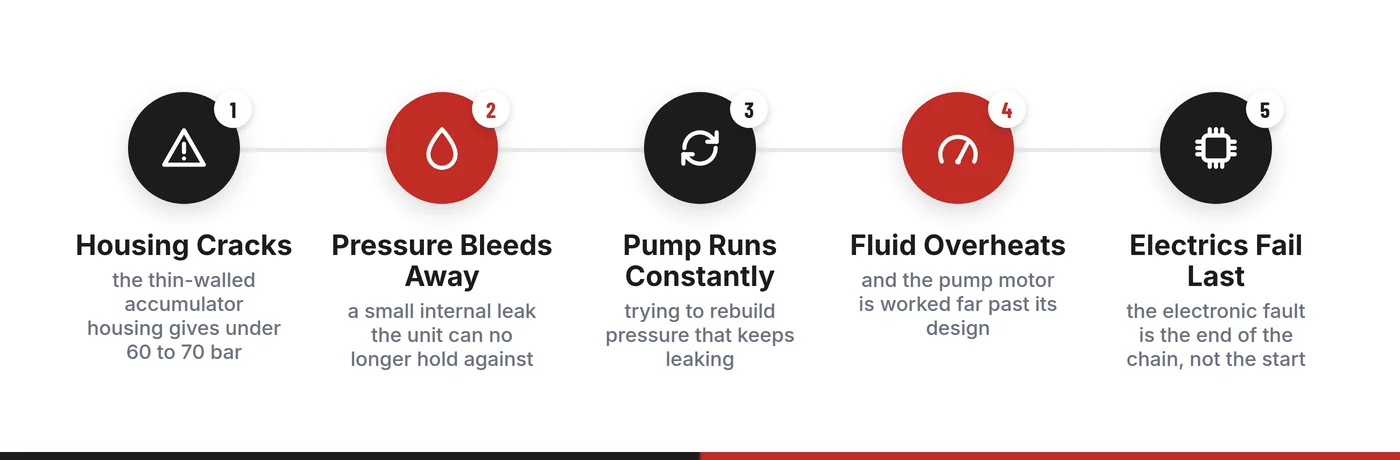
The failure starts in the hydraulics. The housing around the pressure accumulator is aluminium with thin walls, and under the 60 to 70 bar the accumulator generates, it can crack. A crack is a small internal leak, and pressure starts to bleed away.
The pump then does what it was designed to do and runs to restore pressure — except that now it runs almost constantly. The hydraulic fluid overheats, the pump motor is worked far beyond what it was built for, and in the end it fails electrically. That electrical failure is what reaches the unit’s control electronics, at the very end of the chain.
There is a second way in. Conductive debris in the gearbox oil can short the unit’s electrics on its own, with no cracked housing behind it.
This is why a repair that deals only with the electronics does not last. If the housing is still leaking, the pump goes straight back to running constantly and the same chain starts again. A DQ200 rebuild has to deal with the pressure side, not just the part that failed last.
The wet gearboxes break differently. The DQ250 is electronic-led, with pressure sensing inside the unit the usual casualty, and the DQ381 and DQ380 fail on the sensor side. Similar symptoms can come from quite different causes across the family, which is why the gearbox code matters before anyone quotes. Other gearbox families, from ZF to Getrag, are covered in our guide to mechatronic unit faults and symptoms.
Is it the clutch or the mechatronic?
On a DQ200 this is the question that decides whether the right part gets replaced. The dry clutches do wear, and a worn clutch judders on take-up. A mechatronic that cannot hold pressure produces the same judder, because clutch engagement depends on that pressure being there on demand.
From the driving seat the two feel alike. The evidence separates them: a pump that buzzes constantly, fluid at the breather, and pressure codes such as P189C or P17BF all point at the mechatronic. Clutch wear on its own does not make the pump run without stopping.
Getting the order right matters. A new clutch fitted to a gearbox whose mechatronic is losing pressure will be engaged by the same unreliable pressure, and the judder returns. Codes first, then a bench test of the unit, settles it before anything is bought.
One boundary, stated once. The clutch pair itself, the gearsets and the mechanical gear selection inside the casing are gearbox work, and not ours. The mechatronic unit and its control electronics are what we repair.
Sinspeed · DSG mechatronic repair
Have a DQ200 fault read by the people who rebuild the unitTell us the car, the gearbox code if you have it, and what the scan tool is showing. We will tell you whether it reads as a mechatronic fault, and what your garage needs to take out.
Mail-in from anywhere in the UK · Most remanufactured parts carry a lifetime warranty with no mileage limit
Should a DQ200 mechatronic be repaired or replaced with a new one?
A new mechatronic arrives blank, and it has to be programmed to the car before it will work. A repaired original keeps the coding it already carries, because it is the same unit that came off the car.
Either way, basic settings and adaptations are run once the unit is refitted, so that the gearbox and the unit are matched to each other again. That is a routine fitting step for the garage, and it applies to a new unit just as much as to a rebuilt one.
Getting the unit to us is straightforward. Your garage removes the mechatronic with the gearbox left in the car and posts it in, and the car stays where it is.
Here it is bench tested to confirm the fault you reported, then pressure and function tested with the hydraulic side and the electronics treated as one system — because on a DQ200 they fail as one. The known weak point is reinforced rather than rebuilt to the same design, and the unit comes back ready for your garage to refit. Most remanufactured parts carry a lifetime, unlimited-mileage warranty.
The service itself is set out on our transmission valve body and mechatronic repair page. We also list DSG gearbox units for the Volkswagen Golf, the Volkswagen Polo and the Audi A1, three of the cars on the list above, and every transmission unit we repair sits under our transmission control module repair services.
What about the DSG gearbox oil?
The DQ200 has two separate fluid circuits. Gear oil lubricates the gearsets, and a separate hydraulic fluid serves the mechatronic. The two do not mix, and they are not the same product.
That has two consequences for an owner. A gearbox oil change on a DQ200 does not touch the fluid the mechatronic runs on. And hydraulic fluid showing at the breather is a sign from the mechatronic’s circuit, not a reminder that the gear oil is due.
The wet gearboxes work differently: their clutches run in oil, and the particles the clutches shed load that oil over time and wear the valve body. On a DQ250, DQ381 or DQ500, fluid quality and service interval matter more, and low or degraded oil can set the same codes as a failing unit. Which fluid, and how much, is for the garage to take from the manufacturer’s specification.
Why does a DQ200 mechatronic need to come out at a garage?
The accumulator stores hydraulic pressure of between 40 and 70 bar. That is stored energy inside the gearbox, and it is a genuine hazard to anyone opening it without knowing the gearbox.
It is one reason the unit is removed by a garage rather than on a driveway. It is not a reason to put off the repair: the gearbox stays in the car, the garage takes the unit out, and it comes to us by post like any other mechatronic we rebuild.
DQ200 and DSG gearbox questions
How do I know if my car has a DQ200?
The gearbox code is the reliable way: 0AM or 0CW is a DQ200, 02E is a DQ250, 0DE or 0GC is a DQ381 or DQ380, and 0BH is a DQ500. A garage or dealer can confirm it from the car’s build data. As a rule of thumb, a seven-speed DSG behind a lower-torque engine is usually the dry DQ200, but the code is what settles it.
Is the DQ200 an unreliable gearbox?
It has a well-documented weak point rather than a general unreliability. The accumulator housing is the part that starts the chain, and the chain is recognisable from the codes and the pump noise before the car stops driving. Caught at that stage, the mechatronic is a bench repair; left alone, it tends to end with no drive at all.
Can I keep driving with a flashing PRNDS on a DQ200?
Only as far as a garage. Once the pump is running constantly, the fluid is overheating and the pump is being worked beyond what it was built for, which is how a pressure fault turns into an electrical one. Stopping early limits the damage to the part of the chain that has already gone.
Will a new clutch cure DQ200 judder?
Only if the clutch is the cause. Where the pump buzzes constantly or codes such as P189C or P17BF are stored, the mechatronic is not holding pressure, and a new clutch will be engaged just as roughly as the old one. Read the codes and have the unit checked before a clutch is ordered.
Does a repaired DQ200 mechatronic need programming?
No. It keeps its own coding, because it is your original unit. A new mechatronic is the one that arrives blank and has to be programmed to the car. After refitting either, the garage runs basic settings and adaptations as a normal part of the job.
Does the whole gearbox have to come out?
No. The gearbox stays in the car. Your garage removes the mechatronic, sends it to us, refits it when it comes back and runs the adaptations. We work on the unit itself, so where the gearbox sits makes no difference to the repair.
Sinspeed · mechatronic rebuilds by post
Get the pressure side and the electronics looked at togetherSend us the car, the gearbox code and the stored faults. If the mechatronic is the cause, your garage posts the unit, and it comes back rebuilt, tested and still coded to your car.
Programmed and calibrated with dealer-level diagnostic tools before dispatch · Rebuilt by in-house electronic and hydraulic engineers
Final thoughts
The DQ200 fails in a sequence, and the sequence is the useful part. Pressure goes first, the pump works to cover for it, and the electronics fail last — so the gearbox gives real notice, through the pump noise, the pressure codes and the flashing display, before it stops driving.
The mistake to avoid is fixing the last link and leaving the first. A clutch fitted over a mechatronic that is losing pressure, or electronics repaired over a cracked housing, puts the car back on the road with the original fault still running underneath. Establish which gearbox you have, read what it has stored, and treat the pressure side and the electronics as one job.