
Summary: The valve body is the hydraulic control centre of an automatic gearbox, and on most modern designs the electronic control unit is bolted to it or built into it. When it fails you get slipping, flaring, harsh or delayed shifts and limp mode — often behaving so much like worn clutches that the wrong part gets replaced. We rebuild the original unit on the bench and return it, so it keeps the coding and adaptation data your gearbox has already learned. Your garage removes it; the vehicle never leaves your drive.
- The unit: the hydraulic control body of an automatic, dual-clutch or CVT gearbox — and, on many designs, the control unit built onto it
- Also called: mechatronic, mechatronic unit, conductor plate, VGS, EGS, control valve body, TCM — depending entirely on the gearbox
- What fails: valve and bore wear, sticking solenoids, pressure loss, and fluid reaching the control unit’s connections
- The service: mail-in repair and return — your garage removes the unit, the vehicle stays where it is
- Included: bench testing under simulated load, and confirmation of the coding, adaptation or calibration step your gearbox needs on refit
What does a transmission valve body actually do?
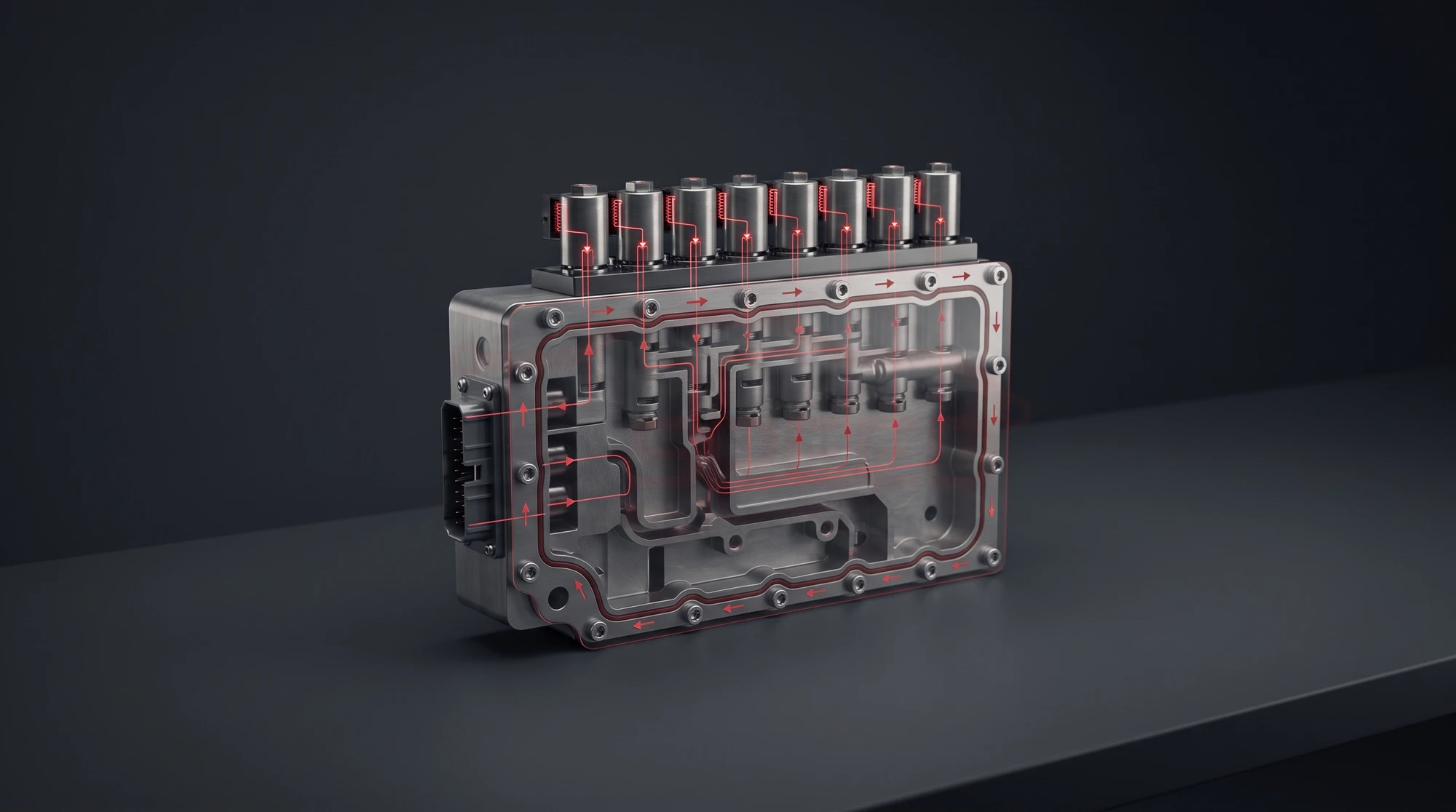
A valve body is a machined casting at the bottom of an automatic gearbox, full of precision bores. Spool valves slide inside those bores against calibrated springs, and solenoids open and close the hydraulic paths between them. Its job is to take one supply of pressurised fluid from the pump and decide, several times a second, where that pressure goes.
Almost everything the gearbox does mechanically follows from that decision. Line pressure is regulated here. Gear selection is a valve routing pressure to one clutch rather than another. Torque-converter lock-up is a valve. The difference between a shift you feel and one you do not is a pressure ramp shaped by a variable-force solenoid and the valve it drives.
It is not confined to conventional automatics. A wet dual-clutch gearbox — a DSG, an S tronic, a Ford MPS6 — applies its clutches hydraulically and needs the same control body to do it. A CVT has one as well: the reference valve-body houses publish full bore layouts and test points for the Jatco JF011E and JF015E exactly as they do for a stepped automatic. What varies between manufacturers is where the electronics sit relative to that casting, and that is what decides what you are actually sending us.
Valve body, mechatronic or TCM — three names, and when they mean different things
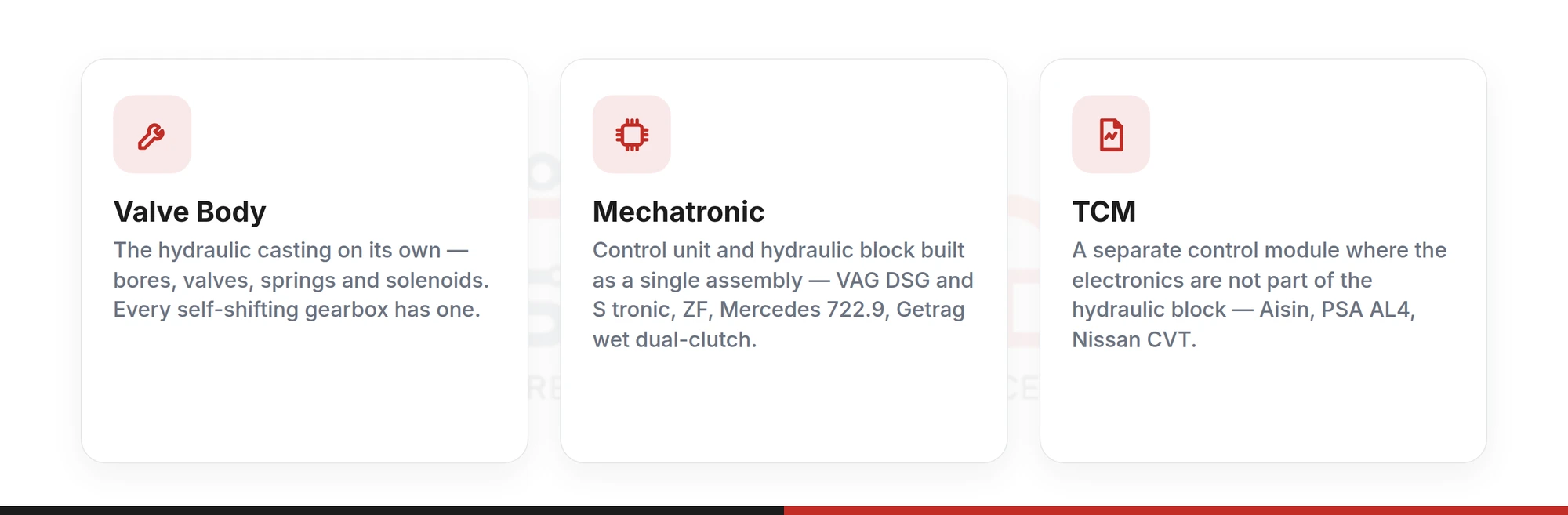
Three terms get used for what most people assume is one part. They are not interchangeable, and on one Mercedes gearbox the trade term means the opposite of what it means on the next one along.
- Valve body — the hydraulic casting on its own: bores, valves, springs and solenoids. Every self-shifting gearbox has one.
- Mechatronic — the correct name where the control unit and the hydraulic block are a single assembly. VW and Audi use it across the DSG and S tronic families, ZF use it for the 6HP and 8HP, and the Mercedes 722.9 control unit bolts directly onto the valve body inside the sump. Mitsubishi put it most plainly of anyone, describing the Getrag unit in the Lancer Evolution: the valve body and the TCM are permanently attached to each other and cannot be replaced separately.
- TCM — the transmission control module, the right term where the electronics are a separate part. On an Aisin TF-80SC it bolts to the outside of the case and never sits in the fluid. On a PSA AL4 it lives in the engine bay behind the battery tray, and PSA’s own literature calls it the calculateur — “mechatronic” is never used for it. On a Nissan CVT it is not on the gearbox at all, but a module inside the cabin.
The trap that catches most people is Mercedes. On the 722.6 the internal part everyone calls the conductor plate is not a control unit: it is a plastic shell carrying six solenoids and their terminals, two speed sensors, the park/neutral contact, the fluid temperature sensor and a 13-pin connector out to the harness. The real control unit — Mercedes call it the ETC — is a separate box under a floor panel or in an engine-bay electrical box, depending on chassis. On the 722.9 the trade uses the same two words, and there the conductor plate genuinely is the control unit.
One gearbox that gets called a valve body constantly has none at all. The Ford DPS6 — the dry-clutch PowerShift in the Fiesta and Focus — runs no oil bath and no hydraulic pressure control; its control module drives the selector drums with electric motors. It fails in a completely different way from the wet MPS6 in a Mondeo or Kuga, which we set out in our guide to Ford PowerShift problems. If you are trying to work out whether what you have is a control-unit fault at all, the symptoms of a failing mechatronic unit are covered separately.
What makes a valve body fail?
Four causes, and they compound.
- Bore and valve wear. The valves in the pressure-regulating circuits never stop moving — on a ZF 6HP all four valves in the converter circuit are driven by variable-force solenoids and are, in the reference source’s phrase, extremely busy. Once a bore and the valve in it no longer seal, pressurised fluid cross-leaks back to the sump, leaving less pressure and less volume for everything downstream.
- Contaminated fluid, and heat. Clutch material and fine metal circulate with the oil and abrade the bores, particularly where solenoid plungers make contact. On the Aisin families that is the documented root of the whole pattern, and the solenoids usually do not fail electrically at all — they go sticky. Wet dual-clutch gearboxes are the most exposed, because clutch particles load the oil and the oil then wears the valve body. On an integrated design the control unit also spends its entire life sitting in that hot fluid, which is the accepted reason the Mercedes 722.9 unit degrades internally.
- Fluid reaching the electrical side. Where the vehicle harness passes through the gearbox casing, the seal is a wear item. On the ZF 6HP and 8HP a failed mechatronic sleeve lets fluid reach the connections at the case connector. On the Mercedes 722.6 it is the 13-pin adapter plug: when its O-rings harden the leak wicks up the harness to the external control module. That is why a repaired 722.6 module should never go back without a new adapter plug — refit one to a car with the original leaking adapter and it is contaminated again.
- Pressure loss that then destroys the electronics. The clearest example is the seven-speed dry DSG. The housing around its pressure accumulator cracks, a micro-leak appears, and the pump runs continuously trying to hold pressure. The fluid overheats, the pump motor is overworked, and the electrical failure that finally stops the car is the last event in a chain that started as a hydraulic one. Selling that gearbox as “an electronics fault” has it backwards.
Two honest points follow from all of that. Gearbox fluid is not sealed for life in any useful sense — ZF specify a change on the 8HP at 50,000 to 75,000 miles or eight years, whichever comes first. And low or degraded fluid produces the same pressure-regulation codes as a worn valve body, so on a DSG the level and the condition of the oil are worth checking before anything is removed.
Symptoms and fault codes that point at the valve body
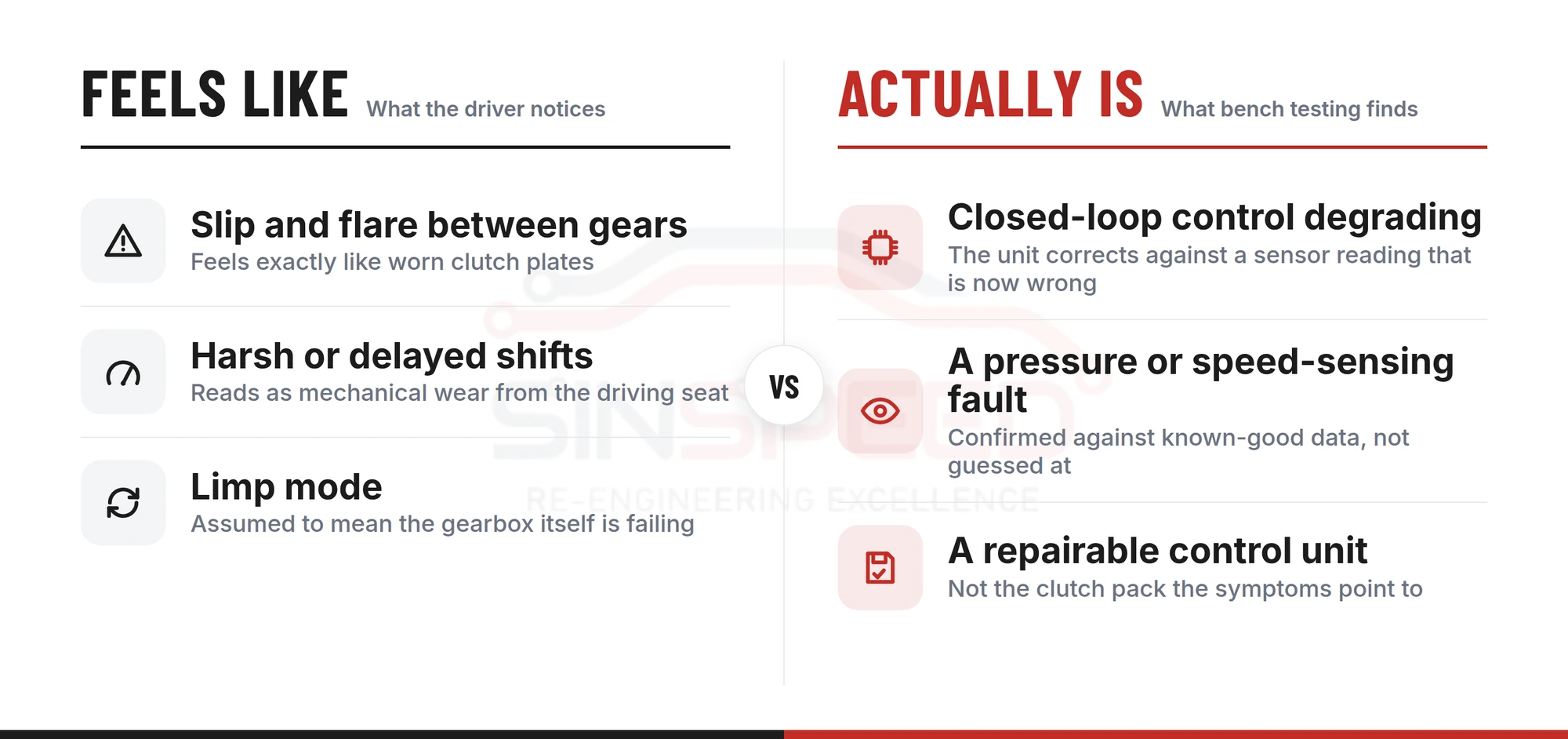
Valve body faults are pressure faults, so the symptoms are all about a clutch being applied too slowly, too hard, or not at all.
- Delayed engagement — a pause of a second or more after selecting D or R before drive arrives.
- Harsh or clunky changes, classically on the 3-2 and 2-1 downshifts.
- Flare or slip between two specific gears while the rest of the gearbox behaves — a 2-3 flare with a 3-4 slip is the documented Aisin pattern.
- Limp mode, and which gear you are left in is often family-specific. An AL4 limps home in third. A 722.6 holds the gear you were in until you stop, switch off for ten seconds and restart, after which second is hydraulically available and reverse always is. A failing Audi DL501 can deactivate half the gears, lose reverse, or leave you with nothing above first.
- On a DSG, the PRNDS indicator flashing with a spanner icon; on the dry seven-speed, continuous pump buzzing with the ignition on and, at worst, a burning smell.
- Judder — on the Nissan CVT fitted to the Qashqai, X-Trail and Juke this is the headline UK fault and it carries its own codes.
- Sudden loss of drive, with the gearbox dropping into neutral.
Why it is so easy to blame the wrong part. Modern pressure control is closed-loop: the unit commands a solenoid, reads a pressure or speed sensor to confirm what actually happened, and corrects. Degrade the sensing side and the unit is regulating against a number that is wrong, which produces slip, flare and harsh engagement — exactly what worn clutches produce. On the Mercedes 722.9 the mechanism is documented: as the control unit breaks down internally it can no longer monitor input shaft speed accurately, so it cannot work out how much the torque converter is slipping, and lock-up becomes ineffective. The driver feels a gearbox that will not change smoothly, or will not select a gear at all. Nothing about that feels electronic.
A clean scan also proves less than people assume. Ford’s own service bulletin for the 6F35 describes a mechanically binding shift solenoid causing harsh reverse engagement and delayed upshifts with no fault codes stored at all.
Where codes are stored, they group by family. A fuller list sits in our guide to transmission control module fault codes.
| Gearbox family | Codes commonly logged | What they point at |
|---|---|---|
| VW / Audi DSG6 (DQ250) | P1814, P1815, P1819, P1820, P0746, P0776, P1740, P1604 | Pressure sensing inside the control unit, and the two pressure-regulating solenoids |
| VW / Audi DSG7 dry (DQ200) | P17BF, P189C, P1895, P0562, P0841, P175D | Loss of pressure build-up, then the electrical failure that follows it |
| Audi S tronic (DL501) | P173C, P173F, P174A, P174B, P174C, P176A, P176B, P179C | Valves and selectors that cannot be regulated — codes that clear and return straight away |
| Mercedes 722.9 — electronic side | P0717, P0718, P2200, P2201, P2204, P2205, P2767, P2768 | Internal speed sensing within the control unit |
| Mercedes 722.9 — hydraulic side | P0748, P0778, P0798, P2716, P2725, P2734 | Pressure-control solenoids rather than the electronics. Where both sets appear together, the control unit is addressed first and the codes re-read |
| Mercedes 9G-Tronic (725.0) | P073E, P07B7, P179C, P2716 | Pressure sensing and main pressure control; commonly presents as no reverse |
| ZF 8HP / BMW | P0867, P0868, P0869, read across P0840–P0843 and P0962, P0963 | Commanded versus measured pressure — read together they separate electrical causes from hydraulic ones |
| Ford 6F35 | Frequently none at all | A mechanically binding shift solenoid, per Ford’s own bulletin |
| Nissan / Jatco CVT | P17F0, P17F1, P0740, P0776, P2813, P2814, P2815 | Judder, lock-up and pressure control. P2813 and P2814 separate a mechanical solenoid fault from an electrical one |
| PSA / Renault AL4, DP0 | “Pressure regulation fault, recommendation/variation”, P0700, P0741, P0715 | Internal hydraulic leakage, most often the pressure-regulation electrovalve |
Sinspeed · mail-in repair and return
Send us the codes before you send us anything elseFill in the repair form with your vehicle details and the stored fault codes. We will tell you which unit is at fault, what it is called on your particular gearbox, and what your garage needs to remove — before anything comes off the car.
UK-wide by post — only the unit travels · Bench-tested under simulated heat, vibration and load before it goes back
What your gearbox’s control unit is called, manufacturer by manufacturer
Using the right name for your gearbox saves a round of questions. This is what the part is called, where the electronics actually sit, and how the unit reaches us.
| Gearbox family and cars | What the part is called | Where the control unit sits | How the unit reaches us |
|---|---|---|---|
| VW, Audi, SEAT, Škoda DSG — DQ250, DQ200, DQ381, DQ500. Golf, Passat, Polo, A3, Q3, TT, Octavia, Superb, Leon, Ibiza, Fabia, Tiguan, T-Roc | “Mechatronic” — VW’s own component designation on the six-speed is J743 | Built into the hydraulic block, inside the gearbox | Gearbox stays in the car; the unit comes out behind the large side cover and is posted |
| Audi S tronic — DL501 (0B5), DL382. A4 B8, A5, A6 C7, A7, Q5, S4, S5, RS5 | “Mechatronic” / S tronic | Integrated | As above — removed with the gearbox in the car |
| ZF 6HP and 8HP — BMW 3, 5, 7, X3, X5, Z4; Jaguar; Land Rover and Range Rover; VW Touareg; Porsche Cayenne | ZF “Mechatronic”; BMW call the control unit the EGS | Integrated on the BMW, Jaguar Land Rover and Ford 6R builds. Some VW and Audi applications instead use a separate external control unit | Sump off with the gearbox in the car. ISN synchronisation with the engine control unit is part of the refit |
| Mercedes 722.9 and 725.0 — C, E, S, CLS, ML, GLK, SLK, R-Class | “VGS”, or conductor plate — and here it genuinely is the control unit | Bolted onto the valve body inside the sump | Sump off, valve body out, module unbolts from it |
| Mercedes 722.6 — earlier C, E, S, SLK, M-Class | External TCM, which Mercedes call the ETC. The internal conductor plate is not a control unit | Under a floor panel, or in an engine-bay electrical box, depending on chassis | Unbolts with no gearbox work at all. Refitted with a new 13-pin adapter plug |
| Getrag 6DCT450 / 6DCT470 — Ford MPS6 (Mondeo, Kuga, S-Max, Galaxy), Volvo Powershift, Mitsubishi TC-SST | “Mechatronic assembly” — permanently attached, in Mitsubishi’s own words | Integrated | Removed with the gearbox in the car and posted |
| Ford 6F35 / 6F15 — Focus, Kuga, Mondeo, C-Max, EcoSport | “TCM” and “valve body”. Ford do not use the word mechatronic | A separate module on the outside of the case on earlier builds; folded into the engine control unit on many later ones | Valve body and external module both post. Ford’s programmable module installation is the refit step |
| Aisin TF-80SC, AF40, TF-81SC — Volvo, Vauxhall, Peugeot, Citroën, Land Rover, Ford, Mazda, Saab | “TCM” and “valve body” — not a mechatronic in the DSG sense | Bolt-on module on the case, not immersed in fluid | Valve body out through the sump; the module unplugs |
| Jatco CVT JF011E / JF015E — Nissan Qashqai, X-Trail, Juke, Micra, Note; Renault Koleos | “Control valve body” and “TCM” | Not on the gearbox — a module inside the cabin | Both post. Nissan’s calibration data write is carried out on the car afterwards |
| PSA and Renault AL4 / DP0 — 206, 307, 407, Xsara Picasso, C4, C5, Berlingo, Partner | PSA say calculateur; UK trade say transmission ECU. Never “mechatronic” | Engine bay, behind the battery tray | The control unit unbolts from the bay. The electrovalve block comes out through a side cover with the gearbox in the car |
| Hyundai and Kia 7DCT — D7GF1 dry, D7UF1 wet | “Mechatronic unit” — the correct trade term on this family | Integrated | The control unit posts. Clutch-actuator work needs a relearn on the car afterwards — see clutch actuator fault codes |
A word on “mechatronic”, because it gets applied to everything. It is the right term for the VAG DSG and S tronic families, for ZF, for the Mercedes 722.9 and 725.0, for the Getrag wet dual-clutch units and for the Hyundai and Kia DCTs. It is the wrong term for Aisin, Jatco, the PSA AL4, the Ford 6F35 and the Ford DPS6 — those manufacturers do not use it, and their electronics are packaged differently. Using it as a blanket word is how people end up ordering the wrong part.
One exception we will be straight about: the Mini CVT fitted to the early Cooper. When its steel push-belt fails it scatters debris through the case and damages the gears, which is mechanical destruction rather than a control fault — there is no control unit there for us to rebuild.
Every unit in that table sits under our transmission control module repair services, where the per-make pages live.
Why a repaired unit beats a replacement
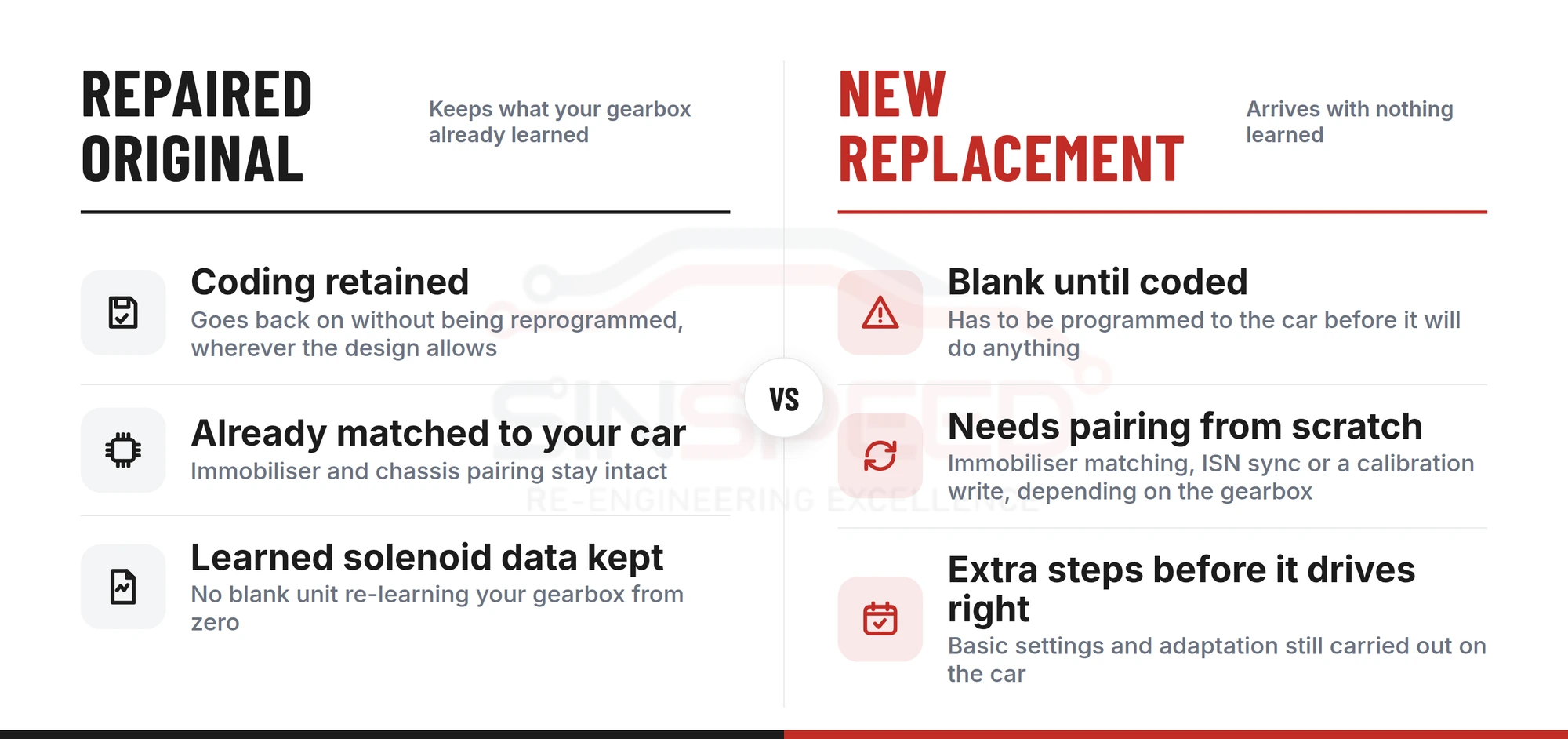
A repaired unit keeps its own coding. A new one is blank. That is the honest technical argument, and it is confirmed independently across the families we see most.
- On a VAG DSG, the coding held in the unit is retained through the repair, so it goes back on without being reprogrammed. A new mechatronic arrives blank and has to be programmed to the car before it will do anything at all.
- On a Mercedes 722.9 it is stronger still: the control module is married to the vehicle’s immobiliser and chassis number, so a second-hand unit cannot be made to work on another car. A replacement has to be the correct VGS version, virgin, and then coded to the vehicle — and plenty of workshops can perform the coding but cannot start the process. Rebuilding the original avoids the sequence entirely.
- On a ZF 6HP the control unit holds a learned flow rate for every solenoid in the block, qualified when the unit was built. An exchange module is supplied marked for what it still needs — one marking means it has not been flashed to a vehicle application at all, another means it carries base parameters only and will require adaption. Your original unit already knows your gearbox.
- On a BMW, replacing the EGS is not finished once it has been coded: its ISN has to be synchronised with the engine control unit, or you end up with a perfectly good module fitted to a car that still will not drive properly.
- On a Ford, a replacement control module goes through Ford’s programmable module installation, with the configuration read out of the old module or pulled by VIN as as-built data. On a Nissan CVT, any valve body or control module replacement requires the calibration data write Nissan document for it.
Read that list as what the job includes rather than as a warning. Those steps are documented, they are routine, and we confirm which one your gearbox needs before the unit goes back in the post. After refitting a DSG mechatronic, for instance, basic settings and adaptations are still carried out on the car — we say so because it is the honest version, and skipping it is a common reason a good unit behaves badly.
How a mail-in valve body repair works
Your vehicle stays where it is. Only the unit travels.
- Tell us what it is doing
Complete the repair form with the vehicle details and any stored fault codes. If you are not certain which unit has failed — a reasonable position to be in on several of the gearboxes above — describe the symptoms and we will confirm what to send.
- Your garage removes the unit and posts it
On most of these designs the gearbox stays in the car and the unit comes out from underneath or from the engine bay. Where the control unit is external — the Mercedes 722.6, the PSA AL4, the Nissan CVT, earlier Ford 6F35 builds — it unbolts with no gearbox work at all.
- We strip, measure and test it
Hydraulic and electrical behaviour is measured against known-good data rather than inferred, and units are run on in-house rigs that simulate the heat, vibration and load the part sees in service. That is how an intermittent fault is made to repeat on a bench instead of on a motorway slip road.
- It comes back ready to fit
Where the design allows it, your unit returns with its own coding and adaptation data intact. Where a step on the car is needed, we name it before dispatch, so the fitting garage is not discovering it on the ramp.
Two things to get right before you post it. Treat the unit as an electronic assembly rather than a lump of aluminium: static discharge damages control modules, so it should travel in an antistatic bag with nothing touching the connector pins. And on the six-speed wet DSG, protect the sender arm. Volkswagen’s own instruction is blunt — never lift the mechatronic unit by the sender arm or lay it on the arm, because a damaged arm renders the unit beyond repair. Damage in transit does exactly the same thing. Pack around it.
Garages, main dealers and independent workshops across the UK send units here alongside private owners, which is why those two notes exist at all: they are the two ways a repairable unit arrives dead.
Transmission valve body repair: FAQs
Can a transmission valve body be repaired, or does it have to be replaced?
It can be repaired, and on most of the gearboxes above that is the better engineering answer. A valve body is a casting with wear items in it — valves, bores, seals and solenoids — and those are measurable and serviceable on a bench. Where the control unit is part of the same assembly, rebuilding the original also keeps the data your gearbox has already learned. Replacement is the right answer where the casting itself is damaged or the gearbox has shed debris internally, and we will tell you if that is what we find.
My garage says the valve body is inside the gearbox casing. Is it still a mail-in repair?
Yes. On almost every gearbox in the table above the gearbox itself stays in the car — the sump or a side cover comes off and the unit comes out from underneath or from the engine bay. Your garage does that removal, posts the unit to us, and refits it when it comes back. A unit sitting inside the casing changes who takes it out. It does not change what we can do with it once it arrives.
Is the fault the valve body or the clutches?
That is the question worth settling before anything is bought, because a degraded control unit produces slip, flare and harsh engagement that are indistinguishable from clutch wear from the driving seat. Fault codes narrow it considerably — pressure-control codes and speed-sensing codes point in different directions — and bench testing settles it, because hydraulic and electrical behaviour can be measured against known-good data rather than guessed at. Send us the codes and the symptoms and we will tell you what to send before you remove anything.
Will a repaired unit need coding or programming when it goes back on?
Often not, and that is the main practical advantage of a repair. Your unit returns with its own coding intact wherever the design allows, so it goes back on as a direct refit. Some gearboxes do need a step on the car afterwards — adaptation or basic settings on a DSG, ISN synchronisation on a BMW, Ford’s programmable module installation, or Nissan’s calibration data write on a CVT. We confirm which one applies to yours before the unit is dispatched.
Do you cover CVTs and dual-clutch gearboxes as well as conventional automatics?
Yes. A wet dual-clutch gearbox applies its clutches hydraulically and has a mechatronic unit doing it; a CVT has a control valve body of its own, and on the Nissan applications the control module is a separate cabin unit that is one of the simplest jobs in the whole set to post. Coverage on newer gearboxes comes from our own research and development work rather than waiting for volume to build up in the aftermarket, so it is worth asking about a recent model rather than assuming.
Sinspeed · mail-in repair and return
Your garage removes it. We rebuild it. It goes back knowing your car.Post the valve body, mechatronic unit or control module to the workshop and it is stripped, measured and tested under simulated load before it is returned — with its own coding intact wherever the design allows.
Most remanufactured parts carry a lifetime, unlimited-mileage warranty · The refit step your gearbox needs, confirmed before dispatch
Final thoughts
Most of the difficulty with this repair is not the repair. It is that three different names describe three different packaging arrangements, and which name you are given depends on who you asked. Establish which gearbox you have and where its control unit actually sits, and the rest falls into place: the codes start meaning something, the symptoms stop being ambiguous, and the part that needs to travel is the size of a book rather than the size of a car.
Have the fault codes read before anything is removed, and send them to us with the vehicle details. If the fault is in the control unit or the hydraulic control body, that is our work. If it is inside the gearbox — clutch packs, gearsets, a torque converter — that is mechanical work we do not take on, and we would rather say so at the start than rebuild a unit that was never the problem.