
Summary: From the Mk2 in 2016, a Peugeot 3008’s instrument panel is a configurable screen rather than a set of dials — so a warning is not always where the handbook draws it. It can sit in a display view you are not currently showing, two 3008s can present the same fault differently, and the panel itself can dim, blank, reboot or report something that is not there. This page gives every Peugeot 3008 dashboard symbol with a safe-to-drive verdict, says which lamps point at a failed electronic unit, and separates a fault the screen is reporting from a fault in the screen.
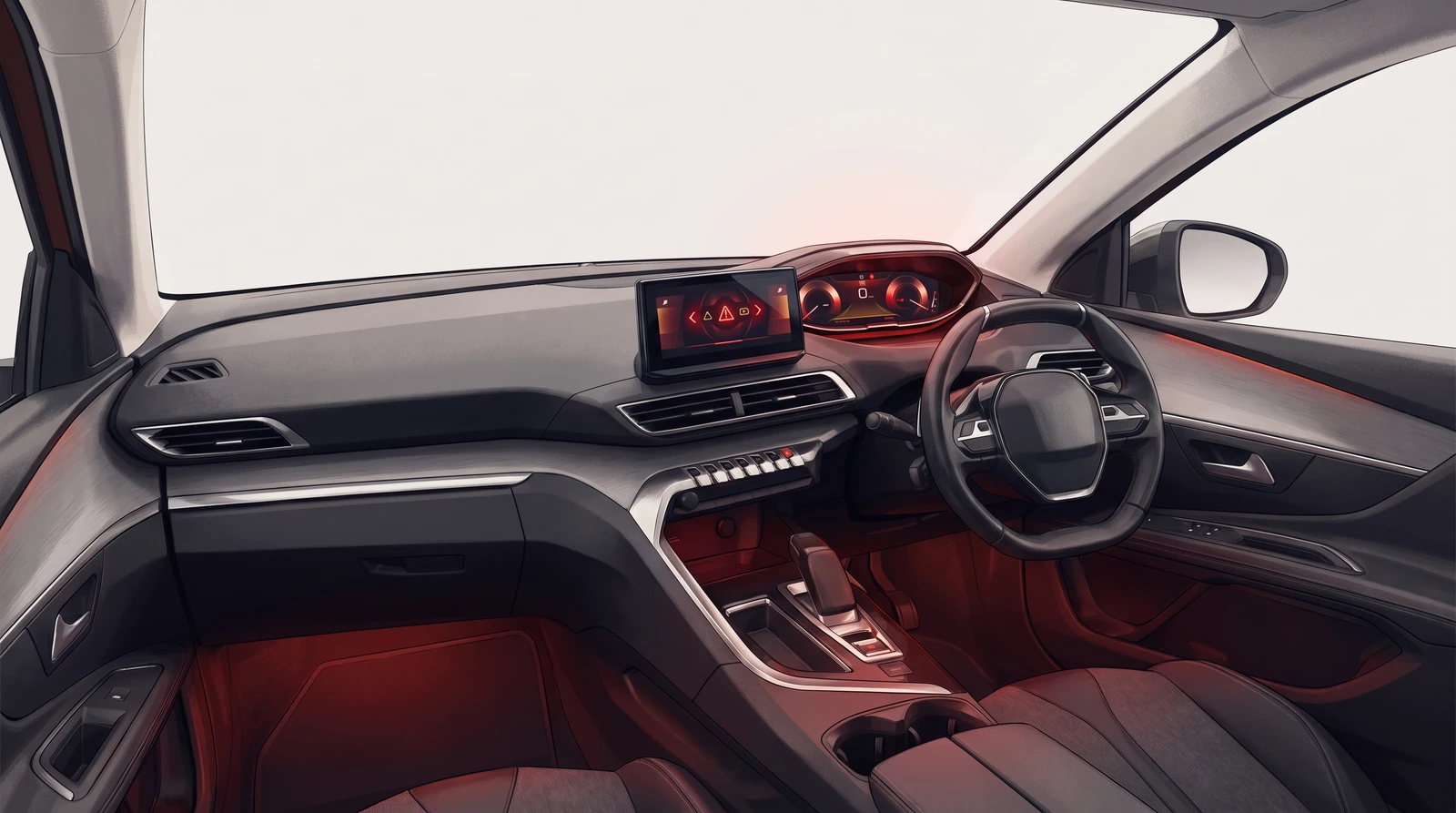
- A 3008’s dashboard is a screen, not a set of dials
- Peugeot 3008 warning lights and symbols: the full reference table
- Which 3008 you are in, and what your dashboard is made of
- When the display itself is the fault
- “Anti Pollution Fault” on a 3008
- Which lamp means a failed module on a 3008
- What to do when a warning light comes on in your 3008
- Peugeot 3008 warning lights FAQs
- Final thoughts
A 3008’s dashboard is a screen, not a set of dials
Colour is the fastest read on any dashboard: red means find somewhere safe and stop, amber means a stored fault wanting attention rather than panic, and green or blue only confirm that something is switched on. Our guide to what a dashboard warning light is actually telling you sets out that grammar, and how a Peugeot tells you something is wrong covers the marque’s message centre, its service spanner and its diesel lamps.
What is different on a 3008 is where the warning appears. From the second-generation car of 2016 the instrument panel is Peugeot’s i-Cockpit: a display set high on the dash, above a small steering wheel you look over rather than through. Peugeot’s own description of the newest panel calls its central area personalisable — the driver chooses whether it shows dials, a digital speed readout, driving aids, trip computer information or, on the electric car, power flow and charge state.
That changes the behaviour of warning lights in three ways.
- A lamp can be in a view you are not showing. The central area changes with the selected view, so a symbol illustrated in one place in the handbook is not always drawn there on your car. A warning that seems to have gone may only be out of sight.
- Two 3008s can present the same fault differently. Trim, options and the view the last driver left it in all change what you see, which makes comparing your dashboard against somebody else’s photograph far less reliable than it is on a car with fixed lamps.
- The screen itself can be the fault. A digital panel does not fail the way a needle cluster fails. It dims, blanks, ghosts, restarts over a bump, or — the difficult one — keeps displaying information that looks entirely plausible and is wrong.
None of that softens the safety rules. A red lamp on a 3008 means what it means on any other car: stop as soon as it is safe. What the screen reading buys you is the second question — not only what the symbol means, but whether the thing showing it to you is reliable.
Peugeot 3008 warning lights and symbols: the full reference table
Filtered to the lamps a 3008 carries, so every row is one you might actually see. Where Peugeot delivers a warning as a written message rather than a symbol, the row keeps the words and gets no icon — there is no standard glyph to show you. The safe-to-drive column takes the serious reading wherever a fault could reasonably be trivial or serious.
| Colour | Symbol | What it means on a 3008 | Is it safe to drive? |
|---|---|---|---|
| Red |  STOP — the word STOP in a red circle STOP — the word STOP in a red circle | Peugeot’s severity lamp. It names no fault of its own — it arrives with another warning and a message. | No. Stop as soon as it is safe, switch off, and read the message. |
| Red |  Brake system — an exclamation mark in a bracketed circle Brake system — an exclamation mark in a bracketed circle | Parking brake still applied, brake fluid below minimum, or a stored fault in the braking system. | No, unless it goes out the moment the parking brake is fully released. Fluid that is genuinely low has gone somewhere. |
| Red | 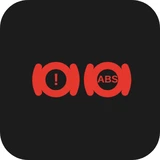 Brake system and ABS lit together Brake system and ABS lit together | Both braking warnings at once. The hydraulic unit they share also balances braking effort front to rear. | No. Brake gently, stop as soon as it is safe, and have the car recovered rather than driven on. |
| Red |  Oil pressure — an oil can with a drip Oil pressure — an oil can with a drip | Oil pressure has fallen. This is the pressure warning, not the amber low-level one below. | No. Switch the engine off. Bearings are damaged in seconds without oil pressure, not in miles. |
| Red |  Coolant temperature — a thermometer in wavy lines Coolant temperature — a thermometer in wavy lines | The engine is running too hot: coolant low or not circulating, or a failed thermostat, pump or fan. | No. Stop, switch off and let it cool. Never open a hot expansion tank. |
| Red | 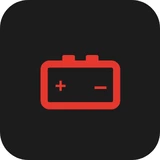 Battery charging — a battery with plus and minus terminals Battery charging — a battery with plus and minus terminals | The battery is no longer being replenished: alternator, belt, a connection or wiring. Falling voltage brings other warnings with it. | Only as far as somewhere safe. Where the car stops is not your choice. |
| Red |  Airbags and belt tensioners — a seated figure facing an inflated circle Airbags and belt tensioners — a seated figure facing an inflated circle | The restraint system has a stored fault. An airbag or a pretensioner may not fire in a collision. | It drives normally, but the protection is not there. Have it read now, and never work on the system yourself. |
| Red and amber |   Power steering — a steering wheel with an exclamation mark Power steering — a steering wheel with an exclamation mark | Assistance is electric, so there is no fluid to check. Amber is reduced assistance or a stored fault; red is assistance lost. | Red, no — it can go without warning and the wheel turns very heavy. Amber, with care, and get it read. |
| Red |   Seat belt, and a door, bonnet or boot ajar Seat belt, and a door, bonnet or boot ajar | A belt is unfastened or a closure is not latched. The boot and the bonnet catch are the usual culprits. | Stop and put it right. A warning that persists with everything shut is a switch or its wiring. |
| Red |  Anti-theft and immobiliser — a car outline with a key Anti-theft and immobiliser — a car outline with a key | The key has not been recognised, or the system has a fault. Peugeot words this condition as starting being prevented. | If it has started, yes for now. If it fires and dies, try the spare key before anything else. |
| Amber |  Engine management — the outline of an engine block Engine management — the outline of an engine block | Steady: a stored engine fault, usually with a message naming a category rather than a part. Flashing: a fault that can damage the catalyst. | Steady and driving normally, gently, and read the codes within days. Flashing, or power down: stop. |
| Amber | “Anti Pollution Fault” — a written message, with no symbol of its own | An emissions-related fault covering several systems and naming no part. Its own section is below. | Briefly, if it is driving normally — but it is a fault with a clock on it. Misfiring or down on power: stop. |
| Amber |  Service — a plain spanner Service — a plain spanner | Two jobs: a service interval counting down, and a stored fault. Peugeot’s lamp table for the newest 3008 lists it as indicating a system fault. | Yes for a countdown. Arriving with a message or another lamp, treat it as a fault rather than a reminder. |
| Amber |  Diesel particulate filter — a filter box with a row of dots Diesel particulate filter — a filter box with a row of dots | Soot has built up and a regeneration has not completed. Short, cold, stop-start journeys are what prevent one. | Yes on its own, and a sustained warm run lets a regeneration finish. Engine lamp joining it and power down: stop. |
| Amber |  Preheat coil — a coiled filament Preheat coil — a coiled filament | Before a cold start on a diesel this is normal preheating. Flashing while you are driving, it is reporting an engine fault. | Preheat, yes. Flashing while driving, treat it as an engine warning, and stop if power has gone with it. |
| Amber |   AdBlue, and water in the diesel AdBlue, and water in the diesel | AdBlue low or an emissions-treatment fault on the later diesels. The droplet means water has collected in the fuel filter. | AdBlue, yes, but top up promptly — once the range runs out the engine will not restart. Water, only briefly. |
| Amber |  ABS — the letters ABS in a bracketed circle ABS — the letters ABS in a bracketed circle | The anti-lock function has switched itself off. Ordinary braking is unaffected, and a wheel-speed sensor is as likely as the unit. | With care, and only if the red brake warning is out. Leave a bigger gap. It is also an MOT defect. |
| Amber |   Stability and traction control, and the OFF version Stability and traction control, and the OFF version | Flashing means it is intervening. Steady means switched off or faulty — and it shares its sensors and hydraulics with the anti-lock system. | Flashing on a wet surface is normal. Steady on dry tarmac in ordinary driving means it is not protecting you. |
| Amber | Automatic gearbox fault — a message, sometimes with the service lamp; no standard glyph, so none is shown | A stored transmission fault, usually with a protective mode: one gear held, drive refused, or a gear dropped. | Short journey and get it read. If it refuses a gear or drops out of drive, stop using it. |
| Amber |   Low levels — an oil can, and an expansion tank, each with a level line Low levels — an oil can, and an expansion tank, each with a level line | Engine oil or coolant is below minimum. Neither is the red pressure or temperature warning above. | Yes, briefly. Check with the engine cold and top up. A level that falls again is a leak. |
| Amber |   Brake pads worn, and tyre pressure Brake pads worn, and tyre pressure | The pad sensor has reached its limit, or a tyre has lost pressure. One that keeps returning is usually a slow puncture. | Pads, yes, but book it. Pressures, only as far as somewhere you can check all four cold. |
| Amber |   Lighting failure, and headlight faults Lighting failure, and headlight faults | A lamp is out, or the module driving the headlights has a fault. On directional headlamps it is reporting the control side. | Yes, but a light that is out is an MOT failure. A warning that survives a new bulb is the circuit. |
| Amber |  Stop & Start — the letter A in a circular arrow Stop & Start — the letter A in a circular arrow | The system has taken itself out of use, most often because the battery no longer holds enough charge for it. | Yes. Not a driving fault, but a battery that weak causes stranger problems than a stopped engine. |
| Amber |  Driver assistance — a car between lane lines Driver assistance — a car between lane lines | The camera or the sensors cannot see, or the system has a fault. Dirt, road film, ice and rain are the everyday causes. | Yes. The car drives normally and the assistance is not there, so do not rely on it. |
| Green, blue and amber tell-tales |        Dipped beam, main beam, indicators, front and rear fog lights, low fuel, passenger airbag off Dipped beam, main beam, indicators, front and rear fog lights, low fuel, passenger airbag off | These confirm that something is switched on, or that a level is low. Indications rather than faults. | Yes. Two deserve a look: a rear fog lamp dazzles the driver behind, and a passenger airbag shown as off should be off deliberately. |
Which 3008 you are in, and what your dashboard is made of
The symbols are largely shared, because they follow an international convention rather than a Peugeot one. What changes between generations is the instrument they are drawn on — and that decides how you go looking for one.
| Generation | On sale | What the dashboard is like |
|---|---|---|
| Mk1 | 2009 to 2016 | A conventional cluster: needles behind glass, a small central trip display, and on many cars a head-up display that flips up from the dash top. The lamps are fixed and always in the same place, so a handbook illustration matches what you see. |
| Mk2 | 2016 to 2023 | The i-Cockpit generation. A high-set instrument display above a small steering wheel, with selectable views, and a separate central touchscreen for infotainment. This is the car most of this page is written for. |
| Mk3, including the e-3008 | 2024 onwards | A larger curved panel, and readouts the earlier cars do not have — Peugeot’s own description includes power flow and vehicle charge state on the electric car, and remaining range in place of a fuel gauge. |
The consequence is worth stating plainly. On a Mk1, if a lamp is not lit, it is not lit. On a Mk2 or a Mk3, a warning that is no longer visible has not necessarily gone: the view may have changed, a message may have been acknowledged, or the panel may not be drawing it where you are looking. That is why the advice below is to have the codes read even when the screen has gone quiet — the stored fault outlives the display of it.
When the display itself is the fault
Every warning on this page reaches you through the instrument panel, which makes the panel the one component worth ruling in or out before you chase anything it reports. It does not fail the way a cluster of needles fails, and the symptoms are distinctive once you know them.
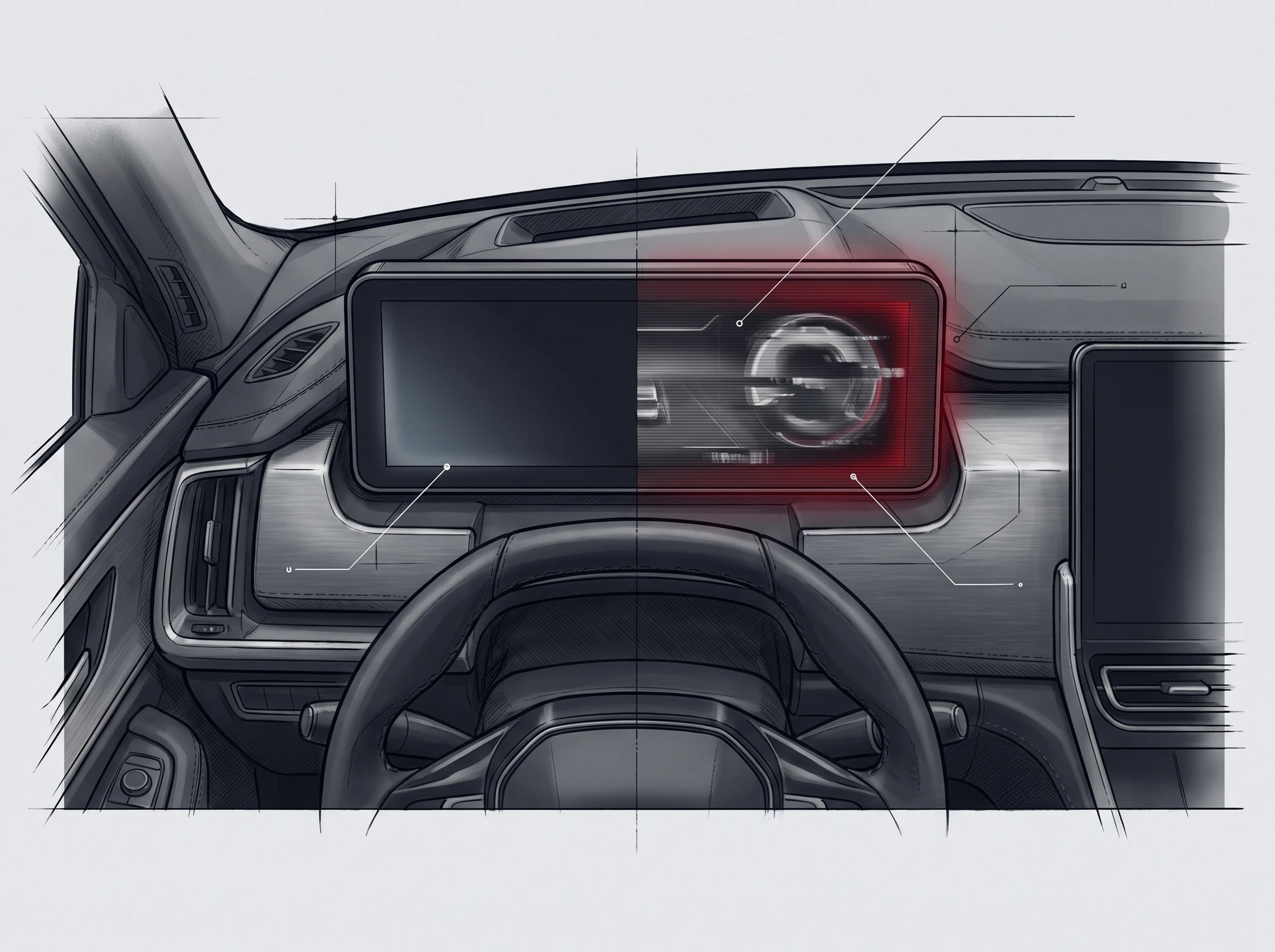
- It dims or the backlight fades, unevenly or in patches, and is worst from cold.
- It blanks on start-up and appears a minute later, or blanks intermittently on the move.
- It restarts over a bump — a mechanical trigger, which points at a fatigued joint or a connector rather than software.
- Areas are missing or ghosting, with parts of the display frozen while the rest updates.
- Gauges stick, drop to zero or sweep on their own, with the car behaving perfectly normally.
- Warnings appear with nothing behind them — several unrelated lamps, or one for a system that is working.
That last one is why this section exists. When a panel misreports, every other symbol becomes untrustworthy, and a driver can spend a great deal of effort on a system that never had a fault. Separating them is not difficult in principle: have the modules those lamps name interrogated. Lamps lit while the modules hold no stored faults and the car behaves normally point at the panel or the path to it, and so does a dark or scrambled panel on a car that drives and scans clean.
Until that is established, treat every red warning as genuine. A panel you suspect is a reason to get the car looked at sooner, never a reason to assume a brake or airbag warning is imaginary.
Two practical points. Low supply voltage produces very similar behaviour — flicker, resets, phantom warnings — so the battery, its terminals and the earth connections are the cheapest thing to rule out and belong first. And the recorded mileage lives in the panel, which is why having your own unit repaired at circuit level rather than fitting a used one keeps the mileage and the vehicle data where they are. That work sits under instrument cluster and dashboard repairs.
One distinction specific to this car: on a Mk1 with the flip-up head-up display, a screen that stays down, stays blank or shows nothing at speed is that display and its mechanism, not the cluster behind the wheel. The two fail independently, and the cluster is the one carrying the warning lamps.
“Anti Pollution Fault” on a 3008
This message is a genuine 3008 signature, and the straight answer is that it is a category rather than a component: an emissions-related fault, usually alongside the engine management lamp, naming no part at all. A blocked particulate filter is one candidate; so are the EGR valve, the catalyst, and a sensor reading outside the range the engine management expects.
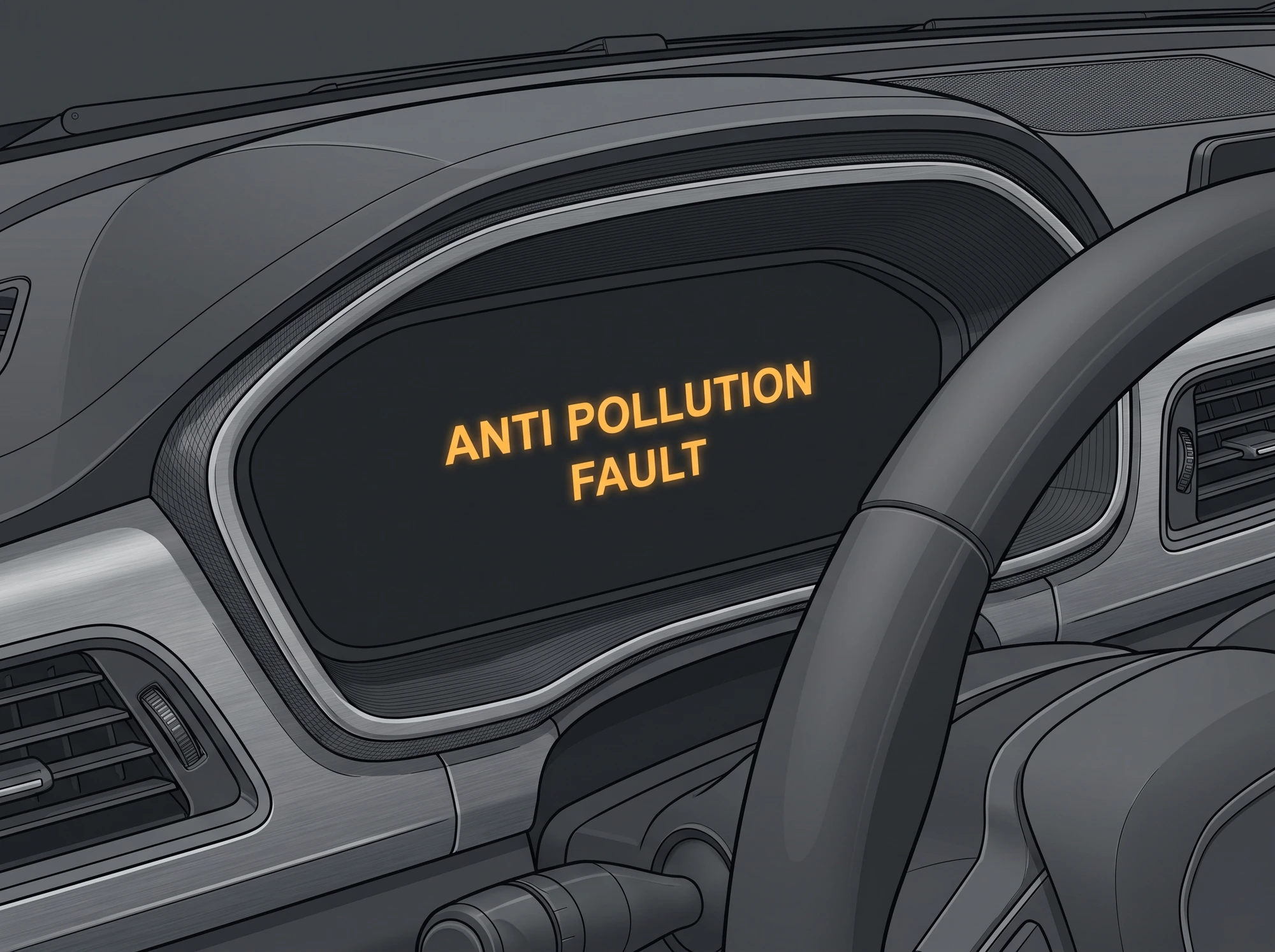
Two things about it are worth knowing before you spend anything. It can appear and clear between journeys while the code stays stored, so a message that has gone is not a fault that has gone. And because the wording names nothing, the stored code is the only thing that will — which makes reading the codes the first spend rather than the last.
The full explanation is on our dedicated page: what an Anti Pollution Fault actually means. If the particulate filter turns out to be the reason, what a DPF is and how a regeneration works explains why short journeys cause it.
Which lamp means a failed module on a 3008
Most warnings on a 3008 are a level, a bulb, a consumable or a sensor, and working through those first is both the right order and the cheapest. A handful are different: they sit in front of a control unit, and no amount of topping up or resetting will move them.
ABS and ESP
Anti-lock braking and stability control share their wheel-speed sensors and their hydraulic modulator, which is why one fault so often lights both. A sensor or its wiring is the cheaper and more common cause, so the codes are what separate them. On Peugeot and Citroën units the brake pressure sensor and switch inside the hydraulic assembly is a recognised failure point in its own right — we cover it on our page for the Citroën, Peugeot and Renault ABS pump ESP fault, with the wider work under ABS pump and module repairs. If the red brake warning is lit alongside, the car needs recovering rather than driving.
The automatic gearbox and its control module
The Mk2’s automatics — the six-speed EAT6 and the later eight-speed EAT8 — are torque-converter boxes managed by a transmission control module. When that module or its wiring fails the car does not gradually worsen: it takes a protective mode, holding a gear, refusing drive or dropping out of it, with a message alongside. Read the codes on equipment that talks to Peugeot’s transmission modules, because a basic reader frequently cannot see gearbox codes at all. The work sits under transmission control module repairs. One thing to get right before anything is removed: this is not the automated-manual gearbox used elsewhere in the range, where the clutch and gear actuator is a separate unit again.
The instrument panel
It belongs on this list because it is a control unit like any other — a board, a processor and a display. The symptoms that point at it rather than at what it reports are dimming, blanking, resets, missing areas and warnings with nothing behind them. Peugeot clusters of every generation reach the bench: the Peugeot 206 instrument cluster is a different unit from a 3008’s, but it is the same failure family — the display and the board behind it.
Electric power steering
Assistance on a 3008 is electric, so a steering warning is an electrical fault rather than a fluid one. Steering heavy from cold and normal once warm, assistance fading in and out, or a wheel heavy on one lock only, all point at the electronics rather than the rack. The symptoms of an electric power steering fault sets out how they present, and our write-up of Peugeot 207 power steering failure is the clearest worked example on this marque. Treat a red steering warning as a stop: intermittent assistance can become none.
The BSI and the body electronics
The BSI — the built-in systems interface — is the controller at the centre of the car’s multiplexed body network, and a problem there does not look like one fault. It looks like several: lighting, wipers, central locking, windows, the display, a car that will not go to sleep, a battery flat overnight. The tell is precisely that the symptoms have nothing to do with each other.
So do not chase each warning separately, and check the battery, terminals and earths before condemning anything — low system voltage makes several modules log faults at once and looks identical from the driver’s seat. What a body control module does explains the architecture these faults live in.
Engine management, and where it goes
There are too many possible causes behind an engine management lamp to guess at, so the codes come first. If diagnosis points at an internal failure of the engine ECU itself, that work belongs with the independent specialists at ecu-repairs.com. If it points at the turbocharger — on a turbo diesel a failed electronic actuator arrives as lost boost, an engine lamp and reduced power together — that is one for our turbo specialists at turbo-repairs.com, our sister site for everything turbo.
Sinspeed · Peugeot electronics
Before you chase the lamp, rule the panel in or outWe are a UK specialist in automotive electronics, and on a car whose dashboard is a screen the first question is whether the screen is honest. Tell us what the panel did as well as what it said — which view it was in, whether it dimmed, reset or blanked, whether the message survived switching off — and we will tell you whether you are looking at a panel fault or at something the panel reported correctly.
Circuit-level board repair and reverse-engineering by in-house engineers · An R&D capability that keeps coverage moving with the newest instrument panels and control units
What to do when a warning light comes on in your 3008
The general sequence is on the Peugeot warning lights page. These are the steps a screen dashboard changes.
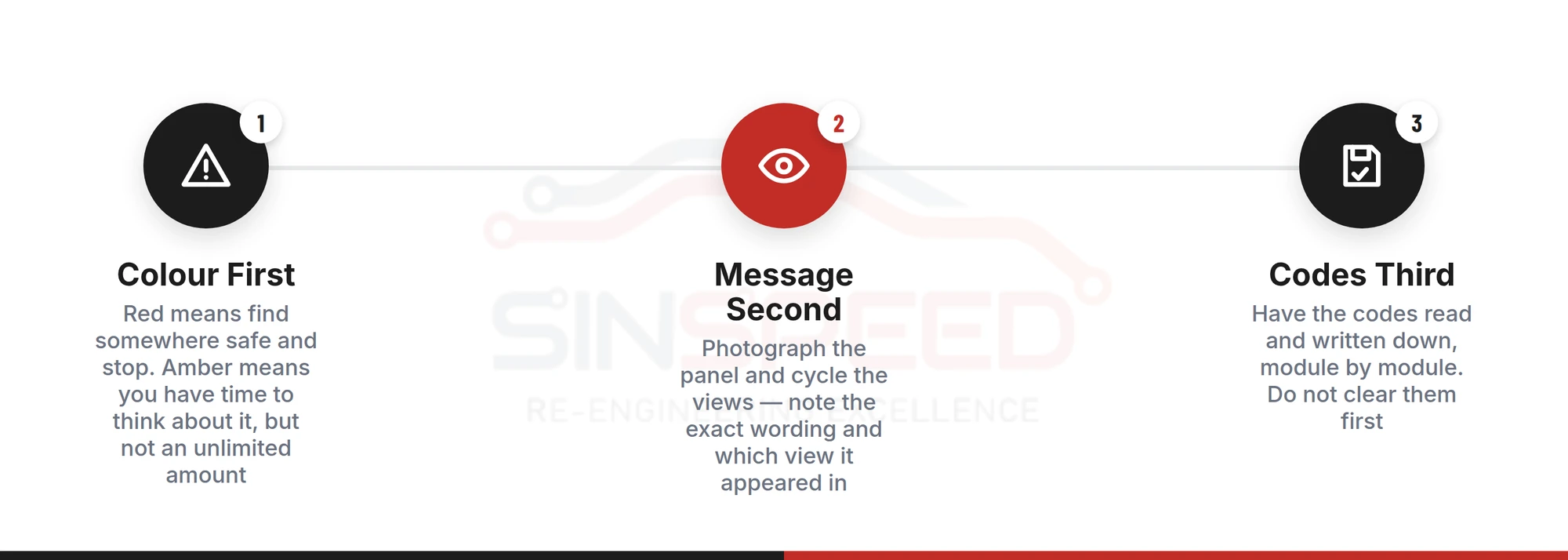
- Take the colour at face value. Red means find somewhere safe and stop. Amber means you have time to think about it, but not an unlimited amount of it.
- Photograph the panel before you switch off. That captures the exact wording, the symbols lit alongside it and the view it appeared in — three things that are hard to reconstruct afterwards.
- Cycle the display views before deciding a lamp has cleared. A warning not drawn in the view you are showing has not necessarily gone out.
- Do the checks that cost nothing. Parking brake fully off, fuel cap clicked shut, oil and coolant cold, all four pressures, doors and boot latched, and a walk round for a dead light.
- Check the battery and its connections before chasing a screenful of warnings. On a car this multiplexed, low voltage produces several unrelated faults at once.
- Have the codes read and written down, module by module. Do not clear them first: that throws away half the diagnosis, and silencing a brake, steering or airbag warning repairs nothing.
Peugeot 3008 warning lights FAQs
Why can I not find a warning light on my 3008 that I am sure was showing?
Because from the Mk2 the panel is a configurable display, and its central area changes with the view selected — dials, a digital speed readout, driving aids or trip data. A warning drawn in one view is not always drawn in the same place in another, and a message can be acknowledged without the fault being cleared. Cycle the views before deciding a lamp has gone out, and have the codes read anyway: the stored fault outlives the display of it.
My Peugeot 3008’s driver display has gone blank, dim or keeps restarting. What is it?
Those are panel symptoms rather than symptoms of what it reports on. A digital panel dims as the backlight degrades, loses areas of the display, ghosts, or resets over a bump — and a mechanical trigger like that points at the panel’s own hardware or a connector rather than software. Check the battery, terminals and earths first, because low supply voltage looks very similar, then have the panel itself assessed. Repairing your own unit keeps the recorded mileage where it is.
Can I trust the other warning lights if the 3008’s screen is faulty?
Not fully, which is why the panel comes first. Every lamp reaches you through it, so a panel that is misreporting can show a warning for a system with no stored fault, or withhold one for a system that has. Have the modules those lamps name interrogated: lamps lit while the modules are clean point at the panel. Until that is established, treat every red warning as genuine — a suspect panel is a reason to act sooner, not a reason to ignore a brake or airbag warning.
Does an “Anti Pollution Fault” message on a 3008 mean the DPF is blocked?
Not necessarily. It is a category message rather than a named part: an emissions-related fault, usually arriving with the engine management lamp. A blocked particulate filter is one candidate, and so are the EGR valve, the catalyst and a sensor reading outside its expected range. Because the wording names no component, the stored code is the only thing that will — and the message can clear between journeys while the code stays put, so have it read even if the screen has gone quiet.
Why has my 3008 shown several unrelated warning lights at once?
Because the body electronics are multiplexed. Peugeot’s BSI — the built-in systems interface — sits between the modules, so a problem on that network shows up as several unconnected complaints at the same time rather than one clear fault. Lighting, wipers, locking, windows and the display all misbehaving together is the pattern. Have the battery, its terminals and the earth connections checked before anything is condemned: low system voltage makes several modules log faults simultaneously.
My 3008 automatic has a gearbox warning and will not select drive. What now?
Stop using it. A transmission that refuses a gear, holds one gear or drops out of drive has taken a protective mode, and driving on risks turning an electronic fault into a mechanical one — as well as leaving you without drive at a junction. The Mk2’s EAT6 and EAT8 automatics are managed by a transmission control module, and a fault there produces exactly this behaviour. Have the codes read on equipment that talks to Peugeot’s transmission modules, and note which module reported them.
Do the e-3008 and the hybrid show different warning lights?
They share the safety and chassis warnings — brakes, anti-lock, stability control, restraints and steering are the same lamps with the same meanings — and add readouts of their own. Peugeot’s description of the newest panel includes power flow and vehicle charge state on the electric car, and remaining range in place of a fuel gauge. Anything red still means find somewhere safe and stop, and a high-voltage warning is not a roadside investigation: it needs a technician trained on that system.
Sinspeed · mail-in repair
Not sure whether it is the panel, or what the panel is reporting?Send us the fault codes and what the dashboard did, and we will tell you which unit is at fault before anything comes off the car. If it is the instrument panel, the ABS unit, the transmission control module or the steering electronics, you post the unit in, we repair and test it, and it comes back to you or your garage to refit — with your own data and mileage intact.
Most remanufactured parts carry a lifetime, unlimited-mileage warranty · Mail-in from anywhere in the UK, and many units go back ready to fit
Final thoughts
Every warning on a 3008 reaches you through the same piece of hardware, and on a Mk2 or a Mk3 that hardware is a computer with a screen. It reports the car faithfully almost all of the time. When it does not, it fails quietly — a lamp shown for a system with nothing wrong with it, a lamp withheld for a system that has, a message that vanishes when the view changes.
So the first question on this car is not what the symbol means. It is whether the panel is telling the truth. Answer that and the rest of the dashboard becomes readable again: take the colour at face value, match the shape in the table above, note the wording exactly as it appeared and which view it appeared in, then have the modules those lamps name interrogated properly. What comes back is either a fault the screen reported correctly, in which case you know which unit to deal with — or a screen that invented it, which is a repair in its own right.