
Summary: VW Transporter T5 dash warning lights follow Volkswagen’s three-colour rule — red to pull over, amber to have the van seen by a professional, green for information — but on a T5 the colour is only the start. Production ended in 2015, so every T5 still working is an older van, and on a van of that age a lamp can come from an ageing control unit as well as from the system it watches. This guide takes each T5 dashboard light by colour from Volkswagen’s own van guide, sets VW’s instruction apart from our own advice, and shows which lamps lead to a unit that can come out of the van and be repaired on our bench: the ABS unit, the airbag unit, the instrument cluster, the body control module or the immobiliser.
- What do the colours of VW T5 dash warning lights mean?
- Which red T5 warning lights mean pull over?
- Amber T5 dashboard lights: which need a garage, and how soon?
- Green and blue Transporter lamps: is anything wrong?
- What does an older T5 add to the picture?
- Lamp or unit: which T5 warning lights point to the electronics behind them?
- VW T5 dash warning lights: common questions
- Final thoughts
What do the colours of VW T5 dash warning lights mean?
Volkswagen’s van guide sets the rule out in three sentences: “Red means you need to pull over as soon as it’s safe to do so. Amber is less severe, but still indicates a problem that needs attention by a professional. Green warnings are for information only and don’t require action.” The guide lists white and blue lamps too, without a rule of their own; the ones on its list confirm that something is switched on, such as the headlights or cruise control.
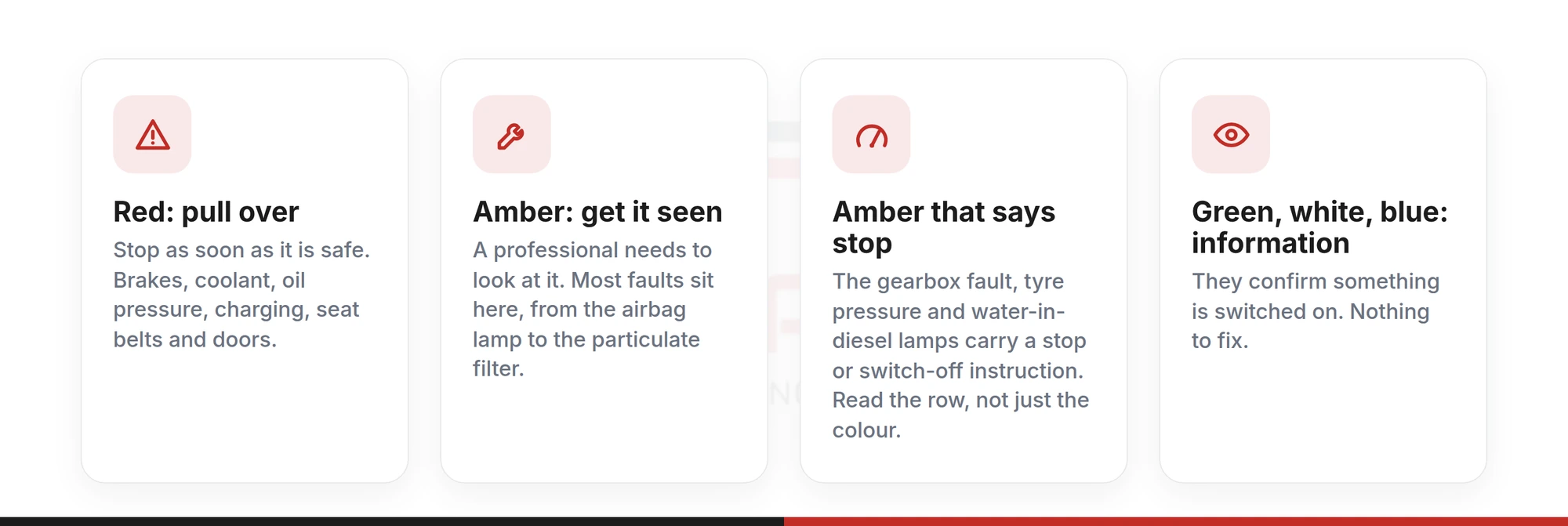
The colour is a fair first read, but it is not the whole instruction. Volkswagen gives each lamp its own page saying what to do, and three amber lamps — the gearbox fault, tyre pressure and water in the diesel — carry an instruction to stop or switch off as firm as anything in the red group. Two red lamps, the seat belt and door warnings, usually clear the moment a belt is fastened or a door is shut, though VW still grades them red. That is why the tables below give the meaning and VW’s instruction for every lamp, not just its colour.
- Red: pull over as soon as it is safe. Brakes, coolant, oil pressure, charging, seat belts and doors.
- Amber: a professional needs to look at it. Most faults sit here, from the airbag lamp to the particulate filter.
- Amber with a stop instruction: the gearbox fault, tyre pressure and water-in-diesel lamps. Read the row, not just the colour.
- Green, white and blue: information only. Nothing to fix.
One caution before the tables. These meanings come from Volkswagen’s own van guide, which covers its vans in general rather than the T5 in particular, and we have kept to lamps a T5 can carry. Fitted equipment differs from one van to the next, so the T5 handbook for your van is the place to confirm which lamps it has. If you also run the smaller Volkswagen van, our VW Caddy dashboard lamp guide covers it.
Which red T5 warning lights mean pull over?
All six lamps in this group carry Volkswagen’s instruction to stop the van as soon as it is safe. Four report a fault that gets worse, or leaves you stranded, if you carry on; the other two clear once the cause is put right.
| Lamp | What Volkswagen says it means | What to do (Volkswagen’s guide first; anything of ours starts “Our advice”) |
|---|---|---|
 Brake system — an exclamation mark in a circle, a bracket each side | The brake system light. VW’s checks point to two causes: the handbrake still applied, or brake fluid below the correct level. | Stop as soon as it is safe. Release the handbrake; if the lamp goes out, carry on normally. If it stays lit, the guide has the brake fluid level checked next, and if the level is low or the lamp will not go out, it says to call for help. Our advice: with the handbrake fully off, a red brake lamp on a laden van is a recovery job, not a drive to the garage. |
 Engine coolant temperature and coolant system fault — a thermometer in waves | The coolant level is not correct, or there is a fault in the coolant system. | Stop as soon as it is safe, switch the engine off and let it cool. VW’s guide then has the coolant level checked; if the level is adequate and the lamp stays on, have the van seen. For a coolant system fault, it says do not drive on. |
 Engine oil pressure — an oil can with a drip | The engine oil pressure warning. VW warns the engine could be damaged. | Stop as soon as it is safe, switch the engine off and check the oil level. VW says not to drive on even if the level is correct, and to get expert help. If the level was low and has been brought up to the mark, the guide allows a five-second run to see whether the lamp goes out; if it stays lit, have the van seen. |
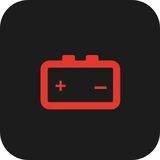 Vehicle battery — a battery with plus and minus terminals | The battery is not being charged while the van is moving. | Stop when it is safe and do not drive on. Switch off any electrical load you do not need and have the electrical system checked. Our advice: from this point the van is running on whatever charge is left, so plan for recovery rather than one more drop. |
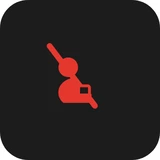 Seat belt — a seated figure wearing a belt | The driver or front passenger has not fastened their seat belt. | Fasten the belt. If the lamp stays on with the belts fastened, VW says to have it checked. |
 Doors — a vehicle seen from above with doors open | At least one door is open or not properly closed. | Stop when it is safe and check every door is shut. If the lamp stays lit, have it checked. Our advice: on a T5 that means the sliding side door and the rear doors or tailgate as well as the cab doors. |
Amber T5 dashboard lights: which need a garage, and how soon?
Amber is Volkswagen’s grade for a problem a professional needs to look at, and for most of these lamps the van can be driven carefully to a garage. Three are exceptions: the gearbox fault and tyre pressure lamps tell you not to drive on, and water in the diesel tells you to switch the engine off.
| Lamp | What Volkswagen says it means | What to do (Volkswagen’s guide first; anything of ours starts “Our advice”) |
|---|---|---|
| Airbag or belt tensioner system fault | A malfunction has been found in at least one airbag or belt tensioner. A message may also appear in the instrument cluster. | Go to a garage and have the airbag system and belt tensioners checked. Our advice: until it is put right, assume an airbag or tensioner may not work as designed in a collision, and book it in straight away. |
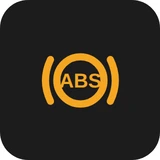 Anti-lock brake system — the letters ABS in a circle | A fault in the anti-lock brake system. The van can still be braked in the normal way, but ABS and ESP may not work. | Drive carefully to a garage to have the ABS examined. Our advice: leave far more room to stop, more again when laden or in the wet. With the red brake lamp lit alongside, the red instruction applies: stop. |
 Electronic stability programme (ESP) — a car above two skid marks | The ESP lamp is lit. | If it stays on, VW’s guide sends you to a garage. |
| ASR (traction control) off | ASR has been switched off by hand. | It switches back on when the ignition is switched off and on again. Our advice: if it is lit and nobody switched it off, treat it like the ESP row. |
 Electronic power control — the letters EPC | A motor control fault. | Have the engine checked immediately. Our advice: this starts with your garage’s diagnosis, because the cause can sit anywhere on the engine side. |
 Exhaust system fault — an engine outline | A fault in an emissions-relevant component that can damage the vehicle. | Drive to the nearest garage and have the engine and the exhaust system checked. |
 Particulate filter clogged with soot — on vans fitted with a filter | VW says the filter has filled with soot and needs regenerating. | Support the regeneration by driving at 31–75 mph, within the speed limits and following the gear-change indicator; the lamp goes out by itself once the filter has regenerated. If it is still lit after about 30 minutes of that driving, have it seen. Ignored, the filter can clog completely, and then a garage has to carry out a service regeneration. |
 Diesel engine preheating — a coiled filament | The diesel engine is being preheated. The lamp lights for a few seconds. | VW gives no further instruction: this is part of a normal start. Our advice: start once it goes out, and if it stays lit or flashes with the engine running, that is outside what the guide describes, so have a garage look at it. |
| Electronic immobiliser | The electronic immobiliser is active. | VW gives no further instruction. Our advice: on its own it is a statement, not a fault. If the van will not start with it lit, see the immobiliser point in the control-unit section below. |
 Gearbox fault — on automatic vans | The gearbox has become too hot. VW gives repeated pulling away in stop-and-go traffic as an example of the cause. | Stop when it is safe; do not drive on. Let the gearbox cool with P selected. If the lamp does not go out, do not drive on and have the van seen, or considerable damage to the gearbox can follow. |
 Tyre pressure — a horseshoe with an exclamation mark | One or more tyres have lost pressure, or a tyre is structurally damaged. | Do not drive on. Check and adjust all the tyre pressures and have a damaged tyre replaced; if the fault persists, have it seen. Our advice: set the pressures for the load the van is carrying, not the unladen figure. |
 Water in the diesel | There is water in the fuel. | Switch off the engine and contact a garage. |
 Brake pad monitoring — a broken dashed ring | The brake pads are worn. | Have a garage check all the brake pads and replace them if necessary. |
 Low fuel level — a fuel pump | The fuel level is low. | VW lists the lamp without an instruction. Our advice: refuel at the next opportunity. |
Green and blue Transporter lamps: is anything wrong?
No. Volkswagen calls green lamps information only, needing no action, and the white and blue lamps on its list are of the same kind. They confirm that something is on: the indicators and a trailer’s indicators, side and dipped lights, the headlights, fog lights, and cruise control or the speed limiter where fitted.
Two things on this side of the panel deserve a second look all the same. A hazard tell-tale flashing when nobody has pressed the switch is not information at all; on a 2004–2009 T5 it is one of the body control module faults covered below. And a panel that flickers, flashes on and off or goes dark is telling you about the instrument cluster, not about any system a lamp belongs to.
What does an older T5 add to the picture?
The T5 was built from 2003 to 2015, so every one still working has years of heat, vibration and use behind its electronics. That changes how a lamp should be read. On a newer van the first suspect for a lit lamp is the system it watches; on an older T5, the unit doing the watching and the cluster showing the lamp belong on the list as well. Our own T5 repair pages show where.
The ABS unit
On the 2003–2006 van, the ABS faults on our T5 ATE MK25 ABS pump repair page show up as an ABS lamp that stays on, with fault code 01276 (04FC) logged against the hydraulic pump or 0003 for a defective control module. On the 2006–2009 van, one unit runs anti-lock, traction and stability control, so its faults tend to light the ABS, traction control and brake lamps together, with code 01130 or 01276 stored. Two more signs listed for that 2006–2009 T5 ABS pump catch owners out: a wheel-speed sensor code that comes back after a new sensor, and a speedometer that drops out.
The instrument cluster
The cluster is the panel that carries the warning lamps, the gauges and the information display, so when it ages, the dashboard itself becomes unreliable. The faults on our T5 cluster pages are a mileage display that blanks or shows dashes, needles that drop to zero on the move, dead or flickering pixels, dial lighting that fades until only the needles show, and a cluster that flashes on and off and resets the clock and trip. We list the T5 instrument cluster for the whole 2003–2015 run, and the 2010–2015 T5 cluster separately. One honest caution from the same pages: if the fuel gauge alone has died and a fuel-level sensor code is logged, suspect the tank sender before the cluster.
The body control module
On the 2004–2009 T5, the body control module runs the lights, wipers, locking and other body functions. When it fails, the signs are hazards that switch themselves on, a horn that sounds with the indicators, front wipers that misbehave, locking and lighting faults, and in some vans the module shutting down while the van is moving — which needs looking at promptly. Those are the faults our T5 body control module repair deals with.
Lamp or unit: which T5 warning lights point to the electronics behind them?
Every lamp on a T5’s dash is a conclusion reached by a control unit, and an ageing unit can reach the wrong one. The 2006–2009 ABS unit reads every wheel-speed sensor; as its electronics degrade, it can start blaming a sensor that tests perfectly well, which is how a T5 ends up with a new sensor and the same code straight back. The sensor or its wiring can still be the fault, so the stored codes, not a guess, should decide what comes off the van.
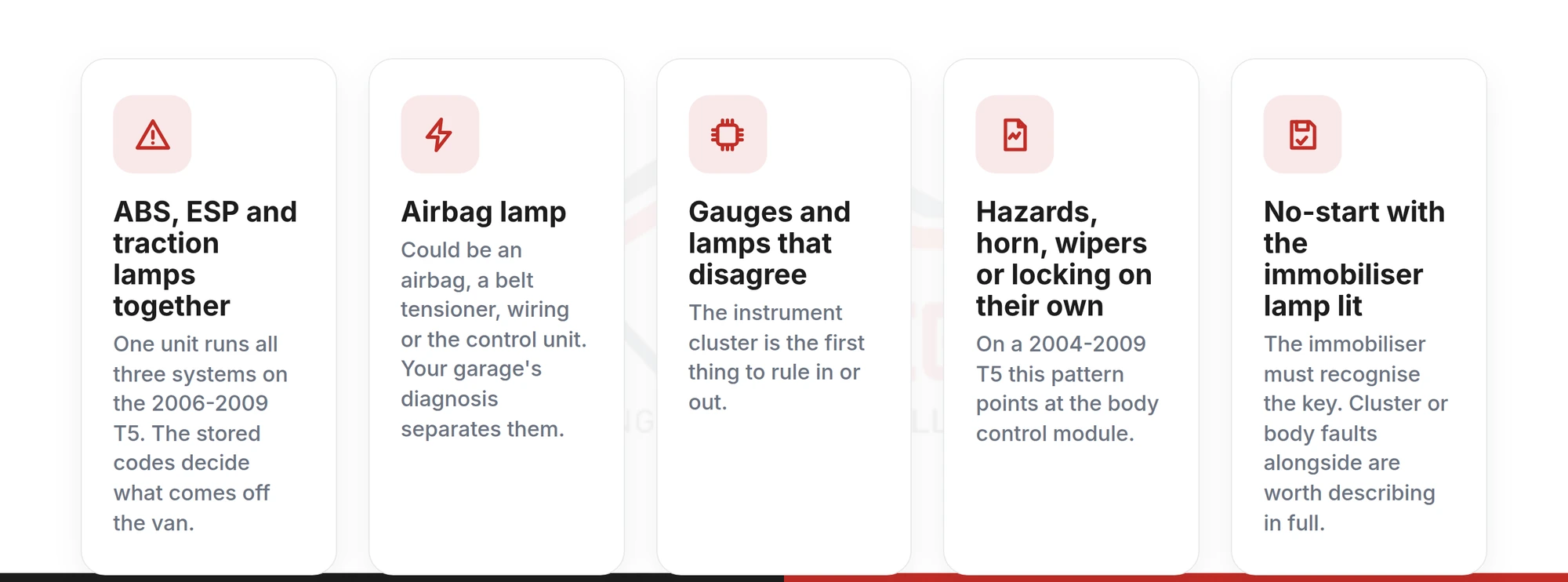
- ABS, ESP and traction lamps together. One unit, three systems, which is why they so often light as a set. Our guide to ABS and traction control lights on at once explains the behaviour, and our Volkswagen ABS unit repairs cover the units themselves.
- The airbag lamp. The fault can be an airbag, a belt tensioner, the wiring or the airbag control unit, and a garage’s diagnosis separates them. Where it settles on the control unit, that is one of our airbag control unit repairs.
- Gauges, display or a scatter of lamps that make no sense. When the needles, the display and the lamps disagree with what the van is doing, the cluster is the first thing to rule in or out, because every other reading depends on it. Cluster work for the range sits under our Volkswagen instrument cluster repairs.
- Hazards, horn, wipers or locking acting on their own. That pattern on a 2004–2009 van points at the body control module. Our guide to what a body control module does explains the unit’s role.
- A no-start with the immobiliser lamp lit. The immobiliser has to recognise the key before the engine will run. On the 2010–2015 T5 the instrument cluster forms part of the immobiliser, and the 2004–2009 BCM carries immobiliser data, so a starting problem that arrives with cluster or body faults is worth describing in full. Our article on our immobiliser no-start guide goes through the signs.
The engine-side lamps are different. EPC, the exhaust system fault lamp and the particulate filter lamp can point anywhere in the engine, its sensors or its exhaust, and they start with your garage’s diagnosis.
When the diagnosis names one of those units, only that unit needs to travel: your garage removes it from the T5 and sends it in. We run it on the bench under simulated load until the fault shows itself, repair it, then put it through the same test again before it is packed. It is the van’s own unit that goes back, so it keeps its coding; a cluster also keeps its recorded mileage and security data, which normally avoids dealer recoding. Refitting steps are part of the job — on an ABS unit, your garage bleeds the brakes and clears the stored codes as it goes back in.
Sinspeed · Transporter T5 electronics
Lamps on, codes read, unit suspected?Put the T5’s year, the lamps that are lit and every stored code on the repair form. An engineer will tell you whether the pattern fits the ABS unit, the cluster, the body control module or the airbag unit before anything is taken out of the van.
Bench-tested under simulated heat, vibration and load before and after repair · Lifetime, unlimited-mileage warranty on most repaired units
VW T5 dash warning lights: common questions
Can a T5 still stop safely with the ABS warning light on?
Volkswagen’s guide says the van can still be braked in the normal way, but ABS and ESP may not function, and asks you to drive carefully to a garage to have the ABS examined. Our advice: the brakes will stop the van, but without anti-lock the wheels can lock in a hard stop, so leave much more room, more again when the van is loaded or the road is wet. If the red brake lamp is lit as well, follow Volkswagen’s red instruction instead and stop as soon as it is safe.
Why are the ABS, traction control and brake lights all on together on my T5?
On the 2006–2009 T5 one unit runs anti-lock, traction and stability control, so a fault in that unit lights the lamps together, and code 01130 or 01276 is usually stored. Your garage will want to rule out a supply fuse or wiring fault first. Because the red brake lamp is part of the pattern, Volkswagen’s instruction for it applies: stop as soon as it is safe, and have the van checked before you rely on it again.
Why does my T5’s speedometer drop out when warning lights come on?
Two units can cause it, and the codes tell them apart. On the 2006–2009 van, a failing ABS unit can make the speedometer drop out alongside the ABS, traction and brake lamps. Needles that fall to zero while you are driving are also one of the instrument cluster faults we repair across the 2003–2015 range. Have the stored codes read before anything is changed, and put them on the repair form so we can say which unit the pattern fits.
What does the immobiliser light mean on a VW T5?
Volkswagen’s guide describes it simply as the electronic immobiliser being active, and on its own that is not a fault. It matters when the van will not start with the lamp lit, because the immobiliser has to recognise the key before the engine runs. On the 2010–2015 T5 the instrument cluster forms part of the immobiliser, and on the 2004–2009 van the body control module carries immobiliser data, so a starting problem that comes with cluster or body faults is worth describing in full on the repair form.
Are VW T5 dash lights the same as on a newer Transporter?
Many symbols are shared, which is why this page works from Volkswagen’s own van guide, but that guide covers Volkswagen’s vans in general and includes lamps for systems that newer vans carry. We have kept to the lamps a T5 can have, and none of them should be read as unique to the T5. The handbook for your van is the place to confirm exactly which lamps it was built with, because fitted equipment differs from one T5 to the next.
Sinspeed · repair by post
Keep the T5’s own unit, with its data on boardA replacement module has to be matched and coded to the van; the one already fitted knows it. Your garage takes it out and sends it to us, we repair it and prove it on the bench, and it goes back in carrying the van’s own coding.
Posted to us from anywhere in the UK · In-house electronic and hydraulic engineers
Final thoughts
For a van built between 2003 and 2015, the T5 dash is refreshingly plain to read. Volkswagen’s colour rule does most of the sorting, and the instruction for each lamp does the rest, including the three amber lamps that ask for more than their colour implies.
What the van’s age adds is a second question for any lamp that will not stay off: is the fault in the system, or in the electronics reporting it? A code that returns after the part has been changed, a speedometer that drops out alongside the ABS lamp, a panel that flickers or goes dark — those are the signs that the answer may be a unit, and that the one already in the van can be repaired rather than replaced.