
 In short
On a Suzuki, C1028 is a brake-pressure sensor fault — the master-cylinder pressure sensor built inside the ABS pump has failed, so the ESP/traction-control light stays on and the ESP-OFF button does nothing. We remanufacture your original unit with an uprated sensor and return it ready to fit, with a lifetime warranty.
What is the Suzuki C1028 ABS/ESP fault?
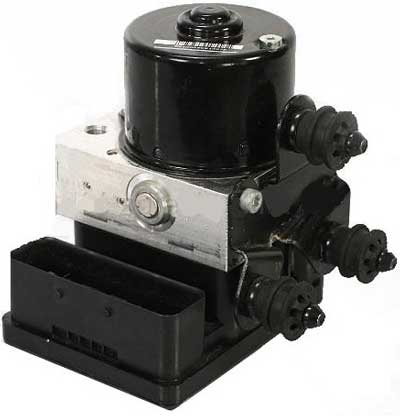
C1028 is a brake-pressure sensor fault on your Suzuki’s ABS system. The Suzuki service manual defines C1028 as a master-cylinder pressure sensor circuit failure — the signal voltage from the master-cylinder pressure sensor reaching the ESP control module has gone too high or too low, so the system can no longer trust the brake-pressure reading it depends on. Put simply, the sensor that tells the stability system how hard the brakes are being applied has stopped reporting correctly.
What makes C1028 distinctive on these Suzukis is where that sensor lives. It is not a separate part bolted onto the brake lines — it is built inside the ABS pump and module itself, as part of the combined hydraulic and electronic unit. So although the code reads as a sensor fault, the failed sensor is integral to the pump, which is why C1028 is described as both an ABS pump fault and a brake-pressure sensor fault — both point at the same physical unit.
Because the pressure sensor feeds the Electronic Stability Programme (ESP), the most visible result is the ESP and traction-control warning staying lit, frequently with the ABS light alongside it. The code turns up across much of the Suzuki range — Swift, Swift Sport, Grand Vitara, Splash and Vitara among them — because they share the same style of internal-sensor ABS unit, and that is exactly the part that fails.
Symptoms of C1028 on a Suzuki
C1028 usually shows itself on the dashboard first, and because it sits in the braking and stability system those warnings are worth acting on rather than waiting to see whether they clear. The signs we see most often are:
- ESP / traction-control warning light on and staying on, rather than flickering and clearing on its own.
- The ESP-OFF button having no effect — pressing it will not turn the light out, which is one of the clearest pointers to C1028 rather than a passing glitch.
- The ABS warning light on as well in some cases, sitting alongside the ESP light.
- Stored fault code C1028 — brake-pressure sensor circuit defective — read from the ABS/ESP control module on a diagnostic scan.
- Braking that feels different on some cars, with the anti-lock and stability assistance no longer working as it should and only ordinary braking left in effect.
The tell-tale that points specifically at C1028, rather than a wheel-speed fault or a passing warning, is the ESP-OFF button doing nothing. Once the code is stored and the light stays on, the safe assumption is that a braking-stability system has dropped offline, so the car should be diagnosed promptly rather than driven on indefinitely.
What causes C1028? The internal brake-pressure-sensor design flaw
C1028 is, at root, a design weakness rather than bad luck. On earlier Suzuki ABS systems the brake-pressure sensor was fitted externally to the unit, and in that position it rarely gave trouble. On the current style of ABS pump and module the sensor was moved inside the unit — and that is where the problem starts. These internal-sensor units fail in service in a way the older external-sensor design did not.
The failure is one of the most common we see on these Suzuki units. The pressure sensor sits inside the pump body, exposed to the heat and electrical load of the assembly around it, and over time its circuit breaks down until the voltage it reports drifts outside the range the ESP control module will accept. At that point C1028 is logged and the warning lights come on — it is not something a driver causes, and not something that resets itself.
It is worth being clear about what is not the cause. The Suzuki manual’s own diagnosis for C1028 first asks the technician to rule out ordinary brake-system issues — a leak or air in the hydraulic system, or too much clearance between pad and disc — and to check the sensor’s calibration before condemning the unit. Where those are sound and the code persists, the fault sits with the master-cylinder pressure sensor inside the pump. That is the failure these units are known for, and the one our repair is built around.
Suzuki fitted more than one make of ABS unit across these models and years — our own workshop experience is dominated by the ATE-type pump, while some Swift units use a Bosch design — so the make on your particular car is not the headline. The unifying fact, and the one that matters for the repair, is the internal brake-pressure sensor: whichever unit it sits in, that sensor is the weak point C1028 reports.
C1028 vs other Suzuki ESP/ABS codes (C1032 and C1036)
It is easy to lump every Suzuki ESP or ABS warning together, but C1028 is a specific fault, and telling it apart from its neighbours saves fitting the wrong part. The codes most often confused with it are the wheel-speed sensor codes — and they point at a completely different component.
C1028 is the brake-pressure sensor code: the internal master-cylinder pressure sensor described above. By contrast, C1032 is a right-rear wheel-speed sensor fault — the Suzuki manual describes it as a right-rear wheel-speed sensor or encoder signal performance problem — and C1036 is the matching left-rear wheel-speed sensor fault. They belong to the wheel-speed group of codes, and they relate to the sensors that read how fast each wheel is turning, not to brake pressure at all.
The practical point is this: a wheel-speed code such as C1032 or C1036 is usually a sensor or wiring problem out at the wheel — a different diagnosis and a different fix from C1028. So if your Suzuki has logged more than one code, it is worth having them read carefully to confirm which is the live fault. Where C1028 is present and the ESP-OFF button does nothing, the internal brake-pressure sensor is the part to address — and that is the unit we repair, working from what your car has actually stored rather than guessing at companion codes.
Sinspeed · mail-in repair
Send us the ABS unit rather than replacing the whole assemblyFill in the repair form with your vehicle details and the fault codes your scanner is showing. Our engineers strip the module, repair the failed circuit or valve driver and test it on our in-house Hardware-in-the-Loop rigs before it goes back to you.
Lifetime, unlimited-mileage warranty on all remanufactured parts · Mail-in, UK-wide · Tested on Hardware-in-the-Loop rigs before dispatch
How C1028 is diagnosed (the checks)
Because C1028 reports a sensor that is built into the ABS pump, the job on diagnosis is to confirm the fault really is the internal pressure sensor — and not something masquerading as it — then to put the unit right rather than simply clear the code. You cannot tell that from the dashboard alone, which is why the unit is properly tested. The table below summarises how the fault presents across the common Suzuki models and the thinking behind it.
| Suzuki model (years / platform) | How the fault presents / related codes | Likely culprit: brake-pressure sensor vs full ABS pump-module | Repair route |
|---|---|---|---|
| Suzuki Swift / Swift Sport (2006–2011) | ESP/traction light stays on and the ESP-OFF button has no effect; sometimes the ABS light too. Stored code: C1028. | Internal brake-pressure sensor within the ABS pump — not the hydraulics and not a wheel-speed sensor. | Remanufacture the original unit: modify it so the sensor no longer overheats and fit an uprated pressure sensor — no new pump needed. |
| Suzuki Grand Vitara | ESP/ABS warning lights on with C1028 stored. Rule out the wheel-speed codes (C1032 right-rear / C1036 left-rear), which point elsewhere. | Same internal brake-pressure sensor design; confirm against the stored code before condemning the whole pump. | Remanufacture of the original unit; uprated sensor fitted, returned self-calibrating and ready to fit. |
| Suzuki Splash (years vary — confirm by part number) | ESP/traction light on with C1028; the ESP-OFF button does nothing. | Internal brake-pressure sensor inside the ABS pump-module — repairable on the unit itself. | Send the unit in; we identify it from the part number and remanufacture with an uprated sensor. |
| Suzuki Vitara (years vary — confirm by part number) | ESP/traction warning with C1028 stored. | Internal brake-pressure sensor — an in-unit repair, not an automatic full-unit swap. | Mail-in remanufacture; uprated sensor, lifetime warranty. |
On the bench we recreate the heat and load the unit sees in the car, so the sensor fault that keeps re-triggering C1028 on your driveway shows itself where we can correct it. If you are not certain which ABS unit your Suzuki has, send us the details through our repair form and we will identify it from the part number — or browse our Suzuki ABS pump and module repairs to see the units we cover.
Suzuki vehicles affected by the C1028 brake-pressure-sensor fault
From the units sent in to our workshops, these are the Suzuki models we most commonly see come in with this brake-pressure-sensor fault:
| Vehicle | Vehicle | Vehicle | Vehicle |
|---|---|---|---|
| Suzuki Grand Vitara | Suzuki Splash | Suzuki Swift | Suzuki Vitara |
Common Suzuki ABS part numbers affected
And these are the Suzuki ABS part numbers we receive most often. If yours is not listed, send the unit in and we will identify it for you:
| OEM | ATE |
|---|---|
| 06.2109-5200.3 | 06.2102-0885.4 |
| 000403-296D.1 |
Can you drive with C1028?
Treat C1028 as a reason to have the car checked rather than to carry on regardless. With the fault stored, the ESP and traction-control systems are not doing their job — the stability system has lost the brake-pressure reading it depends on — and you should take real care, because the safety assistance you would normally rely on is not there.
On ordinary roads at ordinary speeds a Suzuki with C1028 may feel much as it always does, and your standard brakes will still slow the car. What you lose is the layer that works hardest when it matters most: under heavy or emergency braking, on a slippery surface, or in a sudden swerve, the anti-lock and stability functions cannot intervene as they are designed to — precisely when you would want them.
Our advice is to drive only if you genuinely have to while the ESP or ABS light is on, and to have the fault diagnosed without delay. We do not recommend resetting the code, recoding the unit or attempting any repair on the ABS pump yourself — this is a braking-safety system, and the right course is to have the unit tested and put right properly.
Can the brake-pressure sensor be repaired, or does the ABS unit need replacing?
Most main dealers and general garages answer C1028 with a complete new ABS pump and module, because replacing the unit is the only route open to them. A specialist remanufacturer can repair the unit at component level instead, and that changes the answer — in the great majority of cases C1028 is a repair, not a replacement.
Fitting a brand-new unit has real drawbacks beyond the obvious one. It carries a short manufacturer warranty and — this is the important part — it is built to the same design as the one that failed, with the same pressure sensor in the same internal position, so it can go on to develop the very same fault. A used or salvage unit is a bigger gamble still: it may already be on its way to failing, and it usually has to be coded to your car first. Either way, a like-for-like swap does not address the root cause.
Our approach is different, and it is the heart of what we do on these Suzuki units. Rather than return the pump to standard and wait for it to fail again, we modify it so the sensor is no longer subjected to the overheating that breaks it down, and we fit an uprated pressure sensor in place of the original — a component built to outlast the standard part rather than repeat its life. The work is carried out at circuit-board level by our in-house electronic and hydraulic engineers, using brand-new, OEM-quality parts so the rebuilt unit meets and exceeds the original specification.
Because we rebuild the unit that is already matched to your car, it keeps its programming — our remanufactured Suzuki ABS pumps are self-calibrating and come back plug-and-play, with no coding required in most cases. Every unit is proven on our in-house Hardware-in-the-Loop test rigs, which simulate the real-world heat, vibration and load the pump sees in service, and the repair is backed by a lifetime, unlimited-mileage warranty.
How our Suzuki ABS repair service works
Our Suzuki ABS repair is a mail-in, repair-and-return service — there is no need to bring the car anywhere or book it in. You remove the ABS pump and module, send it to us, and we return it ready to fit, typically within a few working days, and we will always tell you if that is going to vary.
- Get in touch. Tell us your vehicle and what it is doing through our repair form, or contact us if you are not sure which ABS unit your Suzuki has. Pass us the part number and we will identify your exact unit.
- Remove and send your unit. Keep the control module and the pump together and send the complete assembly, so we can test it as the single unit it works as on the car.
- We test and diagnose. Your unit is bench-tested to confirm the internal brake-pressure sensor is the cause and to rule out anything else, and we report what we find before any work goes ahead. If the unit turns out not to be faulty, we will tell you.
- We remanufacture. Our engineers modify the unit so it will not overheat again and fit an uprated pressure sensor, using brand-new OEM-quality parts, so you are not left with the same design flaw that failed first time.
- We return it ready to fit. The rebuilt unit comes back self-calibrating and plug-and-play, with no programming needed in most cases, and covered by a lifetime, unlimited-mileage warranty.
All of this is done in a cleanroom-standard, ESD-safe workshop using dealer-level diagnostic tools to test and calibrate the unit before it is dispatched. If you would like to see the wider range we cover, our ABS pump and module repair category lists the units we remanufacture across other makes and models.
FAQs
What is the code C1028 on a Suzuki?
C1028 on a Suzuki is a master-cylinder brake-pressure sensor circuit failure. The pressure sensor that tells the ESP control module how hard the brakes are being applied has failed, and on these Suzukis that sensor is built inside the ABS pump and module. The result is the ESP and traction-control light staying on, often with the ABS light, and the ESP-OFF button having no effect. It is a known weak point of the internal-sensor design, and it is repairable.
Can I drive with C1028?
You should treat it as a reason to stop and have the car checked rather than to keep driving. Your ordinary brakes will still work, but with C1028 stored the ABS and stability systems are not — so under heavy or emergency braking, or on a slippery road, the assistance you would normally rely on is not there. Drive only if you genuinely have to while the light is on, and have the unit diagnosed without delay.
Is C1028 the brake-pressure sensor or the ABS pump?
It is both, in effect. C1028 reports the master-cylinder brake-pressure sensor, but on these Suzukis that sensor is built inside the ABS pump and module rather than being a separate part. So the failed component is the pressure sensor, and the unit that has to be worked on is the pump it lives in — which is why the fault is described both ways.
Can the sensor be repaired, or does the whole ABS unit need replacing?
In most cases it can be repaired, and a full replacement is rarely necessary. A new unit is built to the same design and can develop the same fault, while a used one usually needs coding and may be close to failing itself. We repair your original unit instead — modifying it so the sensor no longer overheats, fitting an uprated pressure sensor, and returning it coded to your car with a lifetime warranty.
What’s the difference between C1028 and C1032 on a Suzuki?
They are different faults on different parts. C1028 is the internal brake-pressure sensor inside the ABS pump. C1032 is a right-rear wheel-speed sensor fault — the sensor that reads how fast the rear wheel is turning — and its partner C1036 is the left-rear wheel-speed sensor. If your Suzuki has logged more than one code, it is worth having them read to confirm which is live, because C1028 and a wheel-speed code call for different repairs.
Sinspeed · mail-in repair
Get the fault confirmed before you spend anythingTell us the symptoms and the codes your scanner is showing. Our engineers will tell you what they expect to find and what the repair involves.
Your own unit remanufactured, not a like-for-like replacement · Lifetime, unlimited-mileage warranty · Dealer-level programming and calibration