
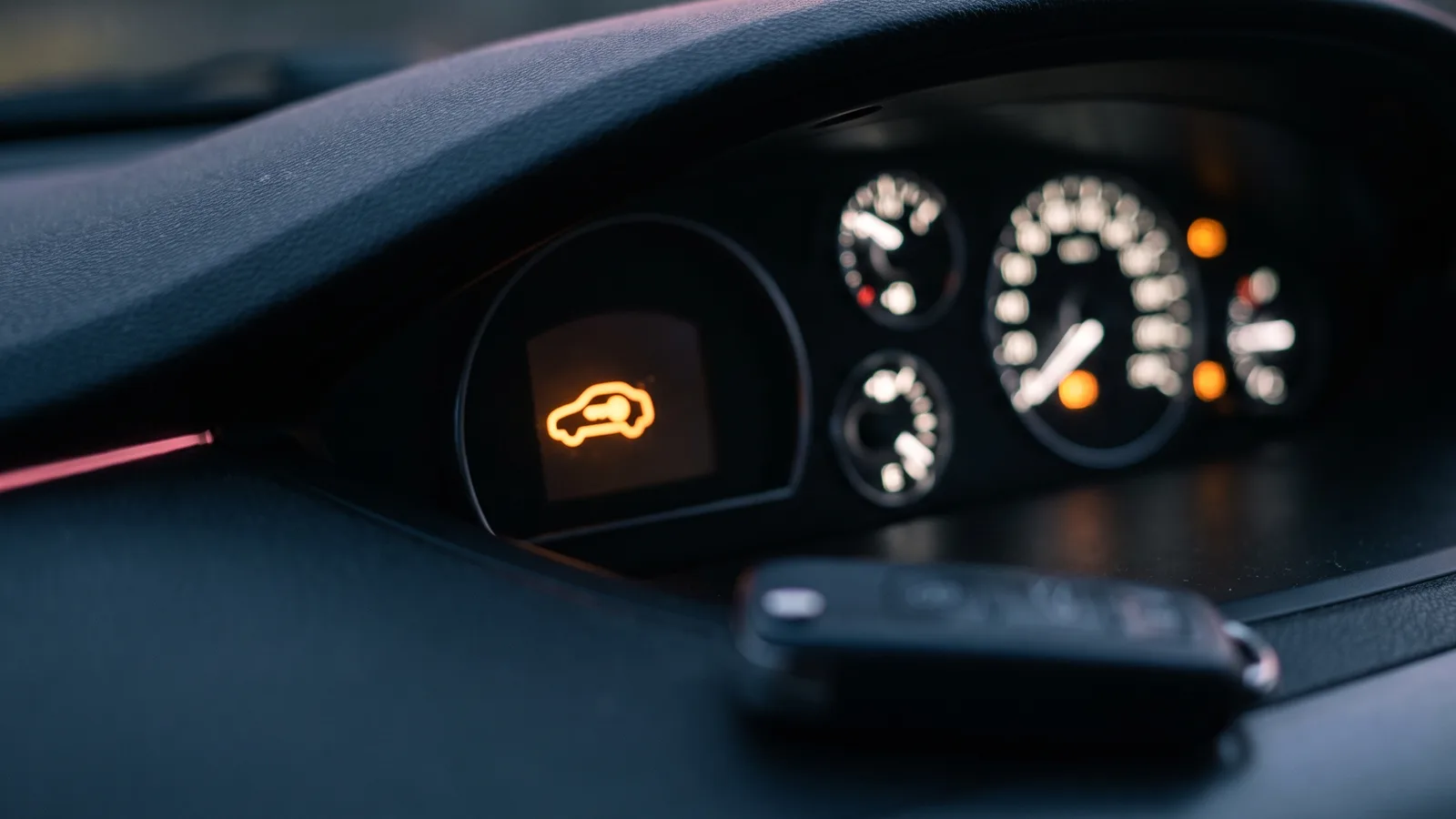
Summary: If your car cranks but won’t fire — or won’t crank at all — and the battery is healthy, the immobiliser is a genuine suspect. This guide shows you how to tell an immobiliser fault apart from a flat battery, a tired key or a starter problem, which part has usually failed on which makes, and the honest options for putting it right.
In this guide
- What the immobiliser actually does
- Is it actually the immobiliser?
- What's actually failed: the four places to look
- Which part fails on which makes
- Repair or immo delete: the honest decision
- Safe first checks before you call anyone
- FAQs
What the immobiliser actually does
The immobiliser is the electronic security system that stops your engine starting unless it recognises an authorised key. It is the reason a modern car cannot be hot-wired the way an old one could — and it is also the reason a perfectly healthy engine will sometimes refuse to turn a wheel.
At a generic level the system is a three-way handshake. Inside your key sits a small transponder chip. When the key is present, a control module reads that chip through an antenna and checks the code against the one stored in the car. If the two match, the module gives the engine permission to run. No match, no permission, no start.
That is the whole point of failure. When any link in the chain breaks — the chip, the module that reads it, the antenna between them, or the power feeding them — the car behaves exactly as if it had been tampered with. It locks itself down. Nothing is mechanically wrong with the engine; the security system has simply decided it should not start, and it is doing its job.
There is no single universal immobiliser part. Each manufacturer builds the function differently and gives it a different name — on a Mercedes it is the EIS or EZS, on a BMW the CAS, on a Ford the PATS. That matters when it comes to diagnosis and repair, and we set out which part fails on which make further down this page.
Is it actually the immobiliser?
Most no-starts are not the immobiliser. Before you assume the worst — and before you pay anyone to chase it — it is worth ruling out the ordinary causes that look identical from the driver’s seat. That said, a handful of signs point at the immobiliser rather than something simpler.
The symptoms that suggest an immobiliser fault are:
- The immobiliser or security warning light stays on, flashes, or will not go out when you switch the ignition on.
- A “key not recognised” message, or the car simply does not respond to the key or fob.
- The engine cranks but will not fire — or will not crank at all — even though the battery is healthy.
- Starting is intermittent and unpredictable, often worse once the car has warmed through.
- The engine catches for a second or two, then stalls as authorisation drops out.
A weak or flat battery is the single most common culprit, and the most deceptive. Low voltage can mimic almost every immobiliser symptom: no crank, intermittent starting, warning lights flickering, the car dead one morning and fine the next. A battery that reads normal at rest can still collapse under the load of cranking, so it deserves a proper voltage and load check rather than a hopeful glance at the dashboard.
A failing starter motor is another. If you hear a single heavy click but the engine will not turn over, the starter or its solenoid is a more likely suspect than the immobiliser. And if the engine cranks over briskly but never quite catches, the problem can sit in fuelling or ignition rather than security at all. The way the car fails tells you a great deal before anyone connects a scanner.
The warning light deserves a closer look, because it splits the diagnosis two ways. If the immobiliser or security light is flashing or blinking and the car will not start, that is the classic signature of non-recognition: the car cannot read a valid key, so it refuses to authorise the start and tells you so. The fault is somewhere in the key, the antenna that reads it, the control module, or the wiring between them — but the system is clearly flagging that it does not trust the key in front of it.
An immobiliser light that is off, however, does not let the immobiliser off the hook. Not every car has a dedicated immobiliser lamp, and on those that do, some failure modes leave the car in a silent no-start state — sometimes described as being “stuck in anti-theft mode” — with no warning light at all. So a flashing light makes the immobiliser a strong suspect, but an absent light is not an all-clear. If the battery is healthy and the car still will not start, the system is still worth ruling in or out properly.
None of this is a confirmed diagnosis on its own — these are signposts, not proof. But they tell you whether the immobiliser is worth suspecting, and they set up the three safe first checks at the end of this guide, which separate a simple trigger from a genuine fault.
What's actually failed: the four places to look
When an immobiliser genuinely is at fault, the problem almost always sits in one of four places. Holding this simple map in your head makes everything that follows easier to understand, because every make-specific fault is really one of these four wearing a different badge.
- The control module — the make-specific brain that authorises the key. This is the Mercedes EIS/EZS, the BMW CAS, a standalone unit on some cars, or a function built into the instrument cluster or engine ECU on others. When the brain fails, the whole handshake fails with it.
- The key and its transponder — the chip inside the key can wear or become corrupted. On some systems the relationship runs both ways: a failing module can corrupt the key, turning a one-part problem into a two-part one.
- The ring antenna, or transceiver — the coil or loop that sits around the ignition barrel, or behind the column shroud, and reads the key. If it cannot energise and read the chip reliably, the module never sees a valid key even when the key is perfect.
- The wiring and power — earths, supply and connections that feed the system. And sitting across all of these, a weak battery, which mimics almost every immobiliser symptom and is the first thing any honest diagnosis rules out.
The reason this matters is cost and honesty. A module fault and a key fault feel identical on the driveway, but they are very different jobs to put right. A worn key or a tired antenna is often far cheaper to sort than a control module — which is exactly why a good diagnosis is worth more than a guess, and why nobody should be condemning an expensive module before the simpler causes are off the table.
Which part fails on which makes
The four places above show up differently from one manufacturer to the next. The table below is the quick reference: what the immobiliser module is called on the common makes, how a fault typically presents, and where the right fix lives. The make-specific pages it links to carry the full symptom, generation and fault-code detail.
| Make / system | The module (and other names) | How it typically presents | Where it goes for the fix |
|---|---|---|---|
| Mercedes | EIS — Electronic Ignition Switch, also called the EZS (Elektronisches Zündschloss). The dashboard key-slot module; also releases the Electronic Steering Lock (ESL). | No-crank, the key not accepted, or a Steering Lock warning — easily mistaken for a flat battery or a dead key. | Mercedes EIS/EZS repair, with a full worked example in our Mercedes EIS/EZS guide. |
| BMW / MINI | CAS — Car Access System. The immobiliser and ignition-authorisation module, married to the car (generations CAS2 to CAS4). | No-crank or crank-but-no-fire, the key not recognised, often intermittent and worse once the car has warmed up. | BMW CAS2 or CAS3 repair; full detail on our BMW CAS no-start guide. |
| Ford | PATS — Passive Anti-Theft System. Where the fault sits depends on the generation: a standalone module, the instrument cluster, or the engine ECU. | Theft or security light showing, no-start; the failed component varies by generation. | See our Ford PATS no-start guide for the generation-by-generation breakdown. |
| Any make | The key/transponder, or the ring antenna/transceiver that reads it — the simpler links in the chain. | Intermittent recognition; the car often starts on the spare key. Frequently cheaper to put right than feared. | Diagnosis first — this is often a key or antenna job, not a module repair. |
One module to keep off this list, because the SERPs constantly muddle it in: the BMW and MINI FRM, the footwell module. A faulty FRM is sometimes mistaken for an immobiliser fault, but it is a different unit doing a different job — it runs body electrics such as lighting, windows and mirrors. The immobiliser brain on a BMW is the CAS, not the FRM. If your symptoms are starting-related, the CAS is where to look.
It is also worth saying plainly that the last row of that table is more common than owners expect. A large share of suspected module failures turn out to be the key or the antenna that reads it — and those are usually the cheaper end of the job. That is why we would always rather see a fault properly diagnosed than route every no-start straight to a module repair it may not need.
Repair or immo delete: the honest decision
Once a fault is confirmed, there are two legitimate ways forward — and which one is right depends entirely on what has failed, not on which is quicker to sell.
When the fault sits in a discrete immobiliser module — a Mercedes EIS, a BMW CAS, a Ford PATS unit or a cluster — the right answer for a normal road car is almost always to repair it. The original unit is remanufactured at circuit-board level by an in-house team of electronics engineers, with the known weak points reinforced rather than replaced like-for-like, so it comes back stronger than the part that failed. Crucially, repairing the car’s own module keeps your existing keys, coding and adaptations intact, and the security system stays exactly as the manufacturer intended. Because the work is done on the unit that is already married to your car, most repairs return plug-and-play with no dealer recoding, and most carry a lifetime, unlimited-mileage warranty.
There is a second route, and it has to be described honestly because the search results around this subject are full of people looking for a shortcut. Where the immobiliser function lives inside the engine ECU, where the original unit is genuinely beyond economic repair, or where an owner makes an informed choice for a legitimate reason — an off-road project, say, or a case where repair simply is not viable — a professional immobiliser delete is a recognised option. That work is handled by ecu-repairs.com, which covers the engine-ECU and immobiliser-delete side of things.
What an immo delete is not is a way around a car’s security, and we will not treat it as one. It is a professional service for a genuine engineering reason, carried out by people who know exactly what they are doing — not a DIY procedure, and not a method for starting a car you should not be starting. For an ordinary road car with a failed discrete module, repair is the route that keeps the immobiliser, and the protection it gives you, fully intact. That is the honest recommendation, and it is the one we lead with.
Safe first checks before you call anyone
Before you book any diagnosis, three simple checks separate a passing trigger from a real fault. None of them involves touching the security system itself — they are the legitimate first steps any sensible owner can try, and each one ends the same way: if the car still will not start, stop guessing and have it diagnosed.
Try the spare key
Because the fault can sit in the key’s transponder rather than the car, swapping to your second key is a quick, no-cost test. If the car starts reliably on the spare, the first key — not the module — may be the problem. One important caution: if you suspect a Mercedes EIS specifically, do not keep cycling keys through it, as a failing EIS can corrupt a key, and trying both keys in a suspect unit risks losing both. Try the spare once; if nothing changes, leave it there.
Check the battery and its terminals
A weak battery is the most common cause of every symptom on this page, so confirm it before anything else. Look for loose, dirty or corroded terminals and clean and tighten them if needed. Ideally have the battery voltage and load tested, because a battery that seems fine at rest can still fail under cranking. If the battery is flat or tired, charge or replace it and try again before you suspect the immobiliser at all.
Check the immobiliser fuse
A blown fuse can disable the immobiliser circuit and stop the car starting. Find the fuse box location and the relevant fuse in your vehicle handbook, check it, and replace a blown one like-for-like with the correct rating. If the new fuse holds and the car starts, the fault is resolved; if it blows again, that points to a wiring or power fault that needs a professional to trace — do not keep replacing it.
If all three checks come up clean and the car still will not start, you have done exactly the right groundwork: you have ruled out the cheap, simple triggers, which means the next step is a proper diagnosis rather than more guesswork. That is the point to send the unit in through our repair form, or to contact us if you are not yet sure which module your car uses. You can also browse the full immobiliser repair category to see the makes and modules covered.
FAQs
How do I know if my immobiliser is faulty?
The clearest signs are an immobiliser or security warning light that stays on or flashes, a “key not recognised” message, and an engine that cranks but will not fire — or will not crank at all — despite a healthy battery; intermittent starting that worsens once the car is warm is another. Before concluding it is the immobiliser, rule out the simple things: try the spare key and check the battery and terminals. If those are sound and the symptoms persist, have it diagnosed to confirm whether the fault sits in the module, the key, the antenna or the wiring.
What does a blinking or flashing immobiliser light mean?
A blinking or flashing immobiliser light means the car’s security system cannot recognise the key, so it is refusing to authorise the start. The fault can sit in the key’s transponder, the ring antenna that reads it, the control module, or the wiring between them — a flat or dead key battery and a weak car battery can produce the same flashing pattern, so rule those out first. A light that flashes steadily with the key in and the ignition on points firmly at non-recognition rather than a mechanical engine problem, and the right next step is diagnosis, not force. A light that is off does not rule the immobiliser out, because some no-start failures leave no warning lamp showing at all.
Can an immobiliser stop a car from starting, or is my car stuck in anti-theft mode?
Yes — stopping the engine from starting is precisely what an immobiliser is designed to do, and a car that will not start because it cannot authorise the key is sometimes described as being “stuck in anti-theft mode.” That state can present with a flashing security light, or with no warning light at all, and it is the system protecting the car rather than a sign of mechanical damage. It is not something to force or override; it needs the fault diagnosed so the system can be made to recognise the key again, whether that turns out to be the key, the antenna, the module or the wiring.
Can a car immobiliser be repaired?
Yes. Where the fault is a failed discrete control module — a Mercedes EIS/EZS, a BMW CAS, a Ford PATS unit or a cluster — the original module can be repaired at component level, which keeps your existing keys, coding and adaptations intact rather than forcing a programmed replacement. Where the fault turns out to be the key or the ring antenna, the fix is usually a simpler and cheaper job than a module repair. Either way it is repairable; the diagnosis decides which part is at fault and which route applies.
How do I reset the immobiliser?
This is the question with the most misleading answers online, so here is the honest one. A legitimate immobiliser reset or key relearn needs the correct keys and the right diagnostic equipment, and it is carried out as part of professional diagnosis or repair — not as a trick you perform on the driveway. It is not a way to bypass the system, and a genuine module fault will not be “reset” away: if the hardware has failed, no reset will mask it, and the unit needs repairing or, where appropriate, replacing.
How much does it cost to reset or fix an immobiliser?
It depends entirely on what has failed. A worn key or a faulty antenna is a very different job from a failed control module, and a fault inside the engine ECU is different again — so the only honest figure comes after a diagnosis. One thing worth knowing is that repairing your car’s original module avoids the recoding a brand-new replacement would need, because your existing coding is kept intact. For a figure specific to your vehicle, request a quote through our repair form.
Is an immo delete a good idea?
It can be, but only for a genuine reason. A professional immobiliser delete is a legitimate option where the immobiliser function lives in the engine ECU, where repair is not viable, or where an owner makes an informed choice for an off-road or repair-not-viable case. It is handled by ecu-repairs.com as a professional service, not as a shortcut around a car’s security. For a normal road car with a failed discrete module, repairing that module is the route that keeps the immobiliser, and the protection it gives you, fully intact — and it is the one we recommend first.
Final thoughts
A car that will not start is alarming, but an immobiliser fault is rarely the disaster it first feels like. Work through it in order: rule out the battery and the spare key, watch how the car fails and what the warning light is telling you, and let the symptoms point you at the right one of the four places a fault can hide. Once you know whether it is the module, the key, the antenna or the wiring, the fix becomes a clear decision rather than a guess — and for most road cars that means repairing the car’s own module and keeping its security intact. Get the diagnosis right and the cure is usually far less dramatic than the symptom.