
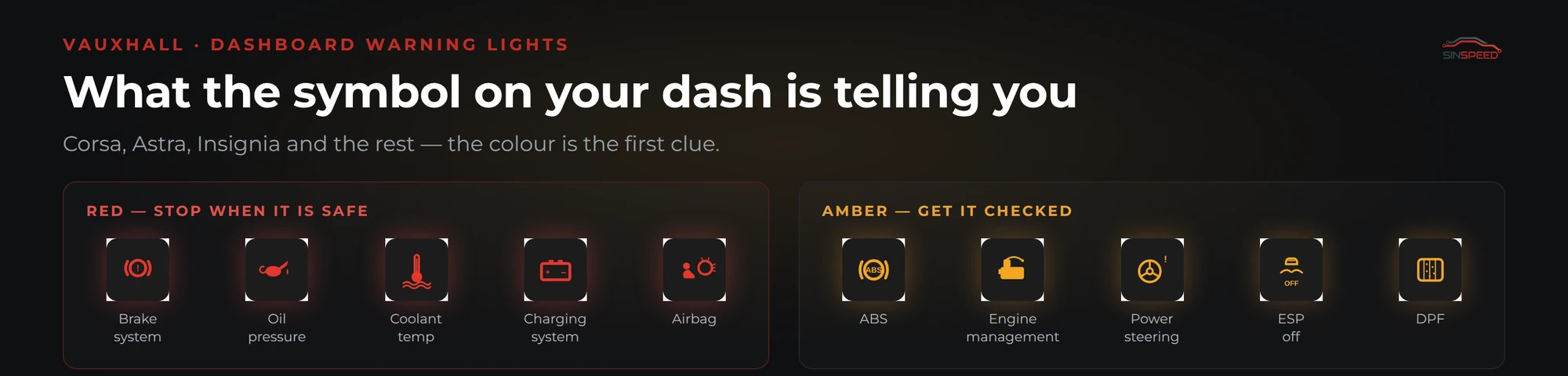
Summary: A Vauxhall warning light tells you two things at once: how urgent the problem is, shown by its colour, and roughly which system has flagged it. Red means stop and act now; amber means get it checked soon — and a handful of amber lights point to a specific electronic module, such as the ABS/ESP pump, that has failed and can often be repaired rather than replaced.
In this guide
- How Vauxhall warning lights work: the colour code
- The most common Vauxhall warning lights and what they mean
- The lights that mean an electronic module has failed
- Vauxhall model notes: Corsa, Astra, Insignia and more
- What to do when a warning light comes on
- Frequently asked questions
How Vauxhall warning lights work: the colour code
Vauxhall, like every modern car, uses a colour-coded warning system. The colour tells you how quickly you need to act, long before you know exactly what is wrong. So read the colour first and the precise symbol second — that order keeps you safe.
There are three bands you need to recognise:
- Red — stop. A red light signals a serious fault that can damage the car or put you at risk. Low brake fluid, an overheating engine, low oil pressure, an airbag fault or a charging failure all show red. Pull over as soon as it is safe and investigate before driving on.
- Amber or yellow — caution. An amber light is a “get this checked soon” warning, not an emergency. The car will usually still drive, but something needs attention: the ABS, the stability system, a tyre-pressure sensor, the diesel particulate filter or the engine management system.
- Green or blue — information. Green and blue symbols simply confirm a system is switched on — headlights, indicators, cruise control, main beam. They are not faults and need no action.
The most serious lights — the ones you should never drive on — are the red brake, coolant-temperature and oil-pressure symbols, along with the red airbag warning. Each of these means continuing could be dangerous or could turn a repairable fault into an expensive one. The rest of this guide takes the colours in turn, then explains which amber lights point to a specific Vauxhall component that has failed.
The most common Vauxhall warning lights and what they mean
Here are the Vauxhall dashboard symbols owners most often ask about, grouped by colour, with a plain-English meaning and the action to take. Where a light points to a recurring electronic fault, the module-fault section below goes into the detail and how it is fixed.
Red warning lights — stop and act now:
| Symbol | What it means | What to do |
|---|---|---|
| Brake system | Low brake fluid, or the braking system is not working properly | Stop as soon as it is safe and check; do not keep driving on it |
| Engine coolant temperature | The engine is overheating or coolant is critically low | Stop — continuing risks serious engine damage |
| Oil pressure (red oil can) | Low oil pressure, which can wreck an engine quickly | Stop now and switch off; do not run the engine until it is checked |
| Airbag / SRS | The airbag or seatbelt pretensioner system has logged a fault and may not deploy | Get the SRS checked promptly to restore the system’s protection |
| Electric power steering (EPS) | A power-steering system failure; the steering will feel heavy | Drive with care and get it checked — steering still works but takes far more effort |
| Charging system (battery symbol) | The battery is not charging — an alternator or electrical fault | Get it checked quickly; the car may stop once the battery drains |
| Engine / transmission electronics (car with spanner) | An electronics or powertrain fault the car wants read | Get the fault code read; the colour can be red or amber depending on model and severity |
| Automatic transmission | A gearbox fault, or transmission-fluid temperature too high | Get it checked and avoid hard driving until you do |
Amber and yellow warning lights — caution, get it checked:
| Symbol | What it means | What to do |
|---|---|---|
| ABS | An anti-lock braking sensor or module fault; on its own, your ordinary brakes still work | Get it checked soon — the ABS is not intervening if you have to brake hard |
| ESP / stability / traction (car skidding) | The stability or traction system is switched off or has a fault | Get it checked; if it is on together with ABS, see the module-fault section |
| DPF (diesel particulate filter) | The filter is full, blocked or has flagged a problem | A proper regeneration run often clears it; a light that stays on needs diagnosis |
| Tyre pressure (TPMS) | A tyre is losing air or is below the correct pressure | Check and reinflate to the door-pillar figures; inspect for a puncture |
| Oil change / service reminder (amber) | An oil-life or scheduled-service reminder — not a pressure fault | Book a service; this is not an emergency |
| Glow plug / pre-heat (diesel coil symbol) | The diesel is pre-heating before start; if it stays on or flashes, a pre-heat fault | Normal for a few seconds; get it checked if it persists |
| Brake pads worn | Pad friction material is low | Book replacement pads soon |
| Immobiliser | Yellow flashing — the key is not being recognised | Try the spare key; get it checked if it continues |
| Water in diesel fuel filter | Water has collected in the fuel filter | Get the filter drained promptly to protect the fuel system |
| Bulb failure | An exterior bulb has failed | Replace the bulb |
| Parking assist | A fault with the parking sensors | Get the sensors checked when convenient |
Two symbols cause more confusion than any other, and they are not the same light. Getting them straight matters, because one is a routine reminder and the other is a fault.
The plain spanner — sometimes shown as “InSP” or “Service” in the mileage display — is an amber scheduled-service reminder. It simply means a service is due, and it is reset at the service. It is not telling you anything is broken. As the common advice puts it, the orange spanner light typically indicates a scheduled maintenance alert: take the car in for a service and the garage resets it.
The car-with-spanner symbol — a small car outline with a spanner through it — is different. It means the engine or transmission electronics have logged a fault the car wants read. That is not cleared by a service; it needs the fault code reading and the underlying cause fixing. If the same symbol flashes rather than sitting steady, that usually points to the immobiliser not recognising the key, and the car may not start. Treat a steady car-with-spanner light as a genuine fault, not a service prompt.
The lights that mean an electronic module has failed
This is where a generic symbol list stops and the useful part begins. Several Vauxhall warning lights are not vague — they point to a specific electronic unit that has a known failure pattern on these cars. Recognising that pattern saves you the guesswork of replacing parts one at a time, and many of these units can be repaired and reinforced rather than swapped for a costly new one that carries the same design flaw.
We are a specialist UK automotive-electronics remanufacturer: we diagnose, test, repair and remanufacture vehicle electronic units — ABS pumps and modules, ECUs, instrument clusters, EPS columns and more — on bespoke in-house test platforms. The faults below are ones we see on Vauxhalls regularly.
ABS and ESP/traction lights on together — the “two lights, one module” pattern. This is the one to learn first. When the ABS light and the ESP/traction light (the yellow car with skid-marks) are both on, the problem is very often the ABS/ESP unit itself rather than a wheel sensor. On the Vauxhall and Opel range the recurring cause is fault code C0131 — a brake-pressure sensor circuit fault, where the pressure sensor built inside the MK60 ATE ABS pump has failed. It affects the post-2004 range: Astra, Corsa, Zafira, Meriva and Vectra.
The tell-tale sign is specific: the ESP light stays on, and pressing the ESP-OFF button does nothing, often alongside the ABS and handbrake lights. When both ABS and ESP are lit together, that points straight at the ABS/ESP unit. We cover this exact fault on our Vauxhall/Opel ABS pump & ESP brake-pressure-sensor repair page, and the wider ABS ECU repair category lists the units we remanufacture.
One caution for Corsa D owners: there is a separate Corsa D ABS pump fault — a Bosch 8.0 hydraulic-block flaw that pulls the car to one side under braking, often with no warning light at all. If that describes your symptoms, see our Corsa D ABS pump repairs page instead — but it is not the warning-light fault, so do not confuse the two.
Power steering warning (steering-wheel symbol or “Service Power Steering”). On the Corsa C and Corsa D, the electric power-steering (EPS) column is a known failure point. The steering goes heavy, the warning shows, and the cause is usually inside the EPS unit rather than anything mechanical. We repair these columns — see our Vauxhall Corsa EPS / steering repair page and the steering repair category.
Airbag / SRS light — a safety system to restore, never to silence. A steady airbag light means the SRS has logged a fault and the airbag or pretensioner may not deploy in a crash. A common cause is the airbag control module holding an internal or stored crash-data fault. The right response is to restore the system’s integrity so it protects you again — never to ignore, disable or simply clear the light. We repair airbag ECUs; you can see what we cover on our airbag ECU repair category. Diagnosis comes first, so the genuine cause is fixed rather than masked.
Instrument cluster faults. Flickering or dead gauges, a failed backlight, several warning lights stuck on, or a cluster that misbehaves as a whole are recurring problems on the Corsa D, Combo and Vivaro clusters. When the cluster itself is the fault, the lights it shows cannot be trusted. We remanufacture these units — see the instrument cluster repair category.
Engine management light (EML) and limp mode. Be honest about this one: the EML has dozens of possible causes, so the first step is always to get the fault code read rather than guess. A common Vauxhall culprit worth naming is the throttle body — we repair these, listed under throttle bodies. Where diagnosis points to a genuine internal failure of the engine ECU itself, that specific work is handled by the independent specialists at ecu-repairs.com.
DPF light (diesel). The diesel particulate filter light usually means the filter is full and needs to regenerate — a longer, steady run at motorway speed often completes a regeneration and clears it. If the light stays on after that, the filter or a related sensor needs diagnosis. Our DPF explainer walks through how the filter works and what regeneration involves. One thing we will not do is push DPF removal: removing the filter is for off-road and motorsport use only and is illegal to use on the road, so it is never the answer to a warning light on a road car.
Vauxhall model notes: Corsa, Astra, Insignia and more
Some faults recur on particular models. These notes cover the patterns we see most; anything not listed here behaves to the general colour rules above.
- Corsa (C, D and E) — the busiest model for electronic faults. The Corsa C and D are known for electric power-steering column failures (the steering-wheel warning), and the Corsa D cluster is a recurring instrument-cluster fault. The Corsa D also has the separate Bosch 8.0 ABS hydraulic-block issue that pulls the car under braking, distinct from the C0131 ABS/ESP sensor fault. Our Corsa warning lights guide takes each generation in turn, including the F.
- Astra — squarely in the C0131 ABS/ESP brake-pressure-sensor pattern when the ABS and ESP lights come on together. The car-with-spanner electronics light and EML faults also feature.
- Insignia — owners frequently report the ABS and ESP lights on together; the same ABS/ESP unit diagnosis applies. Get the code read before assuming it is a wheel sensor.
- Zafira and Meriva — both fall within the post-2004 MK60 ATE ABS pump range, so the C0131 ABS/ESP fault applies here too.
- Vivaro and Combo — the instrument cluster is a recurring weak point, so treat multiple stuck or flickering lights as a possible cluster fault rather than several separate faults.
- Vectra — the older MK60-equipped Vectra is also prone to the C0131 ABS/ESP brake-pressure-sensor fault.
Across all of them, the principle holds: a warning light tells you the system, but the fault code tells you the cause. Reading the code before replacing anything is what separates a fixed car from an expensive guess.
What to do when a warning light comes on
When a light appears, work through it calmly and in order. The steps below keep you safe and avoid making a small fault worse — and they stop short of any repair you should not attempt yourself, such as anything involving the brakes or airbags.
If it is red, stop safely
Treat any red light as a stop-and-check instruction. Pull over as soon as it is safe, switch off, and do not drive on until you understand what it is. Red brake, coolant-temperature and oil-pressure lights in particular can cause real damage or danger if ignored.
Do the simple owner checks
For an amber light, a few quick checks rule out the easy causes: make sure the fuel cap is on tight, check the engine oil and coolant levels when the engine is cool, glance at the battery terminals for looseness or corrosion, and check your tyre pressures. These cover a fair share of everyday amber warnings.
Get the fault code read
If the light stays on after the basic checks, have the fault code read with a diagnostic tool. This is the single most useful step for any electronics or engine warning, because it names the system and often the exact component rather than leaving you to guess.
Book the right repair if it is a module fault
If the code points to one of the units above — the ABS/ESP pump, the EPS column, the airbag module, the cluster or the engine ECU — you can have that unit repaired and reinforced rather than replaced. Most of our remanufactured parts carry a lifetime, unlimited-mileage warranty, and many are returned ready to fit. You can request a quote through our repair form with your fault code and model, or get in touch if you are not sure which unit you need.
One firm rule throughout: never attempt a do-it-yourself repair on the brakes or airbag system, and never simply clear a safety light to make it go away. Those systems exist to protect you, and the safe path is diagnosis followed by a proper repair.
Frequently asked questions
What do the warning lights mean on a Vauxhall dashboard?
They are colour-coded by urgency. Red means stop and act now — a serious fault such as low brake fluid, overheating, low oil pressure, an airbag fault or a charging failure. Amber or yellow means caution: the car will usually still drive, but something such as the ABS, stability system, tyres or DPF needs checking soon. Green and blue simply confirm a system is switched on. Use the reference section above to match your exact symbol.
What is the most serious warning light to see?
The red lights are the ones to act on immediately — the brake-system, engine coolant-temperature and oil-pressure warnings, plus the red airbag and charging symbols. Each means continuing to drive could be dangerous or could turn a repairable fault into a far bigger one. If any of these shows, stop as soon as it is safe and check before going on.
What does the spanner light mean on a Vauxhall, and can I drive with it on?
There are two different spanner symbols. A plain spanner — or “InSP”/”Service” in the display — is just a scheduled-service reminder and is reset at the service; you can drive with it on, though you should book the service soon. The car-with-spanner symbol is different: it means the engine or transmission electronics have logged a fault that needs the code read, not a reset. Drive with caution and get a steady car-with-spanner light diagnosed rather than ignored.
My Vauxhall has the ABS and ESP lights on together — what is it?
When both come on together, the cause is usually the ABS/ESP unit rather than a wheel sensor. On Vauxhall and Opel models that is commonly fault code C0131 — a brake-pressure sensor circuit fault, with the sensor built inside the MK60 ATE ABS pump. The tell is the ESP light staying on while the ESP-OFF button does nothing. Our C0131 ABS/ESP page covers the fault and repair in full: see Vauxhall/Opel ABS pump & ESP brake-pressure-sensor repair.
Which Vauxhall warning lights mean a module needs repairing, and which can I drive with?
The honest split is by colour. Red safety lights — brake, coolant temperature, oil pressure, airbag — are not ones to drive on; stop and act. Amber module faults such as the ABS/ESP pump, the EPS steering column, the instrument cluster or a DPF can usually be driven on with care, but they should be checked soon because the underlying unit has failed. The module-fault section above explains each one and where it is repaired.
Is an ESP fault expensive to fix?
It depends entirely on the cause, so there is no single figure. On many Vauxhalls the ESP light traces back to the ABS/ESP unit itself; repairing and reinforcing the original unit avoids the cost of a full replacement that may carry the same weakness. The best way to get a firm answer is to have the fault code read and then request a quote through our repair form with your code and model.
Final thoughts
A Vauxhall warning light is not something to fear, but it is something to read properly. Get the colour right first — red means stop, amber means check soon — then match the symbol, and remember that a few of those amber lights are pointing at a specific failed module rather than a mystery. The ABS and ESP lights on together, the heavy-steering EPS warning, a misbehaving cluster: these have known causes on these cars, and the failed unit can usually be repaired and reinforced rather than replaced. When you have the fault code, you are no longer guessing — and that is the point at which a warning light turns back into a fixable car.
If the code points at a failed module rather than a sensor, that is usually the cheaper outcome, not the worse one. Tell us what the car is doing on our repair form and we will confirm whether the unit can be repaired before any work starts.