
Summary: The Fiat 500’s dashboard is deliberately sparse, and its most-searched fault warning is a plain amber triangle that names no system at all. This page decodes that generic warning first, then gives every 500 lamp and display message with a safe-to-drive verdict, and separates the warnings that mean a bulb, a fluid or a service interval from the ones that mean the cluster, the Dualogic gearbox, the Blue&Me unit or the steering column has failed.

- What a Fiat 500 dashboard actually tells you, and what it leaves out
- Fiat 500 warning lights and symbols: the full reference table
- The amber triangle: what the Fiat 500’s generic warning light actually covers
- Petrol, TwinAir, MultiJet or electric: what is fitted changes the answer
- Dualogic gearbox warnings: the lamp, the messages and the actuator behind them
- Dim lamps, a dead display and a stuck needle: when it is the cluster itself
- Blue&Me, flashing mileage and warnings for systems that are fine
- The Fiat 500 lamps that point at a failed electronic unit
- What to do when a warning light comes on in your Fiat 500
- Which Fiat 500 warning lights fail an MOT
- Fiat 500 warning lights FAQs
- Final thoughts
What a Fiat 500 dashboard actually tells you, and what it leaves out
The colour code works the same way on a 500 as on anything else — red means stop as soon as you safely can, amber means a fault has been stored and the car needs attention, green and blue simply confirm something is switched on — and our guide to common car warning lights covers that in full. Other makes answer the same problem with more words — a Peugeot writes a sentence on the message centre beside the symbol, and a VW Polo changes its lamp set between generations. What makes the 500 different is how little it says once you get past the colour.
The cluster is small by design. Two analogue dials with a central amber liquid-crystal display between them, and the warning lamps arranged as individual LEDs around the outer edge of the unit rather than as a bank of icons across a wide screen. There is no room for a long, specific warning, so Fiat did two things instead. It gave the car one catch-all amber triangle that stands in for several unrelated faults at once, and it put the detail in a short line of text on the display.
That text line is the informative half of the warning, and it is easy to lose. Fiat sorts fault indications into two categories and shows them differently: a serious fault repeats in a prolonged display cycle, a less serious one in a much shorter one. Either cycle can be interrupted by pressing the MENU button, and the lamp then stays lit on its own until the cause is actually fixed. So the sequence most owners experience is a message appearing, a hand reaching for the button to clear the clutter, and a bare symbol left behind with nothing attached to it.
Two more things follow from the small dashboard. Some faults appear only as a symbol on the display rather than as a lamp in the cluster, which is why a warning you can see on one 500 has no equivalent bulb on another. And the amount of detail you get depends on which display your car has: cars with the plain multifunction display fold several separate faults into the generic triangle, while cars with the later colour display break the same faults out into individual symbols of their own. Two 500s of the same age can therefore report the same underlying problem with very different amounts of information.
The practical consequence runs through the rest of this page. On a 500, read the message first, then note whether the lamp is steady or flashing, then match the symbol, and only then read the codes. Doing it in the other order — symbol first, message never — is how a bulb failure turns into a week of guessing.
Fiat 500 warning lights and symbols: the full reference table
This table is the 500’s own set, taken from Fiat’s lamp and symbol inventory for the car rather than from a general list of dashboard icons. Where a lamp only exists on certain versions, the meaning column says so. Symbol shapes vary slightly between the plain and colour displays and across trim levels, so check the handbook for anything that does not match.
The safe-to-drive column is deliberately cautious. Where a fault could reasonably be trivial or could be serious, the answer assumes serious, because the cost of being wrong in those two directions is not the same.
| Colour | Symbol | What it means on a Fiat 500 | Is it safe to drive? |
|---|---|---|---|
| Red |  Brake system — an exclamation mark inside a circle with a curved bracket each side Brake system — an exclamation mark inside a circle with a curved bracket each side | Fiat puts two things under this one lamp: the handbrake is still applied, or the brake fluid in the reservoir has fallen below minimum, possibly because the circuit is leaking. | No, unless it goes out the moment the handbrake is fully down. If it stays lit with the handbrake off, stop as soon as it is safe and do not drive on. |
| Red and amber together |  Brake system and ABS lit at the same time — the circle-and-brackets alongside the letters ABS Brake system and ABS lit at the same time — the circle-and-brackets alongside the letters ABS | On a Fiat this specific pairing is the EBD warning: electronic brakeforce distribution has failed or is unavailable. Fiat’s own wording is that the rear wheels may lock suddenly and the car may swerve when braking sharply. | No. Brake gently, get somewhere safe and arrange recovery rather than driving it to a garage. |
| Red |  Engine oil pressure — an oil can with a drip falling from the spout Engine oil pressure — an oil can with a drip falling from the spout | Oil pressure has fallen. On some versions this indicator is amber rather than red. It is not the same warning as the flashing oil-condition symbol further down this table, and the two are confused constantly. | No. Switch the engine off. Bearings are damaged in seconds without oil pressure, not in miles. |
| Red |  Engine coolant temperature — a thermometer sitting in wavy lines Engine coolant temperature — a thermometer sitting in wavy lines | The engine is overheating, or the coolant level has dropped. | No. Stop, switch off and let it cool before checking the level. Never open a hot expansion tank. If it appears under heavy load on a climb, slow down first; if it stays on, stop. |
| Red | Battery charge — a rectangular battery with a plus and a minus terminal | The charging system is no longer replenishing the battery. Alternator, drive belt or wiring. | Only as far as somewhere safe. Everything is running on stored charge, and the car stops when it is gone. |
| Red |  Airbag — a seated figure facing a large inflated circle Airbag — a seated figure facing a large inflated circle | Steady means the restraint system has stored a fault and an airbag or a belt pretensioner may not deploy. Flashing means something different: a fault in the warning lamp circuit itself, in which case the lamp can no longer be relied on to report the airbags at all. | The car drives normally, but the protection you are relying on may not be there, and it is an MOT defect. Have it read straight away. |
| Red | Dualogic gearbox — a cog, or a gear-selector gate | On cars with the Dualogic robotised gearbox this lamp comes on flashing, with a message on the display and an audible warning, to report a transmission failure. | No. Stop as safely as you can. A Dualogic in this state can refuse to select or drop out of gear. |
| Red |  Dualdrive power steering — a steering wheel, usually with an exclamation mark beside it Dualdrive power steering — a steering wheel, usually with an exclamation mark beside it | Electric power steering assistance has failed or is unavailable. The 500 assists the steering with an electric motor, so there is no power steering fluid behind this lamp and nothing to top up. | No. Steering remains possible but the effort needed goes up sharply, and it can happen without notice. |
| Red |  Seat belt reminder — a seated figure with a belt across the chest Seat belt reminder — a seated figure with a belt across the chest | A front belt is unfastened. Steady while stationary, flashing with a buzzer once the car is moving. | Not a fault. Belt up, or move whatever is being read as a passenger off the seat. |
| Red |  Doors, bonnet or boot open — a car outline with its panels standing open Doors, bonnet or boot open — a car outline with its panels standing open | A door, the tailgate or the bonnet is not properly latched. A chime sounds if the car is moving. | No. Stop and shut it properly. |
| Red | Speed limit exceeded — a speed-limit roundel (colour-display cars) | You have passed the limit you set for yourself in the setup menu. It arrives with a message and a chime. | Not a fault. Slow down, or change the setting. |
| Amber |  General failure — a triangle with an exclamation mark inside it General failure — a triangle with an exclamation mark inside it | Fiat’s catch-all, and the lamp 500 owners search for most. It names no system on its own, and it stands in for six unrelated faults. The section below lists them. | Usually yes, and the car is normally drivable, but find out what it is covering — one of the six is a fault in the airbag warning lamp. |
| Amber |  Engine management, injection and EOBD — an engine block outline Engine management, injection and EOBD — an engine block outline | Steady: a fault in the fuelling or ignition side, with the risk of higher emissions, lost performance and poor running. Flashing: the catalytic converter may be being damaged. | Steady, with the car running normally: gently, and get the codes read within days. Flashing: lift off to bring the revs down until it stops flashing, keep the speed low and stop driving it. It is also an MOT defect. |
| Amber |  ABS — the letters ABS inside a circle with a bracket each side ABS — the letters ABS inside a circle with a bracket each side | The anti-lock system is inefficient or unavailable. Ordinary braking is unaffected. On a 500 the ABS pump and its control module are one combined unit, so a fault inside it takes the whole function out rather than one wheel’s worth. | Yes, with care, provided the red brake lamp is not lit as well. The wheels can lock in an emergency stop and stopping distances lengthen in the wet. It is also an MOT defect. |
| Amber | ESC stability control — a small car with wavy skid lines behind it | Flashing while driving means the system is intervening and doing its job. Steady means it is switched off or has a fault, and steady alongside the light in the ASR OFF button is a stability system failure. The same lamp also reports a Hill Holder fault. | Flashing on a wet or greasy road is normal. Steady on dry tarmac in ordinary driving means it is not protecting you — get it read. |
| Amber | ASR off — the same car and skid lines with OFF beneath | Traction control has been switched off with the ASR OFF button on the dashboard, and the light in the button is on at the same time. | Yes, but switch it back on. If pressing the button changes nothing, treat it as a fault rather than a setting. |
| Amber | Fiat CODE — a car outline with a key inside it | Steady with the ignition on: a possible fault in the Fiat CODE immobiliser system. Blinking with the engine running: the car is not being protected by the immobiliser. | If the engine has started, briefly. The real problem with this lamp is usually the morning it will not start. |
| Amber | Engine oil deteriorated — an oil can with a drip, flashing | The condition of the oil, not the amount. Fiat flashes this in roughly three-minute cycles with five-second gaps, at every start, until the oil is changed — and states explicitly that it has nothing to do with the level and that you should not top up in response. Short journeys accelerate it. | Yes, but book the oil change. Fiat’s own instruction is not to go much beyond 500 km from the first appearance. |
| Amber |  Brake pad wear — a circle with dashes around its edge Brake pad wear — a circle with dashes around its edge | The front or rear pad wear sensor has reached its limit. | Yes, but book it now. The warning arrives with a margin left, and that margin is finite. |
| Amber | Fuel reserve — a fuel pump outline | About five litres left in the tank. The small triangle beside the symbol points to the side of the car the filler is on. If the lamp flashes, or the symbol stays on constantly, that is a fault in the system rather than an empty tank. | Yes. Fill up at the next opportunity. |
| Amber |  iTPMS tyre pressure — a horseshoe-shaped tyre cross-section with an exclamation mark inside iTPMS tyre pressure — a horseshoe-shaped tyre cross-section with an exclamation mark inside | A tyre is below the recommended pressure or losing it slowly. The 500’s system is indirect: it compares how fast each wheel is turning rather than measuring pressure inside the wheel, which is why you reset it through the menu after inflating. Flashing for about 75 seconds and then staying on means the system itself is unavailable or faulty. | Only as far as somewhere you can check all four pressures. Do not keep driving on a flat — slow down and avoid sharp braking and steering. |
| Amber |  Start&Stop — the letter A inside a circular arrow Start&Stop — the letter A inside a circular arrow | Where fitted. Steady with a message is a Start&Stop system fault; the system switched off deliberately shows its own version of the symbol. A battery that no longer holds enough charge is the usual reason it stops working. | Yes. The engine simply stops shutting down at junctions. Have the battery and its sensor checked. |
| Amber |  Exterior lights failure — a headlamp outline with rays, carrying an exclamation mark Exterior lights failure — a headlamp outline with rays, carrying an exclamation mark | A daytime running lamp, side light, indicator, rear fog light or number-plate light has failed. Fiat names three causes: a blown bulb, a blown fuse, or a break in the wiring. On plain-display cars this is one of the faults hiding behind the generic triangle instead. | Yes, but a lamp that is out is an MOT failure and a hazard after dark. |
| Amber | Brake lights failure — a car rear with light rays and an exclamation mark (colour-display cars) | A fault in the brake light circuit: a blown bulb, a blown fuse or a break in the wiring. | Yes, briefly. The car behind cannot see you slowing, which matters more than the symbol suggests. |
| Amber | Parking sensor failure — a car outline with sensor arcs behind it | A fault in the parking sensors. On plain-display cars this is another of the faults folded into the generic triangle. | Yes. Reverse on your mirrors and the glass until it is fixed. |
| Amber | Fuel cut-off — a fuel pump with a cross through it, or an impact symbol | The inertia fuel cut-off has intervened, typically after an impact, or the system itself has failed. There is a reset procedure in the handbook’s emergency chapter. | Not until it is reset — the engine will not run with the cut-off tripped. If it has intervened without an impact, treat it as a fault. |
| Amber |  Glow plug and preheat, diesel only — a coiled filament like a flattened spring Glow plug and preheat, diesel only — a coiled filament like a flattened spring | Normal for a few seconds before a cold start on a 1.3 MultiJet. Lit or flashing while you are driving is a stored engine fault wearing the wrong badge. | Yes, but have the codes read rather than waiting for it to clear. |
| Amber |  DPF, diesel only — a rectangular filter box with dots inside it DPF, diesel only — a rectangular filter box with dots inside it | The diesel particulate filter is loaded with soot and wants to regenerate. | Yes if the car is otherwise driving normally. A sustained run at a steady speed with the exhaust fully hot often lets the regeneration complete. If it will not clear, the filter needs cleaning properly rather than repeated attempts. |
| Amber |  Passenger airbag deactivated — a seated figure and an airbag with OFF or a cross Passenger airbag deactivated — a seated figure and an airbag with OFF or a cross | The passenger airbag has been switched off through the setup menu. At start-up it also lights for about eight seconds as a self-check, and its brightness can vary between key cycles. | Not a fault. But never carry a rear-facing child seat in the front unless the passenger airbag is deactivated. |
| Amber | Possible ice — a snowflake, sometimes with a thermometer | The outside temperature has reached 3°C or below. | Yes, carefully. This is a road-conditions warning, not a fault. |
| Amber |  Scheduled service due — a spanner, with a distance or a date beside it Scheduled service due — a spanner, with a distance or a date beside it | The service interval is approaching. Fiat shows it about 2,000 km or 30 days ahead, then repeats it roughly every 200 km until the service is done and the message is reset. | Yes. It is a reminder, not a fault, and it should not be confused with the engine management lamp. |
| Amber | Rain or dusk sensor failure — a windscreen with droplets; a headlamp with a downward arrow | The automatic wiper sensor or the automatic headlight sensor has failed. | Yes. Operate the wipers and the lights manually and get it looked at. |
| Amber | Speed limiter failure — a speedometer outline with an arrow | The speed limiter device has failed. | Yes. The limiter simply will not hold the speed you set. |
| Amber |  Rear fog light — a lamp with rays crossed by a wavy line Rear fog light — a lamp with rays crossed by a wavy line | The rear fog light is on. Fiat shows this one in amber rather than green, which catches people out. | Yes, but switch it off as soon as visibility improves — it dazzles the car behind. |
| Green or blue |     Side lights and dipped beam, Follow Me Home, front fog lights, left and right indicators, main beam Side lights and dipped beam, Follow Me Home, front fog lights, left and right indicators, main beam | The feature named is switched on and working. Blue is main beam. Indicators flashing unusually fast normally means a bulb has gone. | Yes. These confirm something is active rather than warn of a fault. |
The amber triangle: what the Fiat 500’s generic warning light actually covers
This is the lamp that brings most 500 owners looking, and the reason is simple: the triangle carries no information. It is not an engine light, it is not a service light, and it does not belong to one system. Fiat calls it the general failure indication and uses it as a shared warning for a specific set of faults. On the 500 that set is:
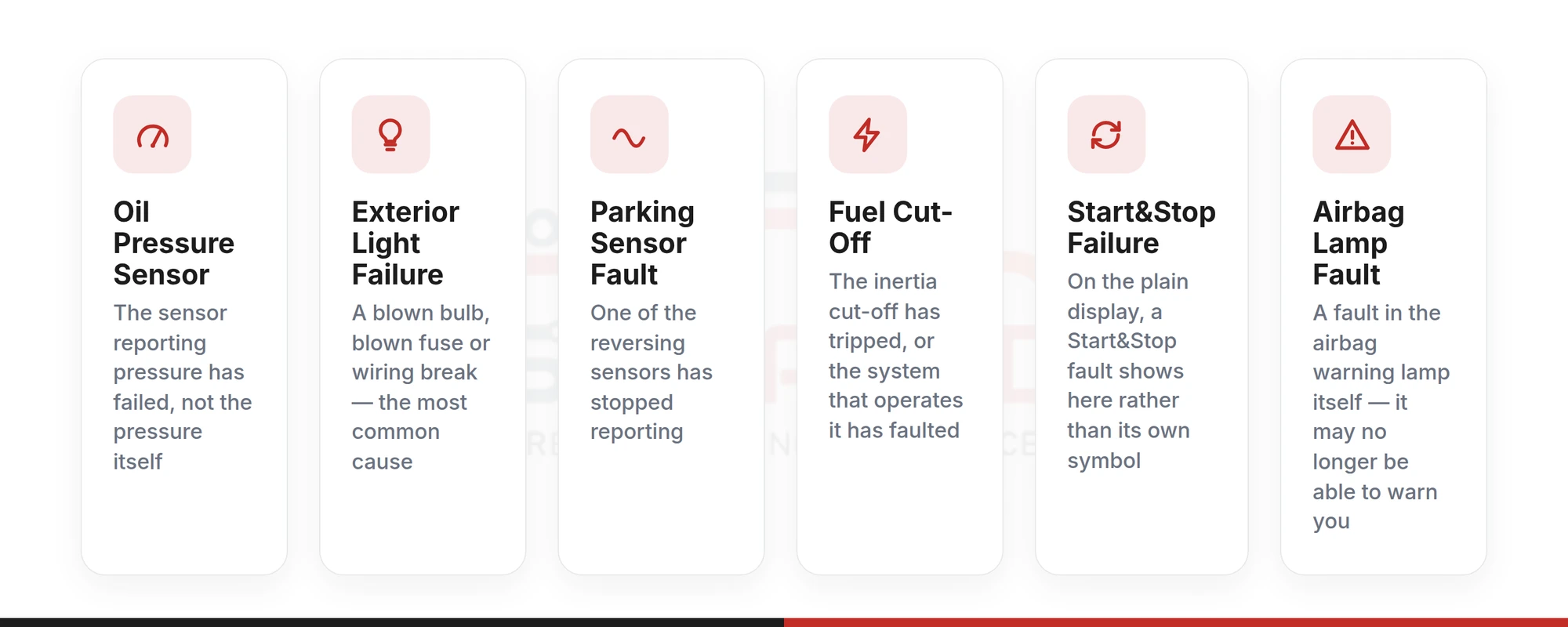
- Engine oil pressure sensor failure. The sensor reporting pressure, not the pressure itself. Note the difference between this and the red oil pressure lamp in the table above — a fault in the sensor is an electrical problem, a genuine loss of pressure is an engine-off situation.
- Exterior lights failure. A blown bulb, a blown fuse or a break in the wiring to a daytime running lamp, side light, indicator, rear fog or number-plate light. This is the most common single cause and the cheapest to find.
- Parking sensor failure. One of the reversing sensors is not reporting.
- Fuel cut-off intervention or failure. The inertia cut-off has tripped, or the system that operates it has developed a fault.
- Start&Stop system failure. On cars with the plain multifunction display, a Start&Stop fault appears here rather than as its own symbol.
- A fault in the airbag warning lamp itself. Fiat flags this one separately for a reason: if the airbag lamp cannot report properly, it may not warn you about the restraint system at all.
Five of those six are inconvenient rather than dangerous. The sixth is not, and it is the reason a triangle is worth taking seriously even though the car drives perfectly. A dashboard that cannot warn you about the airbags is a different proposition from a dead number-plate bulb, and from the driver’s seat the two look identical.
The order to work through it is dictated by cost. Start with a proper walk round in the dark with the lights on and someone pressing the brake pedal — every bulb, including the number plate, the rear fog and both daytime running lamps, because that single check resolves a good share of triangles. Then reverse somewhere and listen for the parking sensors. Then notice whether the engine has stopped shutting itself off at junctions, which points at Start&Stop. If all three come back clean, the remaining causes are not visible from outside the car and the codes need reading.
One correction is worth making, because it sends people down the wrong path. A triangle that goes out after an oil change was almost certainly never the triangle — the oil-condition warning on a 500 is a separate flashing symbol with its own distinctive behaviour, described in the table above, and it is about the state of the oil rather than the amount of it. Resetting a service reminder does not clear a stored fault either. If the triangle is carrying one of the six faults above, it will still be carrying it afterwards.
If your 500 has the later colour display, you get a better deal. Several of these faults appear as their own symbols on that display, with a message attached, instead of being folded into one triangle. That is worth knowing before you compare notes with another owner: the same underlying problem genuinely does report differently on two 500s.
Petrol, TwinAir, MultiJet or electric: what is fitted changes the answer
The 500 has been one car electrically for a long time. The 312 arrived in 2007, was facelifted in 2015, and a dashboard from either end of that run tells you broadly the same things in the same way. So the question that changes the answer on a 500 is not which year it was built — it is what is underneath it.
1.2 8v petrol
The volume car in the UK, and the simplest lamp set of the lot. No glow plug lamp, no particulate filter lamp, and none of the diesel-specific warnings that fill out general Fiat guides. If a symbol you have read about is not on your dashboard at all, that is usually specification rather than a failed LED. Most 1.2 warnings come down to the items in the top half of the table: brakes, ABS and stability, the cluster itself, and the triangle.
0.9 TwinAir
The two-cylinder turbocharged petrol. Two things about it change how you read a warning. It is turbocharged, so a boost or turbocharger problem will light the engine management lamp rather than announcing itself, and the flashing-versus-steady distinction on that lamp matters more on a turbo engine than on the 1.2. And these engines have a recognised habit of leaking oil around the timing cover, where the sealing was not well done, so any oil-related warning on a TwinAir earns a proper look at the level and at the front of the engine before anyone starts talking about sensors.
1.4 and the Abarth
Mechanically these are the quickest 500s, but electrically they are the same car: the same cluster design and the same lamp inventory as the 1.2, with a few extra display readouts on the Abarth. A warning that means one thing on a 1.2 means the same thing here. The Abarth’s turbocharger brings the same point as the TwinAir: the engine management lamp is doing double duty as a boost-system warning.
1.3 MultiJet diesel
Worth being straight about this one — the diesel 500 is a small minority of the UK fleet, and if you have a petrol car you can skip the two lamps it adds. Those two are the glow plug or preheat symbol, which is normal for a few seconds before a cold start and a stored engine fault at any other time, and the particulate filter lamp.
On the DPF lamp the answer is short. It means the filter is loaded with soot and wants to regenerate, and a sustained run at a steady speed with the exhaust fully up to temperature will often let it do so. A filter that will not accept a regeneration needs cleaning properly rather than another motorway lap, and a car that keeps loading its filter usually has an underlying reason that is worth finding. Our explainer on what a diesel particulate filter is covers how the system works and what a regeneration actually involves.
1.0 mild hybrid
Later petrol 500s use a 1.0 with a belt-integrated starter-generator and a small secondary battery alongside the conventional 12-volt system. The mainstream lamps behave exactly as the table describes, but a charging or system warning on one of these cars can belong to the hybrid side rather than to the alternator and battery you would check on a 1.2. If a warning on a mild hybrid does not match anything here, check the handbook for that model year before assuming it maps across.
The electric 500e, and why it is not on this page
The 500e launched in 2020 is a different car rather than a different engine — a new platform, a new interior and its own instrument panel. It has no engine management lamp, no glow plug symbol and no particulate filter warning, because it has none of those systems, and it carries high-voltage, charging and drive-system warnings that no petrol or diesel 500 has ever had. Reading a 500e’s dashboard against this page would be misleading in both directions, so it is out of scope here: the entries above hold for the systems the two cars genuinely share, which is brakes, restraints, tyre pressure and lighting, and nothing beyond that.
On the repair side, coverage of newer models and newer electronic architectures is something we maintain a research and development capability specifically to keep up with, so a warning on a recent Fiat is not automatically a dealer-only job — but it is worth asking rather than assuming, and this page is not the place to guess.
Dualogic gearbox warnings: the lamp, the messages and the actuator behind them
If your 500 changes gear on its own but has no torque converter, it is a Dualogic, and this is the part of the dashboard that general warning-light guides skip entirely. Dualogic is a conventional manual gearbox with the clutch and the gear selection worked by electro-hydraulic actuators instead of a pedal and a lever. It behaves like an automatic and fails like neither.
The lamp is red, and Fiat shows it flashing rather than steady, with a message on the display and an audible warning, to report a transmission failure. A red flashing gearbox lamp on a Dualogic is not a drive-carefully warning — the box can refuse a selection or drop into neutral, and both are worse in traffic than at the roadside.
What makes the Dualogic unusual is that it talks to you in words far more than in symbols. Fiat’s own message set for these cars is worth knowing, because each one narrows the problem down considerably:
- Clutch overheating. The clutch has been held at a slipping point for too long. Fiat’s instruction here is specific and worth following: never hold the car stationary on an incline with the accelerator — use the brake pedal, and only use the accelerator when you actually intend to set off. Doing it the other way round is how a healthy Dualogic clutch gets cooked.
- Depress brake pedal, Depress brake pedal and repeat operation, Depress brake pedal — delayed ignition. The gearbox will not act on a request until it can see that the brake is applied. That dependency is useful diagnostically: a failed brake light switch can present as a gearbox that will not engage, and the gearbox is the innocent party.
- Gear not available, Manoeuvre not allowed. The selection you asked for has been refused, usually because a condition the gearbox needs has not been met.
- Manual mode unavailable, Automatic method unavailable. One of the two operating modes has dropped out and the box has fallen back to the other.
- Reduce gear changes. The system is asking for a lighter workload, which normally means it is getting hot.
- Positioning of the gear lever at N. The gearbox wants neutral selected before it will do anything else.
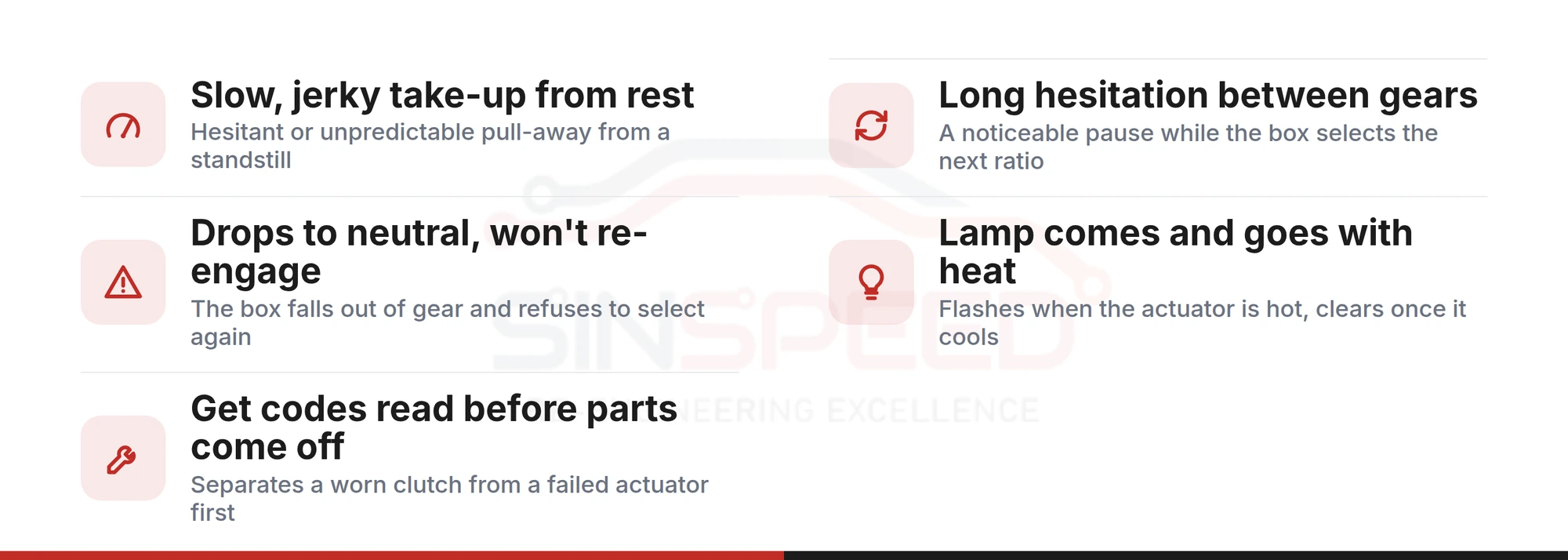
Behind most of the recurring complaints sits the clutch actuator — the electro-hydraulic assembly that operates the clutch on your behalf. The pattern owners describe is consistent: take-up from rest that is slow, jerky or unpredictable, a long hesitation between gears, the car dropping into neutral and refusing to go back in, and a gearbox lamp that comes and goes with temperature. Our Fiat and Alfa Dualogic clutch actuator repairs page covers what fails inside the unit and how it is rebuilt, and the wider work sits under clutch and gear actuator repairs.
One honest caveat. Not every Dualogic fault is the actuator. The clutch itself is a wearing part, the system’s learned positions can drift after work has been done, and a low or contaminated hydraulic system produces symptoms that look identical from the driver’s seat. Get the codes read and the messages recorded before anything is removed, because those two things together usually separate a worn clutch from a failed actuator without taking the car apart.
Dim lamps, a dead display and a stuck needle: when it is the cluster itself
The 500’s instrument cluster is a recognised failure point, and it is the one to rule in or out early — because if the cluster is misreporting, you are not diagnosing the car, you are diagnosing the thing describing the car to you.
Three separate mechanisms live inside that round housing, which is why one 500 loses its display and another loses a needle. The gauges are swept by small motors. The warning lamps are individual LEDs set around the outer edge of the unit, in amber, green, blue and red. And the centre is a transmissive amber liquid-crystal display, lit from behind, made up of fixed segments rather than a dot-matrix screen. Each of those three fails in its own way and on its own timescale.
The symptoms are well established on these cars:
- Warning lamps that light up when you indicate. Moving the stalk to the right-turn position bringing one or more unrelated warning lamps on with it is a known 500 cluster signature, and it is the one that sends owners chasing faults that do not exist.
- Lamps that stay dimly lit, or glow for half a minute after the key is out. Warning lamps should go out. Faint illumination after the ignition is off is an internal cluster fault, not a fault in the system the lamp belongs to.
- The central display losing segments. Typically it starts with part of the display — often the fuel gauge or the odometer — showing incorrectly or not at all, then progresses until the whole screen is blank.
- A speedometer needle that sticks, reads obviously wrong, or stops. A needle that hangs at a particular speed and then jumps is a gauge fault, and the rev counter fails the same way.
- Individual warning LEDs going dim or dead. The quiet one, and the one that matters most.
That last symptom deserves its own sentence. A cluster with dying LEDs does not just show you things that are not happening — it can also fail to show you things that are. On a 500 whose dashboard has already proved unreliable, a dark warning lamp is not evidence that the system behind it is healthy, and that applies to the ABS and airbag lamps as much as to the trivial ones.
These faults often store no useful codes at all, which is why the visible behaviour is the evidence. If what your dashboard is doing matches the list above, our Fiat 500 dashboard and instrument cluster repairs page is the right next stop — it sets out what fails inside the unit and how the repair is carried out. The unit itself is listed as the Fiat 500 instrument cluster, and the wider work sits under instrument cluster repairs.
There is a practical reason to repair the original rather than fit a replacement. Your car’s own mileage, coding and configuration stay with the unit when it is rebuilt, whereas a used cluster arrives with somebody else’s mileage and normally has to be configured to your car before it will behave properly. That is why many repaired units go straight back in ready to fit, with no coding required.
Blue&Me, flashing mileage and warnings for systems that are fine
Blue&Me is the hands-free and USB module Fiat developed with Microsoft and fitted to a great many 500s. It is not a warning-light system, but it is one of the more common reasons a 500 starts producing warnings, so it belongs on this page.
Its failures usually announce themselves through the features it controls rather than through a lamp: Bluetooth that will no longer pair or drops the phone, a USB socket that stops recognising anything, voice control that has gone quiet, and in some cases a battery that is flat after a couple of days standing. A module that is drawing current when it should be asleep is a common enough cause of an unexplained overnight drain to be worth checking before the battery gets replaced.
The behaviour it is best known for is the flashing odometer, and this is where most 500 diagnoses go wrong. Flashing mileage is normally not an instrument cluster failure. The cluster flashes it when it is not receiving a message it expects from another module on the vehicle network — and Blue&Me is one of the usual suspects, along with the airbag module and anything else that has dropped off. There is also a configuration side to it: after a module has been changed, the car may need its configuration aligned so the cluster knows which modules are fitted and which messages to expect, and a cluster expecting something that was never there will flash the mileage even though nothing is broken. If that is what your 500 is doing, our post on Fiat 500 flashing mileage takes it further, and the module itself is covered on our Fiat 500 Blue&Me module repairs page.
The wider lesson is worth holding on to when several warnings arrive at once. Because these modules talk to each other, one unit that has gone half-quiet can produce display messages and warnings about systems that are in perfect health. A 500 with three unrelated complaints and a flat battery on Monday morning is far more often one fault than three.
Sinspeed · Fiat 500 electronics
Rule the dashboard in or out before you chase anything elseIf the display has lost segments, the lamps glow after the key is out, or warnings appear when you indicate, the cluster belongs at the top of your list rather than the bottom — because everything else on the dash becomes unreliable evidence. Tell us what the display is doing and what the message said, and we will tell you whether the cluster is the fault or the messenger.
Mail-in repair and return, UK-wide · Your Fiat stays where it is — only the unit travels
The Fiat 500 lamps that point at a failed electronic unit
Most warning lights on a 500 are a bulb, a fluid, a sensor or a service interval, and working through those first is the right order — it is also why the free checks come before the diagnostic socket. A handful are different. They sit in front of a control unit with a recognised failure pattern on this car, and no amount of checking levels will move them.
ABS, and the EBD pairing
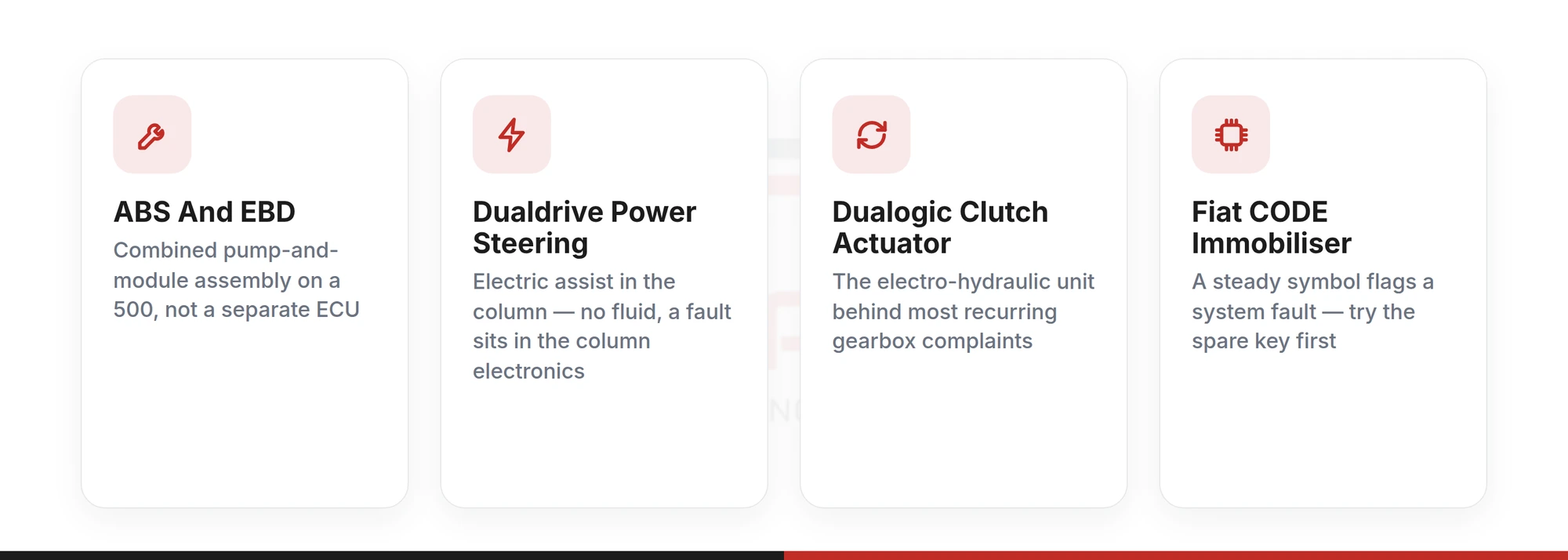
Take the two possibilities in order. A single wheel-speed sensor code is a straightforward job and has nothing to do with the module. Codes pointing inside the unit are a different matter, because on a 500 the ABS pump and its control module are combined into one assembly rather than being a pump with a separate ECU bolted to it. That assembly is repairable, and the range is covered under ABS pump and module repairs.
Two things bear repeating from the table. An ABS lamp on its own leaves you with ordinary brakes and no anti-lock; an ABS lamp lit alongside the red brake lamp is Fiat’s EBD warning and is a stop-driving situation, because the rear wheels can lock under hard braking. And clearing the lamp is not the same as fixing it — our guide on how to reset an ABS light explains why a lamp that comes straight back is telling you the condition never went away.
Dualdrive electric power steering
The 500’s steering is assisted by an electric motor in the column, which Fiat markets as Dualdrive. There is no fluid to check, and the CITY button on the dashboard is not a fault light — pressing it increases assistance for parking and low-speed manoeuvring, and CITY appearing on the display simply confirms the mode is active.
Before assuming the worst, Fiat gives two checks that cost nothing. If the battery has been disconnected, the steering needs initialising: turn the wheel all the way from one lock to the other, or drive in a straight line for about a hundred metres, and the lamp should go out. And because things outside the steering system can bring the lamp on, the handbook’s own instruction is to stop, switch the engine off for around 20 seconds and restart. If it stays on after both, it is a fault rather than a glitch.
Genuine faults usually present as assistance that fades in and out, steering that is heavy from cold and better once warm, or a wheel that is noticeably heavier one way than the other. The failure normally sits in the torque sensor, the motor or the column’s own control electronics, all of which live in the column assembly — see Fiat 500 electric power steering column repairs.
The Dualogic gearbox lamp
Covered in full above. The short version for this list: a red flashing gearbox lamp with a message is a transmission failure warning, the messages are more diagnostic than the lamp, and the clutch actuator is the unit behind most of the recurring complaints.
Fiat CODE immobiliser
A steady Fiat CODE symbol with the ignition on means the immobiliser system may have a fault. The same symbol blinking with the engine running means something different and less obvious: the car is running, but it is not being protected by the immobiliser. Try the spare key before anything else. That single step separates a failing key from a failing module, and it is free.
Airbag and SRS
Restraint systems are handled differently here, deliberately. An airbag control module stores crash data and fires pyrotechnic devices, so it is not a send-it-and-see part and it should never be treated as a lamp to be switched off. Two 500-specific points matter. A steady airbag lamp means a stored fault in the restraint system. A flashing one means a fault in the warning lamp circuit itself, which means the lamp may no longer be capable of reporting the airbags — and that is also one of the six faults the generic triangle covers. If either applies to your car, get the codes read and talk to our engineers about what your 500 needs before anything is disconnected.
Engine management
Too many possible causes to guess at, so the codes come first, and steady versus flashing decides how much time you have. Two routes are worth knowing about, and only one of them leaves the family. On the turbocharged 500s — the TwinAir, the Abarth and the MultiJet — a turbocharger fault lights the same lamp, often alongside lost pull and a smoke complaint, and that work belongs with our turbo specialists at turbo-repairs.com, our sister site for everything turbo. Where diagnosis points at an internal failure of the engine ECU itself, that belongs with the independent specialists at ecu-repairs.com. Sending the codes to the right specialist first is quicker than posting a unit to the wrong one.
What to do when a warning light comes on in your Fiat 500
- Take the colour at face value. Red means find somewhere safe and stop. Amber means you have time to think about it, but not an unlimited amount.
- Read the message before the car takes it away. On a 500 the text line is the specific half of the warning, and pressing MENU interrupts the display cycle. Write the wording down exactly as it appears — it will not come back, and it is worth more to whoever reads the codes than any description of the symbol.
- Note whether the lamp is steady or flashing. On this car that distinction changes the meaning outright on at least three lamps: engine management, stability control and the oil warning. It is the single cheapest piece of information you can gather.
- Do the checks that cost nothing. Handbrake fully off, fluid levels once the engine is cool, all four tyre pressures, fuel cap clicked shut, doors, bonnet and boot properly latched. Then walk the car in the dark with the lights on and the brake pedal pressed, checking every exterior lamp including the number plate and the rear fog — because a dead bulb is one of the six faults hiding behind the triangle.
- Establish what you actually have. Engine, gearbox, and whether Blue&Me is fitted. Half the answers on this page depend on those three, and so do half the answers you will find anywhere else.
- Have the codes read and recorded before anything is cleared. Clearing takes the stored conditions and the occurrence count with it. On an intermittent fault that record is the most valuable thing you have and it cannot be recovered afterwards.
- Rule the dashboard in or out. If the display has lost segments, the lamps glow after the key is out, or warnings appear when you indicate, deal with the cluster first. Every other reading on the dash is unreliable evidence until you have.
Two rules hold throughout. Never attempt a do-it-yourself repair on the braking or restraint systems, and never clear a safety lamp simply to stop it bothering you — on a 500 that is doubly true, because the car has its own warning for a warning lamp that has stopped working. And if the car in front of you on the drive is not a Fiat, the method still applies: our Vauxhall Corsa warning lights and Ford Focus warning lights guides are built the same way for the same reasons.
Which Fiat 500 warning lights fail an MOT
A lit warning lamp is not automatically an MOT failure, but several are, and the DVSA inspection manual lists them as defects rather than advisories. On a 500 the ones to know about are the ABS lamp indicating a malfunction, the airbag and restraint lamp indicating a malfunction, the engine management lamp indicating a fault, the electric power steering lamp indicating a malfunction, the brake fluid level warning lamp illuminated, and — on cars first used from 1 January 2012 — a tyre pressure monitoring system reporting a malfunction.
Two things follow. The first is that removing a bulb solves nothing: a lamp that fails to illuminate during the ignition self-check is also a defect, precisely so that a dark dashboard cannot be passed off as a healthy one. On a 500 that lines up with Fiat’s own design, which flashes the airbag lamp when the lamp circuit itself has a fault — two independent reasons why an airbag lamp that never comes on at all is a problem rather than good news.
The second is that the deadline is a useful prompt rather than the actual reason to act. An ABS lamp is an MOT defect because anti-lock braking matters, not the other way round. Our post on whether an ABS light is an MOT fail goes through that in more detail, and the same reasoning applies to every lamp in the list above.
Fiat 500 warning lights FAQs
What is the amber triangle warning light on a Fiat 500?
It is Fiat’s general failure indication, and on its own it names no system at all. Fiat uses it as a shared warning for six specific faults: an engine oil pressure sensor failure, an exterior lights failure, a parking sensor failure, a fuel cut-off intervention or failure, a Start&Stop system failure, and a fault in the airbag warning lamp itself. Five of those are inconvenient rather than dangerous, which is why the car normally drives on perfectly. The sixth is the reason to take it seriously, because a dashboard that cannot report the restraint system properly looks identical from the driver’s seat to one that can. Start with a walk round every exterior bulb including the number plate and rear fog, then the parking sensors, then whether Start&Stop still works — and if all three are clean, the remaining causes need the codes read.
What does the Dualogic gearbox warning light mean on a Fiat 500?
Fiat shows the Dualogic gearbox lamp in red and, on a genuine transmission failure, flashing rather than steady, together with a message on the display and an audible warning. Treat it as a stop-driving warning rather than a drive-carefully one, because a Dualogic in that state can refuse a selection or drop into neutral. The message matters more than the lamp: Clutch overheating, Gear not available, Manual mode unavailable, Reduce gear changes and the various Depress brake pedal prompts each point somewhere quite different. Behind most recurring complaints — slow or jerky take-up, long pauses between gears, dropping out of gear — sits the clutch actuator, the electro-hydraulic unit that operates the clutch for you, and it is repairable. Get the message and the codes recorded before anything is removed, because the clutch itself wears too and the two look the same from the driver’s seat.
Why is my Fiat 500’s display blank or missing segments?
That is the instrument cluster rather than whatever the display was reporting on. The centre of a 500 cluster is a segmented amber liquid-crystal display lit from behind, and it fails progressively: typically one area goes first, often the fuel gauge or the odometer, then more of the screen follows until it is blank. The same unit produces the other classic 500 symptoms — warning lamps that glow dimly after the key is out, lamps that light up when you move the indicator stalk, and a speedometer needle that sticks or reads wrong. These faults frequently store no useful codes, so the visible behaviour is the evidence. Repairing the original unit keeps your mileage, coding and configuration with the car, which is why many repaired clusters go straight back in ready to fit with no coding required, whereas a used replacement arrives with someone else’s mileage and normally needs configuring.
Why is the mileage flashing on my Fiat 500?
Flashing mileage is normally not an instrument cluster failure, which is the single most common misdiagnosis on this car. The cluster flashes the odometer when it is not receiving a message it expects from another module on the vehicle network. The Blue&Me hands-free and USB module is one of the usual sources, the airbag module is another, and anything else that has dropped off the network will do it too. There is also a configuration side: after a module has been changed the car may need its configuration aligned so the cluster knows which modules are fitted and which messages to expect. A quick sanity check before anything is removed — see whether Bluetooth still pairs and the USB socket still works, and note whether the battery is going flat when the car stands. If those have stopped working as well, Blue&Me is the stronger candidate than the cluster.
Why do warning lights come on when I indicate right in my Fiat 500?
Because the cluster is at fault, not the systems the lamps belong to. Unrelated warning lamps illuminating as the indicator stalk is moved — the right-turn position is the one that comes up most — is a recognised Fiat 500 instrument cluster signature. The warning lamps in a 500 cluster are individual LEDs set around the outer edge of the unit, and internal degradation can drive them from the wrong signal. It is worth knowing about because it costs people money: a driver who takes those lamps at face value can end up paying for work on brakes, airbags or a gearbox that were never faulty. If your dashboard does this, deal with the cluster before you act on anything else it shows you.
The steering has gone heavy on my Fiat 500 and the warning light is on. What is it?
The 500’s steering is assisted by an electric motor in the column, which Fiat calls Dualdrive, so there is no power steering fluid to check or top up. Two free checks come first. If the battery has been disconnected, the steering needs initialising: turn the wheel from one lock to the other, or drive straight for about a hundred metres. And because factors outside the steering can bring the lamp on, Fiat’s own instruction is to stop, switch the engine off for around 20 seconds, then restart. If the lamp survives both, it is a genuine fault, usually in the torque sensor, the motor or the column’s control electronics. A red steering lamp means the car should not be driven — assistance can vanish without notice, and it does so at exactly the moment you need it. Do not confuse any of this with the CITY button, which increases assistance for parking and is a mode rather than a fault.
Is it safe to drive a Fiat 500 with the ABS light on?
With care, and only if the red brake lamp is not lit alongside it. The amber ABS lamp on its own means the anti-lock system is unavailable: ordinary braking is unaffected, but the wheels can lock under heavy braking and stopping distances lengthen on a wet or greasy surface, so leave more room and brake earlier. The combination to take seriously is different. On a Fiat, the brake lamp and the ABS lamp lit together with the engine running is the EBD warning — electronic brakeforce distribution has failed or is unavailable, and Fiat’s own wording is that the rear wheels may lock suddenly and the car may swerve when braking sharply. That one is a stop-and-recover situation, not a drive-it-to-the-garage one. Either way, get the codes read: on a 500 the ABS pump and its control module are one combined assembly, so what the codes point at decides whether this is a sensor job or a unit job.
Why is my Fiat 500’s oil warning light flashing when the oil level is fine?
Because it is not reporting the level. The 500 has a separate warning for the condition of the oil, and Fiat flashes it in roughly three-minute cycles with five-second gaps, at every start, until the oil is actually changed. Fiat states explicitly that this warning has nothing to do with how much oil is in the engine and that you should not top up in response to it — and asks that the oil is changed within about 500 km of the warning first appearing. Lots of short journeys bring it on sooner, because the engine never gets properly up to temperature and the oil degrades faster. Do not confuse it with the red oil pressure lamp, which is a stop-the-engine warning and is a completely different situation.
Sinspeed · mail-in repair
A triangle is not a diagnosis — tell us what the display saidSend us the message wording, the stored codes and what the car is actually doing, and our engineers will tell you which unit is at fault before you take anything off. We diagnose, repair and remanufacture the electronic units behind these warnings — instrument clusters, ABS pumps and modules, electric steering columns, clutch and gear actuators and immobilisers — on the bench, and the car does not need to go anywhere.
Most remanufactured parts carry a lifetime, unlimited-mileage warranty · Many units are returned ready to fit with no coding required
Final thoughts
The 500’s dashboard was designed to be uncluttered, and the amber triangle is what that costs. It is not a diagnosis. It is an invitation to look, and on this car the useful skill is not recognising symbols but catching the short text line that arrives with them — because Fiat lets you interrupt that display cycle with the MENU button, and once it has gone you are back to a triangle. Write the wording down before you do anything else. It is worth more to whoever reads the codes than any description of the shape.
From there the order holds on every 500: the message, then whether the lamp is steady or flashing, then the symbol, then the codes. Three of the 500’s lamps change meaning entirely between steady and flashing, so the sequence is not a formality.
And there is one thing worth carrying away that has nothing to do with the lamp you came here about. The warning LEDs sit around the outer edge of the cluster and they fade, dim and die individually. A 500 with a display that has lost segments, or lamps that glow after the key is out, cannot be trusted to show you the next fault at all — so on a car behaving that way, a quiet dashboard is not evidence that nothing is wrong. That is the one fault worth ruling out before you spend anything on the others.