
Flickering or failed dial lighting, needles that stop moving, a driver information display that fades or breaks up into pixels, and a dash that loses power altogether are the faults we see on the Magneti Marelli cluster fitted to the 2006–2015 Audi Q7 (4L). Your garage takes the cluster out and posts it to us; we repair that same unit and send it back to plug straight in, with its mileage untouched and, in normal circumstances, no visit to a dealer for coding.
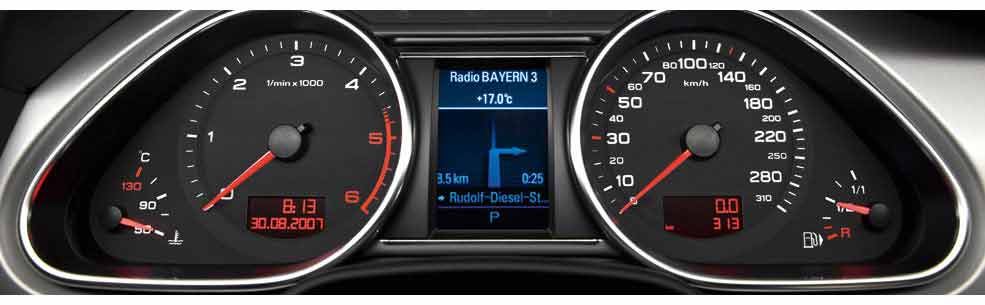
What goes wrong with the Audi Q7 instrument cluster?
The first-generation Q7 carries a cluster made for this model alone. Magneti Marelli manufactured it, and the unit has only ever been found fitted to the Q7 — it is not a part that moves between Audi models. That makes it harder to source second-hand, and it is why the faults below follow a pattern of their own.
The cluster runs the speedometer, rev counter, fuel and temperature gauges, the warning lamps and the driver information display (DIS) between the dials. When it starts to fail, owners usually notice one or more of these:
- Lighting that flickers or fails. The illumination behind the dials flickers, dims or goes out, and it shows most at dusk and after dark, exactly when you need to read your speed.
- Gauges that stop working. The speedometer or rev counter needle freezes or drops to zero mid-journey, or the fuel and temperature gauges stop responding.
- Dead dials, live warning lamps. The dials and the mileage readout stay blank, yet the ABS, airbag and traction lamps still light at start-up.
- A failing driver information display. The DIS goes blank, loses pixels or fades until it can no longer be read.
- Power that comes and goes. The whole cluster switches off and back on while you are driving, sometimes several times on one trip.
- Complete power failure. No lighting, no needles, no display — the dash stays dark.
These faults usually begin as an occasional nuisance and get worse. A flicker you see now and then becomes a speedo that drops out on the motorway, and an intermittent cluster seldom sorts itself out.
When owners call it an “instrument cluster malfunction”
Many Q7 owners describe all of this as an instrument cluster malfunction, and a scan tool tends to back them up in its own way. The cluster talks constantly to the car’s other control units, so when it drops off that network, those units log that they have lost communication with it.
That record is a strong pointer, but on its own it cannot say whether the cluster went quiet or the line to it was cut. The next section covers how to tell the two apart. If your Q7 is the second-generation 4M model that replaced the 4L, its digital cluster is a different unit altogether and this page does not cover it.
- Vehicle: Audi Q7, first generation (4L), 2006–2015
- Unit: Magneti Marelli instrument cluster, specific to the Q7
- Common faults: flickering or failed lighting, frozen needles, a faded or pixelated DIS, intermittent or total power loss
- Service: your own cluster repaired by post, from anywhere in the UK
- On refit: plugs back in with its mileage retained; no dealer coding in normal circumstances
- Warranty: lifetime, with no mileage restriction
Could the fault be somewhere other than the cluster?
It could, and on a car with as much networked electronics as a Q7 it pays to rule out the alternatives before anything comes out of the dash. The cluster shares its power supply with every other module, and much of what it shows depends on information sent to it by them. A problem upstream can make a sound cluster look broken.
Battery and supply voltage
A weak battery, a recent flat battery or a jump start can unsettle the whole network, so warnings appear across several systems and the dash behaves erratically. If the trouble started after the car was left standing or needed a boost, have the battery and charging system tested before anything else.
Passing that test is not the end of the story. The same dip in voltage that upset the car can be what finally exposed a weakness in the cluster, so if the symptoms remain on a supply that checks out, attention moves back to the unit.
Wiring, power and earth
A completely dark dash may simply not be getting power or an earth, and any garage or auto electrician can confirm both at the vehicle before condemning the cluster. When power and earth are both present and the dash still will not wake, or it drops out on rough roads while the supply measures steady, the unit itself becomes the likely cause.
Another module losing communication
Because the cluster relies on other modules for some of its information, a fault in one of them can surface on the dash. A speedometer reading zero while every other gauge works normally may be missing its road-speed information rather than failing to show it. These signs keep the cluster firmly in the frame:
- the needles, lighting and display all cut out at once and return together
- the dials are dead while the ABS, airbag and traction lamps still light
- the fault reacts to bumps in the road while the battery voltage holds steady
- other modules have logged lost communication with the cluster
Why a failing cluster passes for other faults
A cluster that goes silent does not fail alone. The modules that expect to hear from it record faults of their own, so a scan of the car can read as if several systems have failed together when one unit has simply stopped responding. A dark dash on top of that is easily taken for a wider electrical fault.
That is where our bench earns its place. Off the car, the cluster runs by itself while test equipment stands in for the rest of the Q7, so each needle, lamp and line of the display can be checked in turn with nothing else on the network to cloud the result.
Audi Q7 4L · repair by post
Dash playing up on your Q7? Have the cluster proven on our benchTell us what the dials, lighting and display are doing, then have your garage take the cluster out and post it in. We confirm the fault, repair your own unit and send it back ready to plug in.
Bench tested, then function tested in full · Lifetime warranty with no mileage limit · Mail-in service across the UK
Why does the Q7 4L cluster fail?
One event is rarely to blame. The cluster wears with the car, and four things account for most of it.
- Heat cycling. Every drive warms the unit behind the dashboard and every stop lets it cool. Repeated over thousands of journeys, that expansion and contraction wears the electronics down.
- Vibration. Road shock reaches the dashboard on every trip, and the cluster absorbs its share of it for the whole life of the car.
- Voltage events. Flat batteries, jump starts, charging faults and battery changes put the cluster through supply conditions it was never meant to see routinely.
- Age. The three effects above add up. A cluster that has worked reliably for a long service life can begin to fail with nothing more than an occasional flicker as warning.
Because these are wear processes rather than one-off damage, an intermittent fault rarely clears for good. It also means a second-hand cluster of the same age has been through the same wear as the one you are taking out.
Repair your Q7 cluster or replace it?
If you have been told the cluster cannot be repaired and has to be replaced, there are three routes worth comparing. What separates them is the figure on the odometer, what has to happen before the car accepts the unit, and how much you know about the part.
| Route | Odometer | Before it works in your Q7 | What you are getting |
|---|---|---|---|
| Repair of your own cluster | Your car’s true mileage, unchanged | Plugs back in; no dealer recoding in normal circumstances | The unit from your car, with the fault repaired and the whole cluster tested |
| Used cluster | The donor car’s reading | Coded to the donor car, so it must be reprogrammed to yours | A unit as old as yours, with the same wear and an unknown history |
| New cluster | Set up for your car during coding | Must be coded to your Q7 | New, but built to the same design as the one that failed |
A used cluster looks like the quick answer, but the Q7 unit is specific to this model, so the pool of donors is far smaller than for a cluster shared across a range. When one does turn up, it arrives showing another car’s mileage and coded to that car, and the reprogramming it needs is an extra step on the job.
A new cluster avoids the unknown history, but it still has to be coded to your Q7, and it is the same design as the original.
Repairing yours takes those variables away. Our in-house electronic engineers work on the cluster in a cleanroom-standard, ESD-safe workshop and deal with the known weak spots, not only the fault that brought it in. Each repaired unit is then proven on our Hardware-in-the-Loop rigs, which recreate the heat, vibration and electrical load of real driving.
What stays stored in the cluster during the repair?
Your Q7’s recorded mileage and its security data live in the cluster. Because we repair the unit rather than swap it, that information never has to move: the odometer reads the same figure on its return as it did when it left, and the car recognises the unit as its own.
The mileage matters beyond the dash. It is the figure recorded at every MOT and in the service history, and a cluster that shows a different one leaves a gap you would have to explain when the car is sold. Keeping your own unit means the question never comes up.
A dead speedometer is not something to put up with while you decide. It leaves you judging your speed by feel, and an inoperative speedometer is listed as a defect in the DVSA MOT inspection manual.
How do I send my Q7 cluster for repair?
Nobody needs to drive a Q7 with a misbehaving dash across the country for this. The repair happens on our bench, so the cluster is the only thing that makes the journey.
- Register the repair
Fill in the repair form with your Q7’s year, what the dash is doing and the part number from the label on the back of the cluster.
- Your garage removes and posts it
Taking the cluster out of the dashboard is routine work for any garage or auto electrician. Pack it with padding around the lens and display, and add a note of the symptoms.
- Fault confirmed on the bench
We run the cluster off the car and confirm the fault with dealer-level diagnostic tools before any repair begins.
- Repaired by our engineers
Our in-house engineers carry out the repair at circuit level and address the known weak points as part of the same job.
- Function tested in full
The dials, lighting, display and warning lamps are all checked, and the cluster is load-tested on our Hardware-in-the-Loop rigs before it is signed off.
- Back to you to plug in
The same cluster returns with its mileage and security data in place. Your garage plugs it in and, in normal circumstances, no dealer coding is needed.
Every repaired Q7 cluster is covered by our lifetime warranty, with no mileage restriction. If you are not certain the cluster is at fault, contact us with the symptoms before it comes out. Other Audi models are covered in our Audi instrument cluster repairs.
Which Audi Q7 cluster part numbers do we repair?
These are the Q7 4L cluster part numbers that reach our workshop most often. You will find yours on the label on the back of the unit. The table shows the common numbers, not every one we can repair, so if yours is missing, send it to us through the contact page before you post the cluster. The same 4L unit also has its own Audi Q7 instrument cluster page in our shop.
| Common Part Numbers | Common Part Numbers | Common Part Numbers |
|---|---|---|
| 4L0920900T | 4L0920901A | 4L0920951F |
| 4L0920951G | 4L0920951H | 4L0920951J |
| 4L0920933E | 4L0920933F | 4L0920933G |
| 4L0920933H | 4L0920933J | 4L0920985K |
| 4L0920985L | 4L0920985M | 4L0920985N |
| 4L0920985P | 4L0920985Q | 4L0920985R |
| 4L0920985S | 4L0920933B | 4L0920933C |
| 4L0920933D | 4L0920985D | 4L0920985E |
| 4L0920985F | 4L0920985G | 4L0920985H |
| 4L0920985J | 4L0920985C |
Audi Q7 cluster repair: your questions
Can a faulty Audi Q7 instrument cluster be repaired instead of replaced?
Yes. The faults the 4L Q7 cluster is known for — failed lighting, dead gauges, a fading driver information display and loss of power — are repairable in the original unit, so a replacement is rarely necessary. We repair your own cluster and return it with a lifetime warranty.
The dials on my Q7 are dead but the warning lights still come on. Is it the cluster?
That combination is one of the clearest signs of a failing cluster, particularly if other modules have logged lost communication with it. Have the battery and the cluster’s power supply checked first; if both are healthy, the cluster is the likely cause.
Will the mileage change after the cluster is repaired?
No. The odometer reading is held in the cluster itself, and because the same unit comes back to you, it shows exactly the figure it showed when it left the car.
Does a repaired Q7 cluster need coding at an Audi dealer?
In normal circumstances, no. Your own unit already carries your car’s data, so your garage plugs it back in without dealer recoding. A used or new cluster is different: either one has to be coded to your Q7 before it will work properly.
Should I keep driving with the speedometer not working?
It is not a fault to live with. Without a working speedometer you are estimating your speed, and an inoperative speedometer is listed as a defect in the DVSA MOT inspection manual. Book the repair as soon as the fault appears rather than waiting for the next test.
What if my part number is not in your table?
The table lists the Q7 cluster numbers we see most often, not every one we handle. Send us the number from the label on the back of the unit and we will confirm whether we can repair it before you post anything.
Sinspeed · Audi cluster workshop
Ready to get your Q7’s dials working again?Send us the part number, your Q7’s year and a description of the fault. We will confirm the repair before your garage takes the cluster out, and return your own unit ready to plug in.
In-house electronic engineers · Dealer-level diagnostic tools · Lifetime warranty, unlimited mileage