
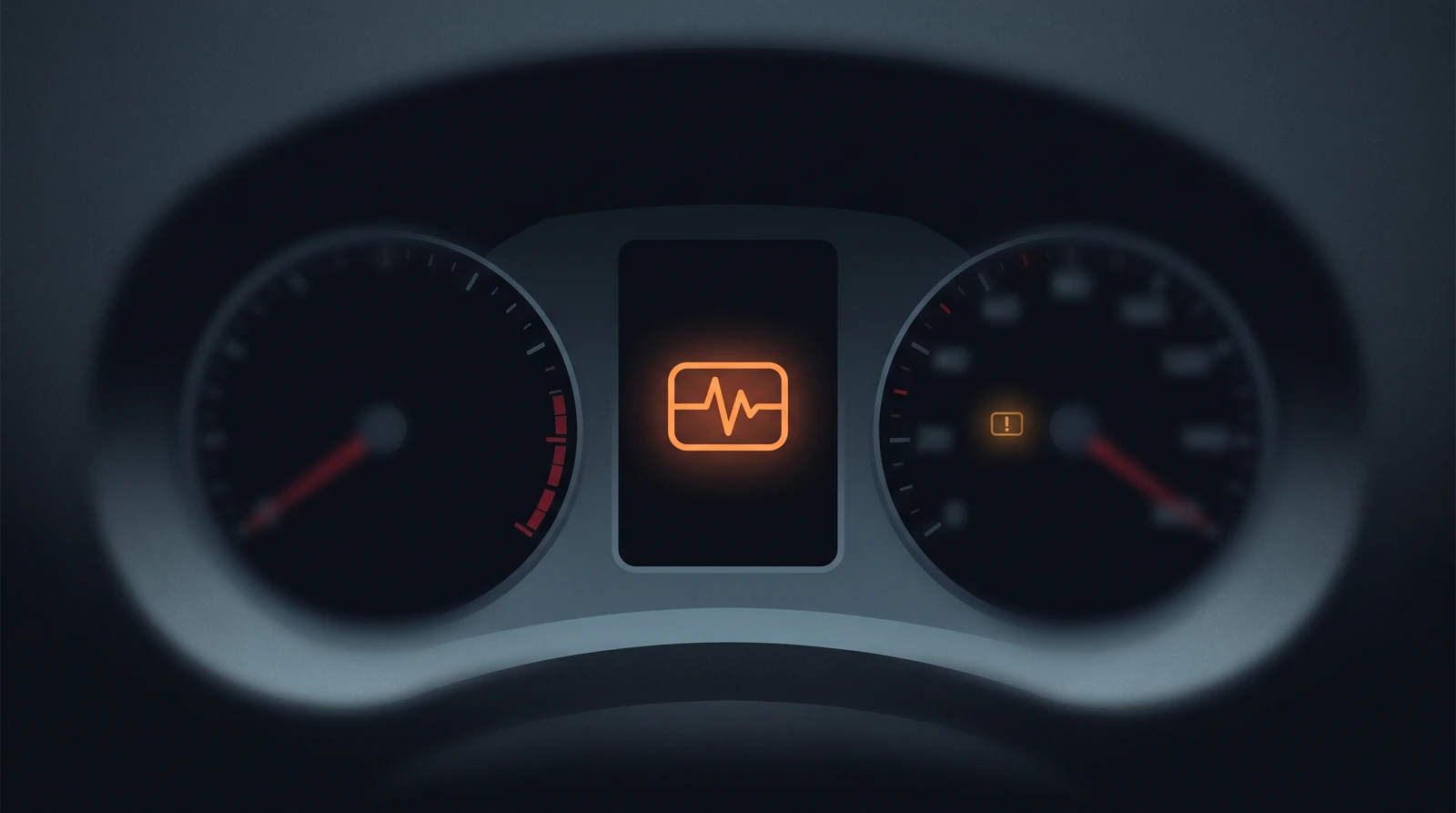
Summary: On a Dacia Sandero dashboard, the lamp owners look up most is the orange or red zigzag, and on its own it does not name a fault. It is a severity flag: orange means drive very carefully to a dealer soon, red means stop as soon as traffic allows and leave the engine off. The lamp or message beside it says which system is involved, so a Sandero’s warnings are read in pairs. This page gives every lamp in Dacia’s own handbook a safe-to-drive verdict, explains the zigzag, and traces the warnings that lead back to an ABS unit, the steering assistance or the instrument panel, which we repair and return.
- Dacia Sandero dashboard warning lights and symbols: the full table
- The zigzag lamp: it sets the urgency, the lamp beside it says what
- Which Sandero warnings point at a failed electronic unit?
- Newer Sanderos: driver-aid, LPG and parking brake lamps
- What to do when a lamp lights on your Sandero
- Dacia Sandero warning lights FAQs
- Final thoughts
Dacia Sandero dashboard warning lights and symbols: the full table
A Sandero’s lamps keep to the colour pattern almost every car shares, which our guide to dashboard warning lights and their meanings lays out across the makes: red to stop, orange for a fault to have seen to, green and blue for something switched on. The Dacia twist is the zigzag lamp, which borrows the two warning colours to grade the urgency of another lamp. It gets its own section below the table.
Dacia is not the only maker that backs a lamp with a second signal. Our Citroën dashboard warning lights guide shows how a symbol and a line of display text share the work on those cars, and the Peugeot dashboard warning lights guide covers a STOP and SERVICE ladder that grades severity in a different way.
The rows come from Dacia’s own material: the lamp index in the Sandero user manual on Dacia’s owner site, and the warning-light chapter of the second-generation Sandero handbook (2013 to 2020), which gives the instruction for each lamp. Dacia states that the presence and operation of the lamps depend on the equipment and the country, so your car may show fewer, or carry one listed only for newer versions. Where our symbol library holds no faithful drawing of a Dacia lamp, the row describes it in words.
| Colour | Symbol | What it means on a Sandero | Safe to drive? |
|---|---|---|---|
| Red | Urgent stop — the red zigzag, a rectangle with a wavy line through it | Lights at switch-on and goes out once the engine starts. On the move it comes on with other lamps and a beep: a serious fault in the system the other lamp shows. | No. Stop as soon as traffic allows, switch off the engine, do not restart it, and contact a dealer. |
| Orange | Warning light — the orange zigzag | Lights at switch-on and goes out once the engine starts. On the move, often with another lamp: a fault that needs attention soon. | Only very carefully, and to a dealer as soon as possible. Dacia warns that carrying on regardless risks damaging the car. |
| Red |  Handbrake on and brake circuit fault (electronic parking brake on newer cars) Handbrake on and brake circuit fault (electronic parking brake on newer cars) | Lit at switch-on and while the handbrake is applied. Coming on during braking, with a beep: the fluid level in the brake circuit is low. | Not if it lights when you brake: Dacia says it may be dangerous to continue. Stop safely and contact a dealer. |
| Red |  Oil pressure — an oil can with a drip Oil pressure — an oil can with a drip | Comes on while driving, with a beep: the engine’s oil pressure has dropped. | No. Stop and switch off the ignition, then check the oil level. If the level is correct, the cause lies elsewhere: contact a dealer straight away. |
| Red |  Coolant temperature — a thermometer in waves Coolant temperature — a thermometer in waves | Stays lit while driving, with a beep: the engine is overheating. | No. Stop and let the engine idle for a minute or two; the temperature should fall. If it does not, switch off and let it cool before checking the coolant level. |
| Red | 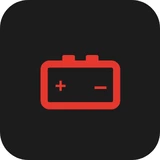 Battery charge Battery charge | On at switch-on, out after a few seconds. Lit while driving: a fault in the charging circuit. | No. Stop and consult a dealer as soon as possible. |
| Red | 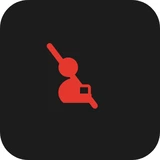  Seat belt reminder and door open Seat belt reminder and door open | Belt: lit at start-up if a belt is not fastened; on the move it lights with a beep for about two minutes until the driver’s belt is done up. Door: a door is not properly shut. | Belt up and shut the door before moving off. |
| Red |  Airbag Airbag | On at switch-on, out after a few seconds. A fault in the system if it does not light at switch-on, or if it flashes. | The car drives, but the airbags may not protect you in a crash. Contact a dealer as soon as possible. |
| Orange or red | 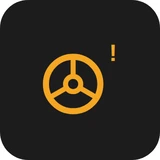 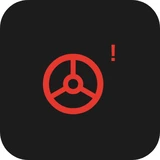 Variable power assisted steering Variable power assisted steering | A fault in the steering assistance, which may be reduced or lost. | It still steers, but with much more effort, above all at low speed. Drive with great care and have it checked promptly. With the red zigzag: stop. |
| Orange | 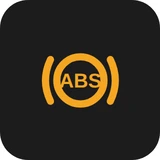 Anti-lock braking (ABS) Anti-lock braking (ABS) | Out a few seconds after switch-on. Staying on, or lighting while driving: an ABS fault. Braking carries on as normal, without anti-lock. | With care, to a dealer as soon as possible. If the red brake lamp lights too, stop. |
| Orange |  Stability control (ESP) and traction control (ASR) Stability control (ESP) and traction control (ASR) | Dacia gives several reasons for it to light, from the system working to hold grip to a fault in it. | Brief flashes on a slippery road: ease off. Lit steadily in normal driving: have the system checked. |
| Orange | 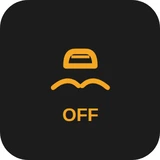 ESC OFF (newer models) ESC OFF (newer models) | Stability control has been switched off. | Yes, but switch it back on. If it will not come back, treat it as a fault. |
| Orange |  Exhaust gas monitoring (emission control) Exhaust gas monitoring (emission control) | On at switch-on, then out. Lit continuously: an emission control fault. Flashing: a fault that calls for lower engine speed at once. | Steady: to a dealer as soon as possible. Flashing: reduce engine speed until it stops flashing, then see a dealer soon. |
| Orange |  Tyre under-inflation (where monitoring is fitted) Tyre under-inflation (where monitoring is fitted) | Pressure has dropped in one or more tyres. | Check the pressures with the tyres cold. With the red zigzag beside it: stop as soon as traffic allows and inspect the tyre. |
| Orange | 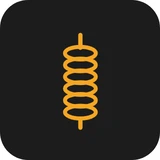 Preheating (diesel) Preheating (diesel) | On at switch-on while the heater plugs work; out once preheating is enough for the engine to start. | Yes. Start once it goes out. |
| Orange |  Water in the diesel filter Water in the diesel filter | On at switch-on, out after a few seconds. Lit while driving: there is water in the diesel. | Contact a dealer as soon as possible. |
| Orange |  Particle filter system (diesel) Particle filter system (diesel) | Reports on the diesel particulate filter, most often a build-up of soot. | Have it looked at soon; regeneration or cleaning usually brings the filter back. |
| Orange |  Reagent (AdBlue) level and exhaust gas reduction faults Reagent (AdBlue) level and exhaust gas reduction faults | One lamp for two things: the AdBlue is running low, or the system that uses it has a fault. | Top up soon. If it stays lit afterwards, have the system checked. |
| Orange |  Low fuel Low fuel | Lit while driving, with a beep: roughly 30 miles (50 km) of fuel remain. | Refuel as soon as possible. |
| Orange | Low LPG level (Bi-Fuel versions) | The LPG tank is running low. | Yes. Refill when you can. |
| Orange |  Front passenger airbag off Front passenger airbag off | The front passenger airbag has been deactivated. | Correct with a rear-facing child seat in the front. Otherwise, switch it back on before carrying an adult there. |
| Orange | Active emergency braking (newer models) | Two lamps in Dacia’s list: one for the function itself, one for a warning, unavailability or a fault. | Yes, but if it reports a fault the car is not braking for you. Have it checked. |
| Orange |  Lane departure prevention (newer models) Lane departure prevention (newer models) | Reports on the lane-keeping function. | Yes. Book in a lamp that stays lit. |
| Orange | Headlight adjustment (newer models) | Reports on the headlamp beam adjustment. | Have it checked before relying on the headlamps at night. |
| Green, blue and orange |      Indicators, main and dipped beam, front and rear fog lights Indicators, main and dipped beam, front and rear fog lights | On as selected with the lighting controls. | Yes. Turn the rear fog light off once visibility improves. |
| Various | Status lamps: speed limiter, cruise control, ECO mode, gear change arrows, engine standby and its unavailability, freewheel, LPG in use, overspeed, driver vigilance, automatic main beam, traction control, side lights, brake pedal | A function is on, or the car is prompting you: the gear arrows suggest a higher or lower gear, and the overspeed and driver vigilance lamps ask you to slow down or take a break. | Yes. None of these reports a fault by itself; an orange zigzag lit beside one would. |
The zigzag lamp: it sets the urgency, the lamp beside it says what
Owners call it the zigzag, the heartbeat or the heart-monitor light: a rectangle with a wavy line running through it, lit orange or red. Dacia’s handbooks never describe the picture. The red version is the “Urgent stop warning light”, the orange one is simply the “Warning light”, and the same drawing serves for both.
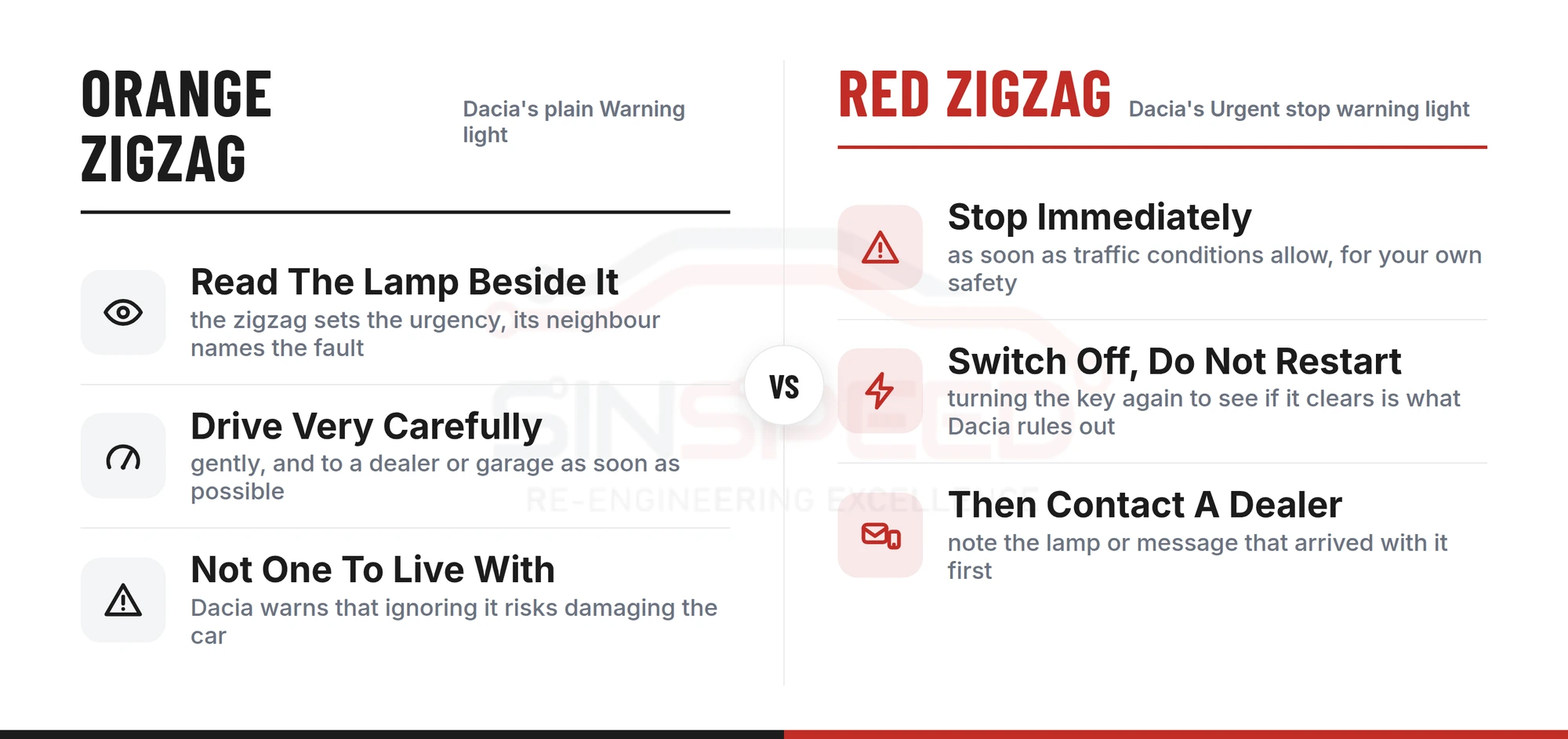
It belongs to Dacia and Renault models rather than to cars in general, which is why a Sandero owner searching for the symbol finds so little about it on all-makes warning-light pages. What matters more is what it does. The zigzag does not report on a system of its own. It lights alongside another lamp, or a message, and tells you how seriously to take that one.
Orange: drive gently, and to a dealer soon
The orange lamp lights with the ignition and should go out once the engine is running. If it comes on while you drive, usually beside another lamp, Dacia’s instruction is to drive very carefully to an authorised dealer as soon as possible, and it warns that ignoring the lamp risks damaging the car.
That is firmer than “book it in when convenient”. The fault is not yet an emergency, but it is not one to live with for a month either, and any garage will do the diagnosis; the handbook says dealer because it is a handbook.
Red: stop, switch off, do not restart
The red lamp follows the same pattern at switch-on. On the move it arrives with other warning lamps and a beep, and the handbook’s wording leaves no room for interpretation: stop immediately, for your own safety, as soon as traffic conditions allow, switch off the engine and do not restart it, then contact a dealer.
The “do not restart” part is the one people break. Turning the key again to see whether the lamp clears is exactly what the instruction rules out, because a red partner such as oil pressure or coolant temperature means the engine can be harmed by running at all.
Reading the pair: what each combination tells you
Put together, the handbook’s instructions give a simple way to read a Sandero dashboard. Look at the zigzag’s colour for the urgency, then at its neighbour for the subject.
| What you see | What it is telling you | What Dacia says to do |
|---|---|---|
| Zigzag lights at switch-on and goes out once the engine runs | The lamp is working | Nothing; this is normal |
| Orange zigzag with another lamp, while driving | The other lamp’s system has a fault that needs attention soon | Drive very carefully to an authorised dealer as soon as possible |
| Red zigzag with another lamp and a beep | The other lamp’s system has a serious fault | Stop as soon as traffic allows, switch off, do not restart, contact a dealer |
| A warning lamp with no zigzag beside it | That lamp speaks for itself | Follow its row in the table above |
| No lamps and no sounds when you switch on | The handbook reads this as a fault in the instrument panel | Stop as soon as traffic allows, make sure the car is secured, contact a dealer |
So the neighbour is where the diagnosis begins. An orange zigzag beside the ABS lamp points at an anti-lock fault that leaves ordinary braking in place; the same orange lamp beside the steering symbol means the assistance may fade. A red zigzag beside the oil can, the thermometer or the brake circuit lamp is an instruction to stop, whatever you had planned. A garage, or our engineers, can do far more with “orange zigzag and ABS” than with “the heartbeat light came on”.
The tyre lamp is a frequent partner on cars with pressure monitoring, and the same rule applies. With red, stop when traffic allows and look at the tyre itself, as a sudden loss points at a puncture. With orange, check all four pressures with the tyres cold as soon as you can.
Which Sandero warnings point at a failed electronic unit?
Most rows in the table report a level, a pressure, a door or a switch. A few report on a control unit: the electronics that run the anti-lock brakes, the steering assistance and the instrument panel. A unit on its way out rarely announces itself cleanly. It can pass for a sensor, a wiring fault or plain wear for months, and a lamp that comes and goes is often the first honest sign of it.
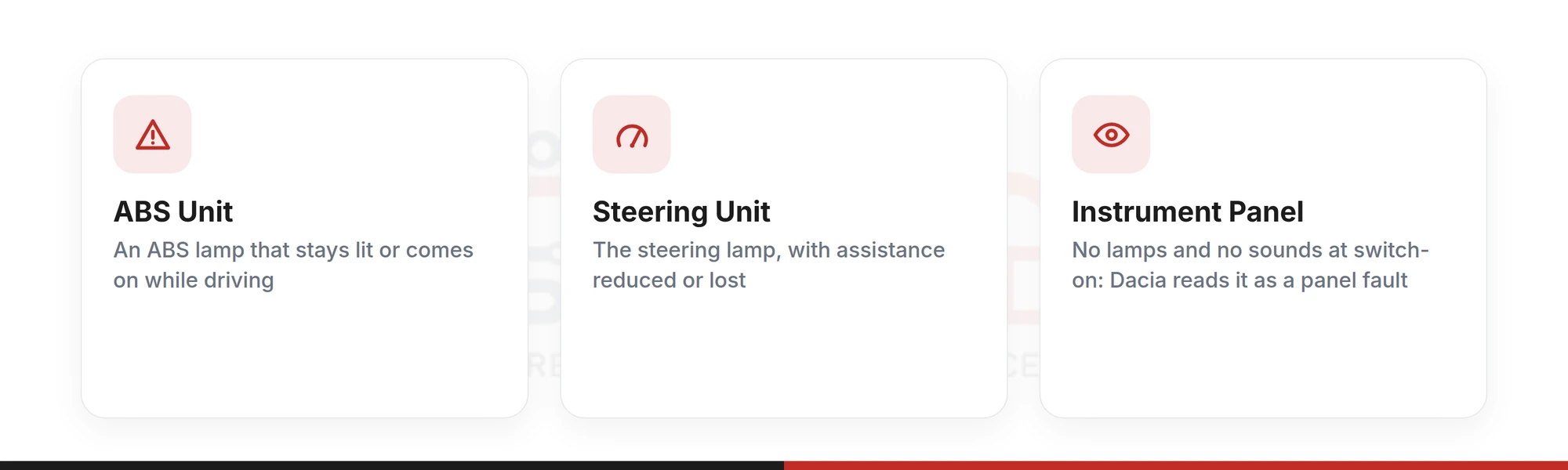
Our catalogue does not yet carry a page for each Sandero unit, so this section works by system, and our engineers confirm the exact unit from your car’s details. Everything we cover is on what we repair.
The ABS and stability lamps
The ABS lamp should go out a few seconds after the ignition is switched on. If it stays lit, or comes on while driving, Dacia’s handbook says the ABS has a fault: braking works as normal but without anti-lock, so drive with care and contact a dealer as soon as possible. If the red brake circuit lamp lights during braking with a beep, the fluid in the circuit is low, and the instruction becomes stop.
Behind the lamp sits the ABS unit: a hydraulic block with a pump and valves, joined to the control module that decides when to release and reapply pressure at each wheel. Its electronics live with engine-bay heat and road vibration, and the brake fluid passing through the block ages with the car. A wheel-speed sensor or its wiring can light the same lamp, so diagnosing an ABS wheel-speed sensor comes first, and how an ABS pump works explains the unit itself.
Among Dacias, we already repair the ATE Mk100 ABS pumps from the Dacia Lodgy and the Dacia Dokker. On those, the recorded faults are brakes that grab and hold, typically on a diagonal pair of wheels, a wheel that gets no fluid, a failing hydraulic pump, and an ABS lamp that stays lit with codes to match. They are Lodgy and Dokker units, not a claim about your Sandero’s; the codes and the unit’s part number settle what you have.
Across the wider Renault range we handle Renault ABS ECUs and ATE’s Teves MK70, which is fitted to Renaults including the Twingo and Laguna. Where the stability lamp will not go out, the ESP button changes nothing and the ABS lamp sometimes joins in, our page on the Renault, Citroën and Peugeot brake pressure sensor fault covers a pattern seen on later ATE units. For the paired lamps, the test and the reset question, see ABS and traction control lights on together, what ESP does, whether an ABS light fails the MOT and what resetting an ABS light does and does not do. All our ABS work is under ABS pump and module repairs.
The steering lamp
Dacia’s lamp index calls it the variable power assisted steering warning light: the assistance changes with speed, generous for parking and firmer on the open road. When the lamp lights, that assistance has a fault and may be reduced or gone. The Sandero still steers, but the wheel can take far more effort, especially at low speed, so drive with great care and have it looked at promptly rather than driving around it.
On versions with electric assistance, the system leans hard on the electrical supply, so a weak battery or a charging fault is worth ruling out first, particularly if the battery lamp has shown. Once the supply is proven, what remains is the assistance system itself: the sensor reading the driver’s effort, the motor, and the control electronics managing the two. Electric power steering fault symptoms and putting an EPS warning light right go further, and our work on steering units sits under steering and EPS repairs.
The instrument panel itself
Every lamp in this guide reaches you through the instrument panel, and Dacia’s handbook covers the case where the panel is the fault: if no lamps or sounds appear, it treats that as an instrument panel fault and says to stop as soon as traffic allows, secure the car and contact a dealer. A panel that is only partly failing is harder to catch. Tell-tales that stutter or glow dimly with nothing wrong, gauges that drop out and recover, or a display that blanks and returns all point back at it.
When several unrelated lamps light at once and a scan tool finds modules that will not reply, the car’s network is the likelier explanation; lost communication fault codes covers how that is traced, and the body control module deserves a look when exterior lights misbehave with sound bulbs. Our panel repairs are under instrument cluster repairs, and because the panel that goes back is the one that came out, there is no mileage to reconcile afterwards.
The emission control lamp
The exhaust gas monitoring lamp watches the emission control system as a whole, so it names no single part; the fault codes do that. On a petrol engine, one unit those codes can lead to is the throttle body, which throttle body fault codes explains, with the repairs under throttle body repairs. On a diesel, a particle filter lamp is more often soot than electronics, and how a DPF works covers regeneration and cleaning.
Sinspeed · Dacia electronics
Orange or red, and next to which lamp? Send us both.Give us the Sandero’s registration year, the colour the zigzag showed, the lamp or message that came with it, and any codes already read. Our engineers match that combination to the control unit most likely behind it and tell you how we would take it from there.
Faults reproduced on in-house Hardware-in-the-Loop platforms · Ongoing R&D to cover newer models and systems
Newer Sanderos: driver-aid, LPG and parking brake lamps
The current Sandero’s lamp index includes several that do not appear in the second-generation chapter: two for Active emergency braking, lane departure prevention, a driver vigilance warning, ESC OFF, an electronic parking brake lamp shared with the handbrake warning, and lamps for engine standby, freewheel and ECO mode. Bi-Fuel cars add an LPG indicator and a low LPG warning.
Dacia’s online index lists these by name without the explanation text, so we have not written a separate instruction for each. The zigzag rule covers them. An orange zigzag beside a driver-aid lamp means the aid may not be there when you need it: book the car in, and drive as though the car had no aid at all. A red one means stop.
A driver-aid fault is easy to underrate because the car drives normally. Nothing feels different; a system you may have come to rely on has simply stopped watching. That is a reason to act on a fault lamp for emergency braking or lane keeping sooner than its orange colour alone suggests.
What to do when a lamp lights on your Sandero
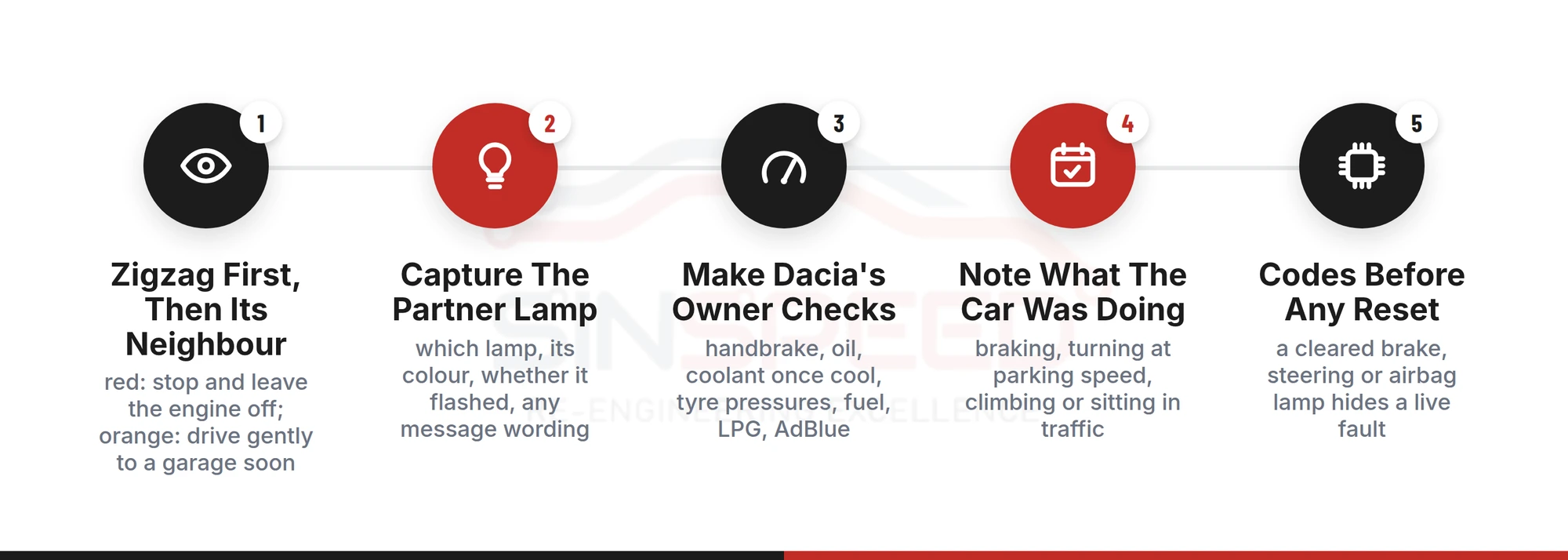
- Look at the zigzag first, then its neighbour. Red: stop as soon as traffic allows, switch off and leave the engine off. Orange: drive gently to a dealer or garage soon. No zigzag: follow the lamp’s own row.
- Capture the partner exactly. Which lamp, its colour, whether it flashed, and the wording of any message in the display. A phone photo is ideal.
- Do the checks Dacia leaves to the owner. Handbrake fully off, oil on the dipstick once the engine has stood, coolant only once it is cool, tyre pressures cold, and fuel, LPG and AdBlue levels.
- Note what the car was doing. Braking, turning at parking speed, climbing a hill or sitting in traffic. That context helps separate a unit fault from a simpler one.
- Leave the lamp alone until the codes are read. Resetting it with a code reader wipes the evidence while the fault stays; on brakes, steering and airbags, that leaves a live safety fault running unseen.
Dacia Sandero warning lights FAQs
What does the zigzag warning light mean on a Dacia Sandero?
It is Dacia’s multifunction warning lamp, an orange or red rectangle with a wavy line through it, and it tells you how urgent a fault is rather than what the fault is. Dacia’s handbook calls the red version the Urgent stop warning light and the orange one simply the Warning light. Both light briefly at switch-on and go out once the engine runs. If one comes on while you drive, look at the lamp or message beside it: that identifies the system, and the zigzag’s colour tells you what to do next.
Can I drive my Dacia Sandero with the orange zigzag light on?
Only carefully, and only as far as a dealer or garage. Dacia’s instruction for the orange lamp is to drive very carefully to an authorised dealer as soon as possible, and it warns that ignoring it risks damaging the car. Check which lamp lit with it first. If that partner is a red one, such as oil pressure, coolant temperature or the brake circuit lamp, follow that lamp’s instruction and stop. Keep the fault codes stored so the cause can be found.
What should I do if the red zigzag light comes on in my Sandero?
Stop as soon as traffic conditions allow, switch off the engine and do not restart it, then contact a dealer or your breakdown provider. That is Dacia’s own instruction for the red Urgent stop warning light, which appears together with other lamps and a beep. The lamp beside it shows which system has the serious fault, so note it, and any message in the display, before help arrives.
Why is the ABS light on in my Dacia Sandero?
The ABS lamp should go out a few seconds after the ignition is switched on. If it stays on or lights while you drive, Dacia’s handbook says the anti-lock system has a fault: the brakes keep working as normal, but without anti-lock, so drive with care and contact a dealer as soon as possible. The cause can be a wheel-speed sensor, its wiring or the ABS unit itself, and the fault codes tell them apart. If the red brake lamp lights during braking with a beep, stop.
What does the steering warning light mean on a Dacia Sandero?
Dacia lists it as the variable power assisted steering warning light. When it comes on, the power assistance has a fault and may be reduced or lost. The car can still be steered, but the wheel takes much more effort, especially at parking speeds, so drive with great care and have it checked promptly. A weak battery or a charging fault can upset electric assistance, so mention any battery lamp you have seen as well. If the red zigzag lights with it, stop.
Why have several warning lights come on at once on my Sandero?
Several lamps or warning messages arriving together usually share one cause rather than being separate faults. Low battery voltage can make a number of electronic systems report errors at once, particularly after a car has stood unused, so the battery and charging are the first checks. A control unit that has dropped off the car’s network, or an instrument panel fault, can do the same. Have every module scanned, not just one, and if the red zigzag is among the lamps, do not drive.
Are Dacia Sandero Stepway warning lights the same as the Sandero’s?
Largely, yes. The Stepway is a version of the Sandero, and the zigzag multifunction lamp and the core warnings for brakes, oil, coolant, charging, ABS, airbags and steering work the same way. What differs is equipment: Dacia says the presence and operation of lamps depend on the equipment and the country, so a Stepway with a particular engine, fuel type or driver-assistance pack may show lamps another Sandero does not. Your own handbook has the definitive list.
Sinspeed · bench repair, posted back
From a lamp on the dash to a repaired unit, by postWhen the codes land on a unit, your garage lifts it out and sends it in; it is the unit that makes the journey, not the Sandero. On the bench we run it through the temperatures, vibration and electrical load it meets in service until the fault shows itself, repair it, prove it under the same conditions and post it back. If it needs coding or an adaptation once refitted, we spell out what, and that is included in the job.
Electronics and hydraulics engineers working side by side in-house · Lifetime cover with no mileage limit on most remanufactured units
Final thoughts
The zigzag is the one lamp on a Sandero that means nothing by itself and everything in company. Orange asks you to get the car to a dealer soon and to drive gently until you do; red asks you to stop and leave the engine off. Neither colour says what has gone wrong.
That job belongs to the lamp or message next to it, and it is the half worth writing down before the dashboard clears. Take the urgency from the zigzag and the subject from its neighbour, have the codes read before anyone resets anything, and the fault is far more likely to be found on the first look than the third.