
Summary: Three of these six codes describe exhaust gas that did not move the way the ECU asked for it — P0401, P0402 and P0404. The other three describe electricity: P0403 is the circuit that drives the valve, and P0405 and P0409 are the circuit that reports where the valve has got to. Sorting your code into the right half of that sentence decides almost everything else, because the two halves need completely different work. The flow codes are usually carbon, and cleaning is ordinary garage work. The circuit codes are connectors, looms and sensors, and two of them are among the most straightforward repairs on the engine. This page takes each code in turn, separates the three parts people confuse — the valve, the position sensor and the cooler — and says what each fault actually needs, including when the answer is nothing we sell.
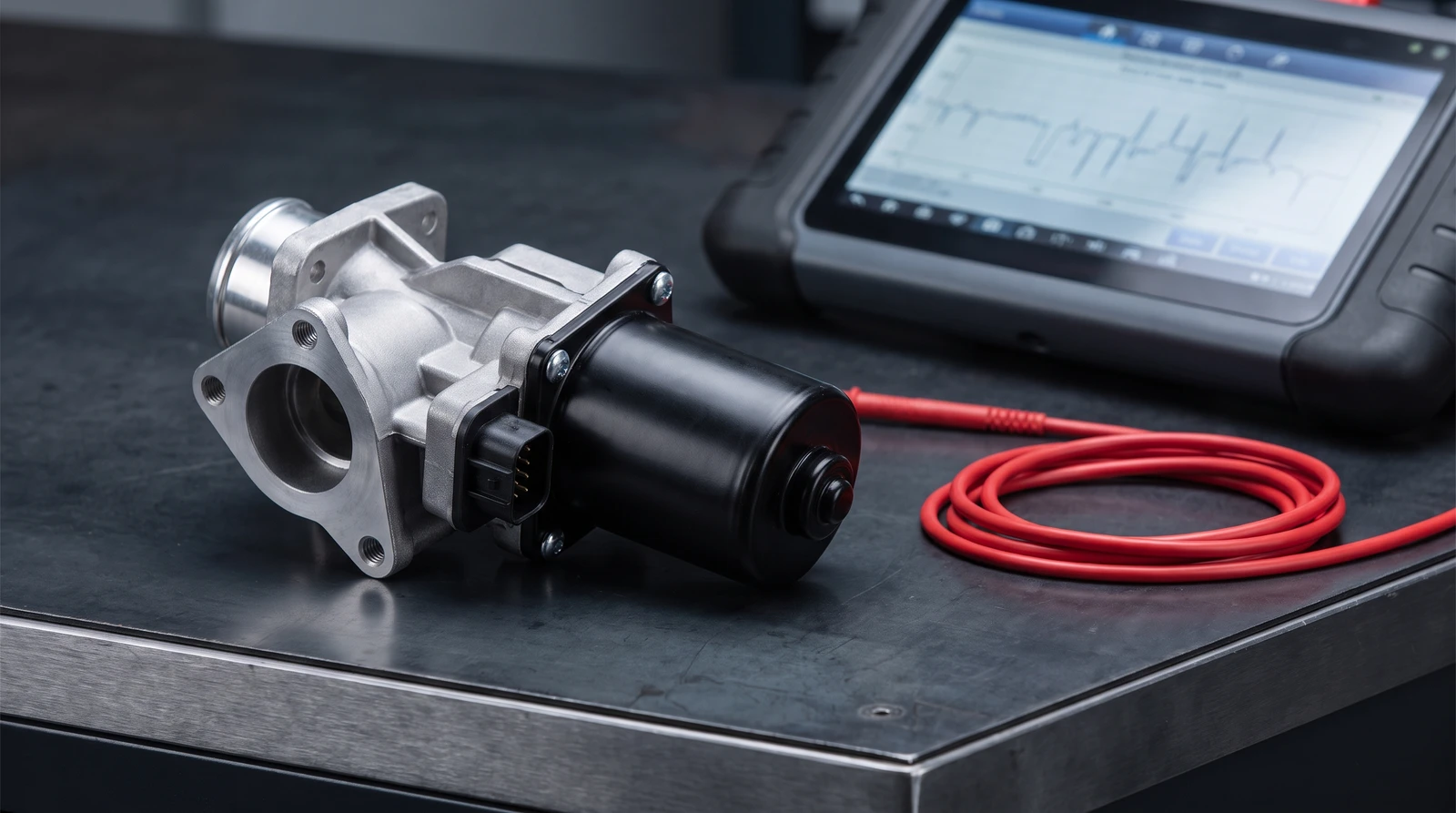
- What an EGR fault code is actually telling you
- P0401: exhaust gas recirculation flow insufficient
- P0402: exhaust gas recirculation flow excessive
- P0403: EGR control circuit malfunction
- P0404: range and performance, despite the word circuit
- P0405 and P0409: the EGR position sensor circuit
- The EGR cooler: coolant loss and white steam, not a flow code
- The six codes side by side, and what each one honestly needs
- What to ask your garage to check, and in what order
- Removing the EGR valve: what the law actually says
- EGR fault code FAQs
- Final thoughts
What an EGR fault code is actually telling you
Exhaust gas recirculation does one job: it routes a metered amount of spent exhaust gas back into the intake, where it displaces oxygen and slows the burn. Peak combustion temperature drops, and because oxides of nitrogen form at high combustion temperatures, less NOx leaves the tailpipe. It is fitted to petrol engines as well as diesels, though it is on diesels that it causes most of the trouble.
Three parts do that job, and keeping them apart is most of this page.
- The valve — the part that opens and closes to let gas through. On older systems a diaphragm moved by engine vacuum through a solenoid; on modern ones an electric motor driving a pintle, controlled straight from the engine ECU.
- The position sensor — a small potentiometer reporting how far the valve actually opened, so the ECU can compare what it asked for with what it got.
- The cooler — a heat exchanger carrying engine coolant, dropping the gas temperature before it reaches the intake. It fails in a completely different way from the other two, and it gets blamed last.
Here is what makes these codes confusing. On almost no vehicle does the ECU measure EGR flow directly. It infers it — from a differential pressure sensor across a restriction in the EGR path, from the drop in the mass airflow reading when the valve is commanded open, or from the position sensor’s feedback. So a flow code can be set just as easily by a sensor reporting wrongly as by a valve that is genuinely blocked.
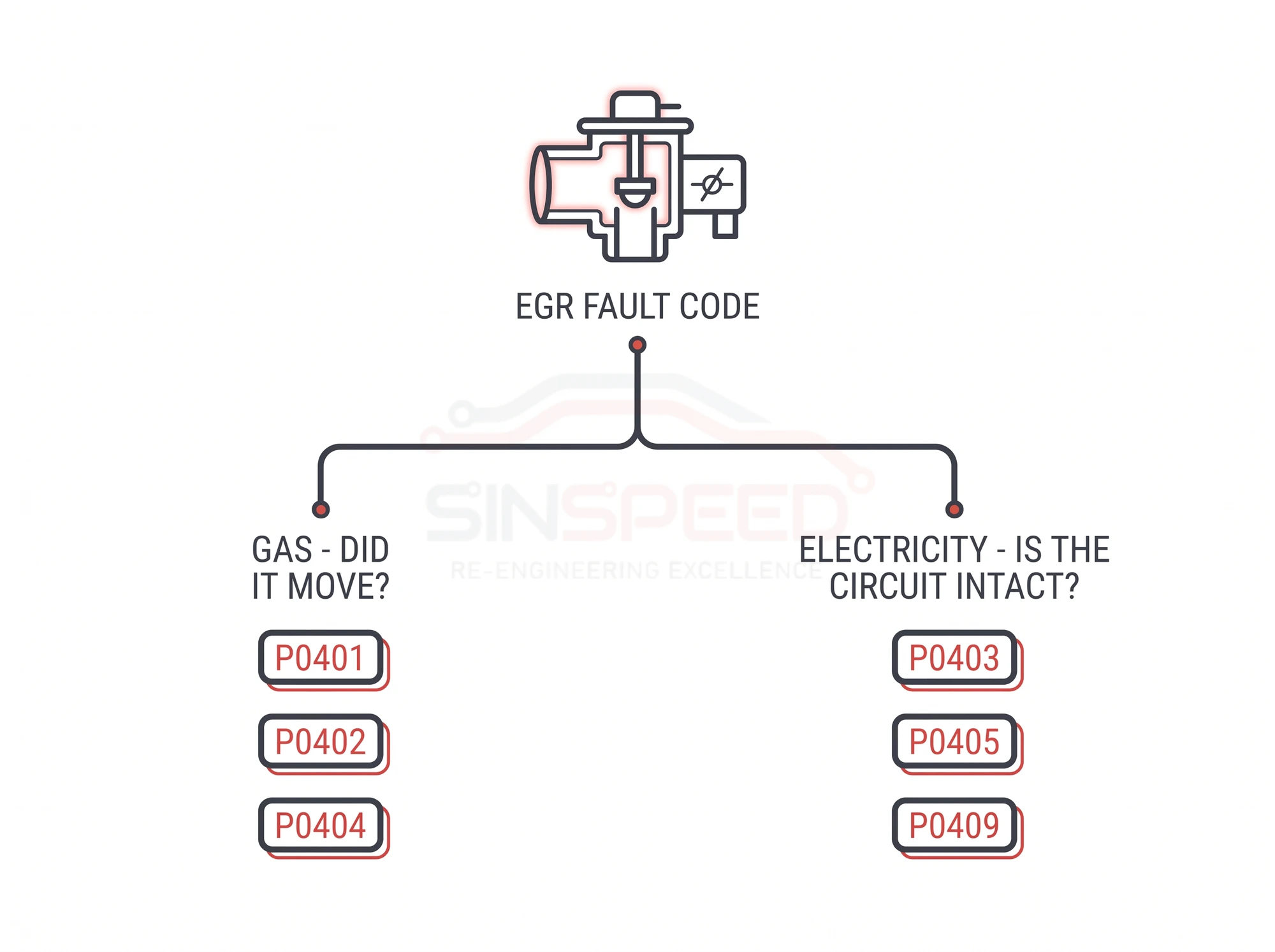
The six codes therefore divide into two families. P0401, P0402 and P0404 are about movement — how much gas went through, and whether the valve reached where it was told to go. P0403, P0405 and P0409 are about electricity — the circuit that drives the valve, and the circuit that reports its position.
One naming trap sits in the middle of that split. P0404’s official description is exhaust gas recirculation circuit range/performance, so the word circuit is right there in the name and it reads as electrical. It is not, and the section below explains why. For the system itself rather than the codes, our guide to EGR problems covers how it works and why it soots up.
P0401: exhaust gas recirculation flow insufficient
P0401 is the most common of the six by a distance, and it means one thing: the ECU commanded the valve open, went looking for evidence that gas had flowed, and did not find enough of it. VAG tools store the same fault as 16785/P0401/001025.
The overwhelming cause is carbon. Recirculated exhaust gas is dirty by definition, and where it meets oil vapour from the crankcase breather it forms a hard, tarry deposit that builds up over tens of thousands of miles. Short journeys and stop-start town driving make it worse, because the engine never runs hot enough for long enough to keep the deposits soft.
Carbon is not the only route to this code, though, and the others matter before anyone starts removing parts:
- The port, not the valve. The passage in the manifold or head that the valve feeds is often more blocked than the valve. A valve cleaned on the bench and refitted to a blocked port sets the code again.
- A plugged cooler matrix. Where the gas passes through the cooler before the valve, the cooler is the restriction. This turns up on petrol engines too.
- The differential pressure sensor and its pipes. Those small sensing pipes soot up and split, and a sensor reporting no pressure difference sets a flow fault with a clean valve.
- Vacuum supply, on older systems. A perished hose or a solenoid that will not pass vacuum means the valve never opens at all.
- A blanking plate. If one has been fitted, this code is the guaranteed result — the plate does exactly what the code complains about.
From the driving seat it is often very little. Many people arrive here because the engine management light came on and nothing else changed. Where symptoms show, they are a rough idle when hot — classically after a motorway run followed by slow traffic — a small drop in fuel economy, sluggish acceleration, and an occasional puff of black smoke at full throttle.
Which raises the question the search results are full of: why did it come back after the valve was cleaned? Usually the port behind the valve was left blocked, or the fault was never the valve but the pressure sensor, its pipes or the vacuum supply. It can also be that nothing about the driving changed, so a valve that caked once has begun caking again. There is a fourth cause on diesels with a particulate filter: a filter that is not regenerating keeps the intake loaded with soot and re-fouls the valve from upstream, which is why an EGR code and a DPF code so often arrive together. If yours have, start with what a DPF is and how it regenerates — fixing the EGR alone will not hold.
On cleaning products, honestly: additives poured into the tank are preventive maintenance. They help a valve that is starting to stick and will not rescue one that is properly caked, which needs the valve and the port physically cleaned. Revving the engine does not clean an EGR valve.
P0402: exhaust gas recirculation flow excessive
P0402 is the mirror image: the ECU has concluded that more exhaust gas is being recirculated than it asked for. VAG tools store it as 16786/P0402/001026.
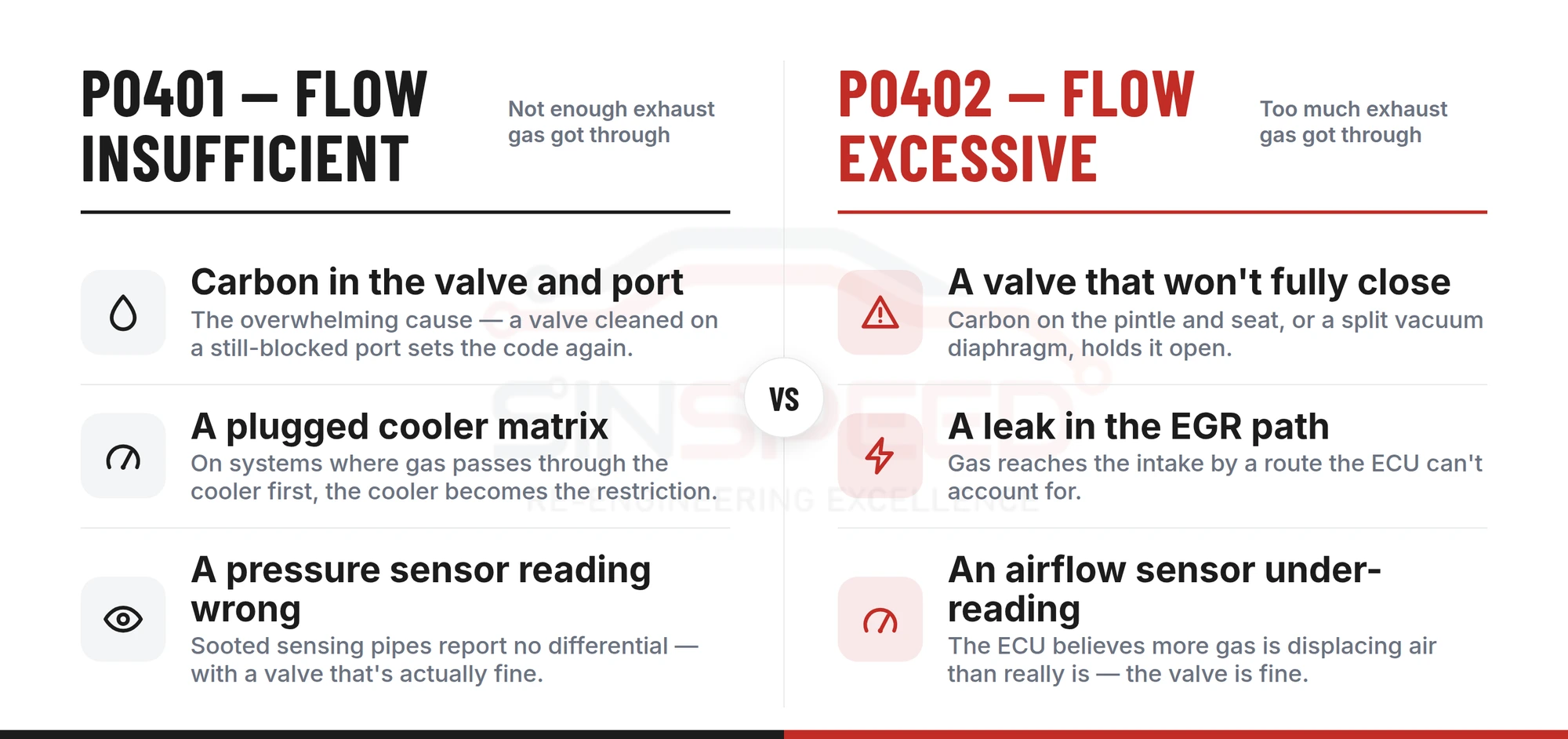
Split the causes the same way — the thing that moves, and the thing that reports.
On the moving side, the usual finding is a valve that will not fully close. Carbon on the pintle or in its seat holds it fractionally open; on a vacuum valve the rubber diaphragm can split, so it floats rather than shuts; and a control fault can leave the valve commanded open. A leak anywhere in the EGR path does it too, because gas is reaching the intake by a route the ECU cannot account for.
On the reporting side, remember that flow is inferred. A mass airflow sensor that under-reads makes the ECU believe more exhaust gas is displacing fresh air than really is, and a pressure sensor reading high does the same by another route. In both cases the valve is fine. A mass airflow sensor in that state usually stores a code of its own, so check the scan for the P0101 mass air flow circuit code before the valve comes off.
This is the one most likely to make the car genuinely unpleasant. Too much inert gas at idle, when the engine needs its air most, gives an unstable idle and stalling as you come to a stop, with hesitation pulling away and higher emissions at the tailpipe.
The first move is to establish whether the valve actually closes, which means looking at it and its seat rather than reading the code twice. If it closes cleanly, the sensing is what needs proving.
P0403: EGR control circuit malfunction
Here the family changes character. P0403 is not about gas at all: it is about the circuit the ECU uses to operate the valve, and the ECU has found an open circuit or a short in it. VAG systems record it as 16787/P0403/001027, usually printed against the EGR valve by its component name.
What that circuit consists of depends on the age of the system. On a vacuum setup the ECU does not move the valve itself — it switches a solenoid, and the solenoid lets vacuum through to the valve diaphragm, so the circuit being complained about is the one to that solenoid. On a fully electric valve there is no solenoid at all; the ECU drives the motor in the valve directly.
In the order that finds it quickest, the causes are a blown fuse feeding the circuit, a corroded or partly unseated connector, a chafed section of loom where it passes a bracket, an open or shorted solenoid winding, and — well down the list — the driver stage inside the engine control unit.
Symptoms follow from the EGR system being shut down as a precaution: engine management light, rough idle, stalling, loss of power, sometimes limp mode. Reduced power with the gearbox locked in one gear is a different fault again, and that reads as a P0700 transmission control module code, which is the gearbox asking for the lamp rather than the EGR system. The vehicle is unlikely to pass an emissions test in that state.
The honest verdict has two halves. Fuse, connector, loom and solenoid account for the great majority of P0403 faults, and that is work for a garage or an auto electrician with a multimeter and a wiring diagram. If the diagnosis genuinely lands on the driver stage inside the engine ECU, that is engine control unit repair — carried out by the independent specialists at ecu-repairs.com rather than by us.
P0404: range and performance, despite the word circuit
P0404’s full description is exhaust gas recirculation circuit range/performance, and that word circuit does real damage. Read the second half instead. Range and performance means the ECU commanded a position, read the feedback telling it where the valve went, and the two did not agree.
It covers three states — stuck closed, stuck open, and moving but erratically or too slowly. Most of the time all three come from the same place: carbon on the pintle and in the seat, jamming a valve asked to move thousands of times through a stream of soot. The other common finding is a tired actuator motor, strong enough to move a clean valve and not a dirty one.
The third possibility is the one to hold on to. The feedback the ECU compares against comes from the position sensor, and a sensor reporting wrongly produces exactly this disagreement with a valve moving perfectly well.
In UK workshops it is high-mileage stop-start diesels that throw this code most — 1.6 TDCi Fords, 2.0 CDTi Vauxhalls and the 1.6 TDI VAG engines come up repeatedly. The symptoms are a flat, gutless feeling pulling away, hesitation at a steady cruise, a rough idle close to stalling at lights, light pinking under gentle throttle when warm, and worse economy than the car used to return.
One test does most of the work here, and it is worth asking for by name: on live data, watch commanded position against actual position while the valve is driven through its range. A valve that lags or sticks is mechanical. A valve that moves smoothly while the feedback figure jumps or flatlines is a sensor problem wearing a movement code’s clothing. The same test settles the same argument anywhere a motor moves something and a sensor reports where it got to; it is how the clutch actuator codes are separated too.
P0405 and P0409: the EGR position sensor circuit
These two belong together, and they are the good news on this page. Both are position sensor circuit faults — ordinary electrical faults, on an ordinary circuit, with an ordinary repair at the end of them. Nothing to weigh up and nothing to disclaim. Something in the circuit that tells the ECU where the valve is has stopped telling it properly.
P0405 is exhaust gas recirculation sensor A circuit low: the signal voltage coming back has dropped below the range the ECU expects. Its counterpart P0406 is the same fault at the other end of the scale, with the voltage abnormally high.
P0409 is exhaust gas recirculation sensor A circuit, and it is the broader of the two. Rather than naming a direction it says the feedback is outside anything reasonable, or is coming and going. In plain English, the ECU has lost track of where the valve is.
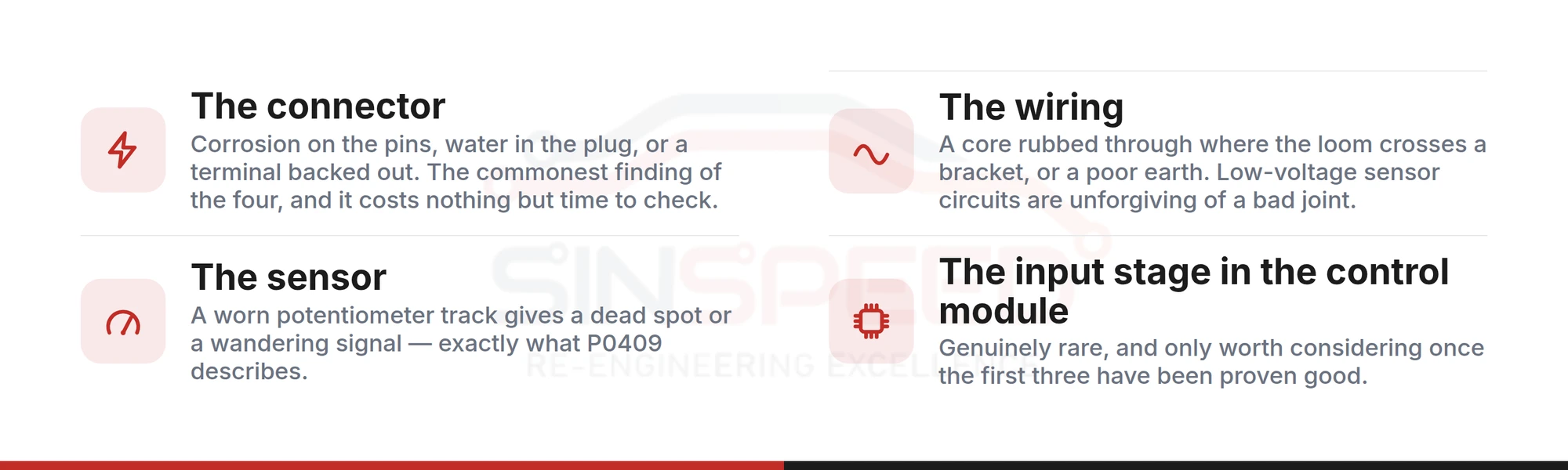
The causes, in the order they are usually found:
- The connector
Corrosion on the pins, water in the plug, or a terminal backed out of its housing. The commonest finding of the lot, and it costs nothing but time to check. P0409, being intermittent by nature, points here more often than anywhere else.
- The wiring
A core rubbed through where the loom crosses a bracket, or a poor earth. Sensor circuits run at low voltage and are unforgiving of a bad joint.
- The sensor
A worn potentiometer track gives a dead spot or a wandering signal, which is exactly what P0409 describes.
- The input stage in the control module
Genuinely rare, and only worth considering once the first three have been proven good rather than assumed good.
One thing to know before anyone orders a part. On most modern electronic EGR valves the position sensor is not a separate component — it is built into the valve assembly with the motor, sharing one connector. That is precisely why the plug and the loom get checked first: a connector fault and a failed sensor set the same code, and only one of them needs a valve.
Symptoms are consistent across both: engine management light, a flat or sluggish feel, hesitation at a cruise, a rough idle, black smoke under load, and on many vehicles a drop into limp mode — which arrives at the worst moment, because load is what triggers it.
The EGR cooler: coolant loss and white steam, not a flow code
The third part is the one people misattribute, and it deserves its own section because it often sets no EGR flow code at all.
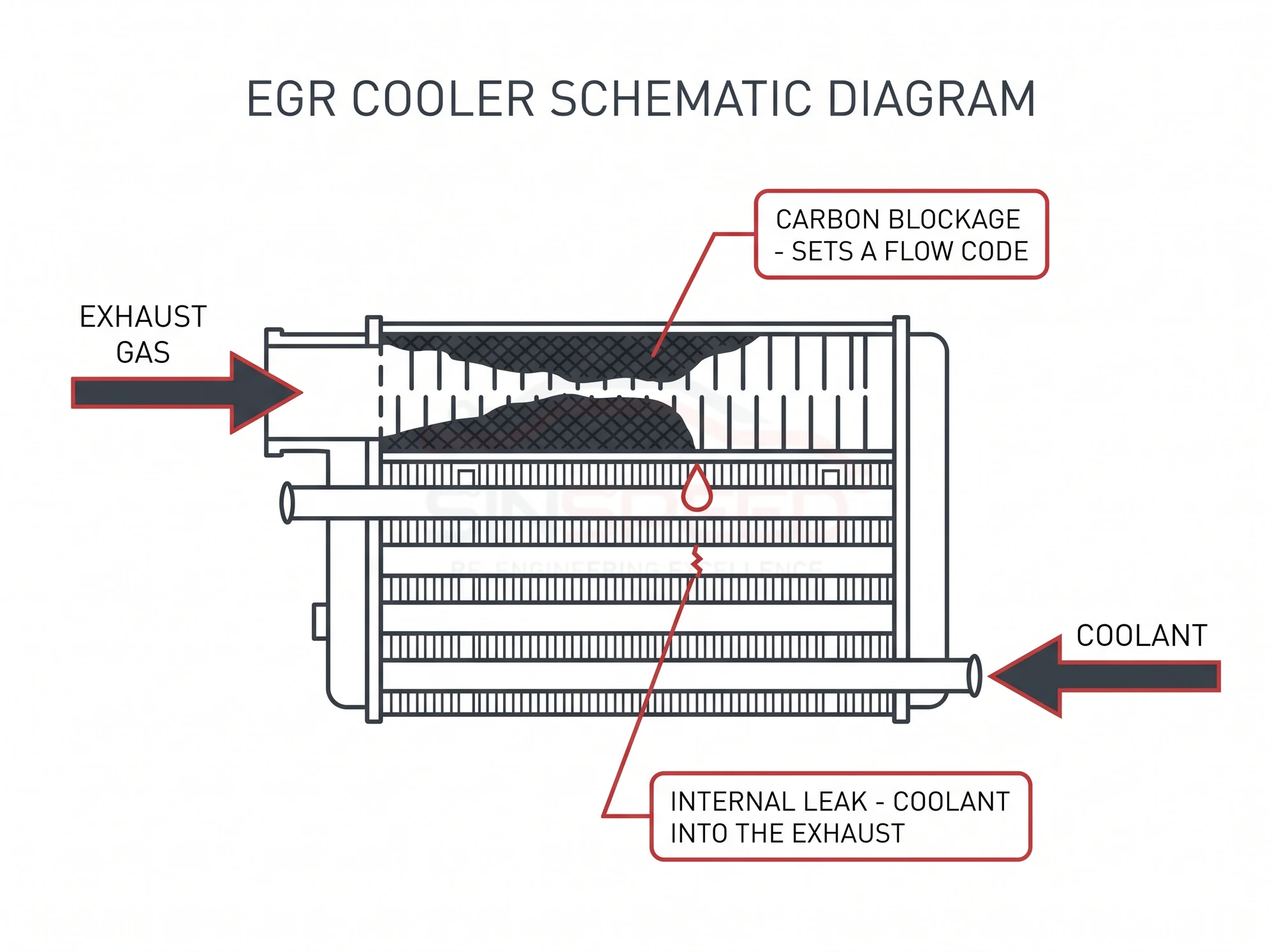
An EGR cooler is a heat exchanger — a radiator working in reverse. Instead of using outside air to cool hot coolant, it uses engine coolant to cool hot exhaust gas before it reaches the intake. Coolers became widespread as the Euro 4 emissions standard came in, and they are built in stainless steel or aluminium. Not a wear part, but they can and do fail over the life of an engine.
They fail in two quite different ways. Plugging up with carbon makes the cooler a restriction in the EGR path, and that ends in a flow code — P0401, above. Leaking internally does not present as an EGR fault at all: coolant escapes from the water side into the exhaust side, and the driver sees white steam from the exhaust, a coolant level that keeps dropping with nothing on the drive to show for it, a slimy residue where the cooler meets the valve, and sometimes an overheating engine.
That combination — disappearing coolant and white steam with no external leak — is very commonly read as a head gasket, and it is not unusual for a head gasket, a cylinder head or the seals around wet liners to be replaced without curing anything, because the cooler was leaking the whole time. If those are your symptoms, have the cooler pressure-tested before anyone takes the top off the engine.
The leaks come from the exhaust side and develop slowly, as aggressive combustion products attack the cooler internally until it weeps. None of this is electronic and none of it is our work. It is cooling-system and engine work for a garage or a diesel specialist.
The six codes side by side, and what each one honestly needs
One thing does not appear in this table, and that is deliberate. Removing the EGR system is not the answer to any individual fault code — it is a separate decision about the whole system, dealt with further down on its own terms.
| Code | What the ECU detected | Most likely cause | First move | Who does that work |
|---|---|---|---|---|
| P0401 | Less recirculated gas than it commanded. | Carbon in the valve and in the port behind it; a plugged cooler; a pressure sensor reading wrongly. | Clean the valve and the port, and prove the pressure sensor first. | A garage or diesel specialist. Not an electronics repair. |
| P0402 | More recirculated gas than it commanded. | A valve held open by carbon or a split diaphragm, a leak in the path, or an airflow sensor under-reading. | Confirm the valve genuinely closes, then check the sensing. | A garage. Same trade as P0401. |
| P0403 | An open circuit or a short in the circuit that drives the valve. | Fuse, connector, chafed loom, open solenoid winding. Rarely the driver stage in the engine ECU. | Fuse, plug and loom, then solenoid resistance. | A garage or auto electrician. If it is the engine ECU driver, that is engine ECU repair at ecu-repairs.com. |
| P0404 | The valve did not reach the position it was told to. | Carbon jamming the pintle and seat, a tired actuator, or a sensor reporting wrongly. | Watch commanded against actual position on live data. | A garage. Cleaning, or a valve if the actuator is dead. |
| P0405 | Sensor signal below the expected range. | The connector and loom first, then the sensor. P0406 is the same fault with the voltage high. | Test the plug and wiring before ordering a part. | A garage or auto electrician. An ordinary repair. |
| P0409 | Position feedback outside a sensible range, or intermittent. | As P0405, with intermittent connector and loom faults over-represented. | Wiggle-test the connector and loom with live data running. | As P0405. Straightforward electrical work. |
Sinspeed · automotive electronics
Not sure which of the three parts your codes describe?Send us the codes exactly as your scan tool prints them, with the vehicle details and what it is doing, and we will tell you what they point at — including when the answer is a garage job rather than anything we sell.
Mail-in automotive-electronics workshop · Your vehicle stays where it is — only a unit ever travels
What to ask your garage to check, and in what order
Cheapest and most conclusive first. The order matters more than the individual steps, because the expensive mistakes on this family all come from starting at the part instead of ending at it.
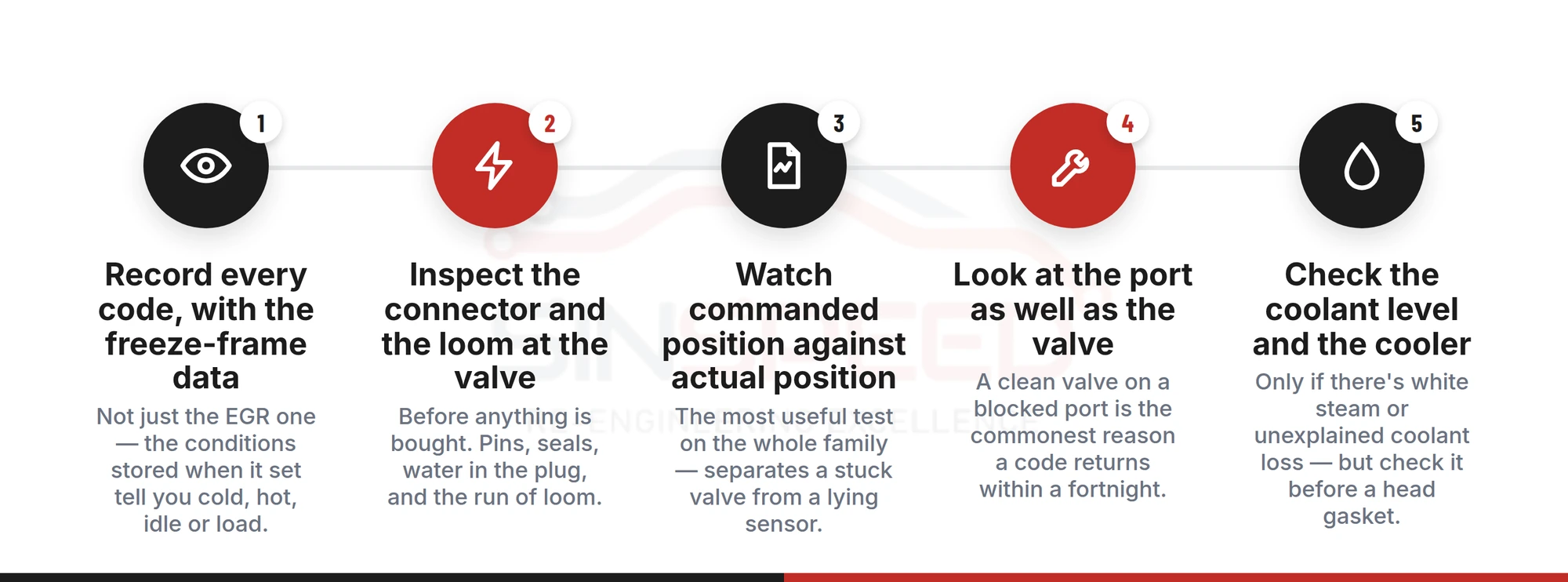
- Record every code, with the freeze-frame data
Not just the EGR one. The conditions stored at the moment the fault set tell you whether this happens cold, hot, at idle or under load. A DPF or fuelling code alongside changes the picture entirely. P0171, the lean-running code, is the one to look for in particular, because it points at unmetered air or a sensor under-reading, and both of those move the EGR figures as well.
- Inspect the connector and the loom at the valve
Before anything is bought. Pins, seals, water in the plug, and the run of loom where it passes anything hard. On the two sensor codes this is where the fault most often is.
- Watch commanded position against actual position on live data
The most useful test on the whole family. It separates a valve that will not move from a sensor that is misreporting, without removing a bolt.
- Look at the port as well as the valve
If the valve comes off, the passage behind it gets inspected and cleaned in the same operation. A clean valve on a blocked port is the commonest reason a code returns within a fortnight.
- Check the coolant level and the cooler
Only if there is white steam, an unexplained coolant loss or a slimy deposit in the intake — but if there is, this comes before anyone considers a head gasket.
Almost everything on that list is work on the vehicle, and none of it is a service we sell. Sinspeed is a mail-in automotive-electronics workshop: units are posted to us, repaired at circuit level and returned, and the vehicle stays where it is. A carbon-caked valve and the port behind it are on the car, which is exactly why cleaning an EGR system is a garage job and not ours.
Two things do bring the trail back this way. If the same scan carries reduced-power and throttle codes, that is a separate family, taken apart on throttle body fault codes. If it carries fuelling codes and the engine is smoking or cutting out, diesel pump EDC fault codes is where to start. And if the tool cannot get a reply out of the engine module at all, no EGR code is worth reading until that is sorted — which is what lost communication fault codes is about.
Removing the EGR valve: what the law actually says
Anyone reading about EGR faults meets the suggestion sooner or later that the simplest answer is to take the system out. It is worth being precise about where that sits, because the wording used around it is often vague and the reality is not.
The EGR valve is an emissions-control device. It was fitted by the manufacturer to meet an emissions standard, and the vehicle was type-approved with it in place. Removing or disabling emissions-control equipment and then using that vehicle on a public road is not lawful in the UK — the offence attaches to the road use. An emissions-related defect is a roadworthiness matter too, and an engine management light left on for one is not something an MOT tester looks past.
There is a practical point alongside the legal one. Deleting the system does not repair the fault; it removes the part that was reporting it. On plenty of vehicles, taking the valve out without the corresponding software work simply produces a fresh code from a different sensor — which is exactly what a blanking plate does when it sets P0401.
For a road-going vehicle, then, the routes are the ones above: diagnose properly, clean the valve and the port, repair the circuit, replace the sensor or the cooler. That is the whole of the answer for the great majority of people who arrive at these codes.
Sinspeed does carry out EGR removal work, and it is carried out for off-road and motorsport vehicles only — not for vehicles used on a public road. The same applies to DPF removal. For anything driven on the road, cleaning and repair are the routes to take.
EGR fault code FAQs
Is it legal to remove or blank off the EGR valve?
Not for a vehicle used on a public road. The EGR valve is an emissions-control device fitted to meet the standard the vehicle was type-approved against, and removing or disabling emissions equipment on a road-going vehicle is not lawful — the offence attaches to using it on the road. Removal work is carried out for off-road and motorsport vehicles only. It also does not repair anything: a blanking plate is the most reliable way there is to set P0401.
Can I keep driving with an EGR fault code?
It depends which one, and it is a question about the engine rather than about braking or steering. P0401 often changes nothing in how the car drives, and the risk of leaving it is that the intake and the particulate filter keep loading up. P0402 matters more in traffic, because a valve stuck open can stall the engine as you come to a stop. P0403, P0405 and P0409 commonly bring limp mode with them, which is a sudden loss of power under load. In every case, clearing the code without finding the cause achieves nothing.
Will cleaning the EGR valve fix P0401, or do I need a new valve?
Cleaning fixes a large share of P0401 and P0404 faults, because carbon jamming the valve causes most of them. Two things decide whether it holds: whether the port behind the valve is cleaned at the same time, and whether the valve is actually the fault rather than the pressure sensor, its pipes or the vacuum supply. A valve is genuinely due for replacement when the actuator no longer has the strength to move it, or when the pintle and seat are eroded rather than dirty.
Is the EGR position sensor a separate part from the valve?
On most modern electronic EGR valves, no. It is built into the valve assembly with the motor, and both share one connector, which is why a failed sensor on those vehicles usually means replacing the valve. On older designs it is more often a separate component. This is exactly why the connector and the wiring get checked before anything is ordered: a corroded pin or a rubbed-through core sets the same P0405 or P0409 that a failed sensor does.
Why did the code come back after the valve was cleaned?
Usually because the port behind the valve was left blocked, or because the fault was never the valve — it was the pressure sensor, its pipes, the vacuum solenoid or the wiring. It can also be that nothing about the driving changed, so a valve that caked once has begun caking again. And on a diesel whose particulate filter is not regenerating properly, the intake stays loaded with soot and re-fouls the valve from upstream.
Sinspeed · automotive electronics
If the trail has led to a module rather than a valveWe are a UK automotive-electronics remanufacturer rather than a garage. We do not clean EGR valves and we do not sell EGR sensors — but the electronic units behind faults like these are exactly what we do. If your diagnosis has stopped at a control module, tell us what the scan says and we will tell you whether it is ours.
Circuit-level board repair by an in-house team of electronic engineers
Final thoughts
Most fault-code families point at one part. This one does not, and that is the useful thing about it. A P0401 and a P0405 in the same scan describe two different components in two different states, needing two different trades — and if there is white steam behind the car as well, a third component is involved that neither code names.
So the work here is not really decoding. It is sorting. Gas or electricity. Valve, sensor or cooler. The part itself, or the passage behind it. Sort that out and the answer is usually ordinary and often simple: a connector cleaned, a port cleared, a length of wiring traced back to a rubbed-through core.
Which means most of this page sends you somewhere other than us, and we would rather it did that than pretend a carbon-caked valve is an electronics job. Where it does come back to us is the narrow end of the family — a circuit traced as far as a module, or a scan that has stopped making sense.