
Summary: When a VW Golf Mk5 blows warm air, the compressor is one suspect among several, but a compressor that leaks refrigerant from its own body or will not engage is a fault we repair by post. Your garage recovers the refrigerant, removes the compressor and sends it to us; we confirm the leak or clutch fault, repair it, test it again and return the same compressor with a lifetime warranty on the repair, ready for your garage to refit and recharge. A compressor that has seized and snapped its shaft is different: it needs replacing rather than repairing.
This page covers the air con compressor on the Golf Mk5, built from 2003 to 2008 in petrol and diesel form, and how to tell a compressor fault apart from the simpler causes of warm air. Compressors for other cars sit within our air conditioning repairs.
Why is my Golf Mk5 blowing warm air?
Warm air from the vents means the refrigerant circuit is no longer pulling heat out of the air on its way into the cabin. On a Golf Mk5 there are four broad reasons for that: the system has lost refrigerant, the compressor is not being asked to run, the compressor cannot do its job, or the refrigerant is cold but the air is not reaching you properly. Only the third is a compressor fault, and it is the one this page deals with.
Most Golf Mk5 engines are listed against the Sanden PXE16: the 1.4 and 1.6 petrols, the 2.0 FSI, the 1.6, 1.9 and 2.0 TDI diesels, the 2.0 SDI and the 3.2 V6 all appear on our Sanden PXE16 compressor page. If your engine is not among them, the number on the compressor’s label settles which unit you have.
The PXE16 is a variable-displacement compressor. Instead of being switched fully on and fully off, the amount it pumps is regulated electrically by the car’s climate control. So if you have read advice about listening for a clutch clicking in when the air con is switched on, it may not describe your car. What matters is whether the compressor pumps when it is asked to.
Searching by the number printed on your compressor? Put that number on the repair form exactly as it appears on the label, alongside the engine and registration, and we will match it from there.
What are the signs of a failing Golf Mk5 air con compressor?
A compressor on its way out tends to show one or more of these. Some point at it firmly; others are shared with faults elsewhere in the system.
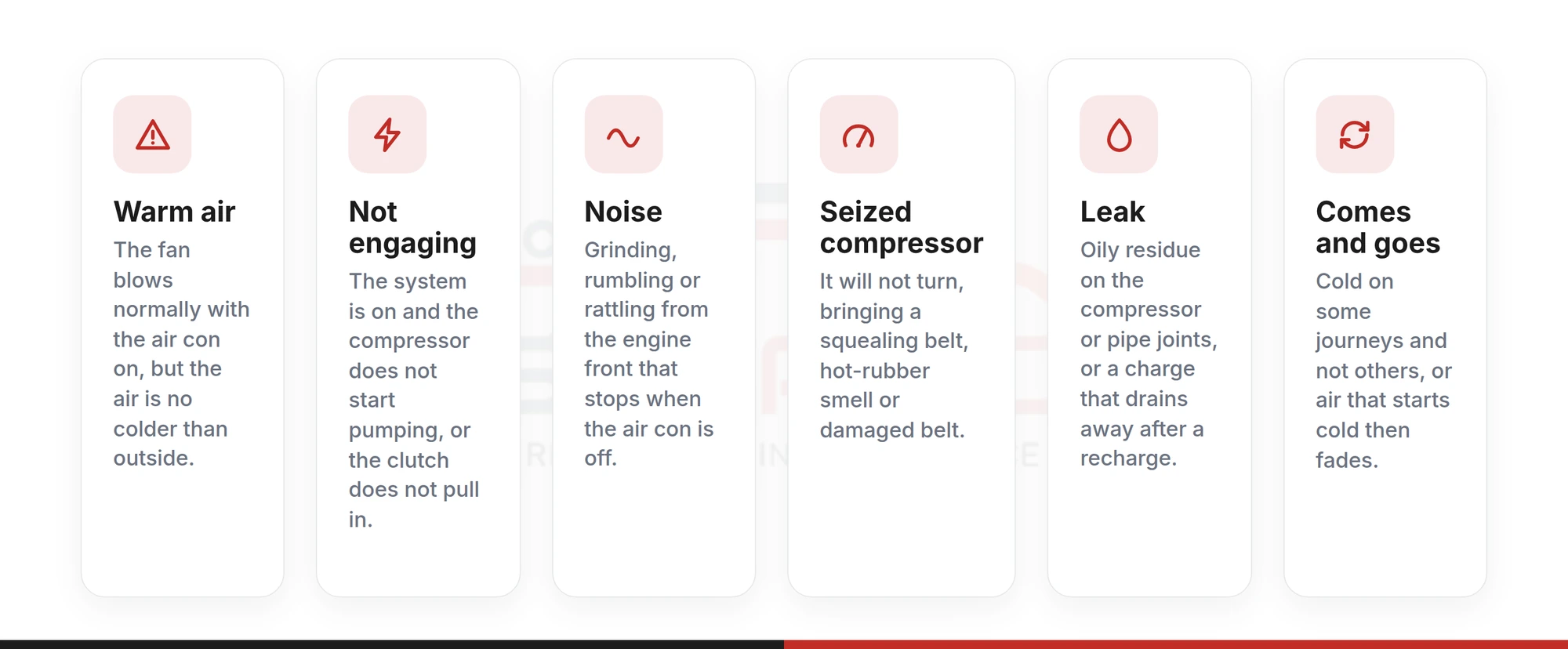
- Warm or barely cool air. The fan blows normally and the air con is switched on, but the air coming out is no colder than outside.
- The compressor not engaging. The system is switched on and the compressor does not start pumping. On a compressor fitted with a clutch, the clutch does not pull in.
- Noise when the air con is on. Grinding, rumbling or rattling from the front of the engine that changes or stops when the air con is switched off.
- A seized compressor. The compressor will not turn. That can bring a squealing belt, a smell of hot rubber or a damaged auxiliary belt.
- A leak at the compressor. Oily residue on the compressor body or its pipe joints, or a charge that drains away again after the system has been recharged.
- Cooling that comes and goes. Cold air on some journeys and not others, or air that starts cold and then fades.
One symptom alone does not condemn the compressor. Noise and seizure point at it most strongly. Warm air and intermittent cooling can just as easily come from the charge or the controls, which is why the checks further down this page come before any compressor is removed.
- Car: VW Golf Mk5, 2003–2008, petrol and diesel
- Compressor: Sanden PXE16 on most engines; the label number confirms yours
- Faults we repair: refrigerant leaking from the compressor, a clutch that fails to engage
- How it reaches us: your garage recovers the refrigerant, removes the compressor and posts it
- What comes back: the same compressor, tested again after the repair
- Warranty: lifetime, on the repair
Why do Golf Mk5 compressors fail?
A compressor is a hard-working mechanical unit bolted to the engine, and it wears for system-level reasons rather than because of anything an owner did. These are the causes we see.
- Heat cycles. The compressor goes from a cold start to full engine-bay temperature on every drive, and squeezing refrigerant generates heat of its own. Each cycle of heating and cooling adds to the wear.
- Refrigerant loss. The refrigerant does more than cool the cabin: it carries the oil that lubricates the compressor around the circuit. As the charge leaks away, less oil comes back, and the compressor runs short of lubrication, often before the air turns noticeably warm.
- Clutch wear. Where a clutch is fitted, it engages and releases every time the system calls for cooling. Wear builds until it no longer pulls in reliably.
- Contamination. Moisture or debris that gets into the circuit, from a leak that let air in or a failure elsewhere in the system, passes through the compressor on every cycle.
- Age. These effects add up. The youngest Golf Mk5 left the factory in 2008, so any compressor still on the road has years of heat cycles and use behind it.
A compressor that seizes can shed debris into the circuit. That is why, when one has seized, your garage cleans the circuit as part of fitting, whichever compressor goes back on afterwards.
Gas, fuse or compressor: what to rule out first
Several faults outside the compressor produce exactly the same warm air, and some are far quicker to put right. Your garage checks the refrigerant charge and the system pressures first, then works through the rest.
- A low charge, or a leak elsewhere. Refrigerant escaping from a pipe, a joint or another component leaves warm air with a perfectly healthy compressor.
- A pressure-switch cut-out. When the pressures fall outside safe limits, the system protects itself by stopping the compressor from working, so a low charge can look like a compressor that will not engage.
- A blown fuse or a failed relay. Without its electrical supply or control signal, the compressor is never told to pump, however sound it is.
- A cabin blower or air-flap fault. The refrigerant can be properly cold while a blower or flap problem keeps that cold air from reaching the vents, or mixes it with warm air on the way.
If the charge and pressures are right, the supply is sound and the air is being routed properly, attention turns to the compressor. Our guide to common air conditioning problems and solutions goes into these wider faults in more depth.
One pattern deserves a note on the repair form: a recharge that brought the cold back only for a short while. A system that keeps losing its charge has a leak somewhere, and a leak from the compressor itself is one of the faults we repair.
Golf Mk5 air con · repair by post
Charge and controls check out? Have the compressor testedPut your registration, the engine, the label number and what the air con is doing on the repair form. We confirm a leak or clutch fault when the compressor arrives, repair it and test it again before it is returned.
Fault confirmed on arrival · Retested once repaired · Your own compressor returned
Your own compressor repaired, or a replacement fitted?
There are two routes back to cold air: repair the compressor that came off the car, or fit a different one. The garage work surrounding them is closer than most owners expect. Which route is open depends on the fault: a leak or a clutch that will not engage is repaired, but a compressor that has seized and snapped its shaft cannot be, and needs replacing.
Either way, the refrigerant is recovered before the compressor comes off and the system is recharged once a compressor goes back on. If the old one seized, the circuit is cleaned as part of fitting. A replacement does not remove any of those steps. It changes only which compressor is bolted on at the end.
What a repair changes is what you know about the unit going back in. Ours is your own compressor: its fault confirmed before we began, the repair tested before it left us, and a lifetime warranty on that repair. It is also the compressor already matched to your Golf’s engine, so there is no second part number to check.
How does the postal compressor repair work?
Wherever you are in the UK, the repair follows the same six steps.
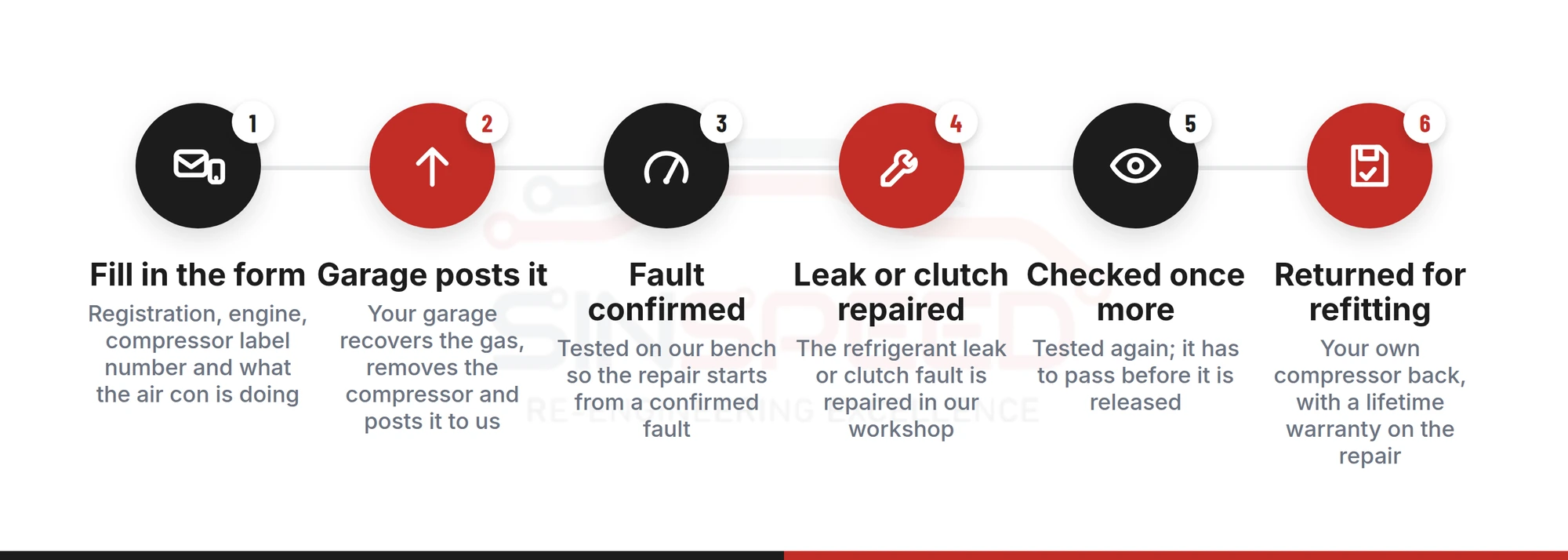
- Fill in the form
Complete the repair form with your registration, engine, the number from the compressor label, what the air con is doing and whether the system has been holding its charge.
- Your garage recovers the gas and posts the compressor
The refrigerant is recovered, the compressor is removed and it is packed securely and posted to our workshop, with a note of the symptoms inside.
- Fault confirmed on our bench
We test the compressor when it arrives, so the repair starts from a confirmed fault rather than an assumption.
- We carry out the repair
The leak or clutch fault is repaired in our workshop.
- Checked once more
The repaired compressor is tested again, and it has to pass before it is released.
- Returned for refitting
Your own compressor comes back with a lifetime warranty on the repair. Your garage refits it and recharges the system, as with any compressor change.
Questions Golf Mk5 owners ask about the compressor
Is it the compressor, or does my Golf Mk5 just need re-gassing?
Often it is the charge. A low refrigerant charge, or a leak elsewhere in the circuit, gives warm air even though the compressor is healthy, so your garage checks the charge and the pressures first. If the system holds its charge and still blows warm, or the compressor itself is noisy, seized or leaking, the compressor becomes the likely cause.
Can I keep driving with a seized air con compressor?
The compressor is driven by the engine’s auxiliary belt, so one that has seized, or is starting to, puts that belt and its pulley under strain. A compressor that has seized and snapped its shaft cannot be repaired and needs replacing. A squeal, a smell of hot rubber or grinding from the front of the engine is a reason to have the car checked promptly rather than driving on as normal.
Which Golf Mk5 engines does this repair cover?
Most Golf Mk5 engines are listed against the Sanden PXE16, including the 1.4 and 1.6 petrols, the 2.0 FSI, the TDI diesels, the 2.0 SDI and the 3.2 V6. If your engine is not among them, read the number off the label on the compressor body and put it on the repair form. That number, not the badge on the boot, tells us which compressor you have.
Will the air con need recharging when the repaired compressor goes back on?
Yes, as with any compressor change. Your garage recovers the refrigerant before removing the compressor and recharges the system once the repaired unit is refitted.
What warranty comes with the compressor repair?
A lifetime warranty on the repair. The compressor you get back is the one that came off your Golf, with its fault confirmed before we started and the unit tested again once the repair was complete.
Can you repair a compressor where only the clutch has stopped engaging?
Yes. A clutch that fails to engage is one of the compressor faults we repair, alongside refrigerant leaking from the compressor. Send the complete compressor and say on the repair form that the clutch is not engaging. Many Golf Mk5 compressors are regulated electrically rather than switched on and off, so have your garage confirm the fuse, relay and pressure readings first.
Sinspeed · air con compressor repairs
Bring the cold back to your Golf Mk5Fill in the form with your engine, the compressor’s label number and how the air con has been behaving, and your garage can post the compressor once it is booked in. Want to check the symptoms first? Ask through our contact page and you will get a straight answer before anything is unbolted.
Lifetime warranty on the repair · Postal service across the UK · Refitted and recharged by your garage