
Summary: On an Audi A1 with the seven-speed automatic, a failing gearbox ECU — the mechatronic unit inside the DSG — usually announces itself with a flashing gear display, the EPC light and gears that will not select, often after a new fuse has already been tried. The fault normally starts as a pressure leak on the unit’s hydraulic side and finishes in its pump and electronics, which is why fixing one part at a time rarely holds. We rebuild your own unit by post with that weak point strengthened, so it refits without reprogramming and carries a lifetime warranty.
This page covers the A1 alone: how its DSG unit behaves when it fails, the codes it leaves, and how the rebuild runs. Every other gearbox control unit we work on is listed under transmission control module repairs.
- The unit: the mechatronic — the gearbox’s control electronics and its hydraulic valve body, made as one assembly and housed inside the gearbox
- The gearbox: the seven-speed, dry-clutch DSG known as the DQ200; the gearbox code confirms it
- The cars: automatic Audi A1s, with repair listings for 2010–2018 and 2018–2021 cars
- Typical signs: flashing gear display, EPC light, gears not selecting, rough or jerky changes
- What comes back: your own unit, rebuilt and tested before and after the work, with its coding untouched
- Warranty: lifetime
- How does a failing DSG unit show up on an Audi A1?
- What do the A1’s DSG fault codes mean?
- Which Audi A1 models and gearboxes does this cover?
- Why does the A1’s gearbox unit fail, and why is it mistaken for something else?
- Should the A1’s unit be rebuilt, or swapped for another?
- What happens once the unit is on its way to us?
- Audi A1 DSG gearbox ECU: common questions
- Final thoughts
How does a failing DSG unit show up on an Audi A1?
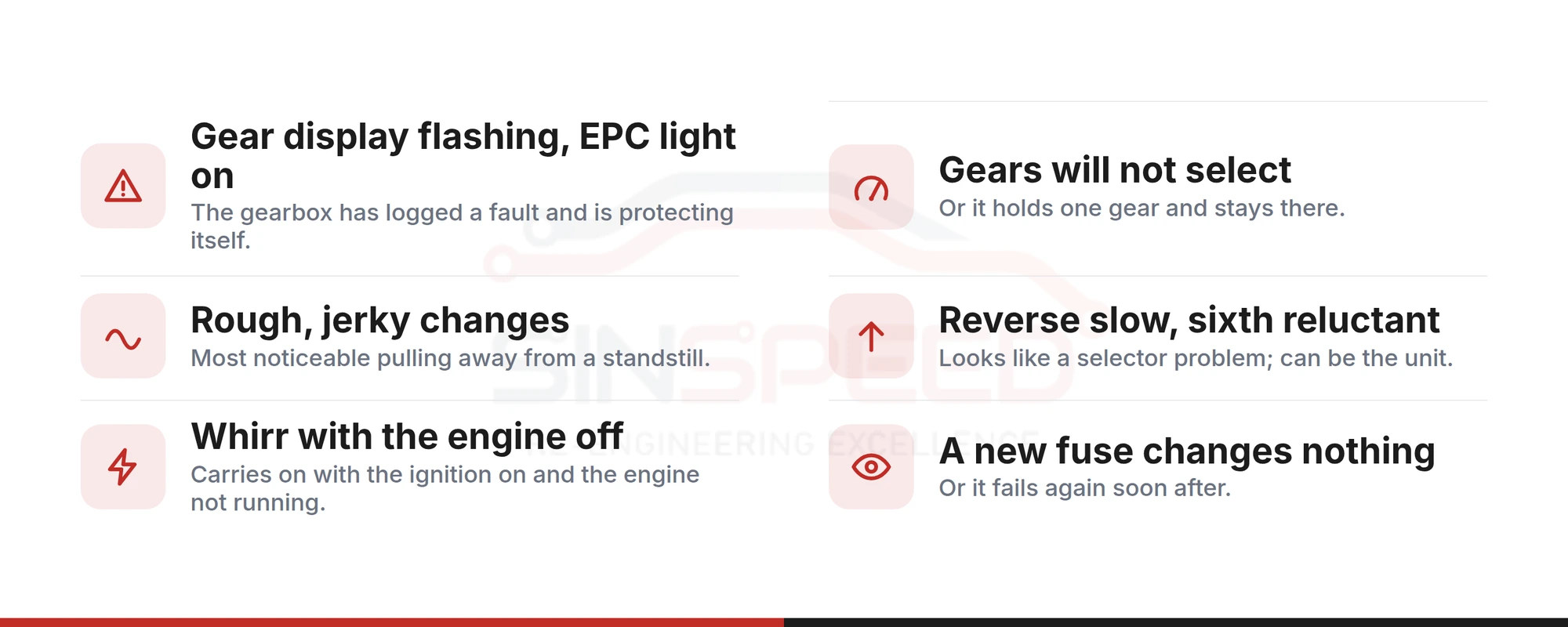
On most A1s the first warning is a light, not a feeling. The gear indicator in the instrument cluster begins to flash, the EPC light comes on, and from then on the gearbox may refuse to change, hang on to one gear or snatch as the car moves off.
These are the signs A1 units come to us with:
- Gear indicator flashing, EPC light on — the gearbox has recorded a fault and is protecting itself
- Gears that will not select, or a gearbox that holds one gear and stays there
- Rough, jerky changes, most noticeable when pulling away from a standstill
- Reverse slow to engage, or sixth refusing to go in
- A whirr from the gearbox that carries on with the ignition on and the engine not running
- A replacement fuse that changes nothing, or one that fails again soon after
- No drive at all once pressure has dropped too far
Two of these are easy to misread on an A1. A snatch on take-up feels exactly like a worn clutch, and a reverse or sixth that will not engage looks like a mechanical selector problem. Either can come from the unit instead, which is why the codes matter before any parts are ordered.
Treat loss of drive as a safety issue. An A1 that will not pull out of a junction, or drops out of gear in traffic, needs to come off the road; if the display is flashing, drive gently to wherever it will be looked at and no further.
What do the A1’s DSG fault codes mean?
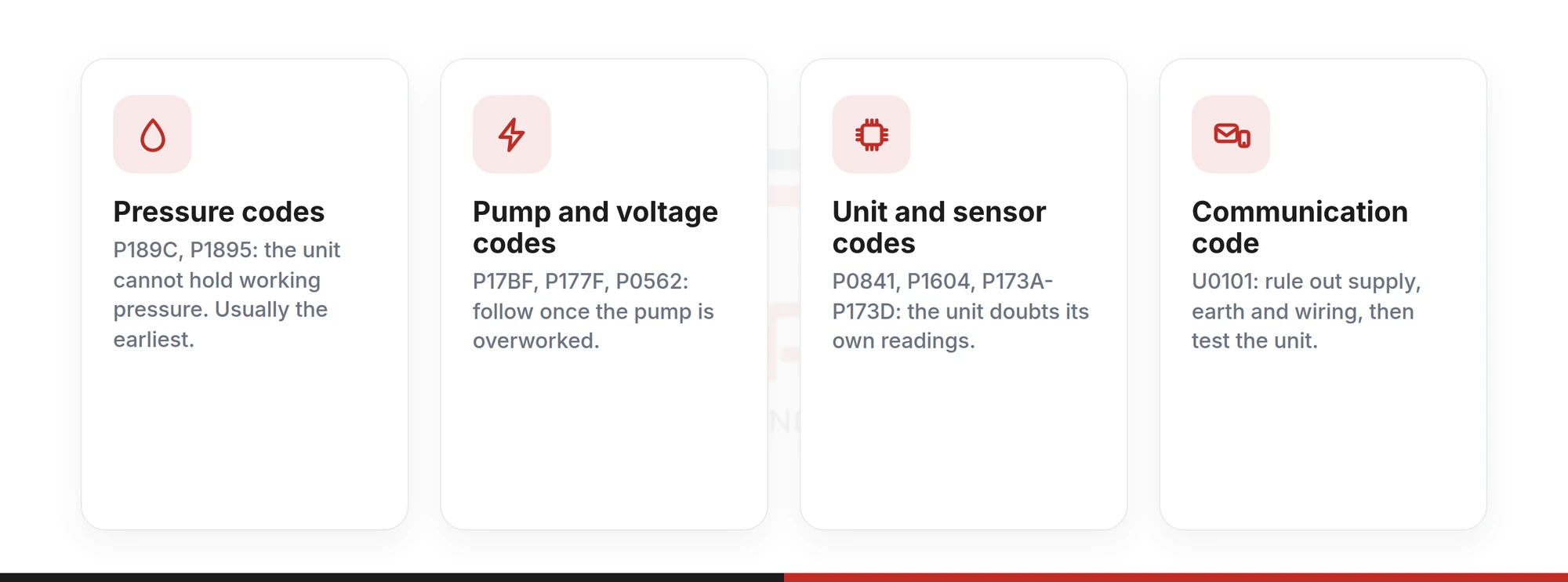
The codes below are the ones A1 units most commonly store. They are listed roughly in the order they tend to appear, because on this gearbox the order is informative: pressure codes come early, and pump and voltage codes follow once the pump has been overworked.
| Code | What the scan tool reports | What it suggests on an A1 |
|---|---|---|
| P189C | Function restriction due to insufficient pressure build-up | The unit cannot bring its hydraulic pressure up to working level — usually the earliest pressure code |
| P1895 | Functional limitation due to pressure drop | Pressure has fallen far enough for the gearbox to limit itself; with this stored, the car may not drive |
| P17BF | Pump protection, maximum limit reached | The pump has run past its protection limit trying to replace lost pressure |
| P177F | Hydraulic pump system, supply voltage too low | The pump is not getting the voltage it needs; check the battery and supply, then the unit |
| P0562 | System voltage low | Often stored alongside the pump codes — and where the replacement-fuse attempts usually start |
| P0841 | Transmission fluid pressure sensor/switch A, implausible signal | The unit no longer trusts its own pressure reading |
| P1604 | Internal control module fault | The unit’s electronics are reporting a fault in themselves |
| P173A–P173D | Gear-selector position sensors 1 to 4 | The unit cannot confirm where a selector sits — consistent with reverse or sixth reluctance |
| U0101 | No communication with the transmission control module | The rest of the car has lost contact with the gearbox unit; rule out supply, earth and wiring, then test the unit |
Read them as a group rather than one at a time. A pressure code with pump or voltage codes behind it describes one fault working its way through the unit, not three separate faults. Write every code down before anything is cleared, and note whether the car was hot or cold when the light came on.
Sinspeed · A1 gearbox electronics
Have the codes read against the unit, not guessed atSend us the stored codes and a few lines on how your A1 behaves. We will tell you whether they point at the mechatronic before a fuse, pump, clutch or gearbox is bought.
Checked under simulated heat, vibration and load before and after the rebuild · Coding left as your car had it · No mileage limit on the lifetime warranty
Which Audi A1 models and gearboxes does this cover?
The A1 is one of the cars fitted with the DQ200, the Volkswagen Group’s seven-speed DSG with a pair of dry clutches. The gearbox and the mechatronic unit that runs it are the same family you find in many small cars across the group.
We list the repair for both generations of the car:
Which gearbox a particular A1 carries depends on its engine and year, so the badge on the boot is not the thing to go by. The gearbox code is: 0AM or 0CW identifies a DQ200. Your garage can read it from the car’s build data, and the label on the unit itself carries a number we can check. If your A1 shows something different, send us what you have on the repair form and we will confirm what it is before anything is posted.
Why does the A1’s gearbox unit fail, and why is it mistaken for something else?
Pressure is where it begins. The unit keeps hydraulic pressure in an accumulator — in the region of 60 to 70 bar — and the housing around that accumulator has thin walls. Thousands of pressure cycles later, that housing can give way and let pressure escape inside the unit.
Heat does the next part. With pressure leaking away, the pump runs far longer than it was designed to. The hydraulic oil gets hotter, the pump motor is driven to the point of burning out, and the damage reaches the unit’s electronics. The pump is the secondary failure, but because it is the part that visibly stops, it is often taken for the main one.
Supply voltage plays into it. A tired battery or a poor earth starves the pump and the electronics, which is why voltage codes turn up on these cars. A fuse that fails is usually reporting a pump motor under strain rather than a wiring fault of its own.
Contamination and age complete the list. Contaminated oil and internal electrical faults take their toll on the solenoid valves that direct the hydraulics, and every one of these stresses builds with years and miles.
That chain explains why the unit is so often blamed on something else. A replacement fuse restores power to a pump that is still chasing a leak. A new pump runs straight into the same lost pressure. Judder from a pressure-starved unit is read as clutch wear, a selector-position fault as a mechanical selector, and total loss of drive as a finished gearbox. Each of those parts looks guilty from the outside, and none of them is where the fault started.
Some A1 gearbox faults genuinely are mechanical. Worn clutches that judder, slip or let the engine over-rev, and differential or shaft bearings that whine, are gearbox work and not something we do. The mechatronic unit, though, can be tested on its own, so it is the part worth ruling in or out first.
Should the A1’s unit be rebuilt, or swapped for another?
Once the unit is confirmed as the problem, the choice comes down to three routes. What separates them most is what happens when the unit goes back into the car.
| Route | At refit | What you are left with |
|---|---|---|
| Your own unit, rebuilt by us | No reprogramming; your garage runs the basic settings the gearbox asks for | The unit your A1 was built with, weak point strengthened, tested before and after, lifetime warranty |
| A used unit from another car | Usually has to be coded to your A1, and must match your gearbox | The same design with its own thin-walled housing and a pressure history nobody can vouch for |
| A new unit | Carries no software for your car until it has been programmed | A unit that will not drive the car properly until that programming is done |
A rebuild keeps everything your A1’s unit already knows about the car, which is why it can go straight back in. It also deals with the reason it failed, rather than fitting another unit with the same weakness still waiting.
What happens once the unit is on its way to us?
The A1 stays at your garage; only the mechatronic travels. For you, it comes down to a form and a well-packed box.
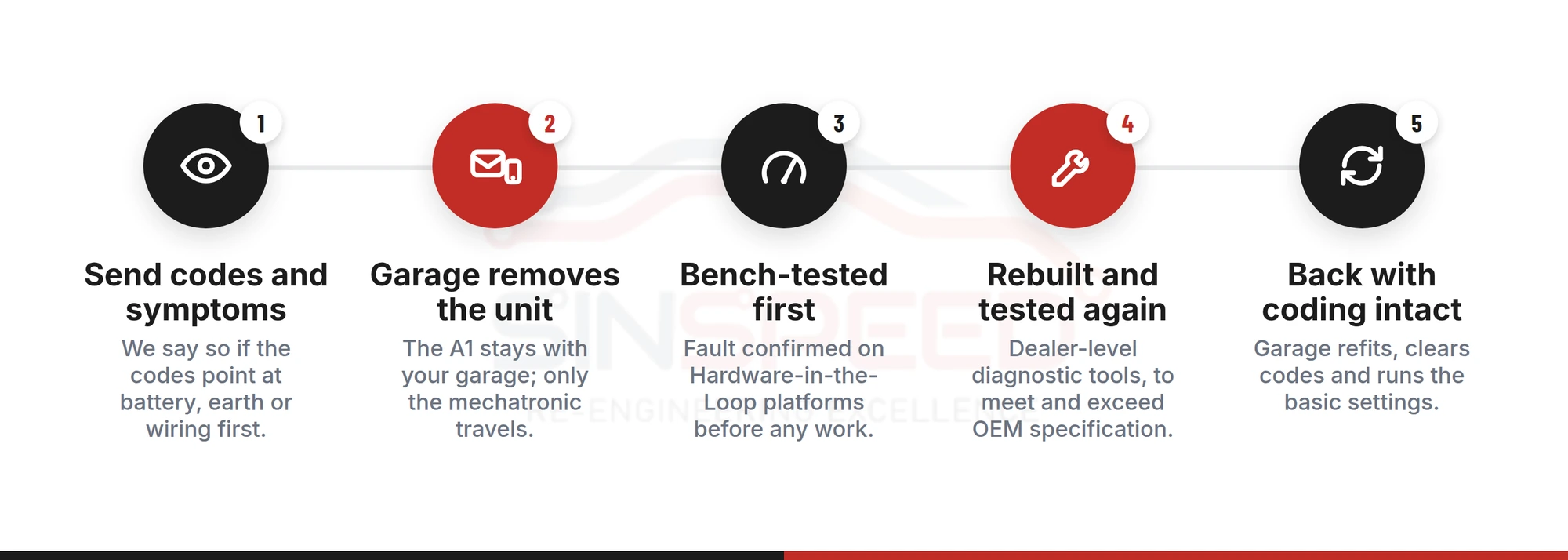
- Give us the codes and the symptoms
The repair form asks for the car, its year, every stored code and what the gearbox is doing. If the codes point at the battery, an earth or the wiring first, we tell you before the unit comes out.
- Your garage takes the unit out
The mechatronic comes out with the gearbox left in the car. It holds hydraulic pressure even when the car is parked, which is one more reason the job belongs with a garage. Protect the connector and pad the unit so it cannot move in transit.
- We confirm the fault before we touch it
The unit is tested on the bench before any work starts, then run on our in-house Hardware-in-the-Loop platforms, which simulate heat, vibration and load, so the fault you reported shows itself.
- Rebuilt, then tested a second time
Our electronic and hydraulic engineers rebuild the unit, strengthening the known weak points with stronger components rather than restoring the original design. It is then tested again, with dealer-level diagnostic tools, to meet and exceed OEM specification.
- Back to your garage to refit
The unit returns with its coding intact. Your garage fits it, clears the stored codes and runs the basic settings and adaptations — routine steps for any unit going back into a DSG.
Audi A1 DSG gearbox ECU: common questions
My A1’s gear display is flashing and the EPC light is on. Is that the DSG unit?
It is the most common way an A1’s mechatronic unit shows a fault, especially if gears stop selecting or changes turn jerky at the same time. The stored codes settle it: pressure or pump codes alongside the flashing display point at the unit.
A new fuse was fitted and the fault came back. Why?
Because the fuse was a casualty, not the cause. When the unit loses pressure, its pump works far harder than it should, and a pump motor under that strain is what takes out the fuse. Until the pressure fault inside the unit is dealt with, a fresh fuse only resets the clock.
Do you repair both the older and the newer Audi A1?
Yes. We list repairs for 2010–2018 A1s and for 2018–2021 cars. Gearbox fitment varies with engine and year, so send us the gearbox code or the number on the unit’s label and we will confirm what your car has before anything is posted.
Will the rebuilt unit need programming when it goes back in?
No. It is your A1’s own unit, so it keeps the coding it left with. Your garage refits it, clears the stored codes and runs the basic settings the gearbox asks for, which is a normal part of fitting any unit.
My garage has quoted for a replacement gearbox. Could the unit be the only fault?
Often it is. Loss of drive, a flashing indicator and pump codes can all come from the mechatronic alone. Clutch wear and bearing noise are genuine gearbox faults, so have the unit bench-tested first; that tells you which job you are actually facing.
Final thoughts
An A1 gearbox unit tends to get diagnosed one symptom at a time: a fuse for the voltage code, a pump for the pump code, a clutch for the judder. Each fix is real enough to look like progress, right up until the gear display starts flashing again.
The pattern is the clue. When pressure codes, pump codes and a flashing indicator arrive together, they are one fault in one assembly, not three separate jobs. Record everything the car has stored, have the unit bench-tested as a whole, and only then decide whether clutches or a gearbox belong in the conversation.
Sinspeed · Audi A1 mechatronic rebuilds
Keep the gearbox and fix the part that is actually failingTell us the car, the codes and what the gearbox is doing. We will confirm whether the unit is the likely cause and what your garage needs to send.
Rebuilt with its weak point strengthened · Checked with dealer-level diagnostic tools before dispatch · Returned for your garage to refit