
Summary: An F or an N in the gear display, solid or flashing, on a Vauxhall Easytronic most often leads back to the clutch actuator: the unit on the gearbox that works the clutch and carries electronics coded to the car. It is the same weak point across the Easytronic range, from the Astra and Zafira to the Meriva and Agila. Your garage removes it and posts it to us; we bench-test it, repair it and send it back with its coding intact, so it goes back on without programming.
This page covers the Easytronic clutch actuator across every Vauxhall that used it, with the model list and the part numbers further down. Automated-manual actuators for other makes are gathered in our clutch and gear actuator repairs hub.
- The part: the Easytronic clutch actuator, mounted on the gearbox, which works the clutch and carries electronics coded to the car
- Typical signs: F or N in the gear display, solid or flashing; a gear that will not engage; a car that will not start
- Codes to note: P1607, P1732, P1735 — and every other code stored
- Models: Astra, Corsa, Meriva, Zafira, Agila, Signum, Tigra and Vectra with Easytronic
- The service: your garage removes the actuator and posts it; we test, repair and return it
- On refit: no programming, because your own coding comes back with it
- Warranty: lifetime warranty on our remanufactured Easytronic actuators
What does the Easytronic clutch actuator do?
Easytronic is Vauxhall’s automated manual gearbox. Mechanically it is a manual — a clutch and a set of gears, with no torque converter — but there is no clutch pedal. The system decides when to release the clutch, when to change gear and how gently to let the clutch back in, and the clutch actuator is the part that carries out the clutch half of that work.
It is more than a motor. The actuator carries its own electronics and is coded to the car it was fitted to. That is the reason a second-hand unit cannot simply be bolted on in its place. And when it fails, the effects can reach beyond the gear changes: a failing actuator can stop the car starting at all.
Easytronic belongs to the same family as Fiat’s Dualogic and Alfa Romeo’s Selespeed — robotised manuals that work an ordinary gearbox for you — and, as with those, the actuator is the part of the system that most often brings these cars to us. If you have a Fiat or an Alfa instead, our Dualogic clutch actuator repairs page covers it.
What are the signs of a failing Easytronic actuator?
The gear display gives it away first. Where the gear number normally sits, an Easytronic with an actuator problem shows a letter instead.
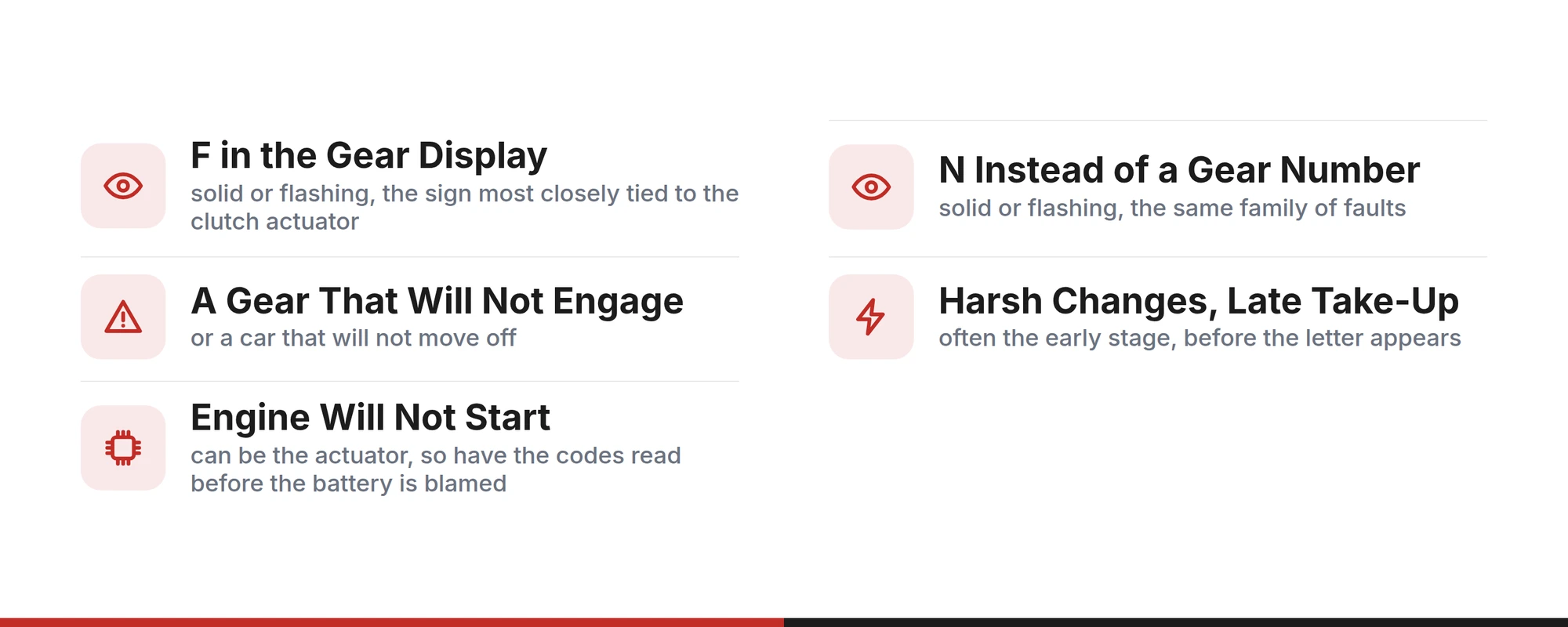
- An F in the gear display, lit solidly
- An F in the gear display, flashing
- An N in the display, solid or flashing
- The engine will not start
- A gear that will not engage, or a car that will not move off
- Harsh, jerky changes, or a clutch that takes up late
The F is the sign most closely tied to a failed actuator, whether it is solid or flashing. An N behaving the same way belongs to the same family of faults. A car that will not start can be the actuator too, which catches out owners who assume the battery or starter is to blame.
The stored codes narrow it down. These are the Easytronic codes most closely associated with the actuator:
| Code | What the scan tool reports | What it can point at |
|---|---|---|
| P1607 | Clutch actuator position control error | The actuator not putting the clutch where it was told to, or not reporting its position correctly |
| P1732 | Gearbox parameter limit reached | The learned clutch values have run out of range — wear in the actuator, the clutch, or both |
| P1735 | Gearbox parameters not learned | The system has no valid learned values to work from, common after a part has been changed without the learn being completed |
Write down every code stored, not only these, and send them with the unit. Our guide to clutch actuator fault codes covers the generic codes in more depth, and clutch actuator fault symptoms walks through the wider symptom picture.
Why do Easytronic clutch actuators fail?
The actuator does the work of your left foot. Every pull-away and every gear change is a clutch movement it has to make, with nobody to share the load. A car that spends its life in town traffic and on short runs asks far more of it than one that cruises on the motorway.
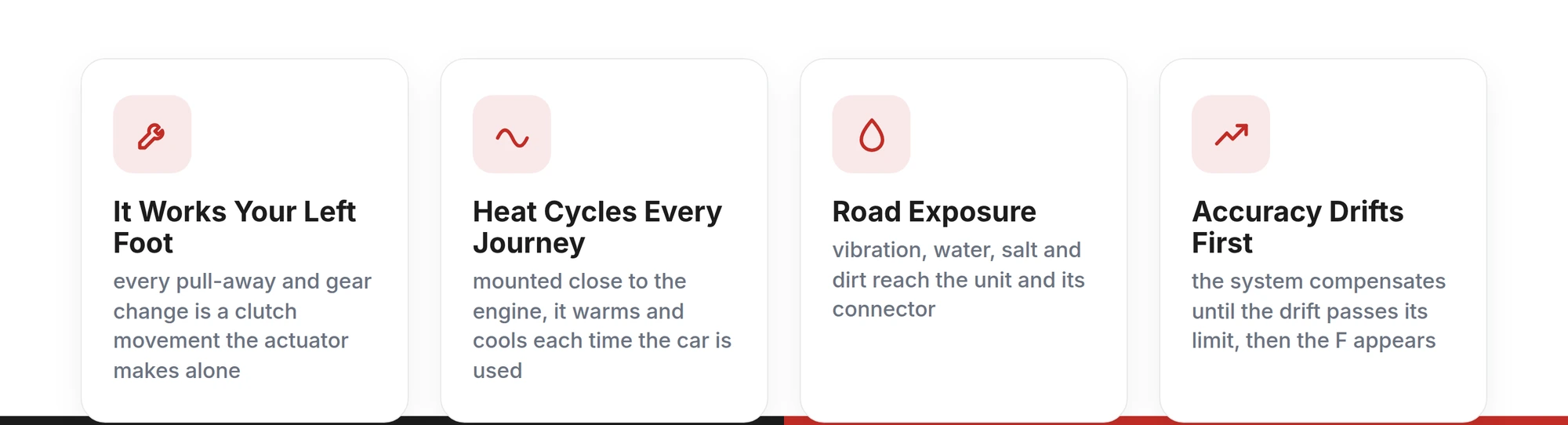
It is warmed and cooled on every journey. Sitting on the gearbox, close to the engine, the actuator goes through a heat cycle every time the car is used. Over the years that cycling wears on its electronics as much as on its moving parts.
It is exposed. The unit is shaken by the gearbox continuously, and water, salt and dirt reach it and its connector from the road and the engine bay. Its electrical connection has to stay clean and secure for the rest of the car to control it accurately.
Its accuracy drifts before it fails. As the actuator wears, its sense of where the clutch actually is begins to wander. The system adapts and compensates until the drift goes past what it can correct — and then the F appears. That is why many cars give a run of harsh changes or a late bite before they stop altogether.
Is it the actuator, the clutch or something else?
An F on the dash says the Easytronic system has a fault. It does not say which part. Several other things produce the same complaint, and each gets blamed on the actuator sooner or later.
| What you notice | Pointing at the actuator | Pointing elsewhere |
|---|---|---|
| F or N with P1607 stored | The actuator not placing the clutch where it was commanded | The wiring or connector between the actuator and the rest of the car |
| Late bite, slipping or harsh take-up | Drift in the actuator’s control of the clutch | A worn clutch whose bite point has moved beyond what the system can learn |
| P1732 after a spell of rough changes | An actuator at the limit of what it can correct | A clutch near the end of its life — often both together on higher-mileage cars |
| A gear refused or grinding, no clutch codes | Less likely on its own | The gear-selection side of the system |
| Will not start, F showing | A failing actuator, which can stop the car starting | A battery or starting fault unrelated to the gearbox |
A worn clutch and a drifting actuator can look identical on a scan tool, and older cars often have both. Fit a replacement actuator to a car whose clutch is finished and the fault can come straight back. If the car simply refuses a gear, our guide to why a car won’t go into gear covers the causes outside the actuator.
Bench testing separates them. Run on its own, under load and at temperature, the actuator either behaves to specification or it does not. If yours is sound, you know before anything else is bought, and we tell you where the fault is more likely to sit.
Sinspeed · Vauxhall Easytronic
Got the codes? Tell us before anything comes offPut the model, the engine, the letter in the display and every stored code on the repair form. We will tell you whether the actuator looks like the right unit to send.
Bench-tested before and after repair on our own Hardware-in-the-Loop platforms
Which Vauxhalls use the Easytronic clutch actuator?
The same failing part turns up across every Vauxhall that was offered with Easytronic. These are the models that reach our workshop:
| Model | Easytronic versions |
|---|---|
| Astra | Astra G and Astra H |
| Corsa | Corsa C and Corsa D — the 1.2 has its own page: Corsa 1.2 Easytronic actuator repair |
| Meriva | Meriva with the Easytronic option |
| Zafira | Zafira B |
| Agila | Agila A |
| Signum | Signum with Easytronic |
| Vectra | Vectra with Easytronic |
| Tigra | Tigra with Easytronic |
If your model is not listed, or you are not sure which version you have, send us the registration and we will confirm the unit before anything is removed.
Easytronic clutch actuator part numbers
Easytronic actuators were made under a range of part numbers. Some are interchangeable; many are not. Two cars that look identical — same model, same engine — can carry actuators with different numbers that will not swap between them.
These are the numbers we see most often on units sent in to us:
| Part number | Part number |
|---|---|
| 9126186 | 0132900002 |
| 1208067 | AG9D300711A |
| GID300607A | AG9D300711B |
| AG9D300710B | AG9D300709A |
| 93189764 | 55354623 |
| 93175433 | 0132900008 |
The number is on the label on the actuator itself. Read it before anything is ordered and put it on the repair form. It matters most if a second-hand unit is tempting: a matching description in a listing is not a matching part number, and the wrong number is the wrong part however similar it looks.
If your number is not in the table, that does not mean we cannot repair it. These are simply the ones we see most often — send yours and we will check it.
Repair your own actuator, or buy another one?
Finding an Easytronic actuator is easy. Finding the right one, and getting it to work on your car, is the hard part.
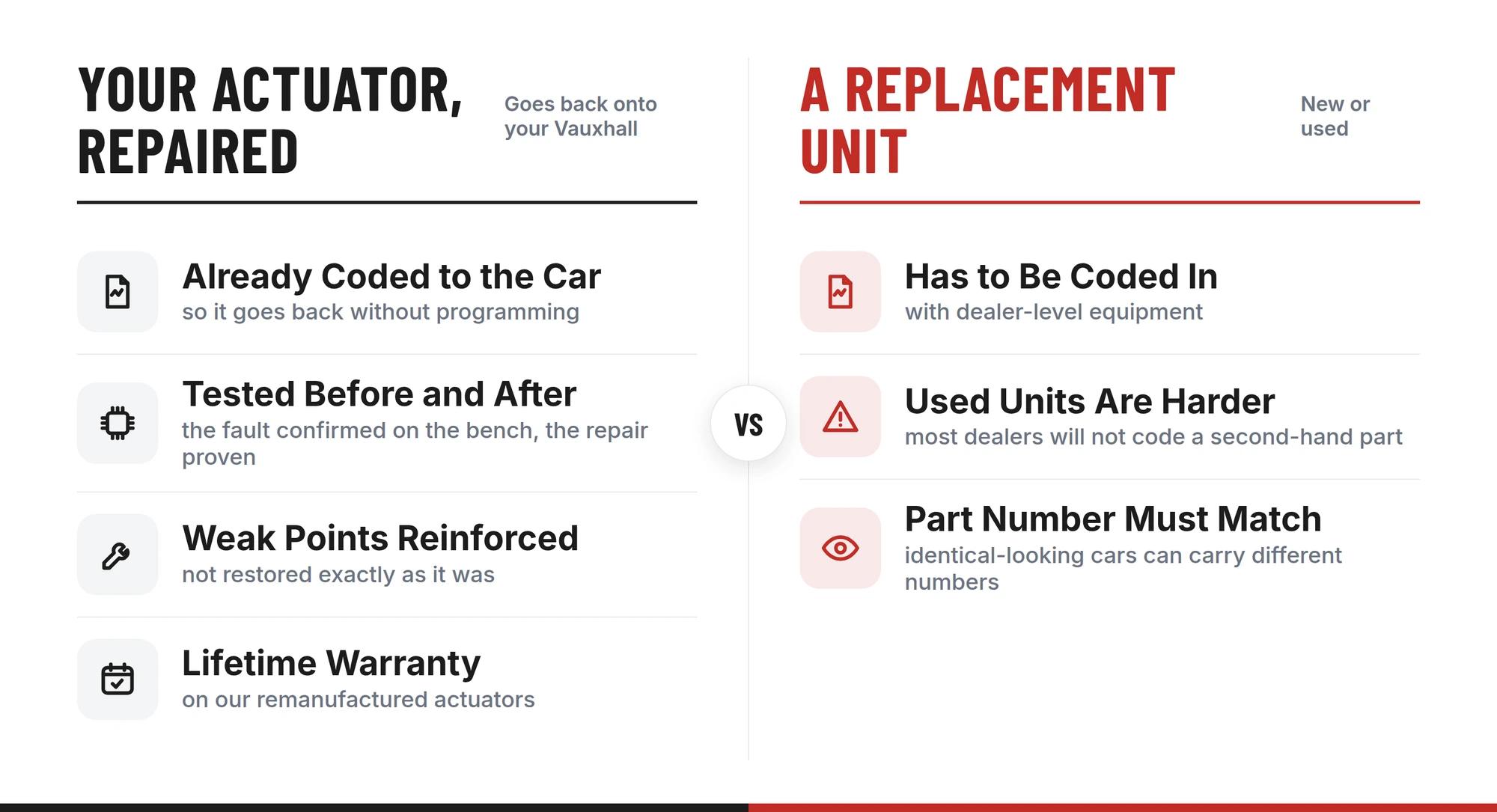
- A new unit from a dealer has to be coded to your car, with the labour and programming that involves. It is the same design that failed on your car, and it normally comes with a standard 12-month warranty.
- A used unit also needs coding with dealer-level equipment, and most dealers will not code a second-hand part at all. It may carry a different part number from yours, and used-part warranties tend to run from 30 to 90 days.
- Your own actuator, repaired, is already coded to your car, so it goes back without programming. It is tested before the work to confirm the fault and after it to prove the repair, and the known weak points are reinforced rather than restored exactly as they were. Our remanufactured actuators carry a lifetime warranty.
Whatever goes back on, the Easytronic has to learn the clutch it is working with. A clutch-point learn with a diagnostic tool once the actuator is refitted is good practice on any Easytronic — it is a routine fitting step for your garage, and quite separate from coding.
How the Easytronic actuator repair works
The car stays with your garage. Only the actuator travels.
- Tell us about the car
Fill in the repair form with the model, engine and registration, the letter in the gear display, every stored code and the part number from the label. If the clutch has been changed recently, say so — it changes how we read the codes.
- Your garage takes it off and posts it
Removing and refitting the actuator is everyday work for a garage. Wrap the unit well, keep the connector covered, and include a note with your details.
- We prove the fault first
The actuator is run on our Hardware-in-the-Loop platforms, which reproduce the heat, vibration and load it meets on the gearbox, and its behaviour is recorded before any work starts.
- Repaired in-house, then retested
Our engineers repair the unit in a cleanroom-standard, ESD-safe workshop, and it is calibrated with dealer-level diagnostic equipment and put through the same tests again before dispatch.
- Back to your garage
It returns with its coding intact and bolts straight back on. A clutch-point learn finishes the job on the car.
Vauxhall Easytronic actuator: FAQs
Sinspeed · Easytronic actuator repair
Keep the actuator your car already knowsYour garage posts the unit, we prove the fault on the bench and repair it, and it goes back on without programming.
Calibrated with dealer-level diagnostic equipment before dispatch · Lifetime warranty on remanufactured Easytronic actuators
Final thoughts
An F on an Easytronic dash feels like the end of the gearbox, but the cause is often one unit on the outside of it. That unit is coded to your car, which is the best reason to keep it: a replacement has to be found with the right number and coded in, while your own actuator, repaired, simply goes back on.
Read the codes, note the letter in the display and the number on the label, and rule out the clutch. If the actuator is the fault, your garage sends it to us and it comes back proven.