
Summary: Every code on this page is a disagreement about one number: how far the clutch actually moved. An actuator pushes the clutch, a position sensor reports where it got to, and the controller compares that report with what it asked for. P0810, P0811, P0900, P0901, P0902 and P0903 are all stored when the report and the command stop agreeing — which can be the sensor, the actuator, the wiring, or a calibration that was never taught in. P0904 is on the list for a different reason: it is about the selector rather than the clutch. This page takes each code in turn and says what it rules in, what it rules out, and which unit it points at.
- What all seven codes are actually comparing
- Which automated gearbox you have, and why it decides the answer
- P0810: the commanded clutch position and the reported one stopped agreeing
- P0811: the clutch is not holding what the gearbox thinks it commanded
- P0900: the circuit to the actuator itself
- P0901: the circuit is there, and the response is wrong
- P0902 and P0903: circuit low and circuit high
- P0904: this one is not the clutch at all
- Why a new actuator that was never taught in stores the same codes
- The seven codes side by side
- What to rule out before anyone quotes you for a clutch
- Which unit to send, and what we need with it
- Clutch actuator fault code FAQs
- Final thoughts
What all seven codes are actually comparing
An automated manual gearbox is an ordinary clutch and an ordinary gearbox with the driver taken out of two jobs. Where your left foot and your left hand used to be, there is an actuator moving the clutch and, on most systems, a second one moving the selector. If you want the components explained first, we have written what clutch and gear actuators do.
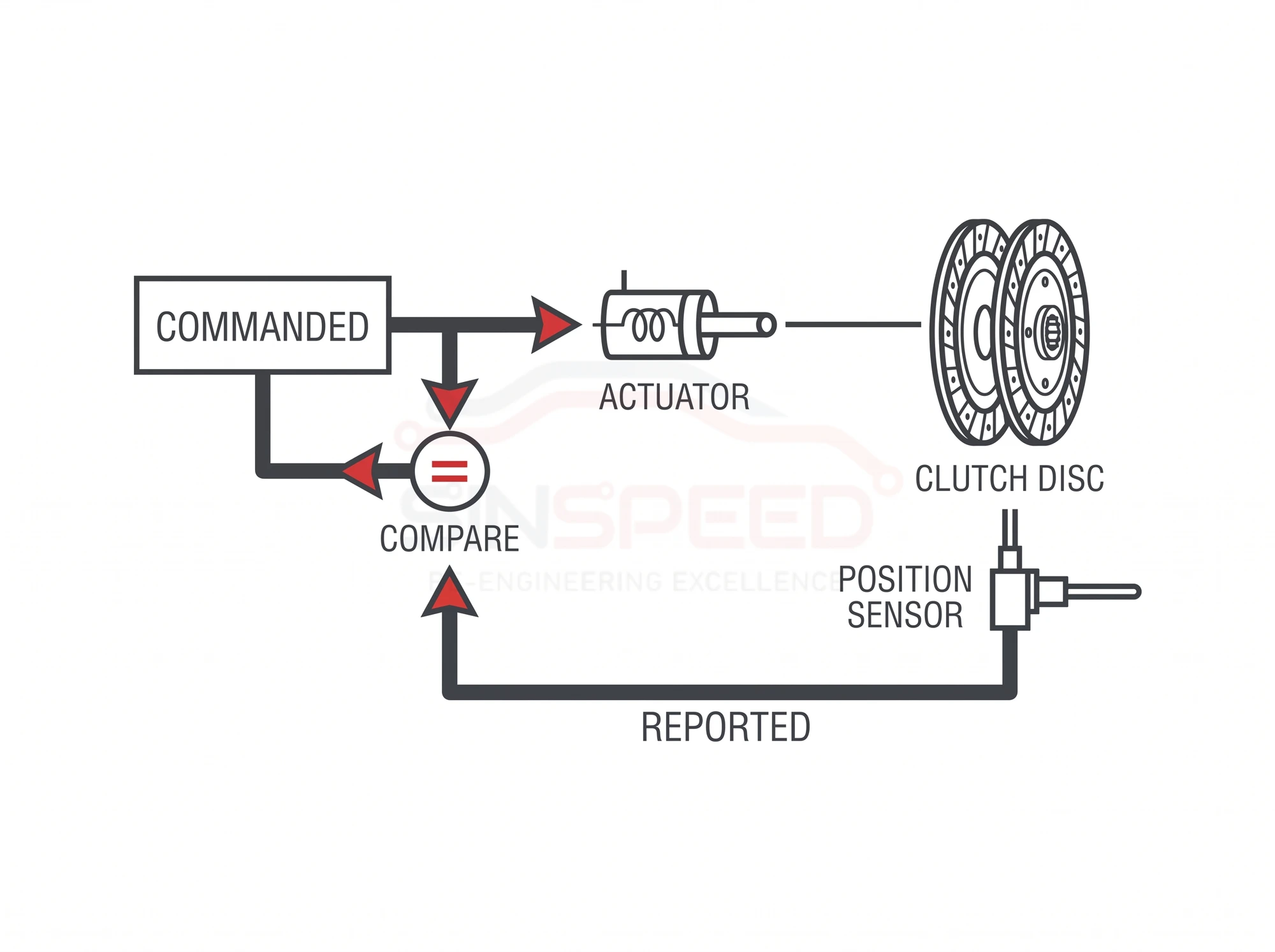
The actuator is only half of the arrangement. Inside or alongside it sits a position sensor that reports how far the clutch has actually travelled — a continuously varying signal rather than an in-or-out switch. The controller commands a position, the sensor reports a position, and the controller compares the two, many times a second. That comparison is the loop every code on this page lives inside. The same loop runs the drive-by-wire throttle at the other end of the car, commanded angle against reported angle, which is why throttle body fault codes read so much like these ones.
Which means a code in this family is a disagreement about one number, and there are only four places the disagreement can start: the circuit carrying the command, the actuator meant to obey it, the sensor reporting back, or the learned values the controller measures the result against. A worn clutch is not one of the four. One code on the list can be produced by a worn clutch, and it is not the one most people arrive with.
It is also why these gearboxes react so hard to what sounds like a minor electrical fault. Without a clutch position it can trust, the controller cannot judge how much torque the clutch is carrying, cannot pull away cleanly and cannot protect the clutch from slipping. That torque figure is a calculation rather than a measurement, worked out from the air the engine is taking in, so the P0101 mass airflow code is worth ruling out when an automated gearbox misbehaves with nothing wrong inside it. Refusing to use it is the only safe option left, which is why these codes arrive with a car in limp mode, stuck in one gear, or not moving at all.
Take that seriously on the road. The fault does not always wait until you are stationary: on these gearboxes the car can drop out of the gear it is in and back into neutral while it is moving. Losing drive on a roundabout or a slip road is a hazard to more people than the driver, so this is a fault to have read rather than one to keep an eye on.
This page is written for a reader who already has a code. If you have the feel of the fault and no code yet, start with clutch actuator fault symptoms and come back once the car has been scanned. If you want the repair side rather than the diagnosis, that is clutch and gear actuator repair.
Which automated gearbox you have, and why it decides the answer
Most people reach a code like this without knowing what their gearbox is called, because the badge on the boot rarely says. It matters for one practical reason: on some systems the clutch actuator is a separate unit bolted to the outside of the bellhousing, and on others it is sealed inside a mechatronic assembly with the control electronics. That decides what has to come off the car.
- Peugeot and Citroën 2-Tronic, Sensodrive, ETG5 and ETG6 — an electro-hydraulic actuator from the SACHS family, shared in principle with the Fiat Dualogic and Alfa Romeo Selespeed systems.
- Toyota MMT (Multimode) — Aygo, Yaris, Auris and Corolla Verso. Two separate electric actuators: one for the clutch, one for the gear selector.
- Honda i-Shift — Jazz and Civic among others, with an electric clutch actuator in place of the pedal.
- Vauxhall Easytronic — a robotised manual with a well-recognised actuator fault; we cover it on the Easytronic clutch actuator page.
- Mini Steptronic, early One and Cooper — a robotised single-clutch gearbox, and not the later conventional automatic that wears the same name.
- Ford PowerShift — a dual clutch, so two clutches and two actuators.
- VAG DSG and S tronic — the actuators and their position sensors sit inside the mechatronic unit, which is why the same code becomes a different job here.
If none of those fits and your car has a clutch pedal you are in different territory, because the generic wording of several of these codes was written around a switch on a pedal. P0810 below says which of the two readings applies to you.
One dashboard behaviour is worth naming, because it is common on these systems and routinely described as something else: a gear display that flashes instead of showing a gear — a flashing N on a Toyota MMT, a flashing PRNDS on other layouts. It is the controller saying it cannot confirm the state of the clutch or the selector, which is precisely what these codes are about. We take that display apart on the PRNDS flashing light.
P0810: the commanded clutch position and the reported one stopped agreeing
P0810 is defined as clutch position control error, and the operative word is control. The controller asked for a clutch position, watched the feedback, and the feedback did not arrive where it was sent — or did not arrive at all. It is a statement about a control loop. It says nothing about how much friction material is left.
Three faults produce it, and they are not equally expensive. The position sensor can be reporting a value that is wrong or drifting, in which case the clutch is where it should be and the report is not. The actuator can genuinely be failing to reach the commanded position, through motor wear, mechanical resistance, or a hydraulic problem on the systems that use fluid. Or the learned values the controller compares against can have stopped describing this clutch and this actuator, which is the case taken apart under teaching in, below.
On automated manuals the code is most often stored when the actuator’s own internal position sensor fails or begins to report incorrect data, at which point the gearbox goes into limp mode and refuses to change gear. On Honda’s i-Shift the recognised set alongside it is a car that will not start, a gearbox that will not shift to the correct gear, and the N symbol flashing on the display.
The refusal to start is worth understanding rather than worrying about. The controller will not crank the engine unless it can prove the clutch is open, because starting an automated manual with the clutch closed would drive the car forward on the starter motor. A P0810 removes that proof. The engine is usually fine.
Be careful with generic code lookups here. Most of them define P0810 around a clutch pedal switch on an ordinary manual car, because that is the generic wording, and everything that follows is advice about a switch you do not have. If your car does have a clutch pedal then that reading is the correct one, and P0805 belongs beside it — we take that pair apart on transmission control module fault codes.
P0811: the clutch is not holding what the gearbox thinks it commanded
P0811 is excessive clutch slippage, and it is the only code here that measures an outcome rather than a circuit. The controller compares engine speed against transmission input-shaft speed. For a given clutch position those two figures have a fixed relationship, so when the engine is turning faster than the input shaft by more than the commanded position allows, the clutch is passing less torque than it should be.
One manufacturer’s service data sets the comparison out in exactly those terms: vehicle inputs, clutch command, clutch position and input shaft speed, checked against each other continuously to confirm the clutch is doing what it was told.
There are two ways to arrive at it and only one is the expensive one. The clutch really can be slipping, through worn friction material, oil contamination from a leaking seal, or insufficient clamp load. Or the actuator is not closing the clutch fully — a travel limit or a learned value stopping it short — which produces a reading identical to wear on a clutch with plenty of life left.
This is the code on the list most likely to end at a genuinely worn clutch, and it would be dishonest to suggest otherwise. What it does not do is prove one. Slip that grows with load and heat, and engine revs that climb without matching road speed, point at the friction side. Slip that appears immediately after clutch or actuator work points at the values rather than the parts. A car that simply feels gutless, with the engine never running away from the road speed, is not slipping at all; on an older diesel that reads far more like one of the pump EDC fuelling codes.
P0811 also appears on conventional torque-converter automatics that have no clutch actuator at all. There, clutch A is an internal clutch pack or the lock-up clutch, and the cause is hydraulic — pressure lost in the valve body rather than an actuator refusing to close. If your car has no automated clutch, none of the actuator reasoning on this page applies to your P0811.
P0900: the circuit to the actuator itself
P0900 is clutch actuator circuit, open. The controller tried to drive the actuator and the circuit did not behave like a completed circuit. Of the seven this is the most literal: something in the electrical path between the controller’s output stage and the actuator’s motor is not connected.
That path is short, and there are only a few places along it that fail: the connector at the actuator, the harness back to the controller, the motor windings and brushes inside the actuator, and the driver stage inside the controller.
The motor is the interesting one, because there is a documented failure mode behind it. Toyota’s own technical service bulletin covering a P0900 clutch actuator circuit malfunction attributes the fault to contamination inside the actuator motor — carbon powder shed by the brushes mixing with the grease. The production change that answered it was a plastic cover fitted around the brushes, and the service repair is to clean the motor and the actuator assembly and fit that cover. That is a wear-and-contamination fault inside a unit, not a gearbox fault, and it is the kind of thing a bench strip finds and a scan tool never will.
The same code on the early Mini Steptronic is stored where the actuator motor circuit fails through internal motor wear or degradation of components on its circuit board. Different housing, same story.
Set against what people are usually quoted when this code appears, P0900 is not bad news. A circuit reading open has a physical cause in a findable place, and on most of these systems the failing part is a unit that comes off the car on its own.
P0901: the circuit is there, and the response is wrong
P0901 is clutch actuator circuit range/performance. Range/performance is the wording used when a signal is present and implausible: the circuit is intact, the actuator answered, and what came back sat outside the window the controller expected. A signal that has vanished altogether gets P0900 instead.
The causes usually listed are the actuator itself, an open in the circuit to it, a loose or disconnected earth, and a failing solenoid on the hydraulic systems. The earth deserves more attention than it normally gets. An actuator on a high-resistance earth path still works, just not quickly enough or far enough — which is what range/performance means in one sentence.
The check to make before condemning anything is the learned values. An actuator in perfect health, driven against adaptation data that describes a different clutch, moves exactly as commanded and still lands outside the expected window, because the window itself is wrong. P0901 and P0810 travel together for that reason, and the pair appearing shortly after work on the clutch is a strong hint that nothing has failed at all.
P0902 and P0903: circuit low and circuit high
These two are a pair and read as one. P0902 is clutch actuator circuit low: the voltage the controller saw on the circuit sat below the expected range. P0903 is clutch actuator circuit high: it sat above it.
As a rule they point in opposite directions. A low reading is usually a short to earth or an open somewhere in the path. A high reading is usually a short to a supply voltage, or a circuit not being pulled down when the controller stops driving it. Both are wiring-first codes, and both earn a proper look at the connector and the loom before anything is unbolted.
In the UK these two turn up most often against Ford’s dry dual-clutch PowerShift, where the clutch actuators are a recognised weak point; we cover that gearbox on Ford PowerShift problems. A dual clutch means two clutches and two actuators, so a code naming one of them is naming one side of the gearbox — useful, because a car that has lost half its gears has already told you which side to look at.
Of the seven codes here, these two are the most likely to finish at a connector, a chafed wire or a corroded pin. That is auto-electrical work on the car and it is not a service we sell, which is a reasonable ground for believing us when we say the other codes point somewhere else.
P0904: this one is not the clutch at all
P0904 is gate select position circuit, and it is the code most often misread on this list, because it sits in the middle of a block of clutch codes while describing the selector.
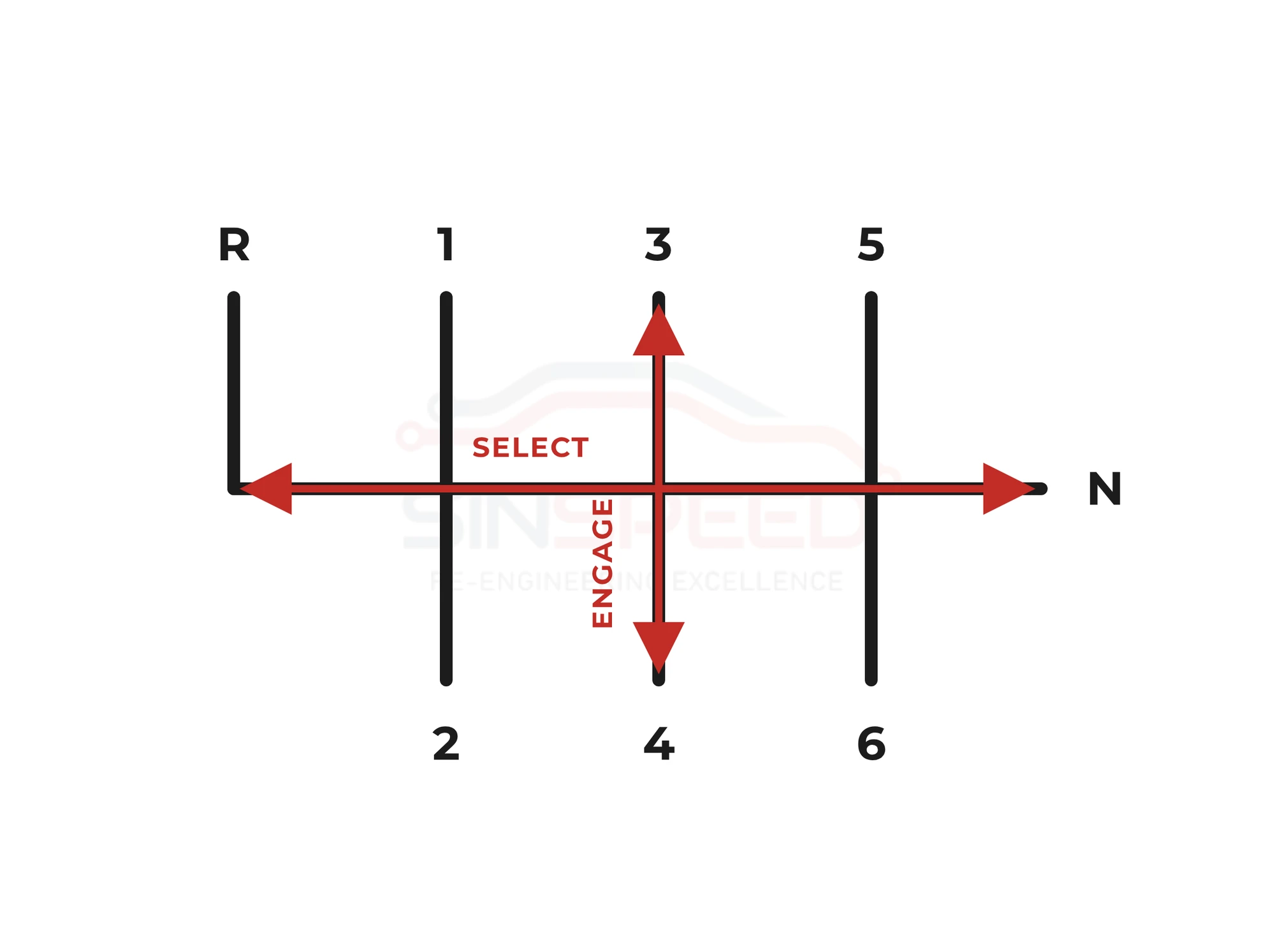
Picture the pattern your hand moves a gear lever through. There are two movements: across the gate to choose a plane, and along it to engage. An automated manual makes both of those with machinery, and it has to know where it is on both axes. P0904 is the across-the-gate position — which plane the mechanism is in — reported by a sensor whose signal the controller could not make sense of.
Where that sensor lives depends on the layout. On systems with two actuators, the Toyota MMT among them, the gear selector actuator is its own unit, distinct from the clutch actuator and removable on its own. On other layouts the position is read by a shift-lever position sensor built into the selector assembly. Either way, the clutch actuator can be in perfect health while this code is stored.
P0905 through P0908 are the same circuit reported low, high and intermittently, and P0909 is a gate select control error — the selector was commanded to a plane and did not reach it, which is the selector’s version of P0810.
What brings it in is a car that will not take a gear, or sits between gears; we go further into that on why a car will not go into gear. And when P0904 arrives alongside P0900, both actuators are implicated — a pairing common enough on the Toyota MMT that it is usually worth sending the two together rather than one and then the other.
Why a new actuator that was never taught in stores the same codes
This is the part of the job the field leaves out, and it is the reason a reader can pay for a new actuator and get the identical code back three days later.
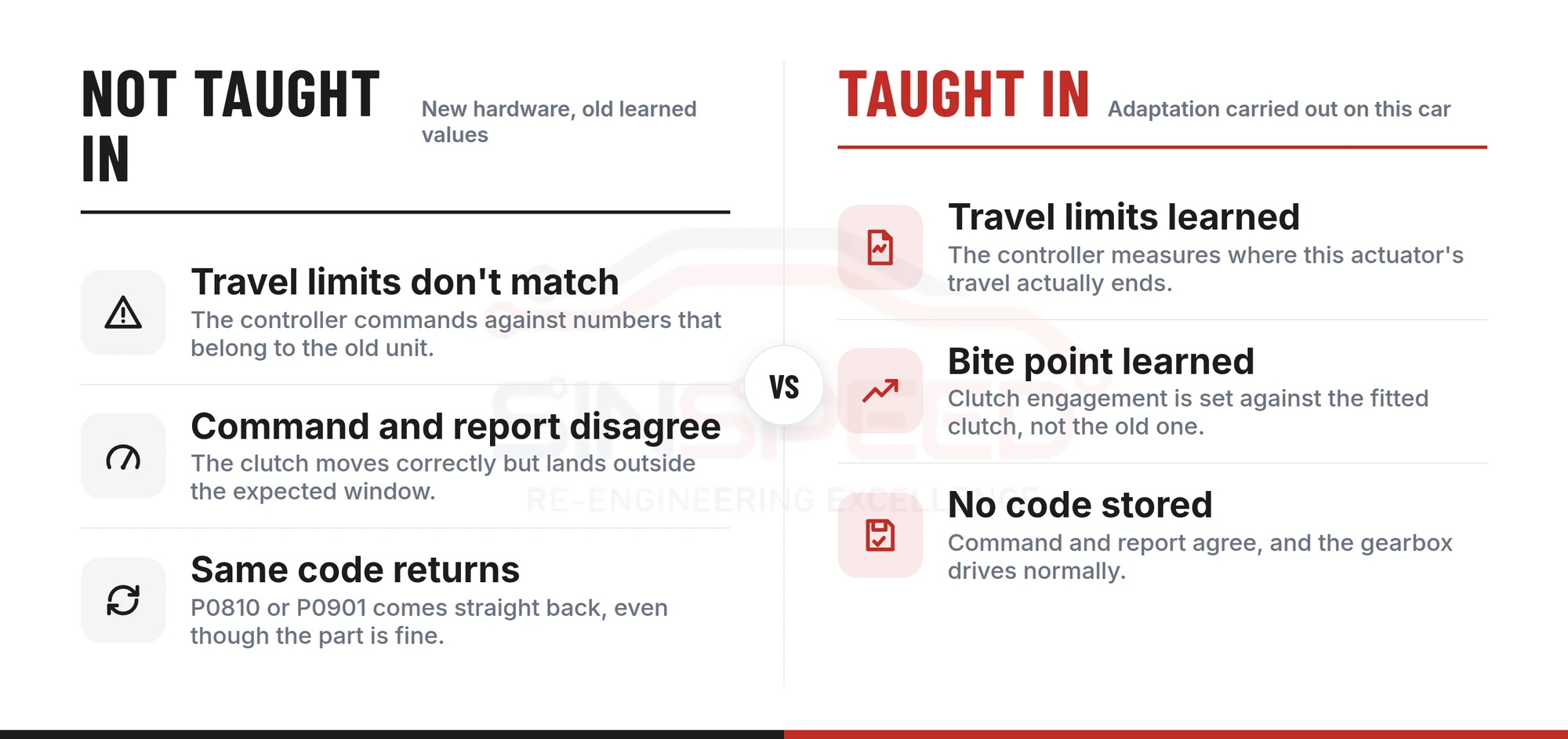
An automated manual is not fitted with universal numbers. The controller has to learn, on that car, where the actuator’s travel ends, where the clutch begins to bite, and on the selector side where each gate actually sits. Those learned values — adaptations, teach-in or basic settings, depending on whose word for it you are reading — are what every commanded position is measured against. They belong to that clutch, that actuator and that installation.
So change the hardware without changing the numbers and the controller commands a position that no longer corresponds to anything real. The feedback disagrees with the command, and P0810 or P0901 comes back. It works in the other direction too: fit a new clutch without resetting the adaptation and the bite point the controller believes in is the old one, on friction material that is now thicker.
The re-learn is not always a two-minute job either. Replacing the clutch actuator, the gear selector and the clutch together on a Toyota MMT triggers a long clutch re-learn procedure, and the time in that is a real part of what a replacement costs you.
It is also why we repair the original unit rather than sending out a different one. A unit that comes back from the bench is your unit, with its own data still on it, so in most cases it goes straight back on with no programming step at all. Where an original is beyond saving the industry alternative is cloning — copying its data onto a replacement — which exists for exactly this reason. Our engineers use dealer-level diagnostic tools to program and calibrate units before dispatch, and where a known weak point caused the failure we reinforce it rather than returning a like-for-like part carrying the same design flaw.
One question costs nothing and settles a surprising number of these. Ask whoever fitted the last part whether the adaptation was carried out afterwards, and with what tool. If the answer is vague, the part may never have been the problem.
The seven codes side by side
The fourth column is the one no generic code database has a reason to write, and it is the one that stops a code turning into a clutch quote.
| Code | What the controller compared | Most likely at fault | What this code alone does not prove | Is it a unit we repair? |
|---|---|---|---|---|
| P0810 | Commanded clutch position against the position reported back. | The actuator’s internal position sensor, or learned values that no longer fit. | That the clutch is worn. It measures agreement, not friction material. | Often — the actuator, and sometimes the controller driving it. |
| P0811 | Engine speed against input-shaft speed, for the clutch position it commanded. | Clutch friction material, or an actuator not closing the clutch fully. | That the clutch needs replacing. An actuator stopping short reads the same. | Sometimes — where the clutch is proven good and the travel is not. |
| P0900 | Whether the circuit to the actuator completed at all. | The actuator motor and its brushes, the connector, or the harness. | That the actuator is scrap. An open circuit has a location. | Usually — the clearest actuator code of the seven. |
| P0901 | The actuator’s response against the window the controller expected. | The actuator, a poor earth, or the adaptation values. | That anything has failed. Wrong learned values produce it on healthy parts. | Often — once the adaptation has been ruled out. |
| P0902 | Circuit voltage against the low limit. | Wiring: a short to earth, or an open in the path. | That the actuator is at fault. Most low readings are the loom. | Sometimes — after the wiring is proven. |
| P0903 | Circuit voltage against the high limit. | Wiring: a short to a supply, or a circuit not pulled down. | That the actuator is at fault, for the same reason. | Sometimes — after the wiring is proven. |
| P0904 | Where the selector mechanism sits across the gate. | The gear selector actuator, or the shift position sensor. | Anything at all about the clutch. This code is the selector. | Often — but the selector unit, not the clutch actuator. |
Sinspeed · mail-in repair
Send us the actuator, not the whole gearboxTell us every code, your vehicle details and what was done to the car last. If the answer is your wiring, your clutch or an adaptation nobody carried out, we will say so. If it is the actuator, the selector or the controller, that posts to the workshop and comes back to you or your garage to refit.
Mail-in repair and return, UK-wide · Most units come back with their own data intact and need no coding
What to rule out before anyone quotes you for a clutch
Cheapest and most conclusive first. The question underneath all seven codes never changes: is the reading wrong, or is the thing being read wrong?
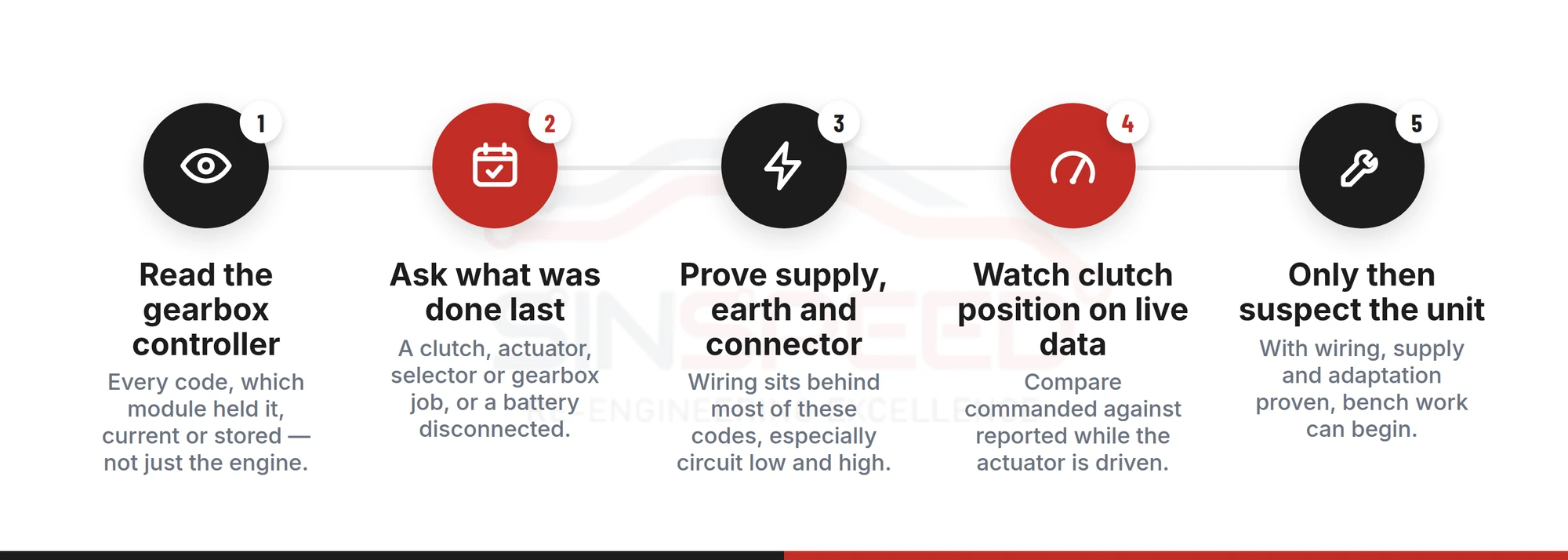
- Have the gearbox controller read, not just the engine.
Record every code, which module held it, and whether each is current or stored. A single code copied off a basic reader is an entry point, not a diagnosis, and several of these travel in pairs that mean more together than apart. The engine controller’s list matters here too: a car that feels flat rather than mechanically confused may be carrying a lean-running P0171 and nothing wrong with the gearbox at all.
- Ask what was done to the car last.
A clutch, an actuator, a selector, a gearbox out, accident repair, a battery disconnected. If any of those happened shortly before the code appeared, the adaptation is the first suspect and no part needs removing to check it.
- Prove the supply, the earth and the connector.
Every one of these codes lists wiring among its causes, and P0902 and P0903 rarely mean anything else. Look hardest at the actuator’s own connector, which lives in a hot, damp, vibrating place.
- Watch the clutch position on live data.
Compare the position the controller is commanding against the position it is being told it reached, while it drives the actuator. That single comparison separates a sensor telling lies from an actuator that cannot move, and it is the test that decides which unit travels.
- Only then suspect the unit.
With wiring, supply and adaptation proven, the actuator, the selector or the controller is what remains. That is bench work, and it is the point at which sending a unit stops being a guess.
Three of those five steps are work on the car and none of them is a service we sell. We do not fit clutches, adjust selector linkages or repair chafed looms, and we would rather say so than take a unit off a car that did not need it removed. What the order protects you from is the expensive version of this fault: a clutch, or a gearbox, quoted from a code that was only ever describing a signal.
Which unit to send, and what we need with it
If the elimination has landed on hardware, the part travels and the car stays where it is. There are usually three candidates on these gearboxes and they are not interchangeable: the clutch actuator, the gear selector actuator where the system has a separate one, and the controller driving both.
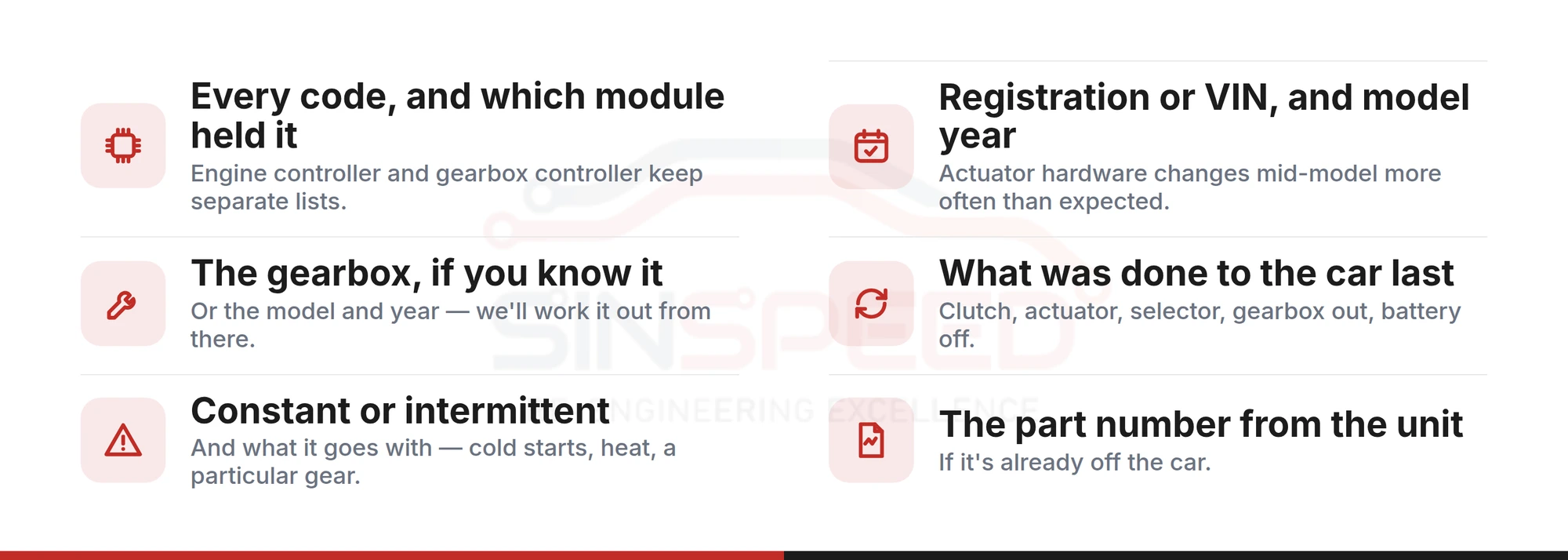
- Every code, and which module held it — the engine controller’s list and the gearbox controller’s list are different lists.
- Registration or VIN, and the model year — actuator hardware changes mid-model more often than the brochure suggests.
- The gearbox, if you know what it is called — or the model and year, and we will work it out.
- What was done to the car last — clutch, actuator, selector, gearbox out, battery off.
- Constant or intermittent — and if intermittent, what it goes with: cold starts, heat, a particular gear.
- The part number from the unit — if it is already off the car.
Which of the three to send is usually decided by the code, which is what the table above is for. P0900 to P0903 point at the clutch actuator and its circuit. P0904 points at the selector. A P0810 that keeps returning with the actuator and its wiring proven good points at the controller, and transmission control module repair is the other half of this cluster. If it is genuinely unclear, send us the codes and we will tell you which unit to remove rather than have you guess. And if the tool cannot raise the gearbox controller at all, nothing on this page applies yet — lost communication codes such as U0101 name a module that has gone quiet, which is a network problem before it is a clutch one.
For the repair-against-replacement picture in more detail, including what makes one the better call on an older car, we set that out on clutch actuator repair costs.
Clutch actuator fault code FAQs
Does P0810 mean my clutch is worn out?
No. P0810 compares the clutch position the controller commanded against the position reported back to it, so it describes a disagreement in the control loop rather than the condition of the friction material. It is most often the actuator’s internal position sensor, an actuator failing to reach the commanded position, or learned values that no longer describe the clutch fitted. The one code in this family that does measure slipping is P0811, and even that can be produced by an actuator not closing the clutch fully.
Can I drive with a clutch actuator fault code?
Treat it as a car to get read rather than a car to carry on with. These gearboxes protect themselves by refusing to use a clutch they cannot locate, which usually means limp mode, one gear, or no drive at all. Reduced power with no gearbox code behind it is a different fault, and on a diesel it is usually engine-side; the EGR fault codes P0401 to P0409 are where those begin. The fault does not always wait until you are stationary either: the car can drop out of the gear it is in and back into neutral while moving, and losing drive on a roundabout or a slip road is a hazard to more people than the driver.
A new actuator was fitted and the same code came back. Why?
The most common reason is that the adaptation was never carried out. The controller has to learn where the new actuator’s travel ends and where the clutch begins to bite, and until it does it is commanding positions measured against the old unit’s numbers. The feedback disagrees with the command and the same code returns. Ask whoever fitted it whether the teach-in was done afterwards, and with what tool. Wiring disturbed during the job is the second thing to check.
Is P0904 a clutch actuator fault?
No. P0904 is the gate select position circuit, which reports where the selector mechanism sits across the gate and says nothing about the clutch. On systems with two actuators, the Toyota MMT among them, that is the gear selector actuator, a separate unit from the clutch actuator. On other layouts it is a shift position sensor in the selector assembly. A car can store P0904 with a perfectly healthy clutch actuator, so a clutch quote raised from it is worth questioning.
Can a clutch actuator be repaired rather than replaced?
In most cases yes. The failures behind these codes are faults inside a unit: worn motor brushes and the carbon contamination that comes with them, degraded components on the circuit board, a position sensor no longer reading accurately, and worn seals on the electro-hydraulic types. Those are repairable at circuit and component level, and a repaired original goes back on carrying its own data. What repair cannot fix is a worn clutch, damaged wiring on the car, or a selector linkage problem.
Which unit do I send, the clutch actuator or the gear selector?
The codes usually decide it. P0900 to P0903 point at the clutch actuator and the circuit driving it, and P0904 to P0909 point at the selector side. Where both appear together, which is common on the Toyota MMT, both units are implicated and it is worth sending them together rather than one and then the other. If a code such as P0810 keeps returning with the actuator and its wiring proven good, the controller is the remaining candidate.
Sinspeed · mail-in repair
Been quoted for a clutch off the back of a code?Send us the codes and your vehicle details before anything comes off the car, and our engineers will tell you which unit the codes actually point at — including when the honest answer is that it is not a unit at all.
Circuit-level repair by an in-house team of engineers · Your vehicle stays where it is — only the unit travels
Final thoughts
Seven codes, and what they have in common is the thing worth taking away: every one of them is a comparison between a position that was commanded and a position that was reported. Nothing in that comparison measures wear.
That matters because of where readers usually arrive from. A car in limp mode with a gearbox code attracts clutch quotes and gearbox quotes, and on an automated manual the part that has actually failed is very often an actuator, a sensor inside it, a length of wire, or a set of learned values nobody ever taught in. Those are four different repairs with four different consequences, and only one of them involves the clutch.
So the habit is a small one. Have the gearbox controller read rather than the engine. Find out what was done to the car last. And be wary of a clutch quote raised from a code whose own name contains the word position, circuit or select — because none of those three words is about friction material.