
Summary: An Astra L shares its electronics with a Peugeot 308 rather than with an Astra H — the badge stayed put and the engineering underneath it changed hands. So a lamp you have matched correctly can still point at a fault pattern your Astra was never built to have, because almost everything written about Astra warning lights was written about the General Motors cars. This page gives every Astra dashboard symbol with a safe-to-drive verdict, then separates the lamps that mean a bulb, a fluid or a service interval from the ones that mean a failed electronic unit.
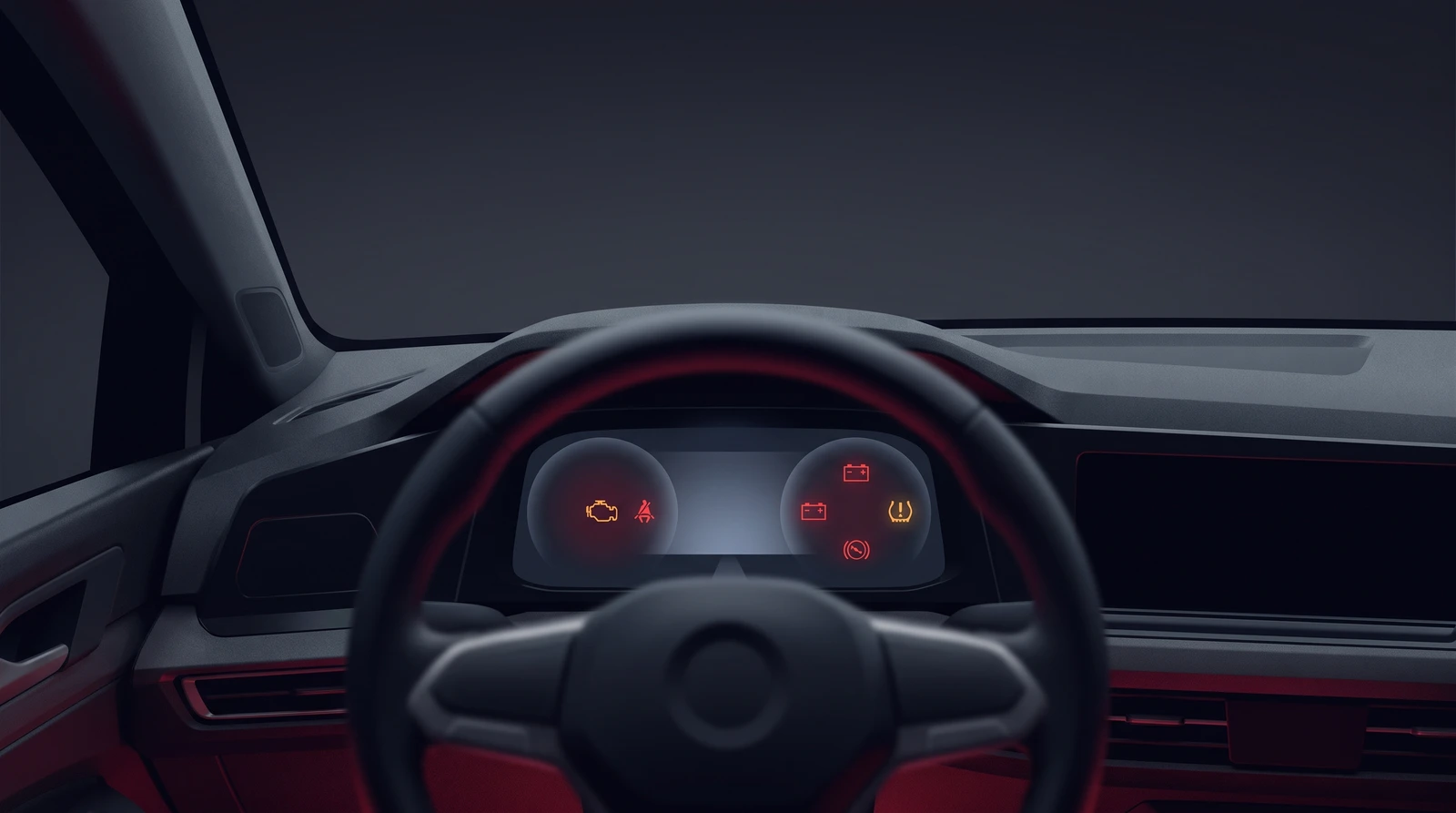
- The Astra changed hands, and the dashboard changed with it
- Vauxhall Astra warning lights and symbols: the full reference table
- Five Astra lamps that generic guides read wrong
- Which unit has actually failed: the Astra lamps that sit in front of a module
- What to do when a warning light comes on in your Astra
- Vauxhall Astra warning lights FAQs
- Final thoughts
The Astra changed hands, and the dashboard changed with it
Colour is the one part of an Astra dashboard that has never changed. Red means stop as soon as you safely can, amber means a fault has been stored, and green, blue or white only confirm that something is switched on — our guide to what a dashboard warning light is actually telling you sets that out in full.
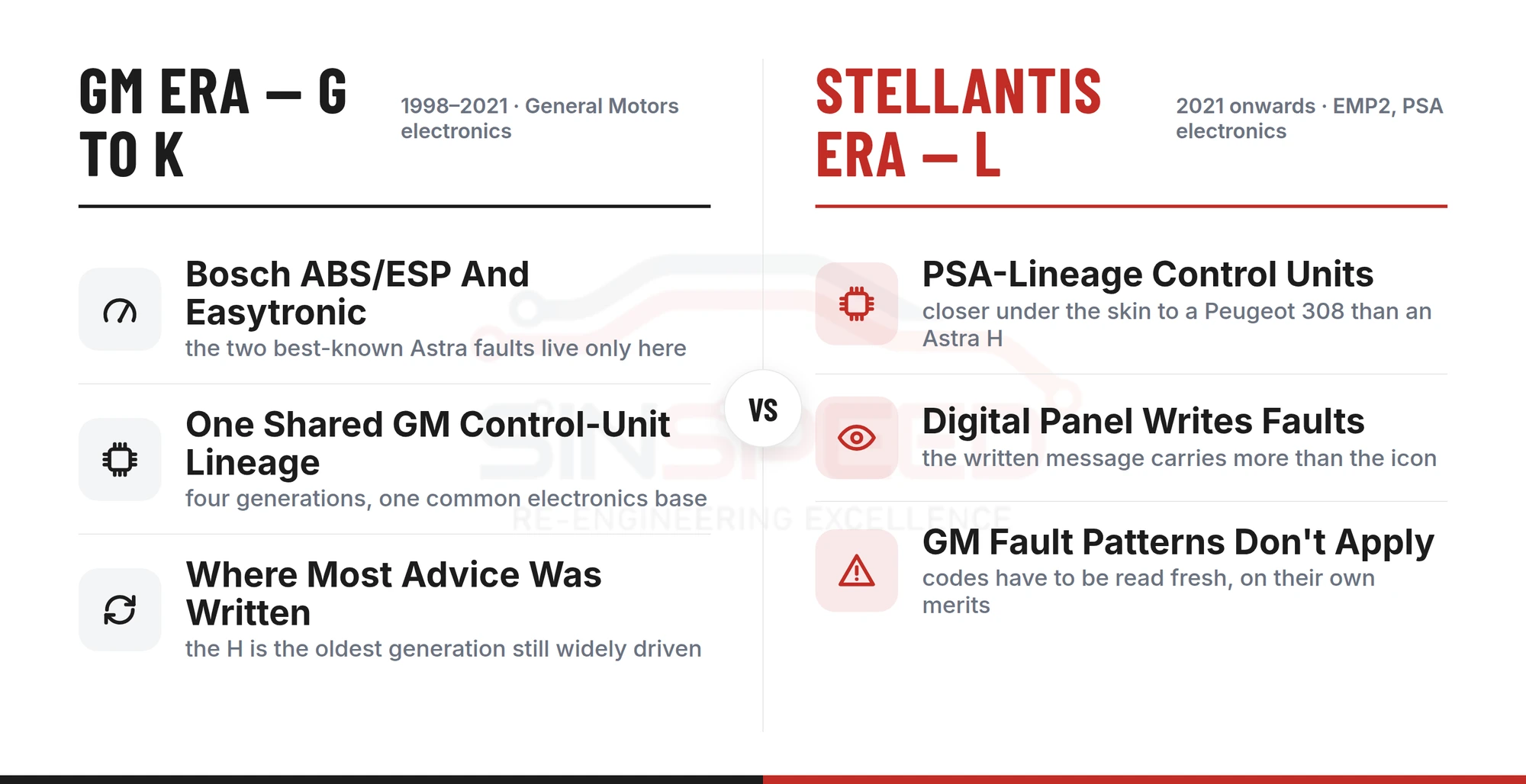
Everything behind the colour has changed. The Astra G, H and J were General Motors cars with GM electrical architecture, and the K was the last of that line. The Astra L is a Stellantis car built on the EMP2 platform, and its control units and driver-information messages come from the PSA lineage rather than the GM one. Under the skin it has more in common with a Peugeot 308 than with the Astra J it replaced two generations later.
That is not a detail for enthusiasts. It decides whether a fault pattern applies to your car at all. The two best-known Astra electrical faults — the brake-pressure sensor sealed inside the ABS unit, and the Easytronic clutch actuator — belong to the GM cars and do not exist on an L. Meanwhile almost everything published about Astra warning lights was written about the H, which is now the oldest generation most people are still driving.
| Generation | Built | What it is | What that changes on the dashboard |
|---|---|---|---|
| Astra G | 1998 to 2004 | GM T-platform. Analogue dials, a small display between them, and the shortest lamp list of the five. | Generic advice keeps offering it systems it does not have. Stability control, tyre-pressure monitoring and driver assistance are largely later arrivals. |
| Astra H | 2004 to 2010 | The generation with the longest option list: adaptive forward lighting, the deflation detection system, Open & Start, interactive driving with continuous damping control, and the Easytronic automated manual. | Two Astras of the same year can carry different lamps. If a symbol on this page is not on your dashboard, that is usually specification rather than a missing bulb. |
| Astra J | 2009 to 2015 | A heavier, more electronically dense GM car. Electric steering assistance, an electronic parking brake on many cars, and a much busier control-unit network. | More lamps sit in front of a module rather than a sensor. This is the generation where reading the codes matters most before anything is bought. |
| Astra K | 2015 to 2021 | Lighter, with a colour screen in the cluster on many cars and infotainment that writes messages as well as showing icons. | The screen itself becomes a repair item. A display that is dim, patchy or missing segments is a cluster fault, not a fault in whatever it was describing. |
| Astra L | 2021 onwards | Stellantis EMP2 platform, PSA-lineage electronics, and a digital instrument panel on higher trims. | The GM-era fault patterns do not carry across. Codes have to be read on their own merits, and the written message beside the symbol is the half that tells you what to do. |
The first-registration date on the V5C settles the year, and the dashboard settles the rest — two analogue dials with a small trip display on the G and H, a colour screen in the middle of the cluster on many K-generation cars, and a wide digital panel available only on the L. The dates overlap slightly at each changeover, so where the year is ambiguous, trust the dashboard.
Vauxhall Astra warning lights and symbols: the full reference table
This is filtered to lamps an Astra carries. The marque-wide Vauxhall symbol set covers the whole range, including all-wheel-drive descent control, air suspension and van-specific warnings, and none of those belong on a hatchback — when you are matching a shape you can see against a list you cannot, that padding gets in the way. The safe-to-drive column assumes the serious reading wherever a fault could reasonably be trivial or serious.
| Colour | Symbol | What it means on an Astra | Is it safe to drive? |
|---|---|---|---|
| Red |  Brake system — an exclamation mark in a circle with a bracket each side Brake system — an exclamation mark in a circle with a bracket each side | The handbrake is still applied, or fluid has fallen below minimum. On a manual Astra this lamp covers the clutch fluid too, because the two share a reservoir. | No, unless it goes out the moment the handbrake is fully released. If it stays lit, stop somewhere safe and arrange recovery. |
| Red |  Brake system and ABS lit together Brake system and ABS lit together | Both braking systems reporting at once. The same unit distributes braking effort front to rear, so that balance may no longer be there. | No. Brake gently, stop as soon as it is safe, and have the car recovered rather than driven on. |
| Red |  Engine oil pressure — an oil can with a drip Engine oil pressure — an oil can with a drip | Oil pressure has fallen. This is the pressure lamp, not the amber low-level warning further down. | No. Switch the engine off. Bearings are damaged in seconds without oil pressure, not in miles. |
| Red |  Coolant temperature — a thermometer in wavy lines, sometimes with a stop-engine warning Coolant temperature — a thermometer in wavy lines, sometimes with a stop-engine warning | The engine is overheating: coolant low, coolant not circulating, or a failed thermostat, water pump or fan. | No. Stop, switch off and let it cool. Never open a hot expansion tank. |
| Red |  Charging system — a battery with plus and minus terminals Charging system — a battery with plus and minus terminals | The battery is no longer being replenished. Alternator, drive belt, a connection or the wiring. | Only as far as somewhere safe. Everything is running on stored charge, and the car stops when it is gone. |
| Red |  Airbag and belt tensioners — a seated figure facing an inflated circle Airbag and belt tensioners — a seated figure facing an inflated circle | The restraint system has stored a fault. An airbag or a seatbelt pretensioner may not fire in a collision. | The car drives normally, but the protection you are relying on is not there. Have it read straight away. |
| Red |  Engine or transmission electronics — a car outline with a spanner through it Engine or transmission electronics — a car outline with a spanner through it | Vauxhall’s powertrain and electronics fault lamp. It is not a service reminder, and the plain spanner further down is a different symbol entirely. | Short journeys at most, and only while the car drives normally. Have the codes read rather than booking a service. |
| Red |  Power steering fault — a steering wheel with an exclamation mark Power steering fault — a steering wheel with an exclamation mark | Steering assistance has failed or been cut. | No. Assistance can disappear without notice, and the steering goes heavy at exactly the moment you need it. |
| Red or amber |  Immobiliser, and Open & Start where fitted — a car outline with a key Immobiliser, and Open & Start where fitted — a car outline with a key | Flashing yellow means the key was not recognised and the engine will not start. Steady red is a stored immobiliser fault. On Open & Start cars it can also mean the steering lock has not released. | If it has started, yes for now. If it cranks and dies, or will not crank, it is going nowhere until the codes are read. |
| Red |   Seat belt, and a door, bonnet or tailgate ajar Seat belt, and a door, bonnet or tailgate ajar | A belt is unfastened, or a closure is not properly latched. | Stop and put it right before driving on. Neither is a fault in the car. |
| Amber |   Engine management, and emission control — an engine block, and an exhaust with wisps of smoke Engine management, and emission control — an engine block, and an exhaust with wisps of smoke | Steady: a stored powertrain fault, or emission limits exceeded. Flashing: a fault that can damage the catalytic converter, usually an active misfire. | Steady and driving normally: gently, and get the codes read within days. Flashing: stop. A management lamp that stays lit also fails the MOT. |
| Amber |  ABS — the letters ABS in a circle with a bracket each side ABS — the letters ABS in a circle with a bracket each side | The anti-lock function has switched itself off. Ordinary braking is unaffected. | With care, provided the red brake lamp is not lit as well. The wheels can lock in an emergency stop, so leave more room and brake earlier. It is also an MOT defect. |
| Amber |   Stability and traction control, and the OFF version Stability and traction control, and the OFF version | Flashing means the system is intervening and working. Steady means it is switched off or has a fault. Not fitted to every Astra G. | Flashing on a wet or greasy road is normal. Steady on dry tarmac in ordinary driving means it is not protecting you — and see the ESP section below before assuming it is the button. |
| Amber |  Power steering, reduced or needing calibration — an amber steering wheel Power steering, reduced or needing calibration — an amber steering wheel | Vauxhall’s symbol set splits this three ways: assistance disabled, assistance reduced because the unit has overheated, and a system that needs calibrating. | The first is a stop-and-check. The other two are drive-with-care and get it read, because reduced assistance can become none without warning. |
| Amber |  Diesel particulate filter — a filter box with dots inside Diesel particulate filter — a filter box with dots inside | Steady: the filter is full of soot and wants a regeneration. Flashing: it has reached its maximum level, and the Astra will start limiting itself — first to 60mph from the next restart, then further, up to refusing to restart at all. | Steady, yes — a sustained run at a steady speed with the exhaust properly hot often completes a regeneration. Flashing needs attention now, before the car limits itself. |
| Amber |   Diesel Astras only — a coiled filament, and a filter box with a water droplet Diesel Astras only — a coiled filament, and a filter box with a water droplet | The preheat coil is normal for a few seconds before a cold start; lit or flashing while driving it is a stored engine fault instead. The droplet means water has collected in the fuel filter. | Preheat: yes, but have it read if it stays on. Water in fuel: only briefly, because water reaching the injection system does expensive damage. |
| Amber |   Low levels — an oil can with a level line, and an expansion tank with a level line Low levels — an oil can with a level line, and an expansion tank with a level line | Engine oil or coolant is below minimum. Neither is the red pressure or temperature lamp, and the two pairs get confused constantly. | Yes, briefly. Check with the engine cold and top up. A level that drops again quickly is a leak, not a habit. |
| Amber |  Service due, or oil change due — a plain spanner Service due, or oil change due — a plain spanner | A time or mileage interval has been reached, and it is reset at the service. Vauxhall also words this as a service-vehicle-soon message on cars with a display. | Yes. This is the reminder. The car-with-a-spanner-through-it above is the fault. |
| Amber |  Brake pads worn — a circle drawn as a broken dashed ring Brake pads worn — a circle drawn as a broken dashed ring | The wear sensor has reached the pads’ limit. | Yes, but book it now. The warning arrives with a margin left, and that margin is finite. |
| Amber |  Tyre pressure — a horseshoe with an exclamation mark Tyre pressure — a horseshoe with an exclamation mark | A tyre is below pressure, or the monitoring system itself has a fault. On the Astra H this is the deflation detection system, which shows red for pressure loss and yellow for a fault in the system. | Only as far as somewhere you can check all four pressures. Reduce speed and avoid hard braking until you have. |
| Amber |   Bulb replacement, and headlight faults — a bulb with a break, and a headlamp with an exclamation mark Bulb replacement, and headlight faults — a bulb with a break, and a headlamp with an exclamation mark | An exterior lamp is out, or the circuit driving it has failed. On cars with adaptive forward lighting the second symbol reports a levelling or bending fault, and the lights may drop to a symmetrical low beam. | Yes, but a lamp that is out is an MOT failure and a hazard after dark. A warning that persists after a new bulb is pointing at the circuit, not the bulb. |
| Amber |  Stop-start fault — the letter A inside a circular arrow Stop-start fault — the letter A inside a circular arrow | The system has taken itself out of use, most often because the battery is no longer holding enough charge for it. | Yes. The engine simply stops shutting down at junctions. Have the battery and its current sensor checked first. |
| Amber | Reduced engine power, automatic transmission warning, and Easytronic transmission electronics — no shared glyph; read the display | Reduced power means the engine has dropped into a protective limp mode. The transmission warnings are a gearbox or clutch-control fault, and on an Easytronic the giveaway is an F or an N in the gear display, solid or flashing. | Limited. Limp mode holds low power and sometimes a single gear, so keep the journey short and off fast roads. An Easytronic showing F may not select a gear at all. |
| Amber |  Generic warning, consult workshop — an exclamation mark in a triangle Generic warning, consult workshop — an exclamation mark in a triangle | Vauxhall’s catch-all. The symbol carries no information on its own; on cars with a display, the text beside it is the actual warning. | Read the message first and treat it as whatever it names. Amber means get it looked at, not ignore it. |
| Amber |  Driver assistance — a car between lane lines, plus following distance, parking assist and hill start assist Driver assistance — a car between lane lines, plus following distance, parking assist and hill start assist | Lane departure, following-distance or parking assistance is unavailable or intervening. Usually the camera or the sensors cannot see: dirt, ice, snow or road film. On Astra H cars with interactive driving and continuous damping control, a fault in those systems reports here too. | Yes. The car drives normally and the assistance is simply not there, so do not rely on it until the lamp goes out. |
| Green, blue and amber tell-tales |        Dipped beam, main beam, indicators, front and rear fog lights, low fuel, passenger airbag switched off Dipped beam, main beam, indicators, front and rear fog lights, low fuel, passenger airbag switched off | These confirm that something is switched on, or that a level is low. Indications rather than faults. Vauxhall adds an upshift prompt and an icy-road warning to the same family. | Yes. Two are worth a second look: a rear fog light dazzles the car behind, and a passenger airbag shown as off should be off deliberately. |
Five Astra lamps that generic guides read wrong
These are the five where following advice written for cars in general, rather than for this car, sends people to the wrong part.
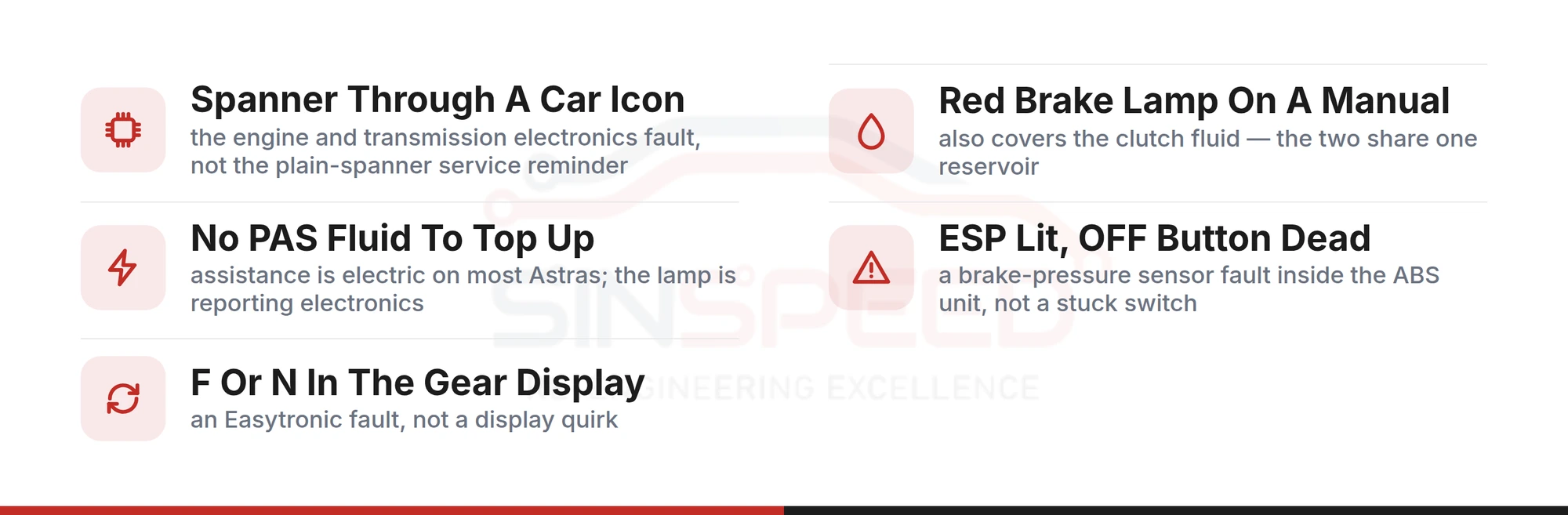
The car with a spanner through it is not a service reminder. Vauxhall uses two separate spanner symbols, and they mean opposite things. A plain spanner is the service or oil-change reminder, reset when the work is done. A small car outline with a spanner through it is the engine and transmission electronics warning — a stored powertrain or control-unit fault. Book a service for the second one and you will collect the car with the lamp still lit, having spent the interval on the wrong thing.
The red brake lamp also covers the clutch on a manual Astra. Generic guides give you the handbrake and the brake fluid and stop there. Vauxhall’s own wording pairs the parking brake with the clutch fluid level, because the clutch hydraulics draw from the same reservoir on a manual car. So a red brake lamp with a clutch that has gone long or spongy is not two problems — it is one, and the level is the first thing to look at.
"Top up the power steering fluid" is the wrong instruction for most Astras. Vauxhall’s symbol set splits the amber steering warning three ways: assistance disabled, assistance reduced because the unit has overheated, and a system that needs calibrating. A system that can overheat and can need calibrating is an electrically assisted one, and there is no reservoir behind it to fill. Open the bonnet and look for a power steering fluid reservoir before you take that advice: if there is not one, the lamp is reporting electronics, and no amount of topping up will change it.
An ESP lamp that will not clear with the button is a specific fault, not a stuck switch. Across the post-2004 Vauxhall and Opel range — Astra, Corsa, Zafira, Meriva and Vectra — there is a well-documented pattern where the stability lamp stays on, the ESP OFF or traction button does nothing at all, and the ABS lamp often joins in. The cause is a brake-pressure sensor failure inside the ABS unit, logged as G201 or 01435. If pressing the button changes nothing, stop treating it as a switch.
An F or an N in the gear display is a warning, not a gear. On an Astra with the Easytronic automated manual, the display sits where the gear number should be and shows F or N, solid or flashing, when the transmission electronics have a fault. Flashing tends to arrive with a car that will not select a gear or will not start. It is easy to read as a quirk of the display because it does not look like a warning symbol, and it is the clearest signal this gearbox gives.
Which unit has actually failed: the Astra lamps that sit in front of a module
Most lamps on an Astra are a sensor, a fluid, a bulb or an interval, and working through those first is the right order. A handful are different: they sit in front of a control unit, and checking levels will never move them. The units below are a narrow slice of the units we repair, picked because on this car they are the ones that announce themselves with a lamp rather than a noise or a leak.
ABS and ESP
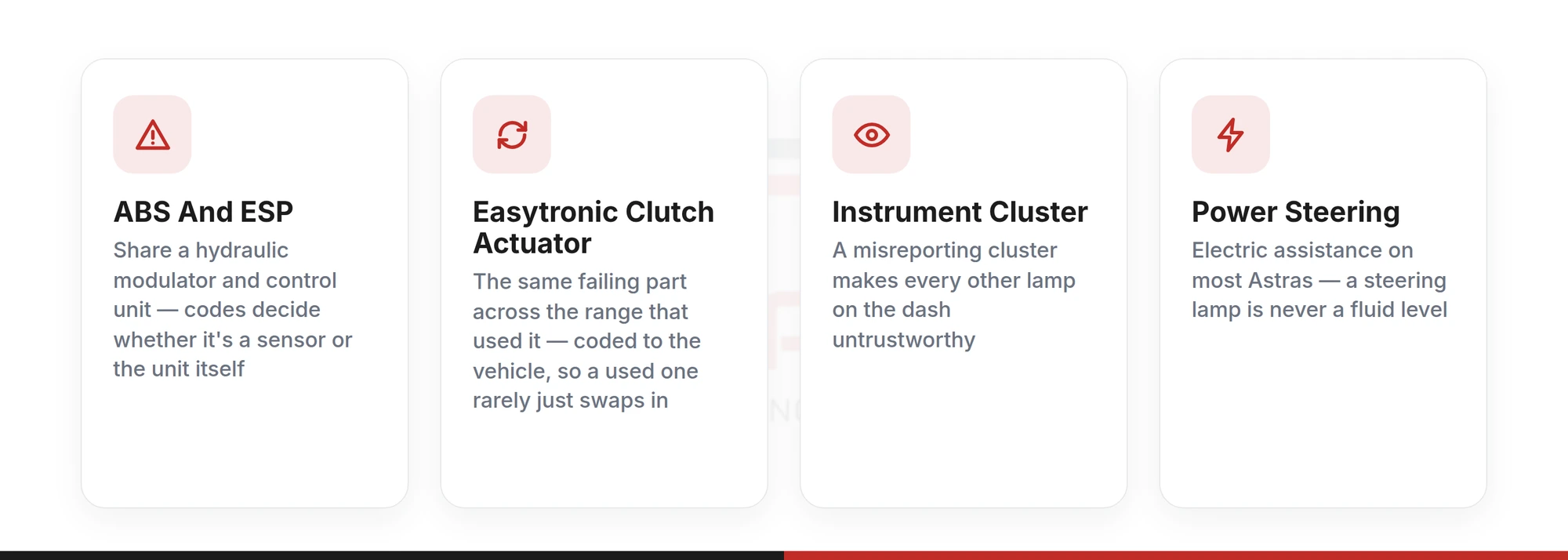
Anti-lock braking and stability control share a hydraulic modulator and a control unit, which is why a fault in one so often lights both. On the Astra the recurring codes are pump motor circuit and pump motor faults, C0110 and C0200, and a brake pressure sensor fault, C1100 — and the separate ESP pattern above logs G201 or 01435. Wheel-speed sensors are a genuine and much cheaper cause, so the codes are what tell you which you are dealing with. Our background pages cover how an ABS pump actually works, what ESP does on a car, what does and does not clear an ABS light afterwards, and whether an ABS light fails the MOT. The repair work sits under ABS pump and module repairs, and the Corsa D ABS pump page shows what that work looks like on a Vauxhall unit of the same era.
The Easytronic clutch actuator
The Easytronic lets the control unit operate the clutch and select gears on what is mechanically a manual gearbox, and the actuator that does it is the same failing part across the Vauxhall range that used the system. The symptoms are consistent: F or N in the display, solid or flashing, gears that will not engage, and in the worst cases a car that will not start. One thing is worth knowing before you shop for a second-hand replacement — the actuator is coded to the vehicle, so a used unit from another car is rarely a straight swap. Vauxhall Easytronic clutch actuator repairs covers the fault, with the wider work under clutch and gear actuators and transmission control module repairs.
The instrument cluster
Rule the cluster in or out early, because one that is misreporting makes every other lamp on this page untrustworthy — you stop diagnosing the car and start diagnosing the thing describing the car to you. The signs are gauges that drop to zero, stick or sweep on their own, backlighting that flickers or fails, a screen that dims or comes and goes with temperature, missing segments, and several unrelated lamps lit with nothing behind them. That work sits under Vauxhall instrument cluster repairs, and repairing your own unit rather than fitting another keeps your mileage where it is.
Power steering
Where the assistance is electric, the steering lamp is reporting electronics and there is nothing to top up. Steering that is heavy from cold and normal once warm, assistance that fades in and out, or a wheel that goes heavy on one lock and not the other all point at the unit rather than the mechanical rack. Vauxhall’s overheating and calibration warnings are the tell that you are looking at an electrically assisted system. Those units are rebuilt under steering and EPS repairs.
The immobiliser, and Open & Start
If the immobiliser lamp flashes and the engine cranks strongly, fires for a moment and dies, the car has not authenticated the key and has blocked fuelling. Try the spare key first: it costs nothing and separates a failing key from a failing module in one attempt. On Astra H cars with Open & Start there is a second possibility — the steering lock not releasing — which presents as a car that will not crank at all. Our guide to a car that will not start, and whether it is the immobiliser takes it further. Where the symptoms are lighting, wipers, indicators or central locking rather than starting, that is the body control module instead.
Engine management, and where it goes
Too many possible causes to guess at, so the codes come first. If diagnosis points at an internal failure of the engine ECU itself, that work belongs with the independent specialists at ecu-repairs.com. If it points at the turbocharger — the management lamp often arrives alongside lost boost and a smoke complaint on the diesels — that is one for our turbo specialists at turbo-repairs.com, our sister site for everything turbo.
Sinspeed · Vauxhall electronics
On an Astra, a second-hand unit is often the expensive answerWe are a UK specialist in automotive electronics. Several of the units behind these lamps are coded to the vehicle, which is why a breaker’s part so often solves nothing — the original is repaired at circuit level instead, with your car’s own data intact. Send the fault codes, the generation and what the dashboard is doing, and we will tell you which unit is reporting before anything comes off.
Circuit-level board repair in a cleanroom-standard, ESD-safe workshop · Diagnosed, repaired and calibrated in house
What to do when a warning light comes on in your Astra
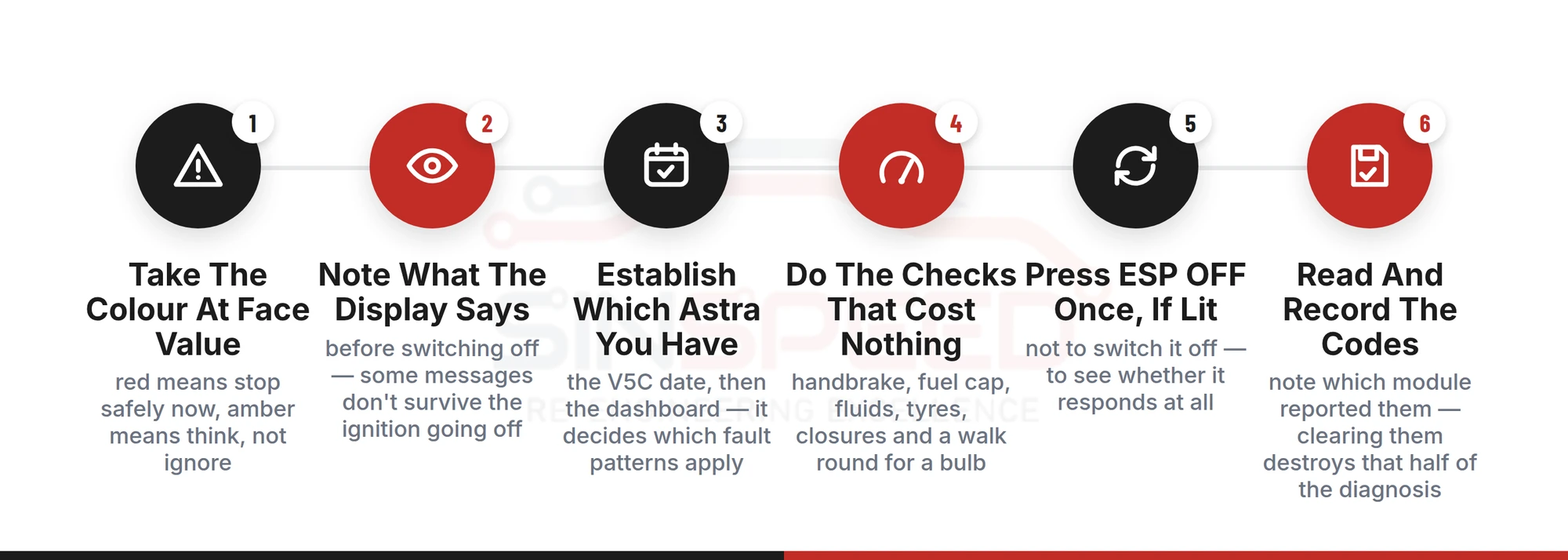
- Take the colour at face value. Red means find somewhere safe and stop. Amber means you have time to think about it, but not an unlimited amount of it.
- Write down anything the display says, before you switch off. On a K or an L the written message carries more than the icon does, and some messages do not survive the ignition going off.
- Establish which Astra you have. First-registration date on the V5C, then the dashboard. It decides whether a fault pattern you read about applies to your car at all.
- Do the checks that cost nothing. Handbrake fully off, fuel cap clicked shut, oil and coolant levels with the engine cold, all four tyre pressures, closures latched, and a walk round for a dead bulb.
- If a stability lamp is lit, press the ESP OFF button once. Not to switch anything off — to see whether it responds. A button that does nothing at all is information, and it points somewhere specific.
- Have the codes read and recorded, and note which module reported them. That is half the diagnosis, and clearing the codes destroys it.
Two rules hold throughout: never attempt a do-it-yourself repair on the braking or restraint systems, and never clear a safety lamp simply to stop it bothering you. If you are working on a different car, the method is the same — we have built Vauxhall Corsa warning lights the same way, and Peugeot dashboard warning lights is the closer relative for an Astra L than anything else we have written.
Vauxhall Astra warning lights FAQs
What does the car with a spanner through it mean on a Vauxhall Astra?
It is the engine and transmission electronics warning — a stored powertrain or control-unit fault, not a service reminder. Vauxhall uses two spanner symbols and this is the one that matters: a plain spanner on its own is the service or oil-change reminder, while a small car outline with a spanner through it means the car has logged an electronics fault it wants read. If the Astra is driving normally you have a little time, so keep journeys short and get the codes read. If it is down on power, in limp mode or refusing gears, stop using it. Booking a service will not clear it, because a service is not what it is asking for.
Why is my Astra’s ESP light on and the ESP OFF button doing nothing?
Because on these cars that combination is a recognised fault rather than a stuck switch. Across the post-2004 Vauxhall and Opel range the stability lamp stays permanently lit, pressing the ESP OFF or traction button has no effect at all, and the ABS lamp often comes on with it. The cause is a brake-pressure sensor failure inside the ABS unit, logged as G201 or 01435, and because the sensor sits inside the unit it is not a separate part you can unbolt and replace. The car still has ordinary brakes, but it no longer has stability control, so treat it as a fault to fix rather than a light to live with.
What does the F on my Astra’s dashboard mean?
It is the Easytronic gearbox reporting a fault. On an Astra fitted with the Easytronic automated manual, the gear display shows F, either solid or flashing, when the transmission electronics have logged a problem — and an N behaving the same way means much the same thing. Flashing usually arrives with a car that will not select a gear, and sometimes with one that will not start. The most common cause is the clutch and gear actuator, which is the same failing part across the Vauxhall models that used this system. Because the actuator is coded to the vehicle, fitting a used one from a breaker is rarely the straightforward fix it appears to be.
Can I drive my Vauxhall Astra with the ABS light on?
Yes, with care, provided the red brake warning lamp is not lit as well. Ordinary braking still works, but the anti-lock function has switched itself off, so the wheels can lock under heavy braking and stopping distances lengthen on a wet or greasy surface. Leave more room, brake earlier and get the codes read — an anti-lock lamp indicating a malfunction is also an MOT defect. If the red brake lamp is lit alongside it, that is a different situation: the same unit distributes braking effort front to rear, so that balance may no longer be there. Stop as soon as it is safe and have the car recovered rather than driven to a garage.
Which Vauxhall Astra warning lights will fail an MOT?
An engine management lamp that stays lit fails on emissions, and a blown exterior bulb fails on lighting, on any Astra. An anti-lock lamp indicating a fault is a defect too. The airbag, tyre-pressure-monitoring and stability-control lamps became testable items under the DVSA inspection manual for vehicles first used on or after 1 January 2012, which falls inside the Astra J’s production run — so check the date of first registration on the V5C rather than assuming from the generation. Treat that as an MOT distinction and not a safety one: a restraint lamp means the airbag may not deploy, whatever your test date says.
My Astra’s DPF light is flashing and the car feels slower. What is happening?
The filter has reached its maximum soot level and the car has started protecting itself. A steady particulate filter lamp means the filter is full and wants a regeneration, which a sustained run at a steady speed with the exhaust properly hot will often complete. A flashing lamp is the next stage, and Vauxhall escalates it deliberately: the Astra limits its own top speed from the next restart, then limits it further, and eventually will not restart at all. So the loss of performance is the car doing what it was designed to do rather than a separate fault. Deal with it while it is still driveable, because each stage removes another option.
Does an Astra L show the same warning lights as an Astra H?
The colours and most of the standard symbols carry across, because they follow an international convention rather than a Vauxhall one. What does not carry across is what sits behind them. The L is built on the Stellantis EMP2 platform with PSA-lineage electronics, so its control units are not the ones an Astra H or J has, and the two best-known Astra fault patterns — the brake-pressure sensor inside the ABS unit and the Easytronic clutch actuator — simply do not exist on it. The L also writes warnings in words on cars with the digital panel, and that sentence is the half that tells you what to do. Read an L on its own codes, not against an older Astra.
Sinspeed · mail-in repair
Keep your Astra’s own units. We repair the one that failedYou post us the module the codes point at, we repair and test it, and it comes back to you or your garage to refit — so the car is not tied up waiting on a workshop slot, and it keeps the unit that was coded to it. If you are not certain which one to send, describe what the dashboard is doing and we will confirm it first.
Most remanufactured units carry a lifetime, unlimited-mileage warranty · Many go back ready to fit with no coding required
Final thoughts
The Astra is a badge that has covered two entirely different engineering lineages, and the symbol on the dashboard does not tell you which one you are looking at. That is the trap. Someone reads a lamp correctly, finds a fault pattern that genuinely is common on an Astra, and buys a part — and the pattern belonged to a General Motors car while theirs is a Stellantis one, or the other way round. The symbol was never the problem. Matching it to the wrong car was.
So the order is worth keeping. Take the colour at face value. Match the shape. Note anything the display writes in words, because on the newer cars that sentence carries more than the icon does. Establish which Astra you actually have. Then have the codes read and written down, and note which module reported them, because that is the piece that turns a lamp into a unit. Done in that order you normally finish at one component, and often at one that can be repaired rather than replaced. Done in the other order you finish at a confident answer about a car that is not yours.