
Summary: A Caddy is a working van, and how it is worked decides which lamps you see. Its two signature electronic failures are duty-cycle failures — the seven-speed DSG, worked hardest by loaded stop-start delivery runs, and the diesel particulate filter, which on short multi-drop work never gets hot enough to finish a regeneration. This page gives every VW Caddy dashboard symbol with a safe-to-drive verdict, separates the lamps that can wait until tonight from the ones that mean stop now, and says which are reporting a failed electronic unit.
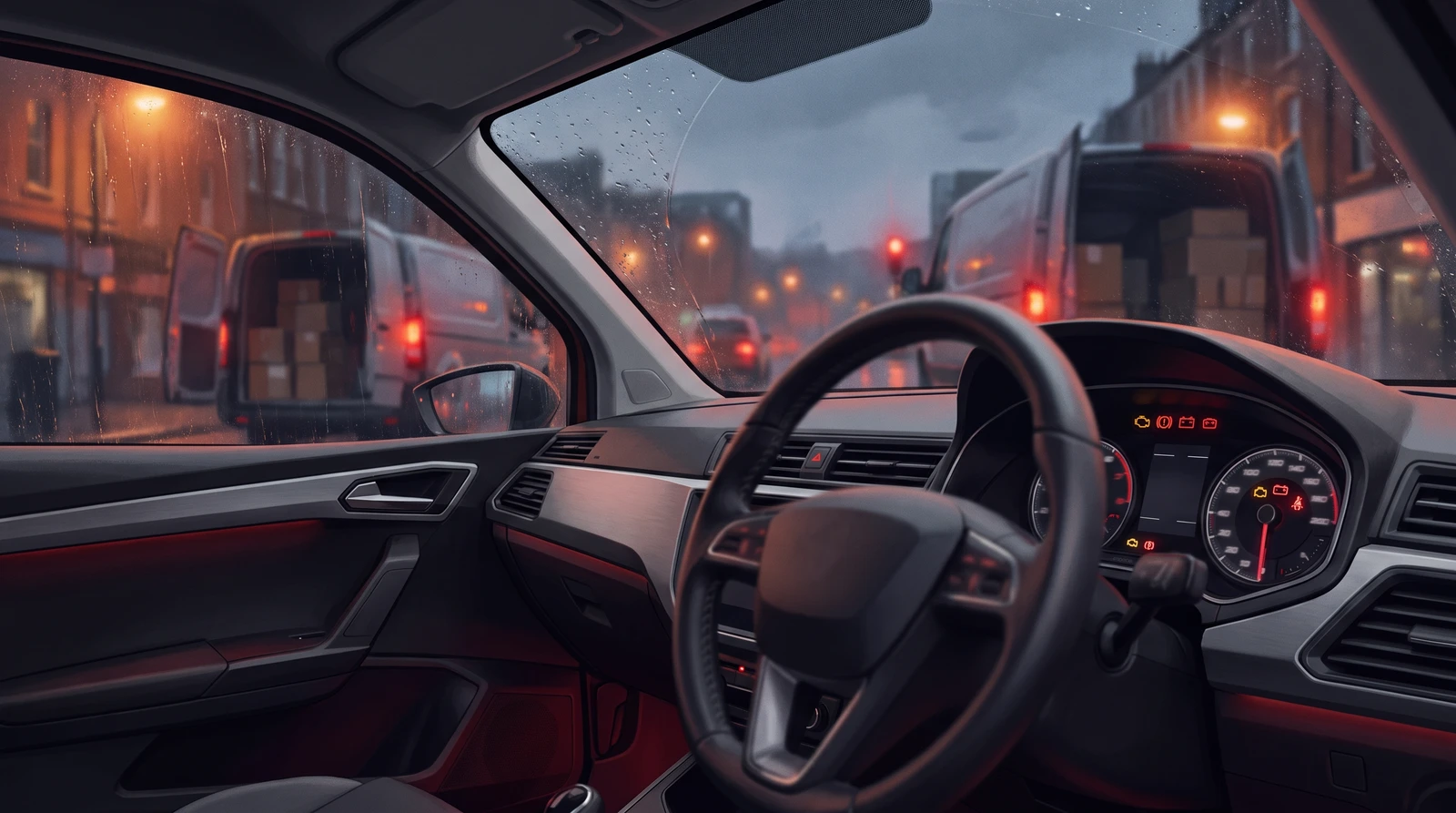
- Why the same lamp means something different on a working Caddy
- VW Caddy warning lights and symbols: the full reference table
- Can you finish the job, or does it have to stop now?
- Which Caddy you have, and why the newest one writes in words
- The Caddy’s two duty-cycle failures: the DSG and the DPF
- Which lamp means a failed module on a Caddy
- What to do when a warning light comes on in your Caddy
- VW Caddy warning lights FAQs
- Final thoughts
Why the same lamp means something different on a working Caddy
Colour is the fastest thing on the dashboard. Red means find somewhere safe and stop, amber means the van has stored a fault and wants attention rather than panic, and green, blue and white only confirm that something is switched on — our guide to what a dashboard warning light is actually telling you sets out that grammar in full.
What colour does not tell you is why a Caddy in particular ends up with the lamp lit. A Caddy is bought to work, and the way it is worked is what breaks its electronics. Two failures dominate, and neither is really an age or a mileage failure.
The first is the seven-speed DSG. A loaded van pulling away from a standstill dozens of times an hour on short urban runs is close to the worst duty cycle a dry-clutch automated gearbox can be given: it is the pattern that puts the most clutch work and the most heat through the unit in the least time. A Caddy doing forty drops a day is not a low-mileage van in the sense that matters here.
The second is the diesel particulate filter. Burning off the soot it collects needs sustained exhaust heat, and a van doing multi-drop work in town rarely holds a speed long enough to reach it. The filter fills, a regeneration starts and is interrupted, and the lamp arrives on a van with nothing mechanically wrong with it. That is a duty-cycle problem before it is a broken part.
None of which changes the safety rules, and none of it is an argument for pressing on. A red lamp on a Caddy means exactly what it means on anything else, and finishing the round is not one of the options. What the working-van reading buys you is the ability to tell the lamps that will wait until tonight from the ones that will not — and to see which are pointing at a control unit rather than a consumable.
VW Caddy warning lights and symbols: the full reference table
This is filtered to lamps a Caddy carries. Volkswagen’s van symbol set covers the whole commercial range, so it also lists four-wheel drive, differential locks, air suspension, natural gas and a tachograph — none of which belong on a Caddy, and all of which get in the way when you are matching a shape you can see against a list you cannot. The safe-to-drive column takes the serious reading wherever a fault could reasonably be trivial or serious.
| Colour | Symbol | What it means on a Caddy | Is it safe to drive? |
|---|---|---|---|
| Red |  Brake system — an exclamation mark in a circle with a bracket each side Brake system — an exclamation mark in a circle with a bracket each side | The handbrake is still applied, or brake fluid has fallen below minimum. | No, unless it goes out the instant the handbrake is fully released. A loaded van has less margin than the car this advice is usually written for. |
| Red |  Brake system and ABS lit together Brake system and ABS lit together | Both braking systems reporting at once. The unit they share also distributes braking effort front to rear, so that balance may no longer be there. | No. Brake gently, stop as soon as it is safe, and have the van recovered rather than driven on. |
| Red |  Engine oil pressure — an oil can with a drip Engine oil pressure — an oil can with a drip | Oil pressure has fallen. This is the pressure lamp, not the amber low-level warning further down. | No. Switch the engine off. Bearings are damaged in seconds without oil pressure, not in miles. |
| Red |  Coolant temperature and cooling-system fault — a thermometer in wavy lines Coolant temperature and cooling-system fault — a thermometer in wavy lines | The engine is overheating, or the cooling system has stored a fault: coolant low, coolant not circulating, or a failed thermostat, pump or fan. A fully loaded van in slow traffic is when it appears. | No. Stop, switch off and let it cool. Never open a hot expansion tank. |
| Red |  Vehicle battery and charging — a battery with plus and minus terminals Vehicle battery and charging — a battery with plus and minus terminals | The battery is no longer being replenished: alternator, drive belt, a connection or the wiring. | Only as far as somewhere safe. Everything is running on stored charge, and the van stops when it is gone. |
| Red and amber |    Electromechanical steering, and the steering column lock Electromechanical steering, and the steering column lock | Volkswagen carries the steering warning in both colours: red for assistance failed or cut, amber for assistance reduced or a stored fault. Flashing, it reports the electronic steering column lock instead. There is no fluid reservoir behind this system to top up. | Red, no — assistance can disappear without warning, and a loaded Caddy goes very heavy when it does. Amber, with care and get it read, because reduced assistance can become none. |
| Red or amber |  Airbag and belt tensioners — a seated figure facing an inflated circle Airbag and belt tensioners — a seated figure facing an inflated circle | The restraint system has stored a fault. Volkswagen lists it in both colours; either way an airbag or a pretensioner may not fire in a collision. | The van drives normally, but the protection you are relying on is not there. Have it read straight away. |
| Red | Transmission overheated — no shared glyph; read the wording in the display | The gearbox has passed its temperature limit. Towing, a full load and repeated pull-aways in traffic are what get it there. | No. Stop somewhere safe and let it cool before going anywhere. Continuing is how a hot gearbox becomes a failed one. |
| Red and amber |  Central warning and central caution lamps — an exclamation mark in a triangle Central warning and central caution lamps — an exclamation mark in a triangle | Volkswagen’s catch-all pair. The symbol carries no information on its own, and its own instruction is to read and follow the text message in the instrument cluster display. | Whatever the message says. Treat the red one as red and the amber one as amber — and write the wording down before you switch off. |
| Red |   Seat belt, and a door, bonnet or tailgate ajar Seat belt, and a door, bonnet or tailgate ajar | A belt is unfastened, or a closure is not properly latched. On a van loaded and unloaded all day, the side door and the tailgate are the usual culprits. | Stop and put it right first. Neither is a fault in the van. |
| Red or amber |  Immobiliser and ignition — a car outline with a key Immobiliser and ignition — a car outline with a key | The key has not been recognised, or the immobiliser has stored a fault. Volkswagen also uses a red version for an ignition switch malfunction. | If it has started, yes for now. If it cranks, fires and dies, or will not crank at all, it is going nowhere until the codes are read. |
| Amber |   Engine management, and emission control — an engine block outline, and an exhaust with wisps of smoke Engine management, and emission control — an engine block outline, and an exhaust with wisps of smoke | Steady: a stored engine-management fault, or emission limits exceeded. Flashing: a fault that can damage the catalyst, usually an active misfire. | Steady and driving normally: gently, and get the codes read within days. Flashing: stop. A management lamp that stays lit also fails the MOT. |
| Amber |  EPC, and reduced power — the letters EPC EPC, and reduced power — the letters EPC | Volkswagen’s electronic power control lamp: the electronic throttle and engine-management side. It often arrives with the engine-management lamp, and often with the van held in a reduced-power mode. | Short journeys at most, and only while it drives normally. Reduced power on a loaded van pulling out of a junction is a hazard in its own right. |
| Amber |  Glow plug preheat, and the diesel engine management lamp — a coiled filament Glow plug preheat, and the diesel engine management lamp — a coiled filament | Lit for a few seconds before a cold start, this is normal preheating. Lit or flashing while you are driving, Volkswagen’s own list makes it the diesel engine management lamp — and on a Caddy it very often arrives with a filter that has not completed a regeneration. | Preheat, yes. Flashing while driving, treat it as an engine warning rather than a glow plug, and stop if the van has also lost power. |
| Amber |  Diesel particulate filter — a filter box with a row of dots inside Diesel particulate filter — a filter box with a row of dots inside | Volkswagen words it as the filter being clogged with soot. It means a partial blockage and a regeneration that has not finished. | Yes, and this is the one lamp where the driving itself is part of the answer — see the DPF section below. If the engine-management lamp joins it and the van loses power, stop. |
| Amber | 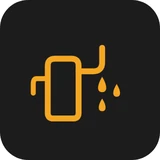  AdBlue and the SCR system, and water in the diesel AdBlue and the SCR system, and water in the diesel | AdBlue is low or the emissions-treatment system has stored a fault, on the later diesel vans. The droplet means water has collected in the fuel filter. | AdBlue, yes while it is only a level warning — top it up promptly, because once the range runs out the engine will not restart. Water in fuel, only briefly: water reaching the injection system does expensive damage. |
| Amber | 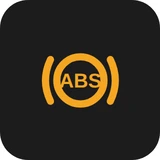 ABS — the letters ABS in a circle with a bracket each side ABS — the letters ABS in a circle with a bracket each side | The anti-lock function has switched itself off. Ordinary braking is unaffected. | With care, provided the red brake lamp is not lit as well. The wheels can lock in an emergency stop, and a loaded van needs more room, not less. It is also an MOT defect. |
| Amber |   Stability and traction control, and the OFF version — a car above two skid marks Stability and traction control, and the OFF version — a car above two skid marks | Flashing means the system is intervening and working. Steady means it is switched off or has a fault. | Flashing on a wet road or a greasy yard is normal. Steady on dry tarmac in ordinary driving means it is not protecting you — and stability control matters more on a van whose load changes through the day. |
| Amber |  Gearbox fault, and the gear selector display — a cog with an exclamation mark Gearbox fault, and the gear selector display — a cog with an exclamation mark | A stored transmission fault. On a DSG Caddy the more telling signal is the selector display itself: normally only the selected letter is lit, so all of them flashing together is the transmission control module reporting a fault it cannot recover from. | If it drives normally, keep the journey short and get it read. If it drops out of gear, refuses a gear or holds one gear only, stop using it. |
| Amber |   Low levels — an oil can with a level line, and an expansion tank with a level line Low levels — an oil can with a level line, and an expansion tank with a level line | Engine oil or coolant is below minimum. Neither is the red pressure or temperature lamp above, and the two pairs get confused constantly. | Yes, briefly. Check with the engine cold and top up. A level that drops again quickly is a leak, not a habit. |
| Amber |   Brake pads worn, and tyre pressure — a broken dashed ring, and a horseshoe with an exclamation mark Brake pads worn, and tyre pressure — a broken dashed ring, and a horseshoe with an exclamation mark | The pad wear sensor has reached its limit, or a tyre has lost pressure and the monitoring system has noticed. Van pressures differ front to rear and change with the load. | Pads: yes, but book it now. Pressures: only as far as somewhere you can check them all, against the laden figures rather than the unladen ones. |
| Amber |   Vehicle lighting failure, and headlight faults — a bulb with a break, and a headlamp with an exclamation mark Vehicle lighting failure, and headlight faults — a bulb with a break, and a headlamp with an exclamation mark | An exterior lamp is out, or the circuit or headlight range control driving it has failed. A van that carries weight over its rear axle is exactly the vehicle where beam levelling matters. | Yes, but a lamp that is out is an MOT failure and a hazard after dark. A warning that persists after a new bulb is pointing at the circuit, not the bulb. |
| Amber |   Stop-start unavailable, and service due — the letter A in a circular arrow, and a plain spanner Stop-start unavailable, and service due — the letter A in a circular arrow, and a plain spanner | Stop-start has taken itself out of use, most often because the battery is no longer holding enough charge for it. The spanner is a time or mileage interval, reset at the service. | Yes to both. Neither is a fault in the driving sense, though a battery that can no longer support stop-start is worth checking before winter. |
| Amber |  Driver assistance — a car between lane lines, with front assist, lane change assist and lane departure reporting here too Driver assistance — a car between lane lines, with front assist, lane change assist and lane departure reporting here too | The camera or the sensors cannot see, or the system has a fault. Dirt, road film, ice and snow are the everyday causes, and a working van is out in all of them. | Yes. The van drives normally and the assistance simply is not there, so do not rely on it until the lamp clears. |
| Green, blue and amber tell-tales |        Dipped beam, main beam, indicators, front and rear fog lights, low fuel, passenger airbag switched off Dipped beam, main beam, indicators, front and rear fog lights, low fuel, passenger airbag switched off | These confirm that something is switched on, or that a level is low. Indications rather than faults. | Yes. Two are worth a second look: a rear fog light dazzles the driver behind, and a passenger airbag shown as off should be off deliberately. |
Can you finish the job, or does it have to stop now?
This is the question a van actually raises, and it deserves a straight answer rather than a shrug towards the nearest garage. Three groups, and the first one is not negotiable.
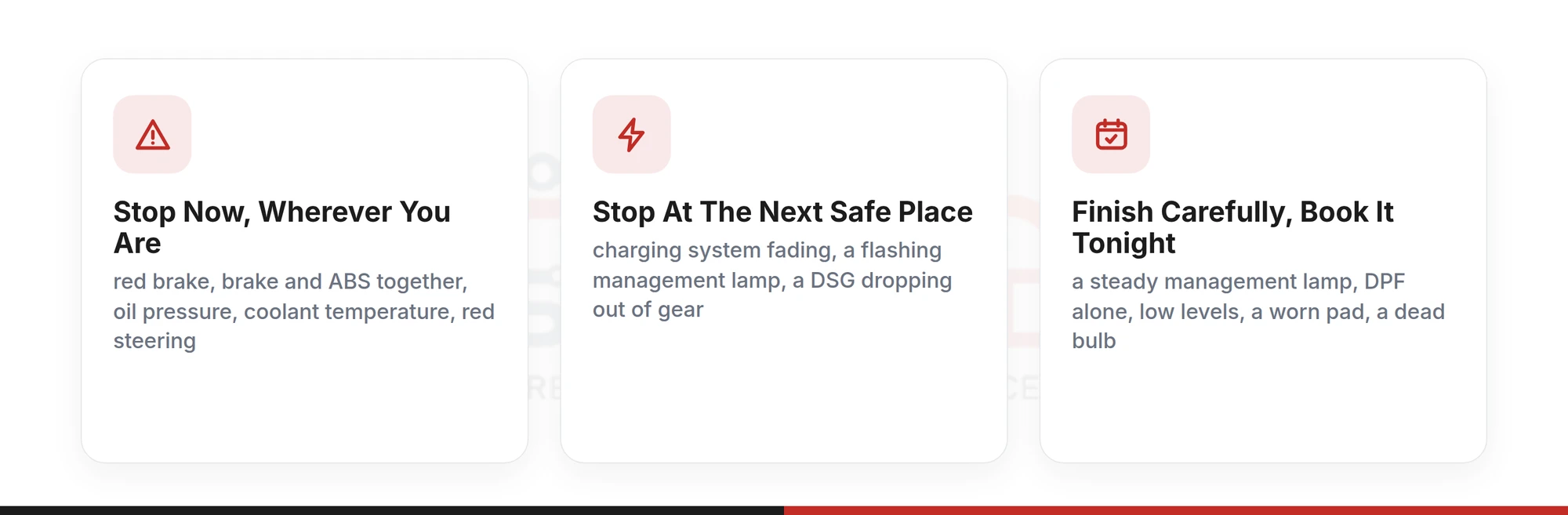
- Stop now, wherever you are in the round. Red brake, brake and ABS together, oil pressure, coolant temperature, red steering, transmission overheated, and a red central warning telling you to stop. These are not lamps you drive to the next drop with. Find somewhere safe, switch off, and arrange recovery rather than a last few miles.
- Stop at the next safe place, then stop for good. The charging-system lamp is the clearest example: the van keeps running on stored charge and then does not, and where it stops is not your choice. A flashing engine-management lamp belongs here too, and so does a DSG that has started dropping out of gear.
- Finish carefully, then book it in tonight. A steady engine-management lamp on a van driving normally, an ABS lamp with the red brake lamp out, a steady stability-control lamp, a particulate-filter lamp on its own, low levels, a worn pad warning, a dead bulb. None of these is nothing — each one is a fault with a clock on it — but they do not turn a working van into a recovery job.
Two things are worth saying plainly, because a loaded van is not the car most of this advice is written for. Stopping distances are longer with weight in the back, so an amber lamp that costs you braking assistance costs you more here than it would in a hatchback. And a lamp that only appears when the van is loaded, or only on the hill out of the yard, is not an intermittent nuisance — it is the fault telling you the conditions it needs, which is genuinely useful information to hand to whoever reads the codes.
Which Caddy you have, and why the newest one writes in words
The symbols are largely shared across the range, because they follow an international convention rather than a Volkswagen one. What changes with the generation is how many lamps there are, and whether the dashboard tells you anything beyond the icon.
| Generation | Built | What the dashboard is like |
|---|---|---|
| Caddy 2K | 2004 to 2010 | Analogue dials with a small trip display between them, and the shortest lamp list of the four. Much of the driver assistance in the marque-wide list simply is not fitted, so a symbol you cannot find is usually specification rather than a dead bulb. |
| Caddy 2K facelift | 2010 to 2015 | The same architecture with a fuller lamp set. This is the span our own Caddy listings cover for both the DSG gearbox and the instrument cluster, which is a fair indication of which vans reach a repair bench. |
| Caddy 4, type SA | 2015 to 2020 | More assistance systems and more lamps, a colour display in the cluster on many vans, and AdBlue and the SCR emissions system on the diesels — which brings its own pair of warnings. |
| Caddy 5, type SB | 2020 onwards | The MQB-based van, with Golf-generation switchgear and a digital instrument panel. Most warnings appear as a written message with a small icon beside it rather than as a fixed lamp behind glass. |
That last row changes how you read the dashboard. Volkswagen’s central warning and central caution lamps have always worked this way — the symbol is a triangle that means nothing on its own, and the instruction attached to it is to read and follow the text in the cluster display. On a Caddy 5 that is most of the dashboard, not an occasional extra.
So write the message down, word for word, before you switch the ignition off. Some do not survive it, and the wording is frequently more specific than anything a scan returns afterwards: a gearbox malfunction message names the gearbox, where a stored code might only tell you a module stopped answering. If it is the centre touchscreen rather than the driver’s display that has gone dark, frozen or started rebooting itself, that is the infotainment head unit and a separate item — that work sits under satnav and infotainment repairs.
The Caddy’s two duty-cycle failures: the DSG and the DPF
The DSG, the gearbox lamp and the flashing selector display
The clearest warning a DSG Caddy gives is not a symbol at all. Under normal running only the letter for the gear you have selected is lit. When every letter flashes together, the transmission control module has found a fault it cannot recover from and has usually put the gearbox into a fail-safe mode alongside it — holding one gear, refusing to engage drive, or dropping into neutral while you are moving. It is not a display glitch, and it does not improve on its own. Our guide to a flashing PRNDS display covers the pattern in detail.
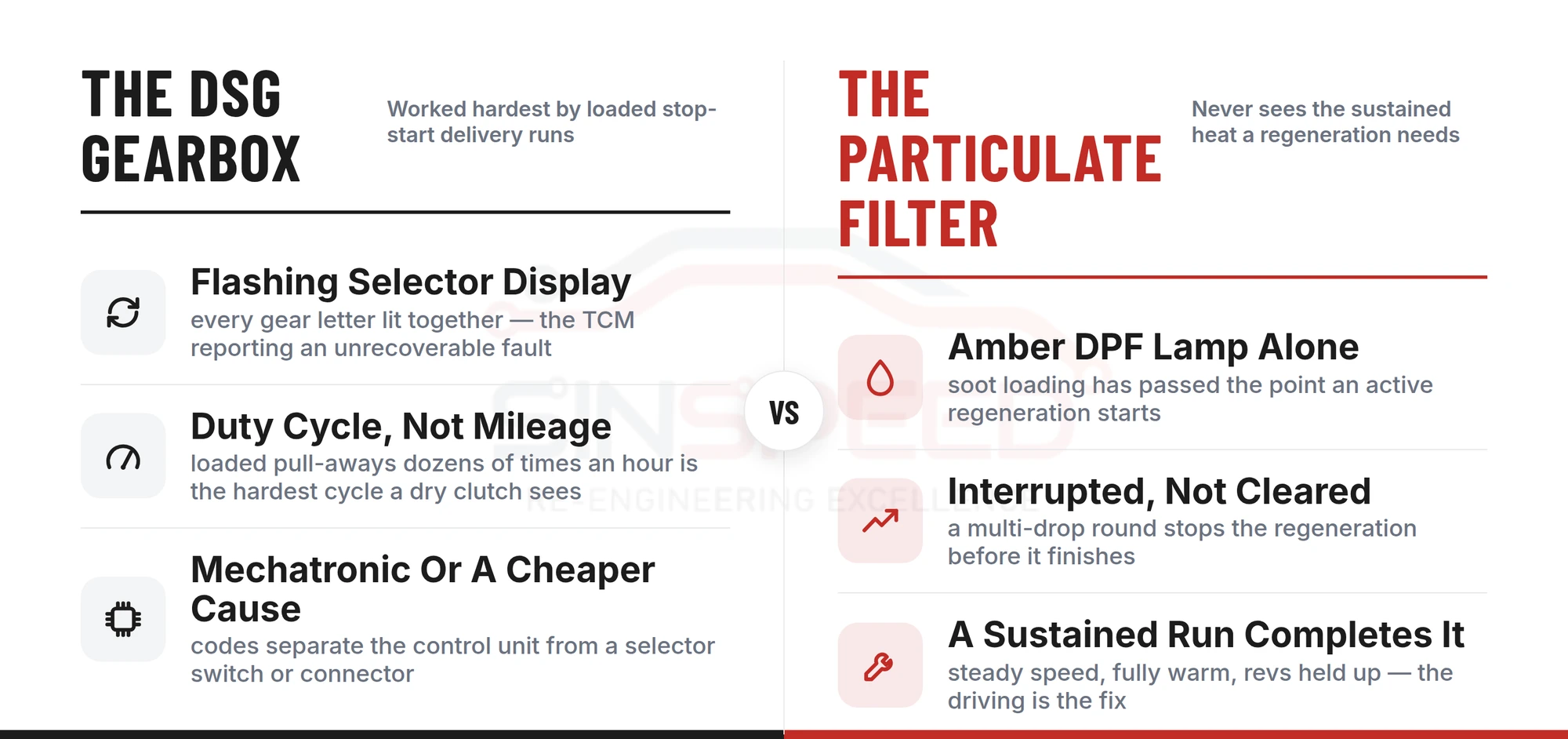
The symptoms that arrive with it are consistent: harsh or hesitant changes, a reverse gear that disappears first, limp mode locked in a single gear, and a fault that clears when you cycle the ignition and returns once the van has warmed up. That last one catches people out, because a fault that goes away looks like a fault that has gone. It has not — temperature-dependent behaviour is characteristic of failing internal electronics.
On a scan, the codes that point at the unit itself include U0101 or 01315 for no communication with the transmission control module, the internal mechatronic codes P1822, P1850, P1851 and P1853 that will not clear on a reset, N215 recorded as a solenoid short to ground, and internal controller errors such as P0840, P1740 and P17C7. Read them on VAG-capable equipment: a generic reader frequently cannot see gearbox-specific codes at all.
It is worth ruling out the cheaper causes first, because not every flashing display is the mechatronic. A sticking microswitch in the gear selector, a corroded connector or a pushed-back terminal on the transmission plug, a valve-body solenoid fault that often logs nothing at all, and low or degraded gearbox fluid can all produce the same warning. Mechatronic unit faults and their symptoms and our explainer on what the DSG gearbox ECU does and how it fails both go further into telling those apart.
The DPF lamp on a van that never gets a clear run
The particulate filter traps soot and then burns it off, and there are two ways that happens. Passive regeneration occurs by itself when the exhaust runs hot for a sustained period, typically on a longer run at a steady speed. When that does not happen often enough, the engine ECU initiates an active regeneration — adjusting injection timing to raise exhaust temperature deliberately, usually once soot loading reaches around 45%. That is when the lamp appears.
A multi-drop round in town interrupts an active regeneration before it finishes, and an interrupted regeneration achieves very little. This is why the lamp is so common on vans with modest mileage and so rare on the same van doing motorway work. Ten minutes or so at a steady speed above about 40mph, engine fully warm and in a gear that keeps the revs up rather than lugging, is usually enough to complete one. Building that into the week — the long way round once, rather than the short way twice — is the cheapest maintenance a Caddy on urban work can be given.
If the lamp is ignored, the sequence is predictable. Soot loading keeps climbing, the engine-management lamp joins in, the coil lamp starts blinking, and the van drops into limp mode. At that point driving alone will no longer clear it and the filter needs a forced regeneration or a proper clean by a specialist or a dealer — another lap of the ring road will not do it. Our explainer covers what a DPF is and how a regeneration actually works if you want the mechanism rather than the summary.
Which lamp means a failed module on a Caddy
Most lamps on a Caddy are a consumable, a level, a bulb or a sensor, and working through those first is the right order. A handful are different: they sit in front of a control unit, and checking levels will never move them. The units below are a narrow slice of the units we repair, chosen because on this van they announce themselves with a lamp.
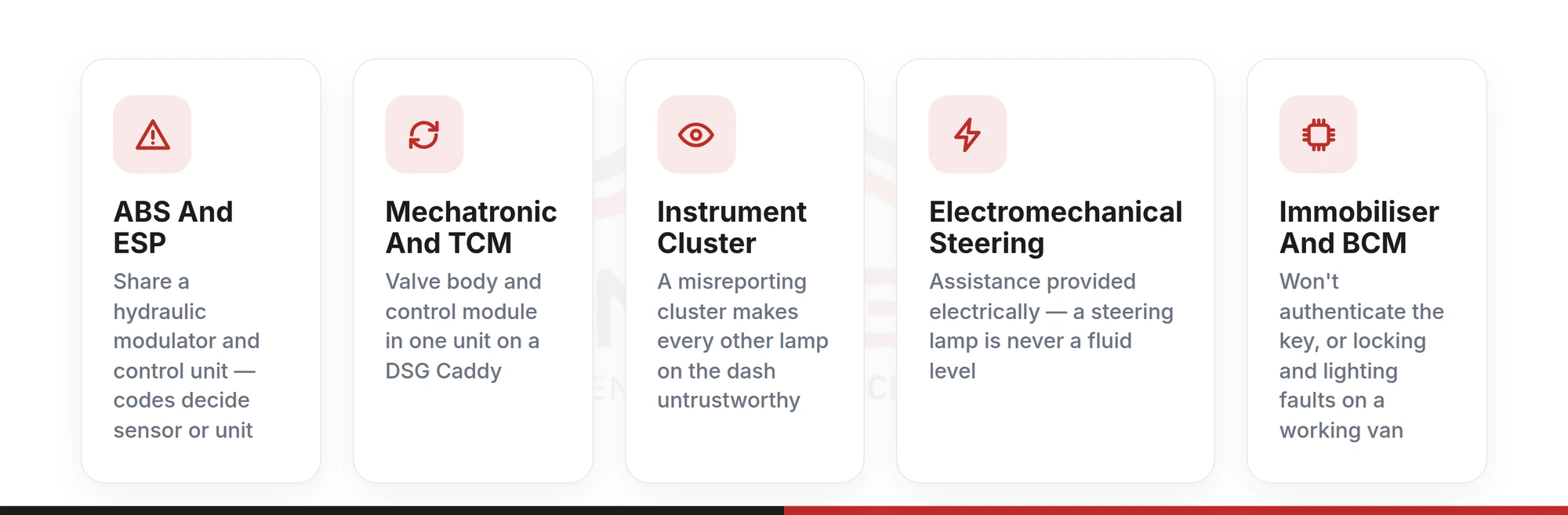
ABS and ESP
Anti-lock braking and stability control share a hydraulic modulator and a control unit, which is why a fault in one so often lights both. Wheel-speed sensors and their wiring are a genuine and far cheaper cause than the module, so the codes are what tell you which you are dealing with — and on a van, a rear sensor living behind a wheel that spends its life in yards and kerbside parking is a plausible suspect. Background reading: how an ABS pump works, what does and does not clear an ABS light, and whether an ABS light fails the MOT. The repair work sits under ABS pump and module repairs.
The mechatronic unit and the transmission control module
On a DSG the mechatronic assembly combines the hydraulic valve body and the control module in one unit, which is why a gearbox complaint and an electronics complaint can be the same job. If you are new to the terminology, what a transmission control module is is the short version. We list the Caddy DSG gearbox and mechatronic repair for the 2010 to 2015 van specifically, with the wider work under Volkswagen DSG and CVT transmission controller repairs and transmission control module repairs. One practical point: a repaired original unit goes back carrying the van’s own coding, so it does not need programming to the vehicle the way a replacement does.
The instrument cluster
Rule the cluster in or out early, because one that is misreporting makes every other lamp on this page untrustworthy. The signs are gauges that drop to zero, stick or sweep on their own, backlighting that flickers, a display that is dim or missing segments, and several unrelated lamps lit with nothing behind them. Volkswagen even carries a dedicated amber lamp for an instrument cluster malfunction. We list the Caddy Mk3 instrument cluster for the 2010 to 2015 van, the wider work sits under instrument cluster repairs, and the same fault on a VW Polo cluster shows the failure pattern on another Volkswagen unit. Repairing your own cluster rather than fitting another also keeps your mileage where it is.
Electromechanical steering
Volkswagen lists the Caddy’s steering warning as electromechanical, in red and in amber, which tells you what you are dealing with: assistance provided electrically, with no reservoir to top up. Steering that is heavy from cold and normal once warm, assistance that fades in and out, or a wheel that goes heavy on one lock and not the other all point at the unit rather than the mechanical rack. That work is done under steering and EPS repairs.
The immobiliser and the body electrics
If the immobiliser lamp shows and the engine cranks strongly, fires for a moment and dies, the van has not authenticated the key and has blocked fuelling. Try the spare key first — it costs nothing and separates a failing key from a failing module in one attempt. A van that will not start, and whether it is the immobiliser takes it further, and the repair work sits under immobiliser and ignition switch repairs. Where the symptoms are lighting, indicators, wipers or central locking rather than starting — and on a van with a side door and a tailgate in constant use, locking faults are common — that is the body control module instead.
Engine management, and where it goes
Too many possible causes to guess at, so the codes come first. If diagnosis points at an internal failure of the engine ECU itself, that work belongs with the independent specialists at ecu-repairs.com. If it points at the turbocharger — on a Caddy TDI a failed electronic turbo actuator typically arrives as lost boost, a management lamp and limp mode together — that is one for our turbo specialists at turbo-repairs.com, our sister site for everything turbo.
Sinspeed · Volkswagen electronics
Tell us what the dashboard did, and when it did itWe are a UK specialist in automotive electronics, and on a working van the circumstances are half the diagnosis. Loaded or empty, cold or warm, pulling away or holding a speed, clearing on a restart or staying put — that pattern narrows a gearbox, ABS or cluster fault faster than a code list on its own. Send us the codes and what the van was doing, and we will tell you which unit is reporting before anything comes off.
Electronic and hydraulic engineers under one roof — which is what a mechatronic unit actually needs · Circuit-level board repair, tested under simulated heat, vibration and load
What to do when a warning light comes on in your Caddy
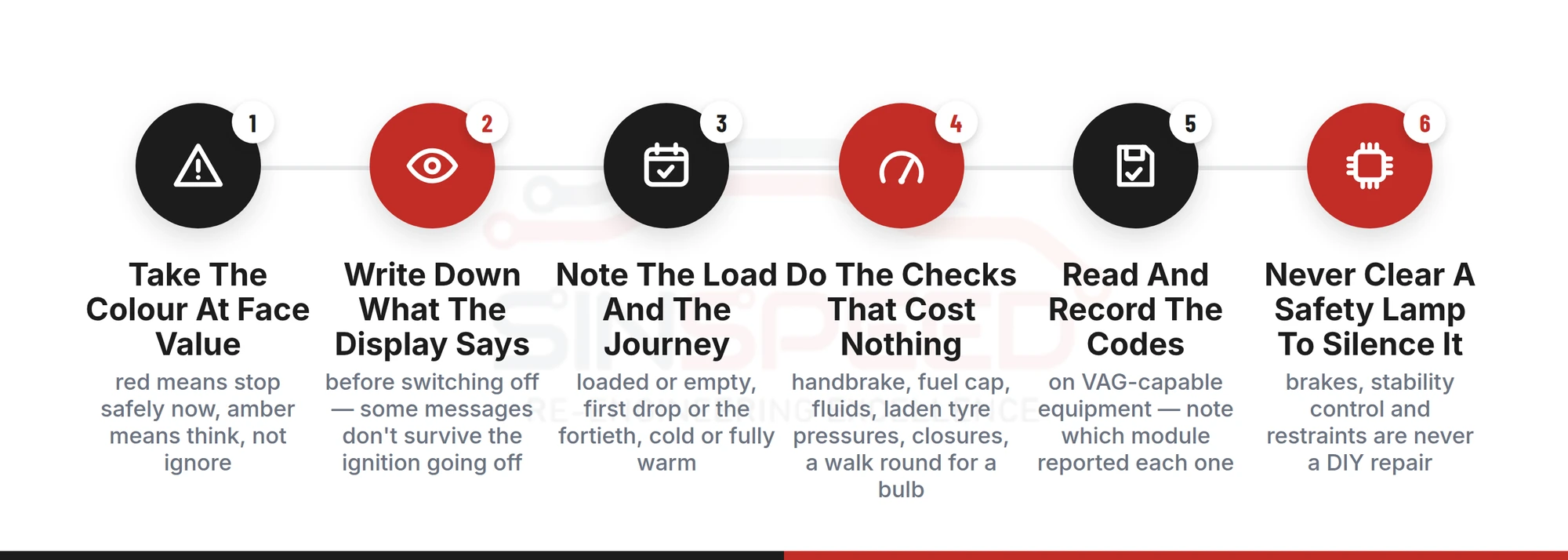
- Take the colour at face value. Red means find somewhere safe and stop. Amber means you have time to think about it, but not an unlimited amount of it.
- Write down anything the display says, before you switch off. On a Caddy 5 the written message carries more than the icon does, and some messages do not survive the ignition going off.
- Note the load and the journey. Loaded or empty, first start of the day or the fortieth drop, cold or fully warm. On a van that context is diagnostic information, and it is the part nobody thinks to record.
- Do the checks that cost nothing. Handbrake fully off, fuel cap clicked shut, oil and coolant with the engine cold, all four tyre pressures against the laden figures, side door and tailgate properly latched, and a walk round for a dead bulb.
- Have the codes read on VAG-capable equipment, and written down. Note which module reported each one. A basic reader often cannot see gearbox or cluster codes at all, and clearing the codes destroys half the diagnosis.
- Do not clear a safety lamp to silence it. Brakes, stability control and restraints are never a do-it-yourself repair, and a lamp switched off is a fault you can no longer see.
If you are looking at a different Volkswagen, the symbol set is largely the same and the method is identical — VW Polo warning lights works through the same lamps on a car, where the generation rather than the duty cycle is what decides the answer.
VW Caddy warning lights FAQs
What does it mean when all the gear letters flash on a VW Caddy?
It means the transmission control module has found a fault it cannot recover from. Normally only the letter for the gear you have selected is lit, so all of them flashing together is a fault signal rather than a display glitch, and the gearbox will usually drop into a fail-safe mode alongside it — holding one gear, refusing to engage drive, or slipping into neutral while you are moving. Cycling the ignition may restore normal running for a while, but that is characteristic of the fault rather than evidence it has gone. Have it read before planning any long journey.
Can I keep driving my Caddy with the DPF light on?
With a steady particulate-filter lamp on its own, yes — and the driving is part of the answer, provided it is the right kind. The filter needs sustained exhaust heat to burn off the soot it has collected, which a stop-start town round never provides. A run of ten minutes or so above about 40mph, engine fully warm and in a gear that keeps the revs up, will often complete the regeneration. If the engine-management lamp joins it, or the coil lamp starts flashing, or the van loses power, stop driving and have it looked at: at that stage more driving will not clear it.
Why is the coil or glow plug light flashing on my Caddy?
Because on a diesel that symbol does two jobs. Lit for a few seconds before a cold start it is the preheat indicator and entirely normal. Lit or flashing while you are driving, Volkswagen’s own list makes it the diesel engine management lamp — so it is reporting an engine fault, not a glow plug. On a Caddy used for short urban work it very often appears alongside the particulate-filter warning, because a filter left to fill eventually brings the engine-management side in with it. Have the codes read before buying glow plugs.
What is the EPC light on a VW Caddy?
EPC stands for electronic power control, and it is Volkswagen’s warning for the electronic throttle and engine-management side of the vehicle. It often appears with the engine-management lamp, and often with the van held in a reduced-power mode that makes it feel sluggish and reluctant to pull. The causes range from a sensor or its wiring to the throttle body itself, so the codes are what separate them. Treat it as a fault to read rather than one to drive through — a loaded van with reduced power pulling out of a junction is a hazard in its own right.
Can I drive my Caddy with the ABS light on?
With care, and only if the red brake warning lamp is not lit as well. Ordinary braking still works, but the anti-lock function has switched itself off, so the wheels can lock under heavy braking and stopping distances lengthen — and a loaded van already needs more room than an empty one. Leave a bigger gap, brake earlier, and get the codes read, because an anti-lock lamp indicating a malfunction is also an MOT defect. If the red brake lamp is on at the same time, that is a different situation: stop as soon as it is safe and have the van recovered.
Why does my Caddy show written messages instead of warning symbols?
Because the newest Caddy has a digital instrument display rather than fixed lamps behind glass, so most warnings arrive as a written message with a small icon beside it. Volkswagen’s central warning and central caution lamps work the same way on the older vans: the triangle carries no information of its own, and the instruction attached to it is to read the text in the cluster display. Write the message down exactly before you switch off. Some do not survive the ignition going off, and the wording is often more specific than the code a scan returns afterwards.
Which VW Caddy warning lights will fail an MOT?
An engine-management lamp that stays lit fails on emissions, and a blown exterior bulb fails on lighting. An anti-lock braking lamp indicating a fault is a defect too. The airbag, tyre-pressure-monitoring and stability-control lamps became testable items under the DVSA inspection manual for vehicles first used on or after 1 January 2012, so check the date of first registration on the V5C rather than assuming from the generation. Treat that as an MOT distinction rather than a safety one: a restraint lamp means the airbag may not deploy, whatever your test date says.
Sinspeed · mail-in repair
One unit in the post, and the Caddy keeps its own codingYou send us the module the codes point at, we repair and test it, and it comes back to you or your garage to refit. The van is not tied up waiting on a workshop slot, and because it is your original unit that comes back, it returns carrying the coding it already had rather than needing a programming trip to match it to the vehicle. Not sure which unit to send? Describe what the dashboard did and we will confirm it first.
Lifetime, unlimited-mileage warranty on most remanufactured parts · Mail-in from anywhere in the UK, and many units go back ready to fit
Final thoughts
A Caddy’s dashboard is not only telling you what has gone wrong. It is telling you what the van has been asked to do. The gearbox lamp on a van that spends its day pulling away loaded, the particulate-filter lamp on a van that never gets a clear run, the steering warning on a vehicle whose front axle works harder at walking pace than most cars ever do — these are the same symbols every Volkswagen carries, arriving for reasons specific to how this one is used.
That is worth holding on to, because it shortens the search. Take the colour at face value. Match the shape, and write down anything the display puts in words, because on the newest Caddy that sentence carries more than the icon. Then ask the question the generic guides never ask: what was the van doing when it appeared, loaded or empty, cold or hot, pulling away or holding a speed. Answer that alongside the codes and you usually finish at one component rather than a list — and often at one that can be repaired rather than replaced.