
Summary: P1664 on a Ford Transit or Tourneo means the electronic diesel control unit bolted to the top of the injection pump has found a fault inside itself, and P1564 means that unit has cut the fuelling back. Between them they account for most no-starts, cut-outs and limp-mode runs on these vans. We repair the control unit your van already has, by post, and it refits without recoding and with a lifetime warranty.
This page is for the Transit, Transit Connect and Tourneo Connect diesels that carry a Bosch distributor injection pump with its control unit mounted on top. It sets out what each code means on these vans, how the fault shows from the driver’s seat, how to tell the electronics from a worn pump, and what repairing your own unit involves. Other makes and pump types are on our diesel pump repair page.
- The unit: the electronic diesel control (EDC) unit on top of a Bosch distributor pump, with the pump’s wiring fixed into it
- The codes: P1664, an internal fault in the EDC, and P1564, reduced fuelling, often joined by P1665
- What you notice: hard starting or no start, cutting out, limp mode, an engine warning light
- Which vans: Transit 240 and 260 2.0 diesels from 2000 to 2006; Transit Connect and Tourneo Connect 1.8 diesels from 05/2002
- Bosch numbers: 0470 004 004/012 on the Transit, 0470 004 008 on the Connect
- How it reaches us: by post, once your garage has taken it off the van
- At refit: no recoding; the pump is re-timed by the garage if it came off
- Cover: lifetime warranty on the repaired control unit
- What do P1664 and P1564 mean on a Ford Transit?
- Transit and Tourneo symptoms: no start, cutting out and limp mode
- Which Transit and Tourneo models carry an EDC on the pump?
- Why a failing EDC passes for a worn-out diesel pump
- Replacement pump, used pump or your own EDC repaired?
- How we test and repair a Transit pump control unit
- Ford Transit P1664 and P1564: frequently asked questions
- Final thoughts
What do P1664 and P1564 mean on a Ford Transit?
On a Ford Transit or Tourneo, P1664 is an injection pump control module fault: the EDC on top of the diesel pump has detected a problem inside itself. P1564 means the same module is requesting reduced fuelling, so the engine loses power or drops into limp mode. Stored together, they point at the pump’s control unit rather than its mechanical parts.
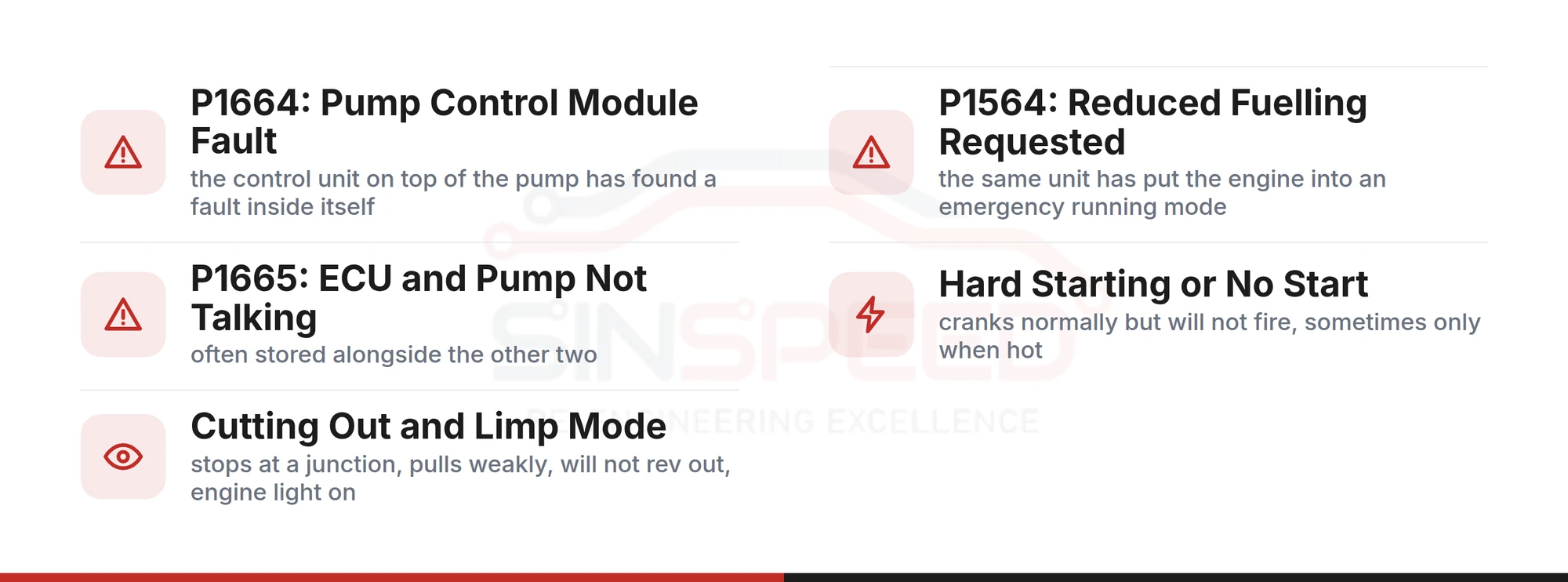
Scan tools word them differently. P1664 can appear as injection pump control module malfunction, injection pump faulty operation or plain fuel pump malfunction; P1564 as the injection pump module requesting reduced fuelling. The meaning underneath does not change. A third code often joins them: P1665, which says the engine ECU and the pump’s control unit have stopped exchanging data properly.
All three are P1 codes, which Ford defines for itself, and another manufacturer can use the same number for something unrelated. The definitions below are Ford’s, for these vans.
| Code | What it records on a Transit | Where it points | First move |
|---|---|---|---|
| P1664 | Injection pump control module fault: an internal fault inside the EDC | The control unit on top of the pump | Record the full code set, then have the unit tested |
| P1564 | Pump module requesting reduced fuelling: the EDC has put the engine into an emergency running mode | Usually the EDC, reacting to its own fault | Read it alongside P1664; stored alone, check the fuel supply and wiring as well |
| P1665 | Communication fault between the engine ECU and the pump control unit | The EDC, or the wiring and connectors between the two modules | Prove the loom and connectors, then the unit |
| P0251 | Injection pump fuel metering control "A", range or performance (a generic code) | On a van with an EDC on the pump, the control unit; on a later common-rail TDCi, the high-pressure pump side | Confirm which fuel system the van has before anything else |
| P1564, P1664 and P1665 together | The recognised signature of a failing pump control unit | The EDC | Recover the van rather than nursing it; send the unit |
For the same codes across every make that uses these pumps, including why P1564 means something else entirely on a Nissan, see our guide to diesel pump EDC fault codes.
Transit and Tourneo symptoms: no start, cutting out and limp mode
The EDC decides how much fuel the pump delivers and when it delivers it. When it starts to fail, the van does not wear out gradually; it stops doing what the accelerator asks. These are the patterns that send Transit units our way.
- Hard starting, or no start at all. The engine cranks at normal speed but will not fire, or takes several seconds to catch. A complete non-start with P1664 stored is where many of these faults end up.
- Trouble starting when hot. The van starts cold, then struggles after a run or a short stop. A fault that only shows at temperature is typical of electronics sitting on top of a hot pump, and it is worth writing on the repair form.
- Cutting out. The engine stops at a junction or on tick-over, then restarts as though nothing happened, until the day it does not.
- Limp mode and loss of power. With P1564 stored, the van pulls weakly, will not rev out and can struggle on a hill with a load on.
- Engine light and rough running. A lit warning lamp with uneven running or a slight misfire, often before any of the above.
A van that can lose power without warning is a hazard in traffic. If yours is dropping into limp mode or cutting out, do not count on it for an overtake, a motorway join or a loaded run, and get the codes read before the next long journey.
No single symptom proves the electronics are to blame; a starved fuel supply can produce some of the same feel. The stored codes are what separate the two.
Which Transit and Tourneo models carry an EDC on the pump?
The pump with its control unit on top belongs to the Transit and Connect diesels of the early 2000s. These are the Ford van applications on our list, with the Bosch numbers that go with them.
| Model | Engine | Years | Bosch part number |
|---|---|---|---|
| Transit 240 | 2.0L D | 2000–2006 | 0470 004 004/012 |
| Transit 260 | 2.0L D | 2000–2006 | 0470 004 004/012 |
| Transit Connect | 1.8 D | From 05/2002 | 0470 004 008 |
| Tourneo Connect | 1.8 D | From 05/2002 | 0470 004 008 (VP30) |
The list is not complete, so a number missing from it is no reason to rule your van out. The same pump family also went on the Ford Fiesta, Focus and Mondeo diesels of the period.
The later Transit and Connect TDCi vans use common-rail injection, and there is no control unit on top of their high-pressure pump. On those, a fuel-metering code such as P0251 points at the pump or its regulator rather than at an EDC, which is a different fault altogether.
The labels settle it. Before anything comes off, photograph the one on the pump, and the one on the control unit if it can be read, and put both numbers on the repair form.
Why a failing EDC passes for a worn-out diesel pump
The control unit is the part that thinks. It meters the fuel and sets the injection timing, while the mechanical pump underneath does the pumping. When the electronics fail, fuel stops arriving as it should, so the symptoms are fuelling symptoms and the code itself names the injection pump. Read at face value, that ends in a quote for a pump.
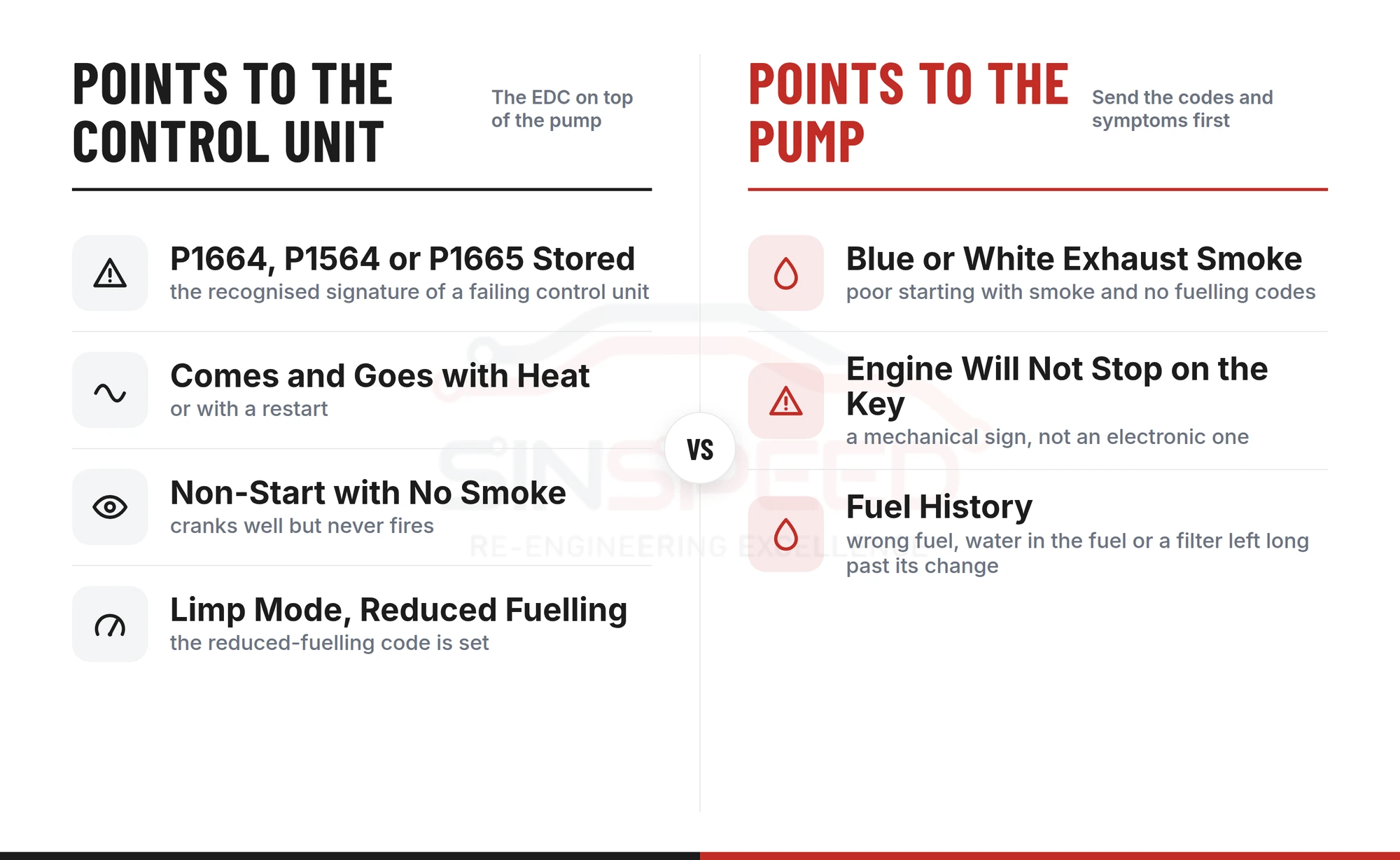
On these vans that is usually the wrong half. Most failures sit in the EDC rather than in the pump’s mechanical components, which is why the control unit is the repair far more often than the pump is the replacement.
| Points to the control unit | Points to the mechanical pump |
|---|---|
| P1664, P1564 or P1665 stored | Blue or white smoke from the exhaust |
| A fault that comes and goes with heat or a restart | An engine that will not stop on the key |
| A non-start with no smoke | Poor starting with visible smoke and no fuelling codes |
| Limp mode with the reduced-fuelling code set | A history of the wrong fuel, water in the fuel or a filter left long past its change |
Our repair is to the control unit. A pump that has failed mechanically needs its internals putting right as well, and an EDC repair alone will not cure it. If your van sits in the right-hand column, send us the codes and symptoms first and we will tell you plainly which side the evidence points to.
What pushes the Transit’s EDC into failure
The unit works in a hard place. It is bolted to the top of the injection pump on a diesel engine, so it heats and cools with every journey and takes the engine’s vibration all day. It is sensitive to exactly that mix of heat and shock, which is why so many of these faults begin as intermittent ones that appear when the engine is warm.
The electrical supply matters too. A tired battery or a poor earth lets the voltage sag while the starter is cranking, just when the EDC needs a steady feed, so a no-start that only happens on a weak battery should be ruled out early. Fuel quality bears mostly on the mechanical side: contamination is the main cause of mechanical pump failure, one more reason to check the fuel and filter before a repair is chosen.
Sinspeed · Ford van pump control units
P1664 stored and the van in limp mode?Have your garage take the unit off and post it with the repair form, listing every code exactly as the tool printed it. Not sure it is the EDC? Send us the codes and what the van is doing, and we will tell you where they point before anything is removed.
Pump control units tested at running temperature · Repaired in our ESD-safe workshop
Replacement pump, used pump or your own EDC repaired?
Three routes get a Transit running again after P1664, and they differ less in the part than in what has to happen once it is fitted.
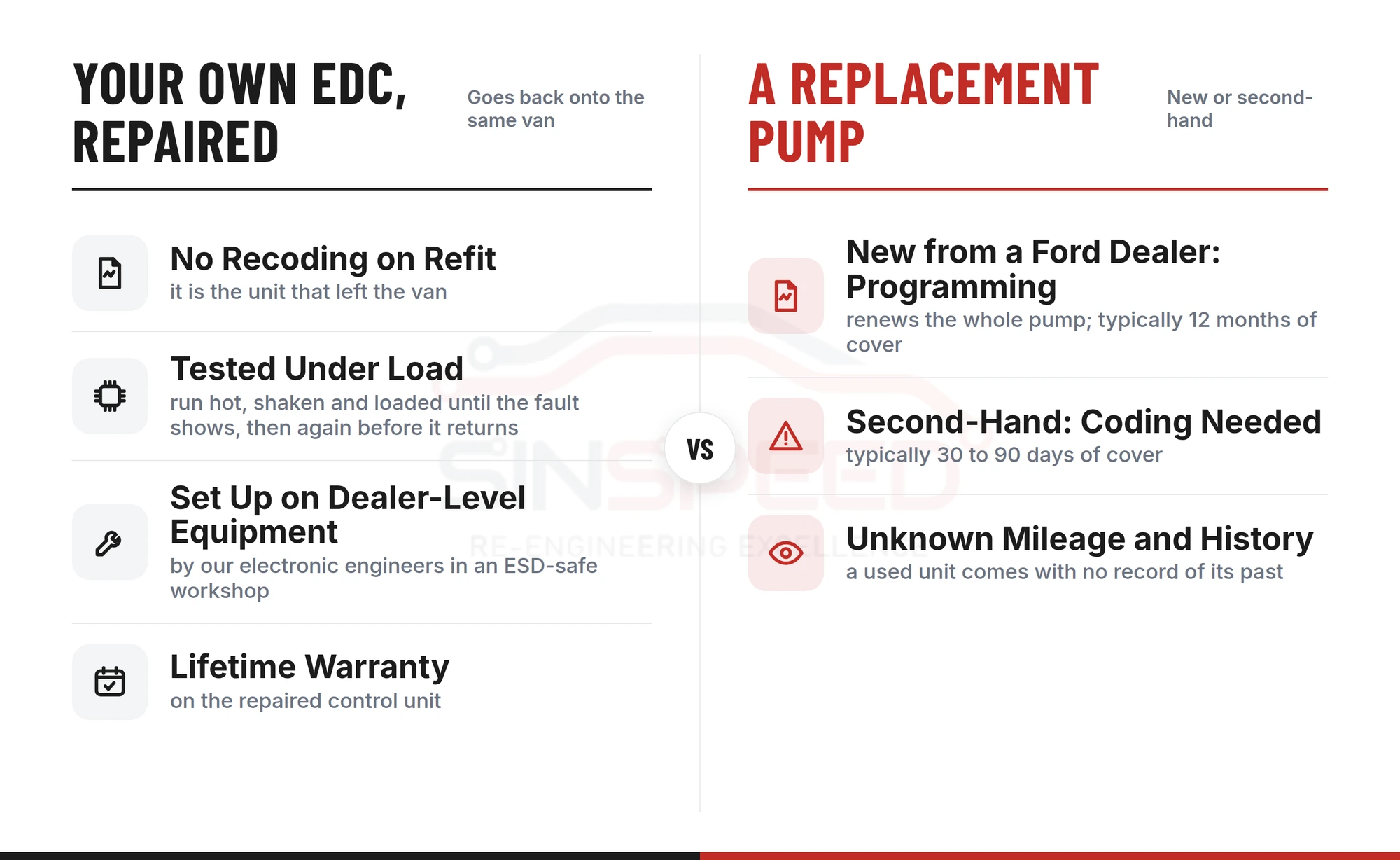
A new pump from a Ford dealer arrives with a new control unit on it. That cures the fault, but it renews the mechanical pump as well, and the new unit has to be programmed to the van. A second-hand pump needs coding too, and brings a control unit of the same design with no record of the mileage or care behind it.
| Option | At refit | Warranty | What gets renewed |
|---|---|---|---|
| New pump from a Ford dealer | Programming required | 12 months | The whole pump, mechanical side included |
| Second-hand pump | Coding required | Typically 30 to 90 days | Nothing: a used unit with an unknown history |
| Your own EDC, repaired by Sinspeed | No recoding | Lifetime | The failed control unit, tested under load before it returns |
Keeping the original control unit is what removes the programming step. It was matched to the van when it was built, so it goes back on as the same unit that came off.
How we test and repair a Transit pump control unit
Transit and Connect pump control units reach our workshop every week, and each one goes through the same sequence.
- Fill in the repair form
Give us the registration, every code exactly as it was stored, what the van does and when it does it (cold, hot or loaded), and the numbers from the pump and control-unit labels. Print the form and send it with the unit.
- Off the van at your garage
Your garage removes the pump and packs it with the connections protected. If they would rather send the control unit on its own, ask us first: it is fixed to the pump with the wiring running into it, not plugged in. Prefer not to arrange removal yourself? We also offer a removal and fitting service.
- Run hot, shaken and loaded
We put the unit on our in-house Hardware-in-the-Loop platforms, which recreate the heat, vibration and electrical load of a running engine, and keep it there until the reported fault shows itself. A unit that behaves on a cold bench and fails at temperature is precisely what this stage is built to catch.
- Repaired, set up and run again
Our electronic engineers carry out the repair in our ESD-safe, cleanroom-standard workshop. The unit is then set up on dealer-level diagnostic equipment and goes back on the rig for a second full run, heat and load included, before it is cleared to leave.
- Refitted with nothing to recode
Your garage refits the pump, re-times it to the engine as it would after any pump removal, and clears the stored codes. The control unit itself needs no recoding, because it is the one that left the van.
The repaired control unit is covered by our lifetime warranty.
Ford Transit P1664 and P1564: frequently asked questions
Final thoughts
P1664 tells you the control unit on the pump has found a fault in itself; P1564 tells you what that fault is doing to the engine. On a Transit or Connect of this age, the pair is about the electronics bolted to the pump far more often than about the pump.
The checks worth doing first cost little: the full code set, the fuel supply, the battery and whether there is any smoke. Once they point at the control unit, repairing the one your van left the factory with is the route that leaves nothing to reprogramme afterwards.
Sinspeed · Transit and Tourneo diesel pump EDCs
Get the van running again on its own control unitComplete the repair form with the registration, every stored code and what the van is doing, then have your garage post the unit to us. Want a view on the codes before anything comes off? Talk to us first.
Faults reproduced on the rig before repair · Refits without recoding · Lifetime warranty