
Summary: A Bosch VP44 or PSG5 diesel pump has a joint across the top of it, and working out which side of that joint your fault sits on is most of the job. Underneath is a mechanical pump that is genuinely reliable. Bolted above it is the electronic diesel control unit — the EDC — and that is the part that usually fails. P0251, P1564, P1631, P1632 and P1664 all get called diesel pump codes, but three of them mean completely different things depending on what you drive, and two can point at an engine ECU instead. This page takes each code in turn, names the platform the pump meaning applies to, and says which side of that joint it lands on.
- What the EDC on top of the diesel pump actually is
- Why the same code number means different things on different makes
- P0251: the answer depends on your fuel system, not your badge
- P1564: reduced fuelling on a Bosch pump, cruise control on a Nissan
- P1664 and P1665: an internal fault inside the EDC itself
- P1631 and P1632: the two that most often are not the pump
- The codes side by side, with the platform column
- What an EDC repair will not fix
- The misdiagnosis that sends people to a whole new pump
- What to rule out before anyone quotes you for an injection pump
- Which unit to send, and what we need with it
- Diesel pump EDC fault code FAQs
- Final thoughts
What the EDC on top of the diesel pump actually is
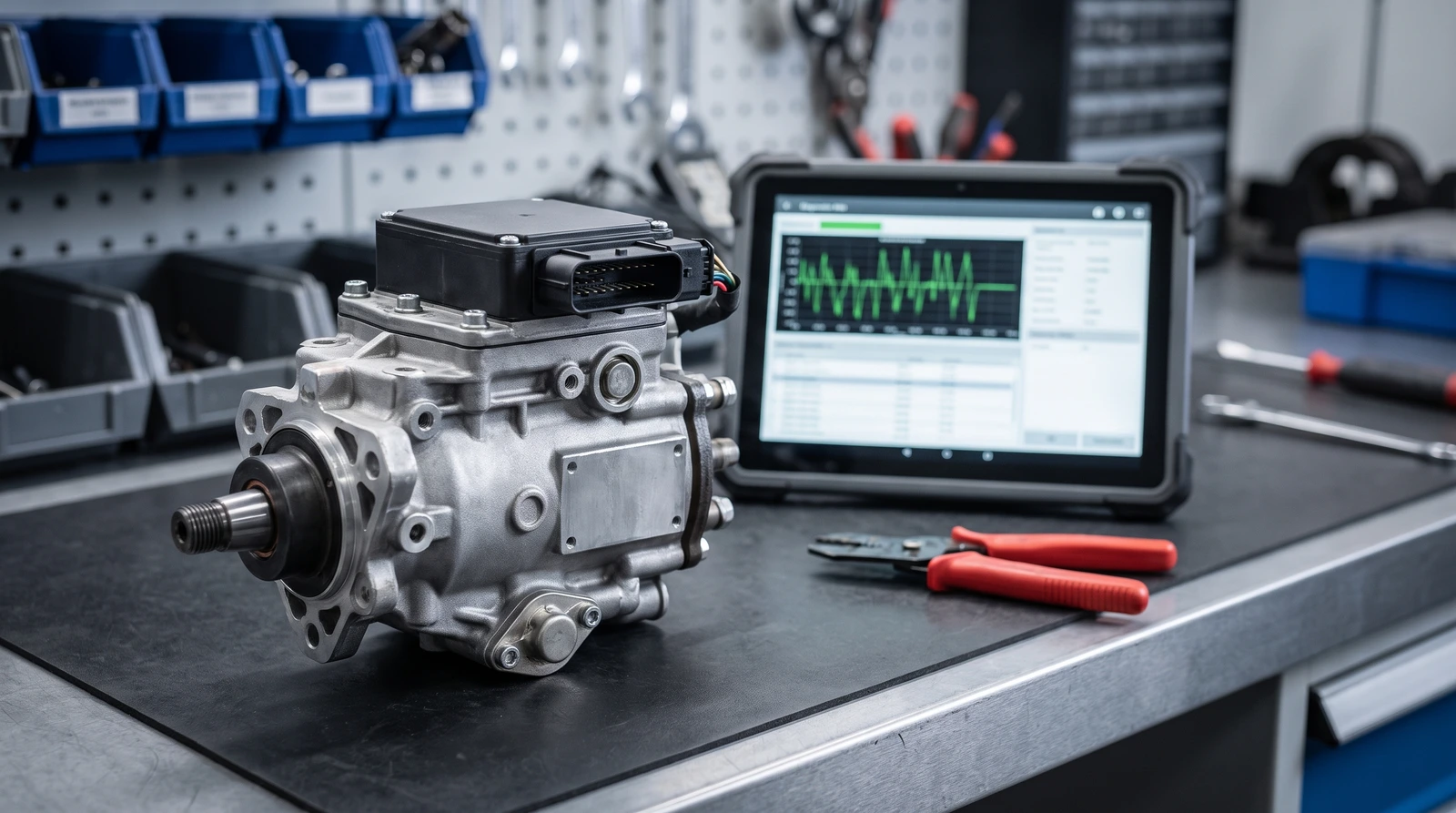
The Bosch VP30 and VP44 are distributor-type diesel injection pumps, fitted across a long list of cars and vans built from the late 1990s to the mid-2000s. What separates them from the purely mechanical pumps before them is the control unit bolted to the top: the electronic diesel control unit, written on most invoices as the EDC and sometimes as the EDU or by the name of the electronics inside it, the Bosch PSG5. It is the part that decides how much fuel the pump delivers and when, working to instructions from the engine ECU.
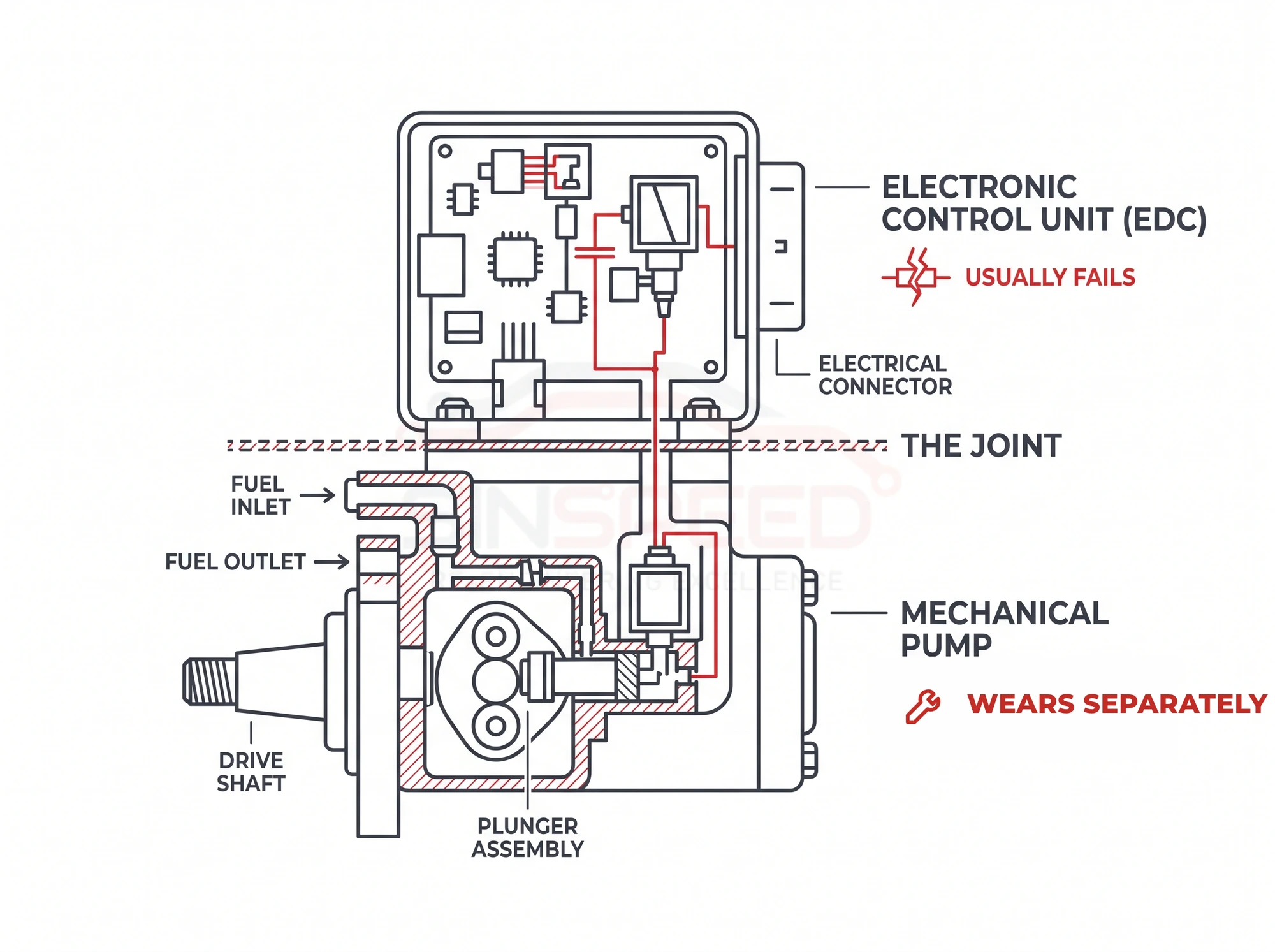
Physically it is a separate assembly with its own circuit board, fixed to the pump body with the pump’s wiring running directly into it. That separation is the reason a VP44 or PSG5 control unit can be repaired on a bench at all. It is not, though, a plug-and-socket arrangement. The wiring is fixed into the unit rather than clipped to it, and the board is built using hybrid construction that is genuinely delicate — several of the components on it are easily damaged by shock and vibration, and opening the unit without knowing what is inside can finish off a board that was repairable when it arrived.
Which brings you to the fact that decides most of this page. On these pumps the mechanical half is the reliable half. The great majority of failures sit in the EDC on top, and they sit there for a reason: the unit lives bolted to a hot, vibrating engine, and what the bench finds is a control board worn out by that environment rather than worn pumping elements underneath.
So on these vehicles, a code that says injection pump is usually a code about the box on top of the injection pump. Diesel pump EDC repair and diesel pump replacement are two different jobs of very different sizes, and everything below is about telling them apart.
Why the same code number means different things on different makes
Before any individual code, one piece of housekeeping that resolves most of the confusion around this family. Look at the second character of the code.
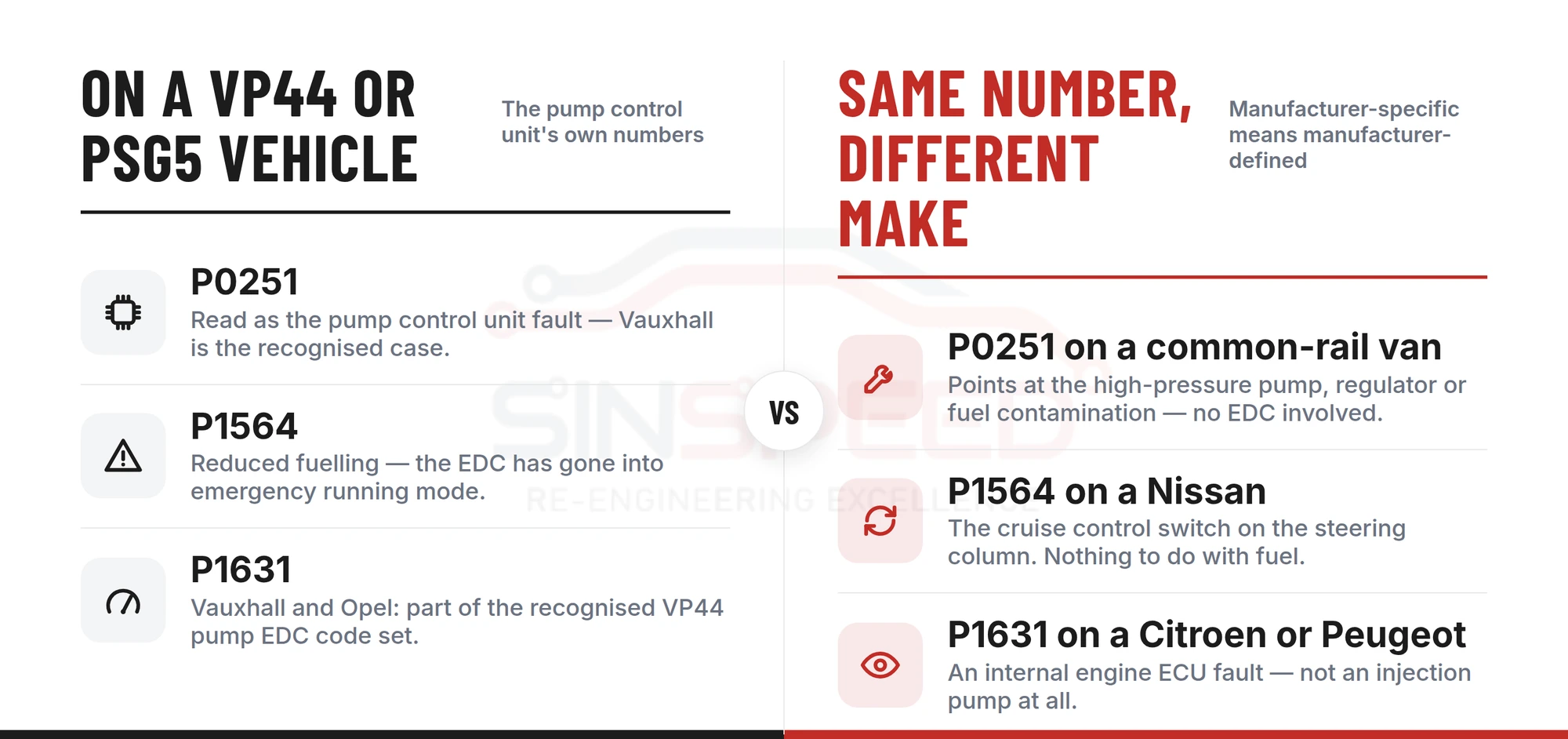
A code beginning P0 is generic. Its definition is standardised, it reads the same on a Vauxhall as it does on a Nissan, and any code reader will print the correct meaning. A code beginning P1 is manufacturer-specific: the number is reserved for the vehicle maker to define as it wishes, and two manufacturers can and do use the same number for entirely unrelated systems.
Of the five codes people arrive here with, exactly one — P0251 — is generic. P1564, P1631, P1632 and P1664 are all manufacturer-specific. That is not a technicality. It is the whole reason a generic code database can tell you with complete confidence that P1631 is a theft-deterrent fault while a diesel specialist tells you it belongs to a Vauxhall pump control unit, and both of them are right about a different car.
So the first thing worth establishing is not what the code means but which vehicle is asking. The pump meanings on this page apply to vehicles carrying a Bosch VP30 or VP44 with a PSG5 control unit — the Audi A4, A6 and A8 2.5 TDI V6, the BMW E46 320d and E39 520d, the Ford Fiesta, Focus and Mondeo, the Transit and Tourneo, the Nissan Almera, Patrol and Terrano, the Saab 9-3 and 9-5, the Rover 25 and 45, the Skoda Superb 2.5 TDI V6, the VW Passat 2.5 TDI V6, and a long run of Vauxhall models including the Astra, Combo, Corsa, Frontera, Meriva, Omega, Signum, Vectra and Zafira. If your vehicle is not on a list like that one, read the sections below for the platform meaning rather than the pump meaning.
One practical note for VW and Audi owners. The same pump faults are often stored under the manufacturer’s own five-digit numbering rather than a P-code, and the numbers that turn up on these pumps are 00550, 00628, 01268 and 01318. If your tool prints both, record both.
P0251: the answer depends on your fuel system, not your badge
P0251 is injection pump fuel metering control "A", range or performance — often printed in full as cam, rotor or injector. Being a generic code, that definition holds on every make. What it describes is a comparison the engine ECU could not reconcile: it commanded a fuelling or a rail pressure, read back what the fuel system actually delivered, and the two did not match. Having found the shortfall, it blames the pump end of the system.
What it does not tell you is which pump. This is the code where the fuel system, not the badge, decides the answer, and it splits two ways.
On a modern common-rail diesel — the Transit and Ranger TDCi vans are the UK examples people arrive with — there is no PSG5 control unit anywhere on the engine. P0251 there points at the high-pressure pump itself, at the pressure regulator or metering valve on it, or at fuel contamination that has damaged the pump internals. Bosch CP1, CP3 and CP4 pumps and the Delphi and Denso common-rail systems all behave this way. It commonly arrives with P0087 or P0088 for rail pressure low or high, and with the regulator codes P1247 and P1248. None of that is an electronics repair.
On the older distributor-pump cars carrying a VP44, the same code is read as a pump control unit fault, and Vauxhall is the recognised case. There it belongs with the rest of the VP44 code set and it is the EDC that is being complained about.
The symptoms are consistent enough across both to be no help in separating them: a hard start when hot, cranking for several seconds before it catches; sudden power loss or a drop into limp under load or on a hill; a random cut-out at a standstill followed by a normal restart; and, on a scan tool, a rail pressure figure that will not hold what was commanded. Which pump you have is the thing that separates them, not what the van is doing. None of it is exclusive to fuelling, either. A diesel that derates under load is just as often reporting an EGR flow or circuit fault, which is another reason the codes decide this and the symptoms do not.
P1564: reduced fuelling on a Bosch pump, cruise control on a Nissan
On a vehicle running a Bosch PSG5, P1564 is a reduced fuelling fault: the pump control unit has taken itself into an emergency running mode and is asking for less fuel than the engine is being asked to deliver. Ford’s own wording for it is that the injection pump module is requesting reduced fuelling, which is a clearer description of what has happened than most code databases manage.
On a Nissan, P1564 is the automatic speed control device switch — the cruise control switch circuit on the steering column, with the clock spring behind the wheel as a common secondary suspect. It has nothing whatever to do with fuel, fuelling or the injection pump.
Those two definitions collide on exactly one set of vehicles, and it is worth naming. Nissan is both the manufacturer that defines P1564 as a cruise control switch and a manufacturer that fitted the Bosch VP44 — to the Almera, Patrol and Terrano. So a Nissan owner with P1564 genuinely has two candidates, and the symptoms separate them cleanly. A switch-circuit fault shows up as cruise control that will not set or will not hold, with the engine running normally. A pump control unit fault shows up as reduced power, a drop into limp, hard starting or no start at all, and the cruise control is the least of it.
On the Transit and Tourneo, where this code turns up most often of all, there is no ambiguity — it is the pump control unit, and it very rarely arrives alone.
Worth being blunt about what reduced fuelling means for the driver. The engine will not answer the accelerator the way you expect, and this family of faults has a habit of progressing: the vans that arrive with P1564 stored have often gone on to cut out or to refuse to start. A diesel that has lost power is not always short of fuel, though. The air side derates it just as effectively, so P0101, the mass air flow code, is worth ruling out on the same scan. A vehicle that may not deliver power when you ask for it is a vehicle to get looked at rather than one to keep working, and pulling out to overtake is not the moment to discover the limit.
P1664 and P1665: an internal fault inside the EDC itself
P1664 is an injection pump control module fault, and of everything on this page it is the code that most directly names the unit we repair. It is set when the control unit reports an internal fault — not a sensor it is reading, not a circuit running away from it, but something wrong inside the box. On the bench that resolves overwhelmingly to a control board that has been cooked and shaken for years, which is exactly what a unit bolted to a hot, vibrating engine eventually produces. Some scan tools print it plainly as injection pump, faulty operation, which is as good a summary as any.
P1665 is the companion: an injection pump control module communication fault. The engine ECU and the pump control unit have stopped exchanging data properly. That can be the unit, and it can equally be the wiring and connectors between the two, which is why it is a code to trace before it is a code to send a unit for. It is the same shape of fault as the U-codes stored elsewhere on the vehicle, and the lost communication codes are worked the same way: prove the wiring, the connector and the supply before blaming the module that went quiet.
The reason to treat these together is that on the PSG5 they usually arrive together. P1564, P1664 and P1665 as a set is the recognised signature of a failing pump control unit, and a scan that returns all three at once has told you a great deal in one go. It is common on the Ford vans and cars in particular.
One caveat, because it applies to every P1 code on this page. P1664 is the most consistent of the manufacturer-specific codes here in a diesel context, but it is still manufacturer-specific, so confirm the definition your own manufacturer publishes for it before acting on the diesel meaning.
P1631 and P1632: the two that most often are not the pump
These two are together because they share a routing problem and because being straight about it is more useful than claiming both.
P1631 on a Vauxhall or Opel with a VP44 is a pump EDC code. It sits inside the recognised Vauxhall and Opel fault-code set for these pumps, alongside P0190, P1220, P1335, P1560, P1600, P1630 and P1660. If your Astra, Combo, Vectra or Zafira is on that pump and storing one or several of those numbers, the control unit on top of the pump is the right place to be looking.
P1631 and P1632 on a Citroën or Peugeot running a Bosch EDC17C60 are an engine ECU fault — an internal failure of components inside the engine control unit itself, with the Berlingo the case most often documented. That is not an injection pump fault and it is not a repair we carry out. Engine ECU repair sits with the independent specialists at ecu-repairs.com, and if that is what your codes describe then that is where the useful conversation is. We would rather send you there than take a pump apart.
P1631 on a GM vehicle is the theft-deterrent start-enable signal. The body control module passes a password to the powertrain module to authorise fuel delivery; if it does not arrive or does not match, the code sets and the engine is disabled. What that looks like is a crank with no start, or a start followed immediately by a stall, usually with a security lamp on. There is no fuelling fault to find.
P1631 on a Jaguar belongs to the same theft-deterrent and start-enable group rather than the fuelling group, with a throttle-motor power-relay circuit failure recorded as a cause on some models. A Jaguar owner who has been sent looking for an injection pump has been sent to the wrong end of the car.
P1632 on a Ford is a smart alternator fault, sensor or circuit. A smart alternator does not charge at a fixed output — the engine ECU varies it against battery state and electrical load, and P1632 flags a fault in the sensor or the control circuit that feedback runs through. Symptoms are charging symptoms: a battery that drains, unreliable electrical behaviour, warning lamps. The wiring and connectors at the alternator and at the battery current sensor are the first things to inspect, and the fault is sometimes the alternator’s own regulator. It is a charging code, and the manufacturer-specific databases that describe it as a battery-supply or voltage-management fault are describing the same thing.
Which leaves P1632 as the weakest member of this family for diesel-pump purposes, and it is fairer to say so than to imply otherwise. On the two makes where it is best documented it is a charging circuit or an engine ECU. There is no recognised VP44 or PSG5 pump meaning for it.
The codes side by side, with the platform column
The fourth column is the one that keeps people out of trouble, and no generic code database has any reason to fill it in.
| Code | Type | On a Bosch VP44 or PSG5 vehicle | On other platforms, the same number | Where the repair sits |
|---|---|---|---|---|
| P0251 | Generic (P0) | Read as a pump control unit fault — Vauxhall is the recognised case. | Definition is stable across makes, but on a common-rail diesel such as a TDCi van it points at the high-pressure pump, the regulator or fuel contamination. | Split. The EDC on a VP44 car; the pump, the regulator or the fuel system on a common-rail van. |
| P1564 | Manufacturer-specific (P1) | Reduced fuelling — the pump control unit has gone into an emergency running mode. | Nissan: the automatic speed control device switch on the steering column. Cruise control, not fuel. | The EDC on a PSG5 vehicle; a steering-column switch circuit on a Nissan cruise control fault. |
| P1631 | Manufacturer-specific (P1) | Vauxhall and Opel: part of the recognised VP44 pump EDC set with P0190, P1220, P1335, P1560, P1600, P1630 and P1660. | Citroën and Peugeot EDC17C60: an internal engine ECU fault. GM and Jaguar: the theft-deterrent start-enable group. | The EDC on a Vauxhall VP44. The engine ECU on an EDC17C60 — not us. The security system on GM and Jaguar. |
| P1632 | Manufacturer-specific (P1) | No recognised VP44 or PSG5 pump meaning. | Ford: smart alternator sensor or circuit. Citroën and Peugeot EDC17C60: an internal engine ECU fault. | The charging system on a Ford; the engine ECU on an EDC17C60. Almost never the pump. |
| P1664 | Manufacturer-specific (P1) | Injection pump control module fault — an internal fault inside the EDC. The clearest EDC code here. | Still a P1 code, so confirm your own manufacturer’s definition before acting on the diesel meaning. | The EDC. |
| P1665 | Manufacturer-specific (P1) | Injection pump control module communication fault — the engine ECU and the pump control unit stopped exchanging data. | Usually seen with P1564 and P1664 rather than on its own. | The EDC, once the wiring and connectors between the two modules have been proven. |
Sinspeed · mail-in unit repair
Send us the control unit rather than the whole pumpTell us the codes, the vehicle and what it is doing, and we will confirm whether the fault is the EDC on top of your pump before anything comes off the engine. If it is the pump itself, an engine ECU or a switch circuit, we will say so.
Mail-in repair and return, UK-wide · Your vehicle stays where it is — only the unit travels
What an EDC repair will not fix
Everything above rests on the electronics being the part that failed, and that is usually true on these pumps. It is not always true, and the difference matters more here than on almost any other unit we handle.
What we test and repair is the control unit on top of the pump. The pump’s mechanical internals are not part of that work and cannot be assessed from the control unit, so a perfectly good repaired EDC refitted to a pump that has failed mechanically will leave you exactly where you started.
These pumps do fail mechanically, and fuel contamination is the main thing behind it when they do. On the VP44 the recognised mechanical failure is seizure of the timing advance piston: the protective coating wears through, the bare steel seizes in the housing, and what the driver gets is blue or white smoke, poor power, rough running, engine shutdown and a non-start. On the VE-family pumps — the VP30 and VP37 among them — the same contamination seizes the head and rotor, whose working tolerances are extremely fine, or damages the cam plate and rollers. That last one is the expensive version, because the fragments are hardened and can travel: they damage the pump housing and can reach the injectors.
There are symptoms that point that way rather than at the electronics, and they are worth knowing before you send anything anywhere. Blue or white smoke from the exhaust. An engine that will not stop on the key. Poor starting alongside visible smoke rather than alongside stored fuelling codes. Any history of the wrong fuel, water in the fuel, or a filter that has been left long past its change.
If that is what you have, it is a job for a diesel injection specialist with the bench equipment to strip and rebuild a pump. It is not an electronics repair, we do not pretend otherwise, and a page that told you every pump code was a circuit-board job would be doing you no favours at all.
The misdiagnosis that sends people to a whole new pump
Most people arriving at these codes have already been told the words injection pump, and there are three distinct ways that conversation goes wrong.
The common one is reading the code’s own name as the diagnosis. The code says injection pump, so an injection pump gets quoted — when on a VP44 or PSG5 vehicle what has actually failed is the control unit bolted to the top of it. Fitting a complete pump does resolve the fault, because a complete pump arrives with a new control unit on it. But it renews the mechanical assembly, which was the reliable half and was not complaining, in order to replace the electronic half, which is a separate part that comes off on its own.
The second is the reverse, and it catches people who have read a page like this one and stopped halfway. On a common-rail van a fuel-metering code very often does mean the pump, or the regulator on it, or fuel that has damaged it. There is no PSG5 control unit on those engines to repair, and going looking for one wastes the week.
The third is the one this whole page exists for: a manufacturer-specific code read against somebody else’s definition. A Nissan cruise control switch, a Jaguar security fault and a Ford charging circuit have all been chased as fuelling faults, because a generic lookup returned a diesel-pump meaning for a number the manufacturer had used for something else entirely.
The pattern is not unique to diesel pumps. It repeats wherever a small control unit is bolted to a large mechanical assembly: on an automated gearbox, clutch actuator fault codes routinely turn into a quote for a clutch. A code that names a system rather than a part gets treated as though it named the most expensive part in that system, which is the same trap we take apart on transmission control module fault codes. What protects you here is narrow and cheap: establish which pump is on your engine, and read the definition your manufacturer publishes rather than the first one a lookup returns.
What to rule out before anyone quotes you for an injection pump
In order, cheapest and most conclusive first. The order matters because it ends at the control unit rather than starting there.
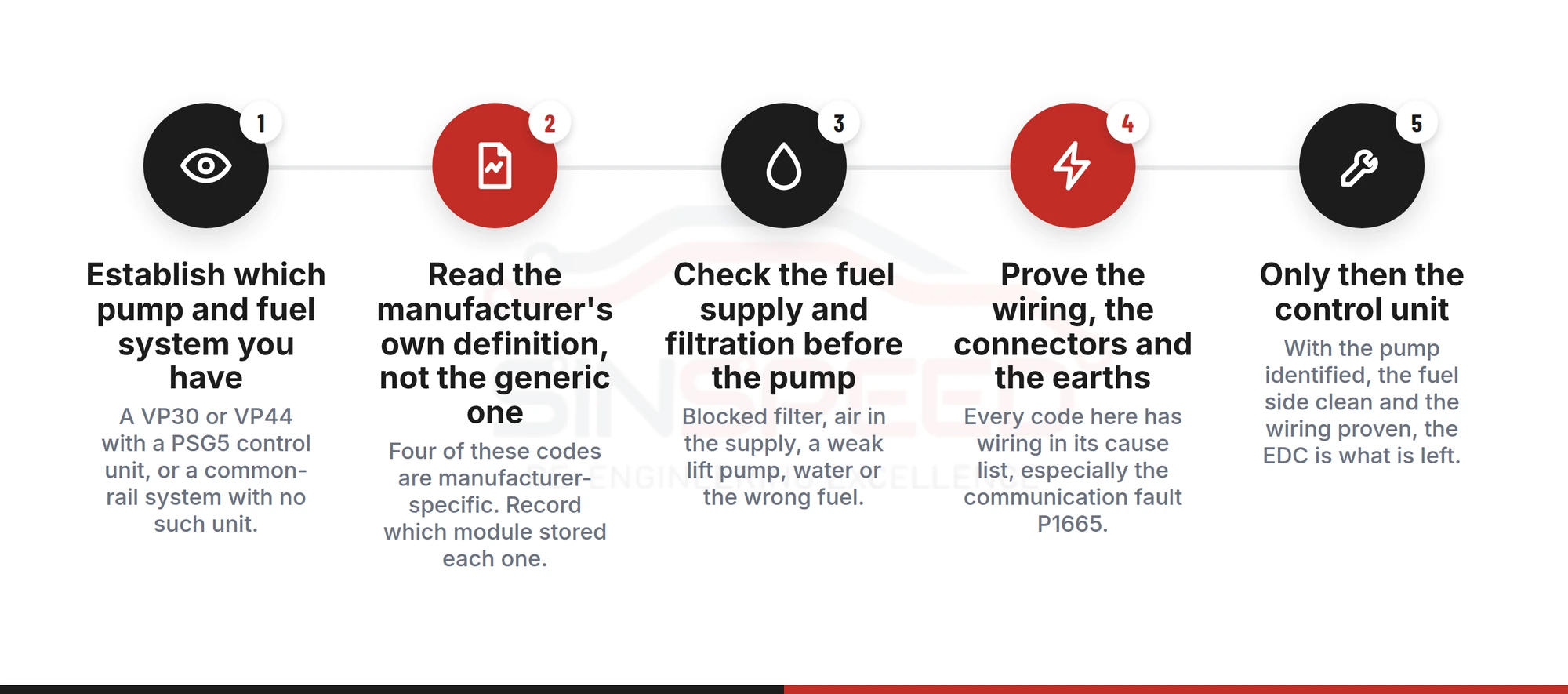
- Establish which pump and which fuel system you have
A VP30 or VP44 with a PSG5 control unit on top, or a modern common-rail system with no such unit anywhere. Nothing else on this list means anything until that is settled, and it changes the meaning of every code above.
- Read the manufacturer’s own definition, not the generic one
Four of the codes here are manufacturer-specific. Record every code, and record which module stored each one — a code held in the engine ECU and a code held in a body or security module are telling you about different systems, and on P1631 in particular that distinction is the whole answer.
- Check the fuel supply and filtration before the pump
A blocked or long-overdue filter, air drawn into the supply, a weak lift pump, water or the wrong fuel in the tank. This is the cheapest check on the list and it sits behind both the fuelling codes and the mechanical pump failures described above.
- Prove the wiring, the connectors and the earths
Every code here has wiring in its cause list, and on the communication fault P1665 the loom between the engine ECU and the pump control unit is the first suspect rather than the last. On P1632 the same step means the connections at the alternator and the battery current sensor, and it is worth confirming the battery and charging are sound before condemning anything electronic.
- Only then the control unit
With the pump identified, the definitions confirmed, the fuel side clean and the wiring proven, the EDC is what is left standing. That is the point at which sending it stops being a guess.
Three of those five steps are work on the vehicle, and none of them is a service we sell. We do not change filters, trace looms or rebuild pumps, and we would rather say that here than have a unit posted to us that did not need removing. If the elimination lands on the fuel side or the wiring, your garage or an auto electrician is who you want.
Which unit to send, and what we need with it
If it has landed on the EDC, the control unit is what travels. The pump stays with the vehicle or with your garage, and the vehicle stays wherever it is.
One caution before anything is undone. The control unit is fixed to the pump with the wiring running into it rather than plugged into it, and the board inside is the delicate hybrid assembly described at the top of this page. Separating it is a job to do deliberately, not with a screwdriver and optimism, and a unit damaged on the driveway is a unit that arrives harder to repair than it left. If it is still on the pump and you are not certain how it comes off, ask us first.
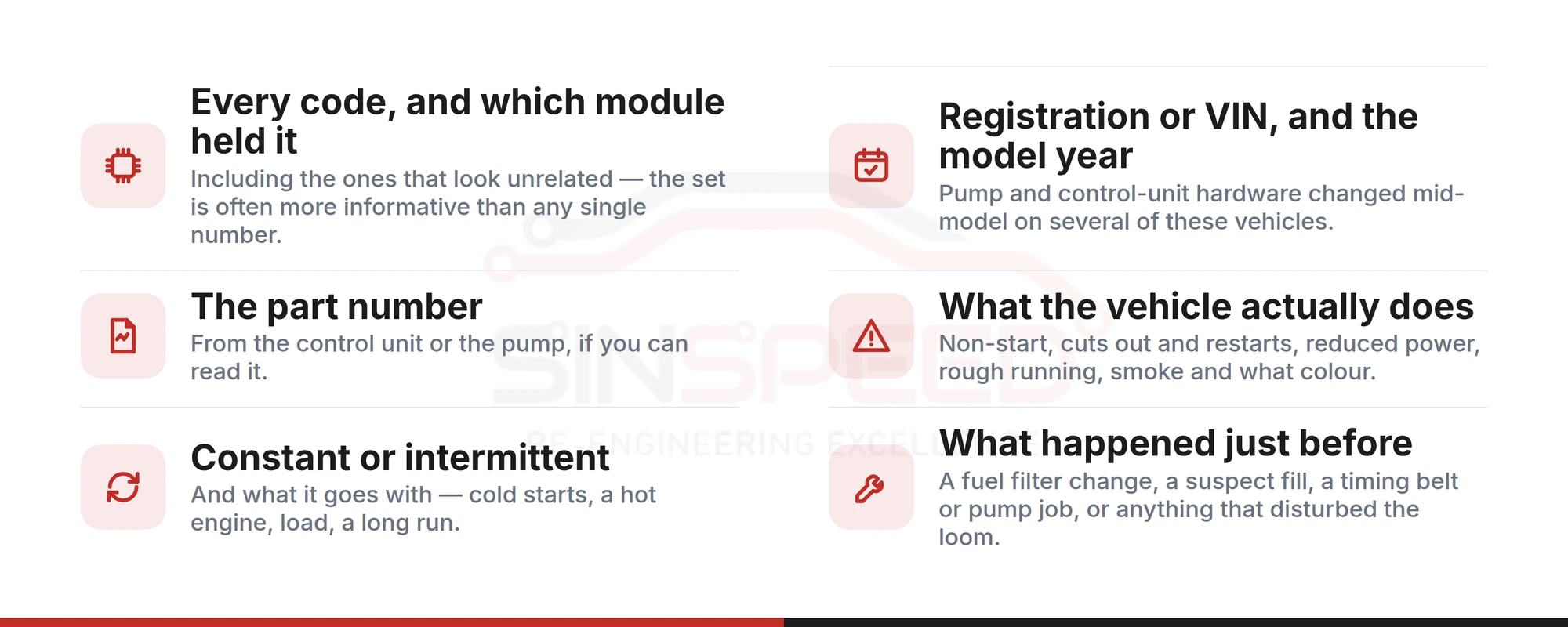
- Every code, and which module held it — including the ones that look unrelated. The set is often more informative than any single number.
- Registration or VIN, and the model year — pump and control-unit hardware changed mid-model on several of these vehicles.
- The part number — from the control unit or the pump, if you can read it.
- What the vehicle actually does — non-start, cuts out and restarts, reduced power, rough running, smoke and what colour it is.
- Constant or intermittent — and if intermittent, what it follows: cold starts, a hot engine, load, a long run.
- What happened just before — a fuel filter change, a suspect fill, a timing belt or pump job, or anything that disturbed the loom.
On the bench the unit is powered and driven rather than guessed at. Our in-house Hardware-in-the-Loop platforms run it under simulated heat, vibration and load, which is the only honest way to test a unit whose faults are so often heat-related and intermittent — a fault that behaves perfectly cold and appears at running temperature is invisible in a five-minute scan and obvious on a rig. Repairs are carried out at circuit level by our in-house team of electronic engineers, and where a unit has a recognised weak point it is reinforced rather than restored to the condition that failed, which is the one thing a like-for-like replacement carrying the same design flaw cannot offer you. Many units come back ready to fit with no coding required, and most remanufactured parts carry a lifetime, unlimited-mileage warranty.
We cover the VP44 and PSG5 platforms across the makes they were fitted to, including the Saab 9-3 and 9-5 and the VW Passat 2.5 TDI V6. And if the same scan is also carrying reduced-power and throttle codes, that is a separate family with its own logic, taken apart the same way on throttle body fault codes.
Diesel pump EDC fault code FAQs
Does P1564 mean my diesel pump has failed?
Not on its own, and not on every make. On a vehicle carrying a Bosch VP30 or VP44 with a PSG5 control unit, P1564 is a reduced fuelling fault and it points at that control unit rather than at the pump’s mechanical internals. On a Nissan, the same number is the automatic speed control device switch on the steering column, which is a cruise control fault and has nothing to do with fuel. Nissan fitted the VP44 to the Almera, Patrol and Terrano, so a Nissan owner can genuinely have either. The symptoms separate them: cruise control that will not set with the engine running normally is the switch, while reduced power, hard starting or a non-start is the pump control unit.
Can the EDC be repaired without replacing the whole injection pump?
Yes. The electronic diesel control unit is a separate assembly bolted to the top of the pump with its own circuit board, and it comes off and is repaired on its own. That is the whole point of the distinction this page draws, because on the VP44 and PSG5 the mechanical pump underneath is the reliable half and is usually not the part that failed. What repair cannot do is fix the pump’s mechanical internals — a seized advance piston, a seized rotor or cam plate damage are pump failures, and no work on the control unit will touch them.
Which cars and vans have the Bosch VP44 or PSG5 pump?
It was fitted very widely to cars and vans built from the late 1990s to the mid-2000s. The ones that come through most often are the Ford Transit, Tourneo, Fiesta, Focus and Mondeo; the Audi A4, A6 and A8 2.5 TDI V6; the BMW E46 320d and E39 520d; the Nissan Almera, Patrol and Terrano; the Saab 9-3 and 9-5; the Rover 25 and 45; the Skoda Superb 2.5 TDI V6; the VW Passat 2.5 TDI V6; and a long run of Vauxhall models including the Astra, Combo, Corsa, Frontera, Meriva, Omega, Signum, Vectra and Zafira. If your vehicle is not on a list of that kind, treat the pump meanings on this page as not applying to it.
I have P1631 on a Citroen — is that the same fault as P1631 on a Vauxhall?
No, and this is the most important thing on the page to get right. P1631 is a manufacturer-specific code, so each maker defines it for itself. On a Vauxhall or Opel with a VP44 pump it belongs to the pump control unit set. On a Citroen or Peugeot running a Bosch EDC17C60 it is an internal fault inside the engine control unit, most often documented on the Berlingo — a completely different part, in a completely different place, and not an injection pump fault at all. Engine ECU repair is not something we carry out; that work sits with the independent specialists at ecu-repairs.com. On GM and Jaguar vehicles the same number belongs to the theft-deterrent and start-enable group instead.
My van has P1564 and P1664 together and will not start. What does that combination mean?
P1564, P1664 and P1665 arriving together is the recognised signature of a failing pump control unit on a Bosch PSG5, and it turns up on the Ford vans more than anywhere else. P1564 says the unit has dropped into a reduced fuelling mode, P1664 says it has found an internal fault, and P1665 says the engine ECU can no longer talk to it properly. A non-start with that set stored is consistent with the control unit rather than the pump’s internals. Treat it as a vehicle to recover rather than one to keep trying to start, and if there is blue or white smoke or the engine will not stop on the key, tell us — those point at the mechanical side instead.
Will a repaired EDC need coding to my vehicle?
In most cases no. Your original unit is repaired and returned with your vehicle’s own data intact, so it goes back on as a direct refit and many units need no coding at all. That is one of the practical advantages of repairing the unit you already have rather than introducing a replacement that has to be matched to the vehicle. If your particular application does need anything doing after refitting, we will tell you before the unit goes back, rather than leaving you to find out on the driveway.
Sinspeed · mail-in unit repair
Been quoted for a whole injection pump?Send us your fault codes and vehicle details and our engineers will tell you which side of the pump the fault is on before anything is removed — including when the honest answer is that it is not a unit we repair.
Circuit-level board repair by in-house electronic engineers · Tested on Hardware-in-the-Loop platforms under heat, vibration and load
Final thoughts
Two questions decide everything on this page, and neither of them is about the code. Which pump is on your engine, and whose definition applies to your badge. Answer those and every code above resolves; skip them and a P1631 on a Jaguar and a P1631 on a Vauxhall Astra look like the same fault, which they are not.
The rest is a joint across the top of a pump. On the VP44 and PSG5 vehicles, the mechanical half underneath it is the half that tends to survive, and the box screwed above it is the half that fails — which is a good outcome, because it is the smaller of the two things to put right. On a modern common-rail van there is no such box, and a code pointing at the pump is far more likely to mean the pump.
Which leaves the honest arithmetic. Of the six codes set out above, two lead somewhere we cannot help — an engine ECU, a charging circuit, a steering-column switch, a security system. Saying so is the only thing that makes the other four worth believing.