
Summary: When the rotary gear selector on a Range Rover, Evoque or Discovery stays flush with the console, refuses to turn or leaves the car stuck in gear, the selector module is usually at fault, not the gearbox. P176C-11 logged with P176A and P176B is the pattern that points at it. You or your garage lift the module out of the centre console and post it to our Epsom workshop; we test and repair your own unit and return it with a lifetime, unlimited-mileage warranty.
This page walks through what the selector does, the faults and codes that implicate it, how to tell it apart from a gearbox problem, the models it affects and how the repair works by post. Our other transmission control module repairs sit in the same hub.
- The part: the rotary gear selector module in the centre console
- The cars: Discovery 4, Discovery Sport, Discovery 5, Range Rover, Range Rover Sport and Range Rover Evoque
- The signs: a dial that will not rise or fall, will not rotate, or will not select a gear
- The codes: P176C-11, usually stored with P176A and P176B
- The route: the module comes out of the console and travels by post; the car stays with you
- The cover: lifetime, unlimited-mileage warranty on all repaired units
- What does the Land Rover rotary gear selector do?
- Gear selector problems: the dial that will not rise, turn or select
- P176C-11, P176A, P176B and P176B-71: the codes that point at the selector
- Is it the gear selector or the gearbox?
- Gear selector faults by model: Evoque, Discovery Sport, Discovery 4 and Range Rover
- Why do rotary gear selector modules fail?
- Land Rover gear selector part numbers we repair
- How Sinspeed repairs your gear selector
- Questions Land Rover owners ask
- Final thoughts
What does the Land Rover rotary gear selector do?
These cars have no gear lever. In its place is a round dial set into the centre console: it rises when the car is started, lowers again when it is switched off, and in between it turns to choose park, reverse, neutral or drive.
The dial is the part you touch, but it belongs to the gear selector module, a self-contained electronic unit. The module reads the position you have chosen and passes that request to the transmission, which makes the change. It is the link between the driver and the gearbox: the gearbox does the shifting, and the selector tells it what to shift to.
Because the selector is a separate unit, it can fail while the gearbox behind it is perfectly healthy. That is the fault this page deals with, and it is why a car that suddenly refuses to go into gear is often a much smaller job than it first appears.
Gear selector problems: the dial that will not rise, turn or select
Selector faults show themselves at the dial. These are the three we see most often on units sent to us:
- The dial does not rise or fall. It stays flush with the console when the car starts, or stays up after the car is switched off.
- The dial will not rotate. It has risen, but it will not turn from one position to the next.
- No gear will select, or the car is stuck in one. The dial may move, yet the car stays where it was.
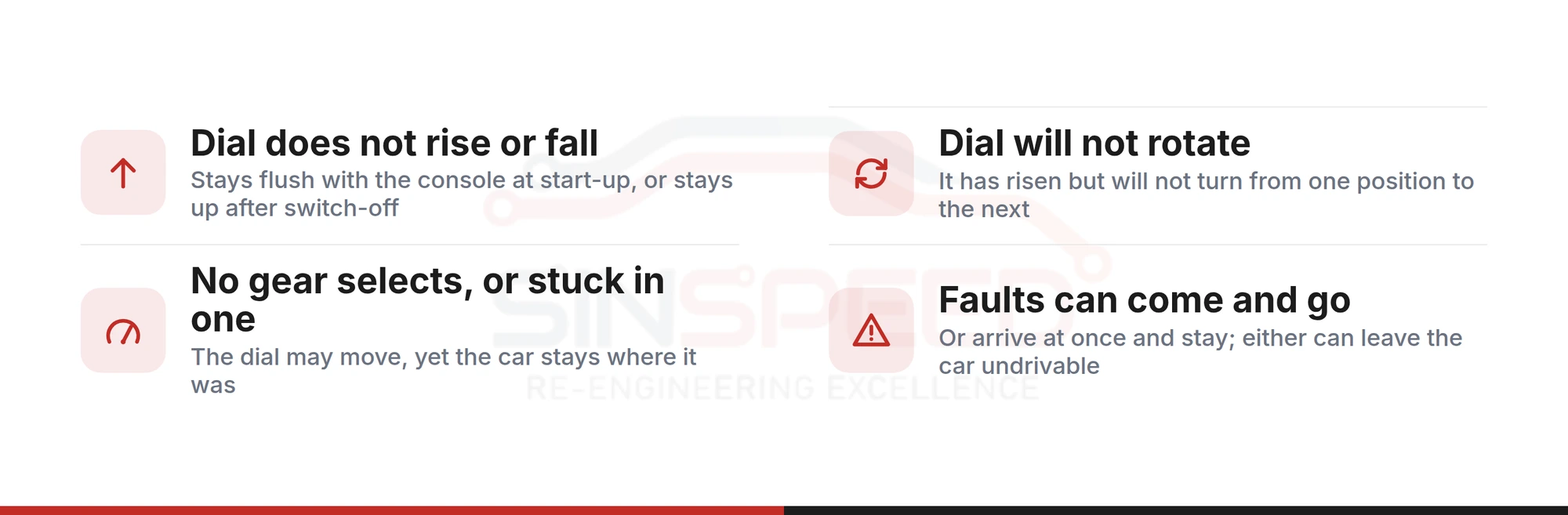
Some of these faults come and go; others arrive at once and stay. Either kind can leave the car undrivable. When you contact us, say which you have and whether it first appeared after a cold start, a long hot drive or a spill in the console, because each of those tells us something before the module reaches the bench.
If the dial behaves normally and it is the gear letters on the instrument panel that are flashing, our guide to the flashing PRNDS light covers that warning on its own.
Never force a dial that will not move. Force will not put the car in gear, and it risks adding damage to a fault that was repairable. If the car is stuck in gear or will not select one, have it recovered rather than driven, and get the codes read where it stands.
P176C-11, P176A, P176B and P176B-71: the codes that point at the selector
Three codes come up again and again when a Land Rover selector fails. P176C-11 is logged as a transmission range selector lock control error, and on these cars it tends to arrive with P176A and P176B stored alongside it. Seen together, the three point at the gear selector module rather than the gearbox.
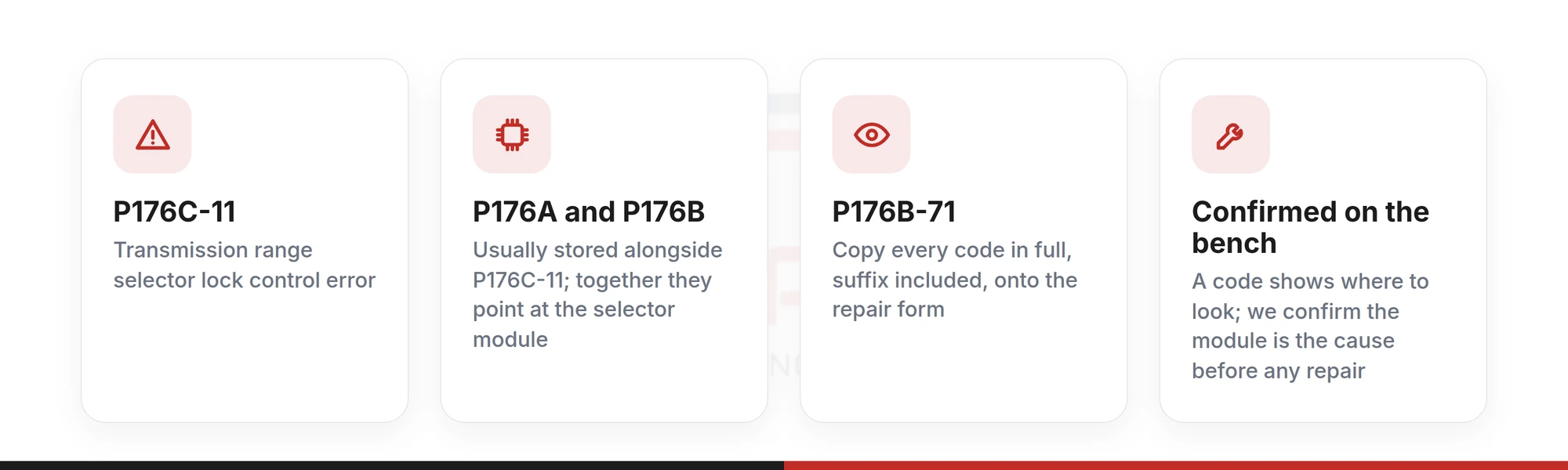
Many owners search for P176B-71. Whatever your garage’s tool displays, copy every code in full, suffix included, and put them all on the repair form.
A code tells us where to look, not what to conclude. A weak battery or a disturbed connector can also leave faults in the memory, so we confirm on the bench that the module is the cause before any repair begins.
Is it the gear selector or the gearbox?
The two are easy to confuse because they fail with the same result: a car that will not move. The selector only reports what you have asked for; the gearbox and its control unit carry out the change. Our explainer on what the transmission control module does covers the gearbox side of that partnership.
When the dial cannot rise, cannot turn or cannot report its position reliably, the transmission never receives a request it trusts, so it holds where it is. From the driver’s seat that looks exactly like a gearbox that has given up, which is how a selector fault gets mistaken for a far bigger repair.
Three questions usually separate the two:
- Is the dial itself misbehaving? Not rising, not lowering or not turning points at the selector.
- Are P176C-11, P176A or P176B stored? That pattern points at the selector too.
- Does the dial work normally while the car still will not drive? That points away from the selector and towards the gearbox side.
If your car fits the last pattern, our guide to why a car will not go into gear walks through the wider causes. If the codes leave you in two minds, send them to us before anything is removed and we will tell you whether the selector is the unit to take out.
Sinspeed · selector modules
Dial stuck down and P176C-11 logged?That combination is the one that points at the selector module. Fill in the repair form, lift the module out of the console and post it to Epsom; the car stays at home.
Repair proven on the bench before your module is posted back
Gear selector faults by model: Evoque, Discovery Sport, Discovery 4 and Range Rover
The rotary selector is fitted across much of the Land Rover and Range Rover range, and the symptoms and codes above apply to every model below. What differs is the part number, so the label on your module is what settles whether we can help.
Range Rover Evoque (2011 to 2019)
The Evoque draws more searches for selector problems than any other model on this page. We repair selector modules from Evoques built between 2011 and 2019; if yours is a later car, send us the part number from the module’s label and we will check it first.
Land Rover Discovery Sport (2015 to 2019)
Discovery Sport selectors from 2015 to 2019 reach us with the same three faults: the dial that will not rise, the dial that will not turn and the car that will not take a gear. Compare the number on your module with the table further down; it is the quickest way to confirm a match.
Discovery 4 (2009 to 2016)
The Discovery 4 is among the oldest cars on our list. On a vehicle of that age the module has been raised, turned and lowered on every journey the car has made, which is why wear from use, covered below, weighs most heavily here.
Range Rover (2012 to 2020) and Range Rover Sport (from 2009)
We repair selector modules from the full-size Range Rover built between 2012 and 2020, and from the Range Rover Sport from 2009 onwards. If yours is used off the road or for towing, mention it on the form: vibration and damp both feature in why these modules fail.
Discovery 5 (from 2017)
The Discovery 5 is the newest model on our list. A newer car does not rule the selector out, because heat, moisture and low voltage do not wait for high mileage, so the same codes deserve the same check.
Driving a model not listed here? Send us the number from the module’s label and we will give you a yes or no before the console is opened.
Why do rotary gear selector modules fail?
A rotary selector works harder than its size suggests. It rises on every start, lowers on every switch-off and turns several times on every journey, in a part of the cabin that sees drinks, wet hands and summer heat. The causes we see sit at system level, and they tend to build on one another.
- Wear from use. Every start and every gear choice adds a cycle, and a module that has done more of them has had more chances to fail.
- Heat. The console warms up in a car parked in the sun and cools again overnight, and that daily swing stresses any electronic unit.
- Vibration. Rough tracks, off-road driving and broken road surfaces shake the console and everything in it.
- Moisture and contamination. Spilt drinks, condensation and damp carried in on clothing can find their way down into the console.
- Low voltage. The dial rises as the engine starts, just when battery voltage dips furthest. A tired battery or a poor earth can produce selector symptoms on its own, so rule both out first.
When a degraded module cannot report its position or its lock state cleanly, the transmission errs on the side of not moving: it refuses the change, or holds the gear it already has. That caution protects the car, and it is also why a fault in a small console module can feel like the end of the gearbox.
Land Rover gear selector part numbers we repair
These are the Land Rover gear selector part numbers that come into our workshop most often for testing and repair. Check them against the label on your module.
| Part Numbers | Part Numbers |
|---|---|
| BH427E453AH | 30SLK10011107 |
| BH427E453AJ | BH427E453AE |
| EH227E453AB | 30SLK10121364 |
| PEJ327E453CA | 30SLK10103699 |
| GJ327E453AB | 30SLK10130800 |
The list is not complete. If your number is missing, send it to us and we will confirm we can repair it before anything is posted.
How Sinspeed repairs your gear selector
Your car stays on your drive or at your garage throughout. The work happens on the selector module alone, posted to our Epsom workshop and returned to the same car.
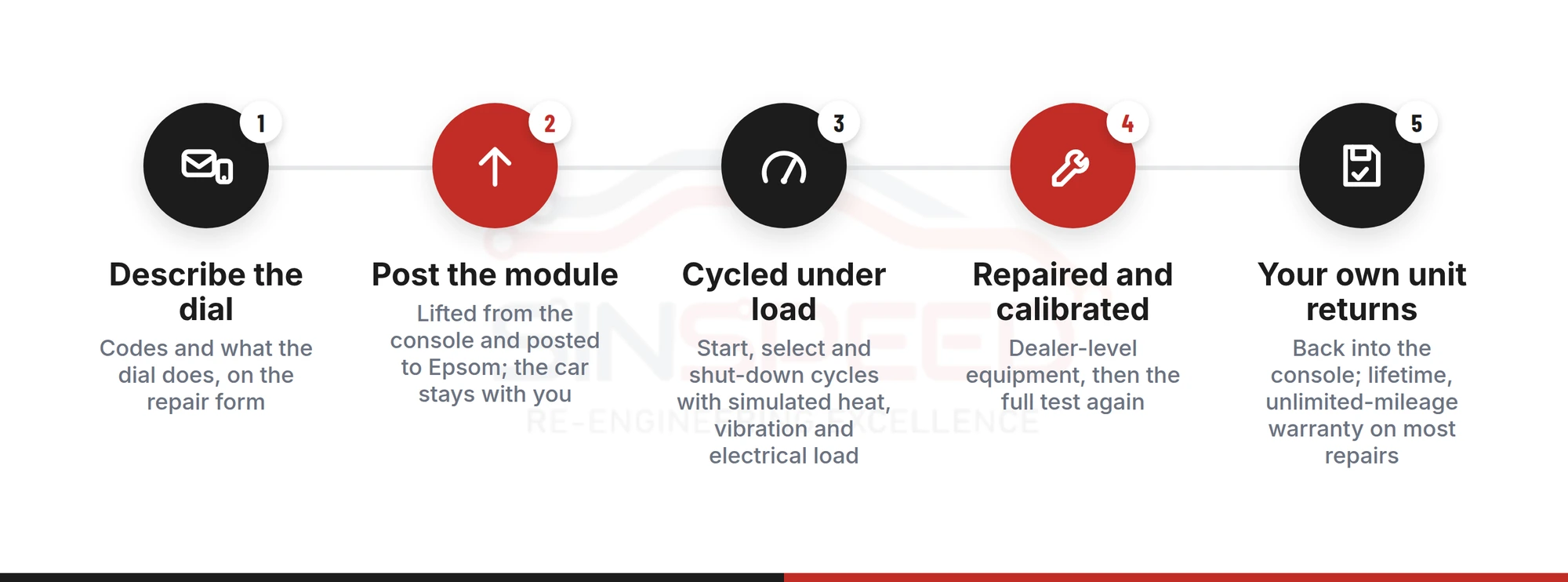
- Describe what the dial does
On the repair form, give us the registration, the model and year, every code as it was read and a line on the dial: whether it rises, whether it turns, and whether the fault comes and goes.
- Out of the console and into a box
You or your garage lift the selector module out of the centre console. Wrap it so the dial cannot take a knock, protect the connector and post it to Epsom.
- Cycled under load until the fault shows
On our in-house Hardware-in-the-Loop platforms the module is run through repeated start-up, selection and shut-down cycles under simulated heat, vibration and electrical load. We measure how it responds and what it reports until the fault you described appears.
- Repaired, calibrated, then proven again
Our in-house engineers repair the module in a cleanroom-standard, ESD-safe workshop, then program and calibrate it with dealer-level diagnostic equipment. It repeats the full test and is packed for return only when it passes.
- Back into your console
Your own unit comes home, so there is no replacement to pair to the vehicle. It goes back into the console, the stored codes are cleared, and all repaired units carry our lifetime, unlimited-mileage warranty.
Questions Land Rover owners ask
Final thoughts
A Land Rover that will not take a gear feels like a gearbox bill on its way, and most of the time it is nothing of the sort. When the dial stays down or will not turn, the fault usually sits in the small module in the console, not in the transmission beneath it.
Read the codes, rule out the battery, and let P176C-11, P176A and P176B decide what comes out of the car. If they point at the selector, only the module has to travel, and the car never leaves you.
Sinspeed · Land Rover gear selectors
Get the dial rising and turning againPut the codes and what the dial is doing on the repair form, then post the selector module to our Epsom workshop. If the codes leave you unsure, contact us before the console comes apart and an engineer will go through them with you.
Same module back in your console · Calibrated on dealer-level equipment · Lifetime, unlimited-mileage cover on most repairs