
Summary: On a Volkswagen Passat, an ABS lamp that stays on with the traction lamp beside it, a speedometer that has stopped reading, or an ABS module that no scan tool can reach are the usual signs of a failing TRW ABS / ESP pump module. We test the unit from your car, rebuild it with new genuine OEM components and return it ready to refit with no programming, backed by a lifetime warranty.
Volkswagen fitted the Passat with ABS units from ATE, Bosch and TRW at different points. This page is about the TRW module found on some 2006–2007 Passat variants. Our Volkswagen ABS pump and module repairs page covers the wider VW range, and our ABS pump and ECU repairs section covers every make we work on.
- The part: TRW ABS / ESP pump module — the hydraulic pump and the electronic controller that runs it
- Found on: some Volkswagen Passat variants from the 2006–2007 model years
- Label numbers: 3C0 614 109 ABEF, which supersedes the earlier 3C0 614 517 SBEF
- What owners notice: ABS and traction lamps, a speedometer that stops, no OBD communication
- What we do: test it fully, then rebuild it with new genuine OEM components
- Going back on: no programming, because it is the car’s own unit
- Cover: lifetime warranty on the rebuilt unit
- Which Passat warning lights and faults trace back to the TRW unit?
- Reading the scan: which results implicate the Passat’s ABS module?
- What wears out a Passat’s ABS module, and why is it so often misdiagnosed?
- Which Passats use the TRW unit, and how do you confirm yours?
- Rebuild, new or second-hand: which suits a Passat’s failed ABS module?
- How does the Passat’s ABS module reach us and get back on the car?
- Passat ABS module questions from owners and garages
- Final thoughts
Which Passat warning lights and faults trace back to the TRW unit?
A failing TRW module seldom announces itself with a single lamp. It runs the anti-lock braking, and traction and stability control lean on the same module and its wheel-speed readings, so a fault inside it tends to switch several systems off together and leave side effects elsewhere on the car.
These are the faults recorded against Passat TRW units, how each one connects to the module, and what to check before the unit takes the blame.
| What you notice | How the ABS module can cause it | Check this as well |
|---|---|---|
| ABS lamp stays on | The module has logged a fault in itself or in a signal it reads | Read the codes stored in the ABS module |
| Traction lamp on | Traction and stability control depend on the same module | It normally appears alongside the ABS lamp |
| Handbrake or brake lamp on | Recorded on failed Passat TRW units | Brake fluid level first — low fluid lights it too |
| Steering lamp on | Recorded on failed Passat TRW units | Scan the steering system too, so a separate fault is not missed |
| Speedometer not working | The module shares its wheel-speed data with the instrument cluster | With the ABS lamp also lit, this points firmly at the module |
| Wheel speed sensor faults | A failing module can reject readings from sound sensors | Test the sensor and its wiring first |
| No communication via OBD | The module has dropped off the diagnostic network | Battery, earths, loom and connector |
| Pressure sensor faults | The module will not accept its brake pressure reading | Note the exact wording your scan tool gives |
| Brakes juddering | Recorded on failed Passat TRW units | Have the discs and pads inspected too, as judder has other causes |
While the ABS lamp is on, the Passat’s ordinary braking normally carries on working — press the pedal and the car stops. What has gone is the anti-lock and stability assistance that keeps the wheels from locking in a panic stop or on a greasy road. Have the car checked promptly rather than getting used to the lamp. Our explainer on what an ABS pump does sets out the system in working order.
The lamp matters at the MOT as well. The DVSA counts an ABS warning lamp that stays on after the start-up check as a major defect on vehicles first used from 1 July 2003, which takes in every Passat this unit was fitted to.
Reading the scan: which results implicate the Passat’s ABS module?
A generic code reader and a Volkswagen-specific diagnostic tool will word the same fault differently, so look for the shape of the results rather than one exact line.
| Scan result | Typical code | How far it gets you |
|---|---|---|
| ABS module will not respond | None — nothing can be read | The module is missing from the network. That can be the unit, but a weak battery, a poor earth, a damaged loom or a corroded connector cause the same silence. |
| Lost communication with the ABS module, logged by other modules | U0121 on generic readers | The rest of the car has stopped hearing from the ABS unit. It tells you the module is offline, not the reason. |
| Pressure sensor fault | Depends on the tool | The module has rejected a brake pressure reading — one of the recorded faults on Passat TRW units. |
| Wheel speed sensor fault at one or more corners | Depends on the tool | Test the named sensor and its wiring. If a sound sensor keeps being flagged, the module interpreting it moves up the list. |
The silent module is the result most often misread. Clear the car’s own supply and wiring before the unit is condemned; our guide to ABS module communication faults gives the order to work in. Where the only complaint is one lamp and a single wheel-speed code, start with our wheel speed sensor guide instead.
Sinspeed · TRW ABS modules from the Volkswagen Passat
Not sure it is the TRW unit? Let us look at the detailsGive us the lamps, the scan results and the number on the label. We will tell you whether the module is one we rebuild before your garage disconnects anything.
The Passat keeps its own ABS unit · Nothing to program when it goes back
What wears out a Passat’s ABS module, and why is it so often misdiagnosed?
The module is mounted in the engine bay and plumbed into the brake lines. It warms up and cools down on every journey, absorbs vibration from every road surface, and its pump runs each time the anti-lock or stability control intervenes. The brake fluid passing through it ages and takes on moisture unless it is renewed on schedule.
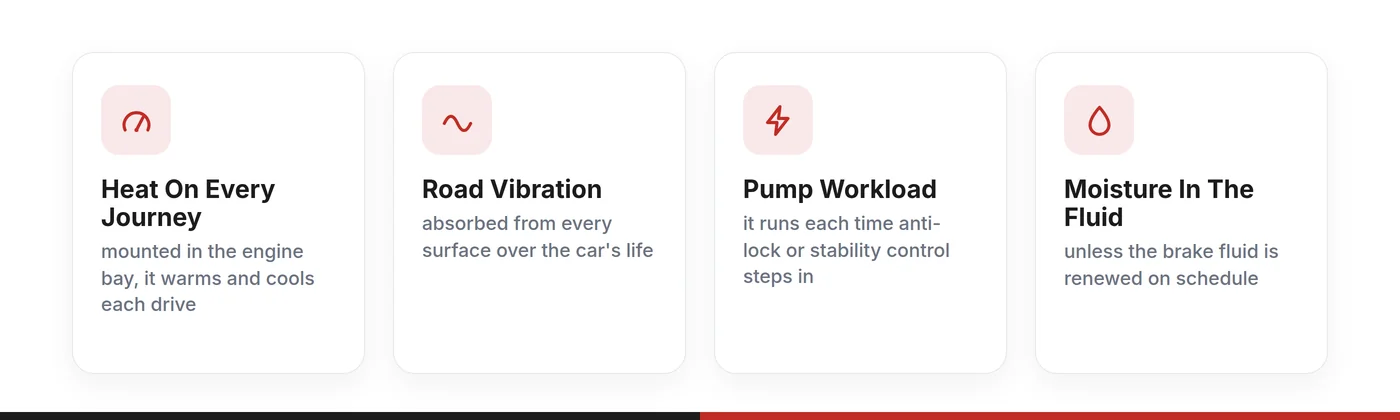
Each of those stresses is modest on its own. Added up over the life of a Passat built in 2006 or 2007, they explain why this module is a common failing part rather than an occasional one.
The misdiagnosis comes from where the module sits in the system. Every wheel-speed signal, the brake pressure reading and the speed data the instrument cluster relies on pass through it. As the module degrades, it can report faults that are not really there — a healthy sensor flagged, a speedometer starved of its data — and each of those sends a mechanic looking somewhere other than the unit itself.
A module can also stop talking altogether, which reads exactly like a wiring fault. New sensors followed by a lamp that comes straight back on are often the first real clue.
Which Passats use the TRW unit, and how do you confirm yours?
The TRW module has been found on some Passat variants from 2006 and 2007. Because Volkswagen also used ATE and Bosch units on the Passat, the model year only narrows the search. The label on the unit settles it.
| Number on the label | What it tells you |
|---|---|
| 3C0 614 109 ABEF | The most common number on this unit. It supersedes the earlier number below. |
| 3C0 614 517 SBEF | The earlier number, superseded by 3C0 614 109 ABEF. A unit wearing either label is the TRW module this page covers. |
If your label names Bosch rather than TRW, our Bosch 5.7 ABS / ESP pump module page lists the Passat among the vehicles that unit was fitted to. For ATE units and the rest of our Volkswagen work, go to our Volkswagen ABS repairs page.
Found a number that is not shown here? Put it on the repair form or send it through our contact page, and we will check it before the unit is removed.
Rebuild, new or second-hand: which suits a Passat’s failed ABS module?
Many dealers and workshops are not aware this module can be repaired, so a replacement is often the only option quoted. The TRW unit can be rebuilt, and the real differences between the three routes show up at refit and in the warranty behind each.
| Route | Warranty | At refit | What you do not know |
|---|---|---|---|
| New replacement module | Limited, typically 12 months | Has to be programmed to the car | Nothing about its history, but it is the same design that failed |
| Second-hand unit | Very short, typically 30 to 90 days | Needs reprogramming to the car | How much life it has left, or how well it was looked after |
| Your unit, rebuilt by Sinspeed | Lifetime | Refits with no programming | Fully tested and rebuilt with new genuine OEM components |
Programming is the step that catches owners out. A module that has never been on your Passat carries none of its configuration and has to be set up with diagnostic equipment able to talk to the car. The rebuilt unit is the one that came off, so it goes back on with the configuration it already had.
How does the Passat’s ABS module reach us and get back on the car?
The repair runs by post, and your garage handles both ends of it.
- Tell us what the car is showing
The repair form asks for the Passat’s details, the lamps that are lit, any scan results and the number on the unit’s label. We confirm it is the TRW module before anything is disconnected.
- Your garage disconnects and sends it
The garage takes the module off, seals the brake-pipe ports and packs it so the connector is protected in transit.
- Our engineers confirm the fault first
Our in-house electronic and hydraulic engineers put the module on test and make the reported fault show itself before any work starts. The process is the same whether the unit comes from a private owner or from one of the garages and independent workshops that send us their ABS work.
- Rebuilt with new genuine OEM parts
The module is rebuilt to OE specification using new genuine OEM components, then tested again before it is packed for return.
- Refitted without programming
Your garage fits it, bleeds the brakes, clears the stored codes and confirms the lamps go out after the start-up check.
If you would rather we carried out the diagnosis or the fitting too, both are available where required — contact us to arrange them.
Passat ABS module questions from owners and garages
Can I carry on driving the Passat with the ABS light on?
The normal brakes usually keep working, so the car will stop, but the anti-lock and stability assistance is off until the fault is fixed. Have it checked promptly and allow more stopping distance in the wet. A lamp that stays on after start-up is also an MOT major defect.
Will the rebuilt TRW module have to be programmed to my Passat?
No. You get back the module that came off your car, so it keeps its configuration and refits with no programming. Your garage bleeds the brakes and clears the codes as part of fitting it. A new or used replacement, by contrast, has to be programmed.
Why did the speedometer stop when the ABS light came on?
The ABS module shares its wheel-speed data with the instrument cluster. If the module fails or drops off the network, the speedometer can lose its reading at the same moment as the ABS and traction functions.
My unit is labelled 3C0 614 517 SBEF, not 3C0 614 109 ABEF. Is it the same unit?
Yes. 3C0 614 109 ABEF supersedes the earlier 3C0 614 517 SBEF, and both belong to the TRW module this page covers. Add whichever number is on your label to the repair form.
My garage says the ABS unit can only be replaced. Is that right?
Not for this unit. Many workshops are not aware the TRW module can be repaired, so a replacement is what they quote. Rebuilding the one already fitted means no programming at refit and a lifetime warranty instead of a limited one.
Final thoughts
A Passat with its ABS lamp lit and its speedometer lying dead looks like a car with several separate problems. On the cars fitted with the TRW unit, it is usually one: a module that every one of those systems depends on.
Confirm the part number, clear the battery, earths and wiring, and if the module is still the cause, have the one already fitted rebuilt. The car keeps its own configuration, and the anti-lock and stability assistance return with it.
Sinspeed · for Passat owners and their garages
Clear the Passat’s ABS fault at its sourceSend us the label number, the lamps and any scan results, and we will confirm the rebuild, or ask what we need to know, before the module comes off.
Rebuilt with new genuine OEM parts · Refitted without programming · Covered by a lifetime warranty