
Summary: A DRL fault usually shows as one LED strip, ring or section going dark while every other light works — and because LED daytime running lights have no bulb to change, the usual answer is a whole new headlamp. The fault is normally in the electronics that drive the LEDs or the module that switches them, and the same is true when an adaptive (AFS) headlight flags a malfunction or leaves the beam pointing the wrong way. We repair that unit, test it on Hardware-in-the-Loop rigs, code it to the car where the system needs it and return it with a Lifetime warranty.
This page covers the two lighting faults that bring most people here — a daytime running light gone dark and an adaptive beam that has stopped behaving — and, make by make, which unit is really behind each. If your problem is a xenon lamp that flickers, glows pink or will not strike, that is a ballast question, answered on our headlight control module repair hub.
- What we repair: LED DRL and angel-eye drivers, BMW light control and footwell modules, adaptive (AFS) control modules, LED headlight modules
- Typical faults: one DRL dark, DRL warning messages, adaptive headlight malfunction, beam aimed wrong
- Makes: BMW, Audi, Volkswagen, Volvo and Land Rover; Mercedes and others by enquiry
- What you send: the module, or the complete headlamp where the fault sits inside it
- Before return: bench-tested under heat, vibration and load; coded where the car needs it
- Warranty: Lifetime, unlimited mileage
Why has one DRL gone dark while the rest still work?
On most modern cars a daytime running light is a strip, ring or signature of LEDs built into the headlamp, not a bulb in a holder. The LEDs are long-lived. What they depend on is the electronics that feed them a controlled current and, on many cars, a separate module that decides when the DRLs should be lit at all.
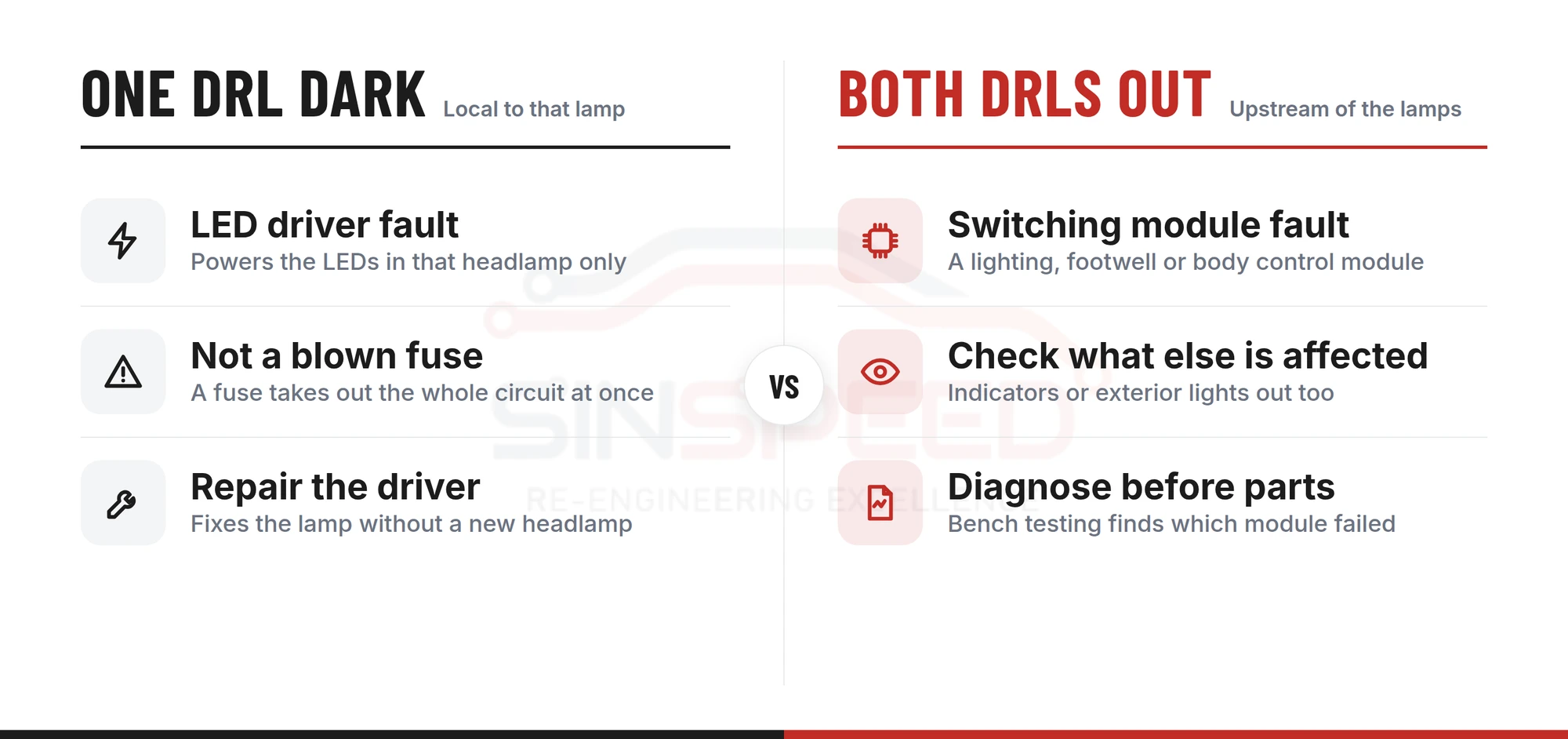
That explains the pattern behind most searches. When one strip, or one section of a strip, goes dark while everything else works, the failure is almost always in the LED driver or on the LED board in that lamp. A blown fuse behaves differently: it takes out its whole circuit at once, not one side or one segment.
The new-headlamp answer comes from the same design. Because the LED electronics are built into the lamp, a parts-only approach can only swap the whole assembly, even when the lens, housing and LEDs are sound. Repairing the driver in your own lamp, or the module that commands it, puts the light back without replacing what has not failed.
When both DRLs go out together
Two lamps rarely fail at the same moment. If both DRLs disappear while the headlights, sidelights and indicators still work, the likelier cause sits upstream, in whatever switches the DRLs on: a lighting module, a footwell module or the body control module.
Is your DRL faulty, or doing what it was designed to do?
Some DRL behaviour that looks like a fault is designed in. DRLs come on automatically with the engine and go off when the headlights are switched on. Where the DRL shares a lamp with the front position light it dims instead, and where it sits right beside the indicator it goes out on that side while the indicator flashes.
So a DRL that dims at dusk, or blinks off on one side as you indicate, is working. A DRL that stays dark in daylight with the engine running, flickers on its own or is out on one side in every condition has a fault.
One case is not a failed part at all. Many cars monitor their lamps so they can warn of a failure, and an aftermarket LED bulb or retrofit can trigger a lamp-out warning on a light that works. If the warning began straight after lamps were changed, tell us what was fitted before sending anything.
What does an adaptive headlight malfunction warning mean?
Adaptive front lighting (AFS) moves the beam. It swivels the projector into bends as you steer, and its levelling keeps the beam at the right height as the car pitches over crests. A control module decides where the beam should point; a stepper motor inside the headlamp moves the projector there.
When either side fails, the car says so. On a BMW the message is ‘Adaptive Headlight — Malfunction’, and the projector is often left stuck straight ahead. On a Volkswagen an AFS fault is logged once the beam stops swivelling, and levelling faults show on the dash with the beam aiming too high or too low.
A beam that no longer turns into bends is an inconvenience. One stuck high dazzles oncoming drivers, and one stuck low shortens how far you can see at night — neither is safe to leave. Because the module and the motor raise the same warning, the first job is establishing which has failed, and that is what our bench testing of the control side settles.
Which unit is behind your symptom?
Match what you are seeing to where the fault usually sits, and to what we would ask you to send.
| What you are seeing | Where the fault usually sits | What to send |
|---|---|---|
| One DRL strip, ring or section dark; the rest fine | The LED driver or LED board in that lamp | The complete headlamp, where the driver is built in |
| Both DRLs out; headlights and indicators working | The module that switches the DRLs, not the lamps | Tell us the make first |
| DRLs, indicators and exterior lights lost after a flat battery or jump start (BMW) | A scrambled Footwell Module (FRM) | The FRM |
| ‘Left’ or ‘Right Daytime Driving Lamp’ message (Mercedes) | That side’s DRL circuit | Tell us the model and the message |
| DRL flickers, or drops out over bumps | An intermittent fault in the driver or module | Describe it; we confirm which |
| Lamp-out warning straight after aftermarket bulbs or a retrofit | Lamp monitoring, not necessarily a failed part | Nothing yet — tell us what was fitted |
| ‘Adaptive Headlight — Malfunction’, beam fixed straight ahead | The AFS/TMS control module or the stepper motor | The adaptive module, or the headlamp where the fault is inside it |
| Beam aiming high or low, with a levelling fault on the dash | The levelling side of the control module | The control module |
| Misting inside the lamp, then a DRL or adaptive fault | Water through a failed seal reaching the electronics | The complete headlamp |
Which module runs the DRLs and adaptive lights on your make?
The unit that fails depends on where each manufacturer put the lighting logic, and it is not always in the headlamp.
| Make | Units we repair | Worth knowing |
|---|---|---|
| BMW E38, E39, E46, E53 | Light Control Module (LCM / LSZ) | Bulb-out warnings for lamps that clearly work point here |
| BMW E8x, E9x, E6x and X-series | Footwell Module (FRM / FRM2 / FRM3); adaptive (AFS / TMS) modules; angel-eye and DRL LED drivers | The FRM runs the DRLs, indicators and exterior lights |
| BMW F-series and later | LED headlight modules | The electronics behind the full-LED lamps |
| Audi and Volkswagen | Xenon and adaptive (AFS) control modules; LED matrix drivers | A DRL out on one side is a known VW symptom |
| Mercedes-Benz | Confirmed per model | Tell us the model and the dash message |
| Volvo and Land Rover | Xenon control units and adaptive modules | Built on shared Automotive Lighting and Hella platforms |
| Vauxhall, Ford and others | The body control module, where it runs the lighting | Ask us first with the make and model |
BMW: why the DRL fault can be in the footwell
BMW makes the point most clearly. On the E8x, E9x and E6x ranges and the X-series, the Footwell Module sits in the driver’s footwell and runs the exterior lights, the indicators and the daytime running lights. A dead DRL on those cars can start in a module nowhere near the headlamp.
The giveaway is company. When DRLs disappear alongside indicators or other exterior lights, often straight after a flat battery or a jump start that has scrambled the FRM, the module is the first suspect rather than the lamps. Our footwell module (FRM3) repair page covers that unit in full.
Where only one angel-eye ring or one DRL section is dark, the fault is local instead, on the LED driver behind it. The BMW headlight control module page covers those drivers alongside the xenon and adaptive units.
Volkswagen, Mercedes and other makes
On Audi and VW the lighting electronics sit with the headlamps, and the VW headlight control module page covers the Golf, Passat and wider range. On many other makes the body control module runs exterior lighting along with locking and windows, so a lighting fault there often arrives with other electrical symptoms; our guide to what a body control module does explains why. For those cars, and for any Mercedes, send us the model and the symptom and we will confirm the unit.
Why do DRL drivers and adaptive modules fail?
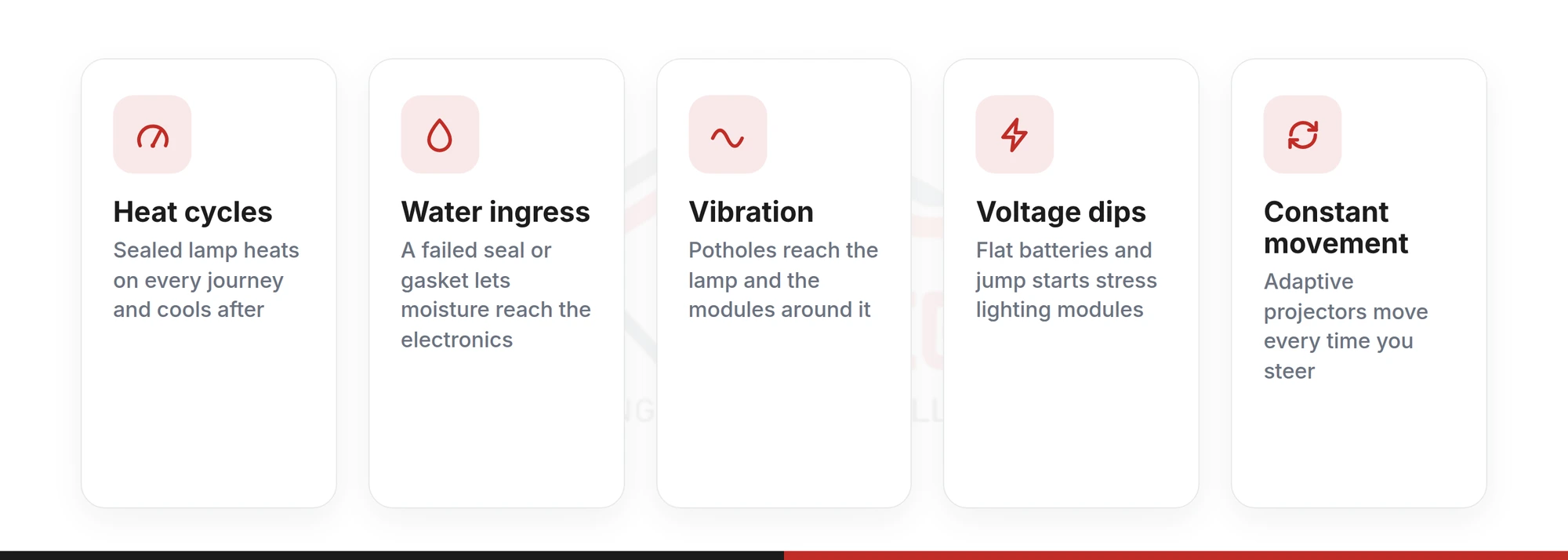
- Heat in a sealed lamp. The LEDs and their driver share a closed housing that heats up on every journey and cools afterwards, cycle after cycle.
- Water through failed seals. A perished gasket, a failed breather or a hairline crack lets moisture in. Misting is the visible sign; the electronics are where it does its damage.
- Vibration. Every pothole reaches the lamp and the modules around it, and a light that drops out over bumps is the early warning.
- Voltage dips. Flat batteries, battery changes and jump starts are the roughest moments in a lighting module’s life, and a BMW FRM can lose its memory to one.
- Constant movement. An adaptive projector is moved every time you steer, so its motor and the circuit driving it work far harder than anything behind a fixed beam.
A failed module also looks exactly like a failed lamp. A dark DRL is identical whether the driver behind the LEDs has failed or a module elsewhere has stopped sending the command. That is why a new headlamp does not always fix it: if the fault was upstream, the new lamp stays dark too.
Sinspeed · DRL and adaptive lighting
Dark DRL or a malfunction message? Tell us which lights are affected
Give us the make, model and year, the exact wording on the dash and anything that happened just before. We will tell you which unit to send, or whether there is anything to send at all.
Module or complete headlamp accepted · Coded where the car needs it · Lifetime warranty
Is a dead DRL or a misaimed adaptive beam an MOT problem?
Yes. DRLs became a legal requirement on new passenger cars and small vans in 2011, under EU rules that apply to new cars. A DRL that has stopped working is a fault an MOT tester will pick up, and a headlamp that does not work or is badly misaimed is an MOT failure.
The road matters more than the test. DRLs exist so other road users see you in daylight, and a misaimed adaptive beam either dazzles oncoming drivers or robs you of distance at night. Neither is a fault to live with until the next service.
How the repair works, from removal to refit
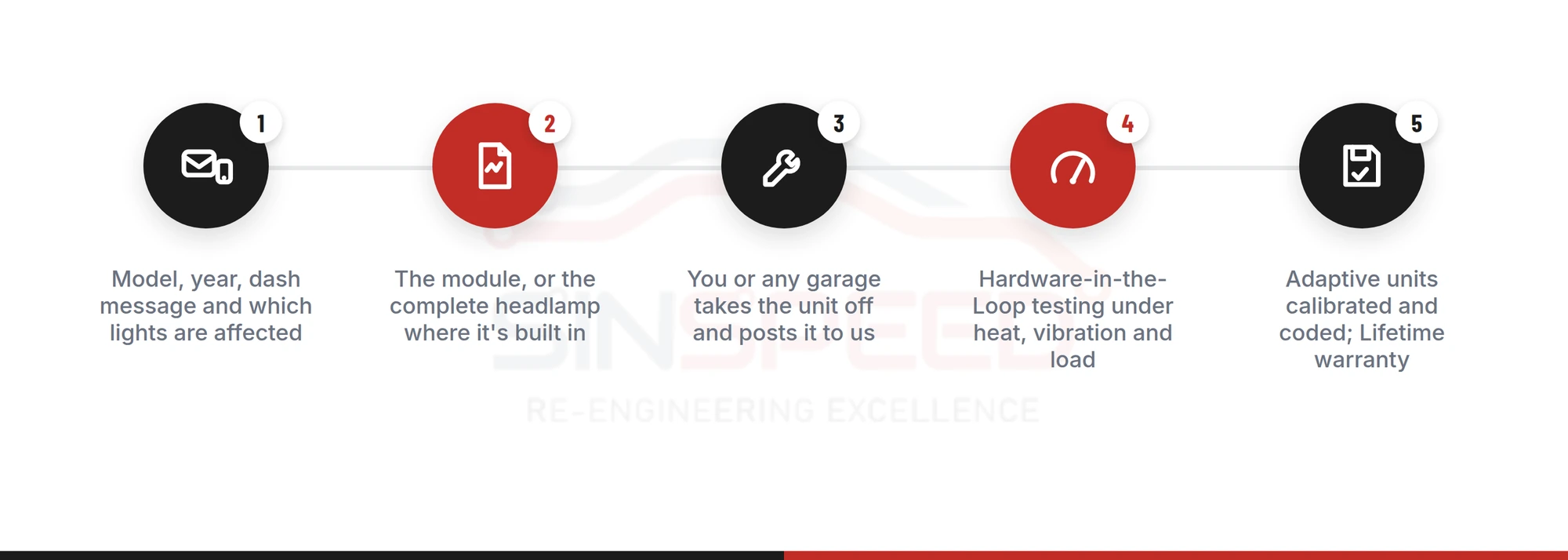
- Tell us the car and the symptom
Use the repair form with the model, year, the exact dash message and which lights are affected. Say if it followed a flat battery, a jump start or new lamps.

Five-step DRL and adaptive headlight repair process: tell us the symptom, confirm what to send, remove and post, bench test and repair, calibrate code and return - Confirm what to send
Usually the module: the FRM, LCM, adaptive unit or LED driver. Where the fault sits inside the lamp, send the complete headlamp. If you are unsure, ask first.
- Remove and post it
You, or any garage, take the unit off the car and post it to us. We handle every step from the moment it arrives.
- Bench test and repair
The unit is tested on our Hardware-in-the-Loop rigs, which simulate heat, vibration and electrical load, and repaired at circuit level in our cleanroom-standard, ESD-safe workshop.
- Calibrate, code and return
Adaptive units are calibrated, and anything the car expects to be coded is programmed on dealer-level tools. It comes back tested, with a Lifetime, unlimited-mileage warranty.
DRL and adaptive headlight FAQs
Sinspeed · headlight electronics
Keep the headlamp and repair what drives it
Book the module or the headlamp in through the repair form, or check your make with us first if you are not sure which unit has failed.
Adaptive units calibrated before return · Your own unit sent back · Lifetime, unlimited-mileage warranty
Final thoughts
A dark DRL or a stubborn adaptive warning looks like a headlamp problem because the headlamp is where you see it. Often the fault sits in a driver inside the lamp or a module elsewhere on the car — on a BMW, possibly in the footwell. Find that unit and repair it, and the headlamp you already have works as designed again.
Tell us the make, the message and which lights are affected, and we will tell you what to send.