
Summary: When a Ford Focus with the PowerShift automatic judders away from junctions, drops gears or throws a transmission warning, the part most people are searching for is a clutch actuator motor: one of two electric units bolted to the outside of the dry DPS6 gearbox, each working one of its twin clutches. They wear from the constant work of engaging a dry clutch in traffic. We test both on the bench under simulated load, repair the one that has failed and return them ready for your garage to refit.
Everything below is about those two actuators. The control module that selects the gears is a separate part with its own page, and clutch actuators for other makes sit in our clutch actuator repairs hub.
- The part: two clutch actuator motors, one per clutch, bolted to the casing of the dry DPS6 (Getrag 6DCT250) gearbox
- Not the TCM: the transmission control module is a separate unit that commands the actuators and moves the gear selectors
- Typical signs: judder pulling away, a whole set of gears lost, no reverse or no first, a transmission warning and limp mode
- Codes to note: P0901, P090B, P073E, P073F — and P0606, which points at the module instead
- The service: your garage removes the actuators and posts them; we test, repair and return them
- On refit: a clutch adaptation on the car, part of fitting any DPS6 clutch actuator
What is the transmission actuator on a Ford Focus?
On a Mk3 Focus with the PowerShift automatic, “transmission actuator” nearly always means a clutch actuator. The gearbox is the dry DPS6 — Getrag’s 6DCT250 — a twin-clutch design in which one clutch carries the odd gears and the other the even gears. Nothing hydraulic engages them. Each clutch has its own electric actuator motor bolted to the gearbox casing, and between them the pair carry out every clutch engagement the car makes.
The actuators are not part of the transmission control module. The module is a separate unit on the same gearbox: it decides when each clutch should bite, commands the actuators to do it, and moves the gear selectors with motors of its own. It fails in its own ways and has its own page, Ford PowerShift TCM repair. The two clutch actuators come off the gearbox independently of it, and they are the subject here.
That split is where most of the confusion starts. Parts listings for this car sell clutch actuators singly and in pairs, under several names, with nothing to say whether your fault needs one, two or neither. The codes and the way the car behaves narrow it down, and the rest of this page is about doing that before anything is bought.
What are the symptoms of a failing Focus clutch actuator?
Actuator faults build slowly. The clutch an actuator controls begins to bite a fraction late, a fraction hard or unevenly, and the gearbox compensates for as long as it can.
- Judder or shudder pulling away, worst creeping in traffic or starting on a slope
- Hesitant or jerky changes, most noticeable low down
- A delay after selecting D or R before the car moves
- A whole set of gears lost — the car drives only in the odd gears, or only in the even ones
- No reverse, or no first gear
- A transmission malfunction warning, with the gearbox falling back into limp mode
- Loss of drive altogether, the engine running and the car going nowhere
The lost-gears symptom is the most telling. Each actuator works one clutch, and each clutch carries half the gears, so a fault that takes out a whole set at once points at one clutch and whatever operates it, rather than at the gearbox as a whole.
The codes are the other half of the picture. These are the ones worth writing down before the car goes anywhere.
| Code | What the scan tool reports | What it points at on a Focus DPS6 |
|---|---|---|
| P0901 / P090B | Clutch actuator faults | A clutch actuator circuit not doing what it was commanded — the actuator itself, or the module driving it |
| P073E | Reverse gear not achieved | The clutch or selection for reverse not responding |
| P073F | First gear not achieved | The same on first; often logged alongside P073E |
| P0606 | Internal control module fault | Past the actuators, to the transmission control module |
Send us every code stored, including any that look unrelated. The fuller reference is our guide to clutch actuator fault codes, the wider symptom read is in clutch actuator fault symptoms, and the gearbox’s reputation as a whole is covered in Ford PowerShift problems.
Why do DPS6 clutch actuators fail?
They are among the hardest-working parts on the gearbox. Every pull-away, every metre of creeping in a queue and every gear change hands load from one clutch to the other, and each of those is actuator movement. A Focus that lives in town traffic asks for far more of it than one that spends its days on the motorway.
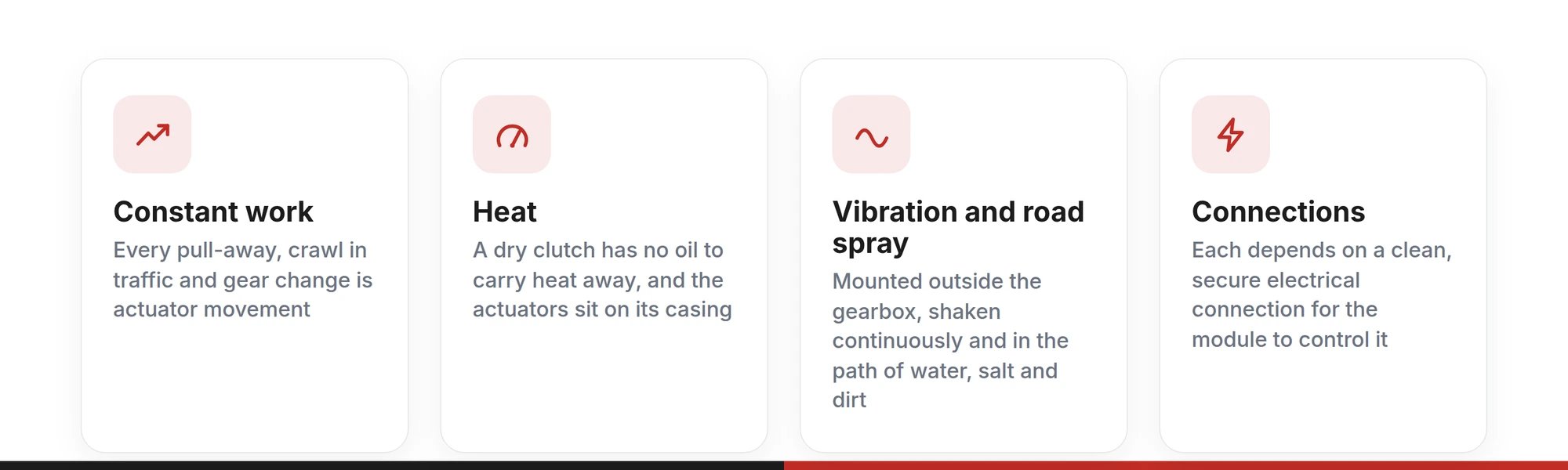
Heat adds to the load. A dry clutch has no oil to carry heat away, so every slow, slipping engagement warms the casing around it — the same casing the actuators are bolted to. They are heated and cooled on every journey.
Then vibration and the road. Mounted on the outside of the gearbox, the actuators are shaken continuously and sit in the path of water, salt and dirt thrown up from below, and each depends on an electrical connection that has to stay clean and secure for the module to control it accurately.
None of this produces a sudden failure at first. The actuator still moves, just less precisely than the clutch needs, and the gearbox’s adaptation keeps compensating until the margin runs out. That is why the early judder comes and goes, and why a car that has shuddered for months can stop moving in an afternoon.
Actuator, clutch or control module: which one is it?
On a DPS6 three different parts can produce the same complaint, and each regularly gets blamed for the others: the clutch actuators, the dry twin clutch itself, and the control module that commands both.
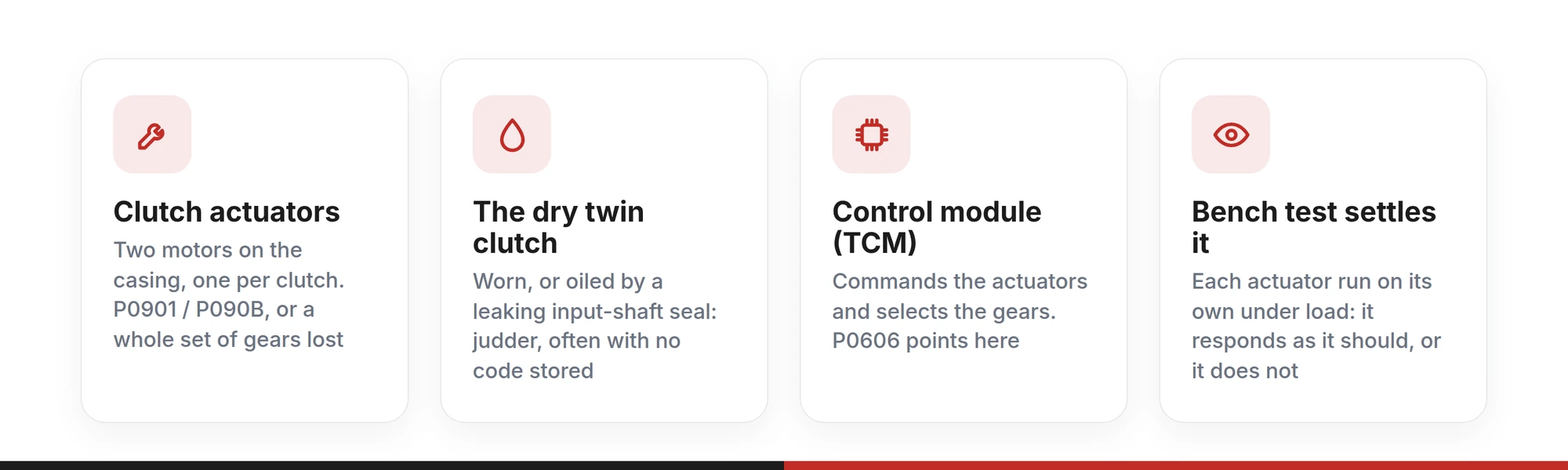
| What you notice | Pointing at an actuator | Pointing elsewhere |
|---|---|---|
| Judder pulling away | A clutch being engaged unevenly by a worn actuator | A leaking input-shaft seal putting oil on a clutch meant to run dry gives the same judder, often with no code stored |
| Only odd or only even gears | One actuator no longer controlling its clutch | The clutch on that side is worn, or the module has stopped driving that actuator |
| No reverse or no first (P073E / P073F) | The clutch that gear needs is not being engaged | The module has lost gear selection on that side |
| Warning light with P0606 stored | Unlikely on its own | The module reporting a fault in itself — the TCM is the unit to send |
This is why the clutch actuator codes are not a verdict by themselves. P0901 and P090B say the actuator circuit did not do what it was asked, and that circuit runs from the module to the motor. Fit a new pair of actuators to a car whose module is the fault and the codes come straight back.
Bench testing is how the question gets answered. Run on its own, under load and at temperature, an actuator either responds as it should or it does not. If yours are sound, the search moves to the clutch or the module — and the module is work we do as well.
Sinspeed · Ford DPS6 clutch actuators
Settle which part it is before you buy onePut the model, the engine, the gears the car has lost and every stored code on the repair form. We will tell you whether the actuators, the module or both are worth sending.
Each actuator run on its own on in-house Hardware-in-the-Loop platforms, under simulated heat, vibration and load
Repair your actuators, or fit a new pair?
Actuators for this gearbox are easy to find: singly, in pairs, new or used. Finding one is not the hard part. Knowing which one has failed, and whether an actuator is the fault at all, is.
- A new actuator is the same design that wore out on your car. It treats the symptom without telling you whether the original was actually the cause.
- A used actuator comes from a car you know nothing about — the same design, with a mileage and a heat history you cannot see.
- Your own actuator, repaired, is tested before the work, so the fault is confirmed, and after it, so its performance is too. Known weak points are reinforced during the repair rather than restored exactly as they were.
Whichever route is taken, the gearbox has to relearn its clutches once the actuators are back on. That clutch adaptation is part of fitting any DPS6 clutch actuator, new, used or repaired, and is carried out on the car with diagnostic equipment. It belongs to the job, not to one option over another.
How the Focus clutch actuator repair works
Your garage takes the actuators off the gearbox casing and posts them to us, and the car stays with them. From there, the work is ours.
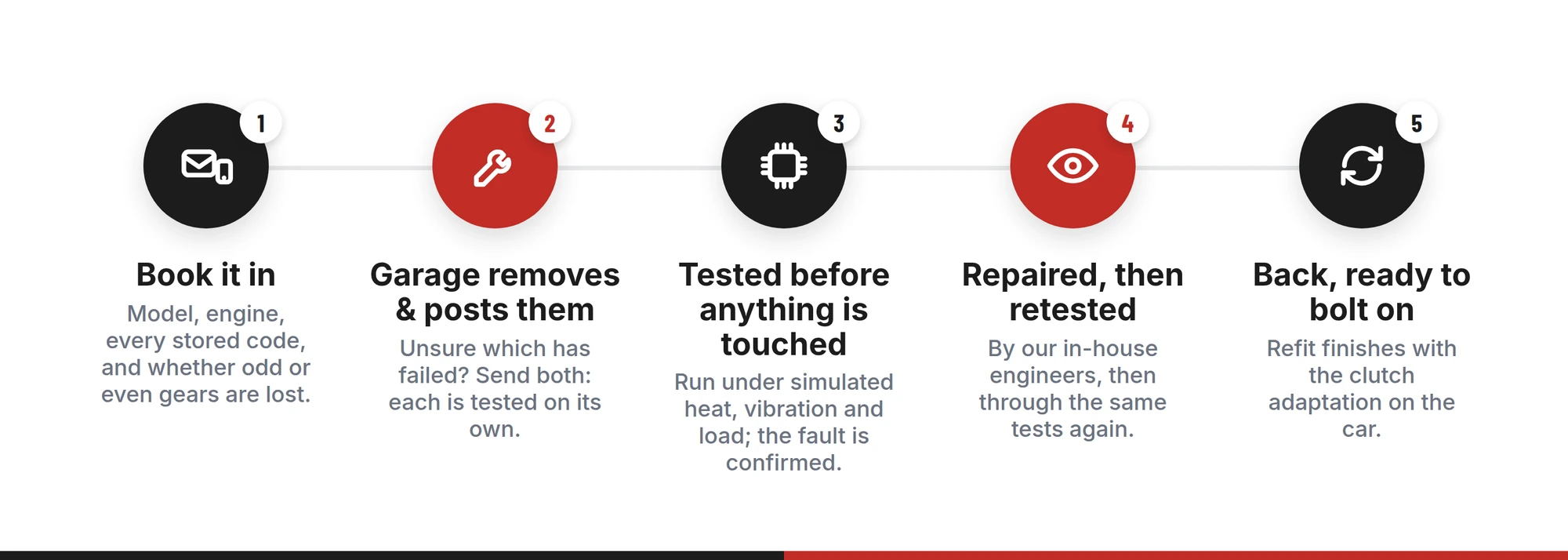
- Book it in
Complete the repair form with the model, engine and every stored code. Tell us whether the car has lost the odd or the even gears — it tells us which actuator to look at first.
- Your garage removes and posts them
Taking the actuators off and refitting them is routine work for the garage. If it is unclear which one has failed, send both; each is tested on its own. Pack them firmly, with the connectors protected.
- Tested before anything is touched
Each actuator is run on our Hardware-in-the-Loop platforms, which reproduce the heat, vibration and load of the gearbox, and its movement and response are recorded. The fault is confirmed on the bench, not assumed from the symptom.
- Repaired and tested again
The failing actuator is repaired by our in-house engineers in a cleanroom-standard, ESD-safe workshop, then run through the same tests before it is packed.
- Back to your garage
The actuators return ready to bolt on. Refitting finishes with the clutch adaptation on the car, which teaches the gearbox the repaired actuators.
Which Fords use the DPS6 clutch actuators?
The Focus is the car most people search for, but the dry 6DCT250, with its clutch actuators on the casing, went into several Fords:
- Focus Mk3 with the PowerShift automatic
- Fiesta Mk7 PowerShift
- B-MAX, EcoSport and Ka+
- Transit Connect, Tourneo Connect and Transit Courier
Give us the model and engine and we will confirm the actuator before anything comes off.
Two Fords that look similar are different jobs, and both are ours. Some European Focus models carry the wet PowerShift, the 6DCT450, whose clutches are applied hydraulically through a mechatronic unit; there are no electric clutch actuator motors on it, and the mechatronic repair is on our Ford PowerShift gearbox repair page. The earlier Fiesta 1.4 automated manual is not a PowerShift at all — it has its own clutch actuator and gear actuator, covered on our Ford Fiesta 1.4 clutch and gear actuator repairs page.
Ford Focus clutch actuator repair: FAQs
Sinspeed · actuators tested, not guessed
Send the actuators. Get back an answer and a repair.Your garage posts the DPS6 clutch actuators to the workshop. Each is tested under load, the failing one is repaired, and they return ready to refit.
Repaired in-house in an ESD-safe workshop · Most remanufactured parts carry a lifetime, unlimited-mileage warranty
Final thoughts
The transmission actuator on a Focus is a small part with a large reputation, mostly because it is so easy to replace the wrong thing. Two actuators, a control module and a dry clutch can all produce the same judder, and a parts listing cannot tell you which one your car needs.
Have the codes read, note which gears the car has lost, and send us the details. If the actuators are the fault, they come off, come to us, and go back proven — with the clutch adaptation as the last step on the car.