
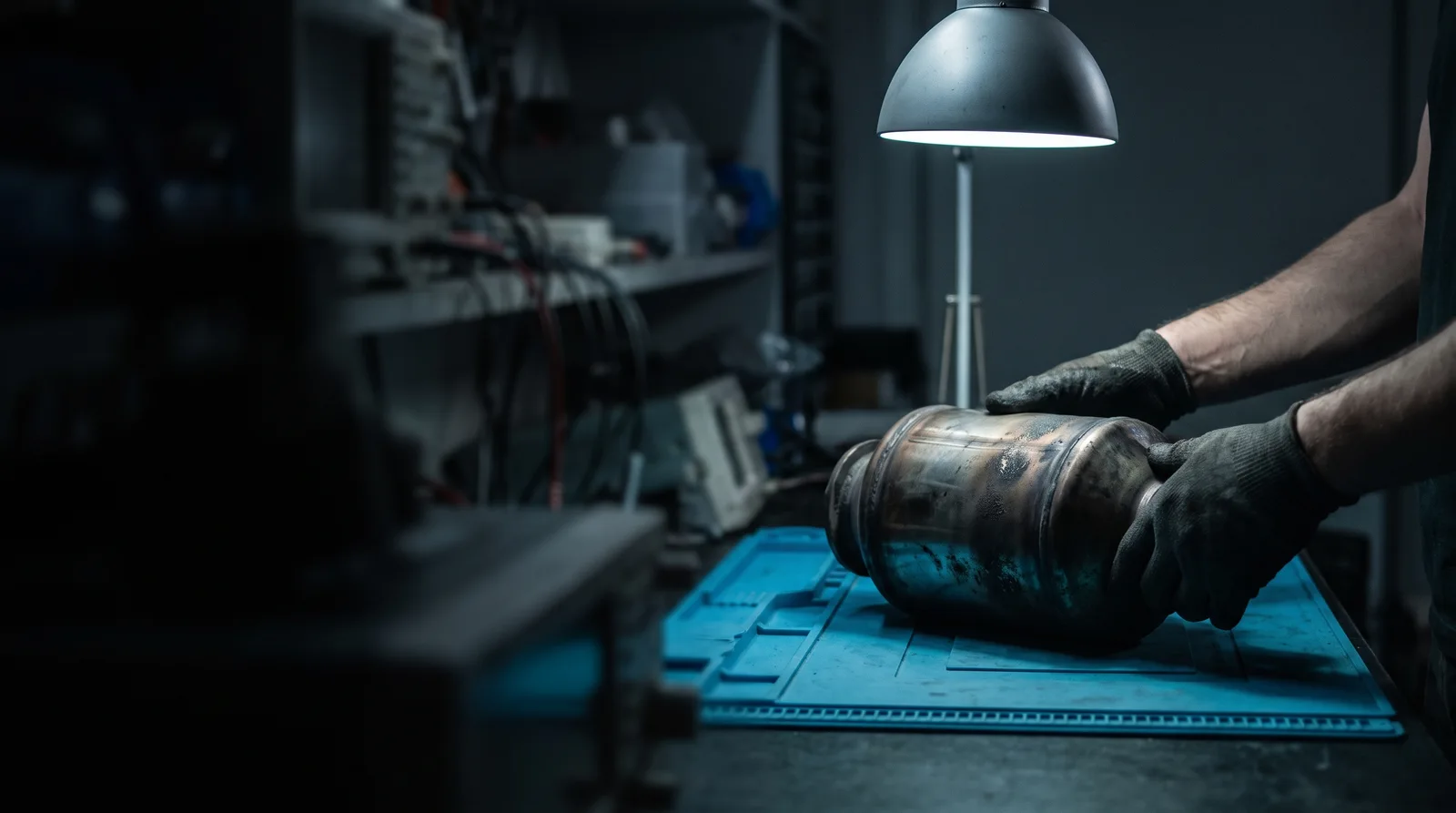
 In short
The Volvo XC90 2.4 D5 (185 bhp) is built to regenerate its diesel particulate filter on longer, faster runs, so on mostly short or town journeys the filter loads up with soot, blocks and trips warning lights or limp mode. You have two genuinely different routes. For any car driven on the road the answer is DPF cleaning and repair — it restores your original filter and keeps the car MOT-legal and road-legal.
What goes wrong with the Volvo XC90 D5 DPF?

The Volvo XC90 2.4 D5 — the 185 bhp five-cylinder diesel — was fitted with a diesel particulate filter (DPF) from the factory to meet the emissions standard it was designed to. The filter traps soot from the exhaust and then burns it off in a process called regeneration. The catch is what regeneration needs: a warm engine under sustained, medium load — in practice a steady run of roughly 15 to 20 miles of motorway driving at a time — to get the filter hot enough to clear itself.
That suits the car Volvo intended the XC90 D5 to be: one used regularly for longer motorway journeys. It does not suit the way many XC90s are actually driven. If most of your trips are short, stop-start runs around town, the filter rarely reaches the temperature it needs, and the regeneration cycle keeps starting but failing to finish. Soot then accumulates faster than it is burned away, and the filter slowly loads up until it blocks.
This is why simply fitting a new filter so often disappoints. A replacement DPF on a car that still does mostly short journeys blocks up again, because the cause was never really the filter — it was the driving pattern and a regeneration that cannot complete. Owners who have had the filter renewed and then watched the same warning lights return are seeing exactly this.
Repeated failed regenerations also have knock-on effects that are specific to how the D5 manages the process. Each attempted regen injects extra fuel to raise the exhaust temperature; when the regen does not complete, some of that fuel can wash past into the engine oil, which is why a rising oil level is a common warning sign on these engines. The car judges how blocked the filter is from a differential-pressure sensor that reads the pressure either side of the DPF, so a fault or drift in that sensor can mask a real blockage or trigger warnings of its own. And because the EGR system recirculates exhaust gas back into the engine, a sticking or carboned-up EGR valve adds to the soot the filter has to cope with — which is why EGR trouble and DPF trouble so often turn up together on the D5.
XC90 D5 DPF symptoms, causes and your options
The table below sets out the symptoms we see most on the XC90 D5, what tends to cause each one, what it tells you about the state of the filter, and the route open to you — the road-legal fix for any car used on the road, and the off-road-only option where it applies. Read it as a guide to where your car sits, not a substitute for a proper test.
| Symptom | Likely cause | What it indicates | Recommended fix |
|---|---|---|---|
| DPF / "soot filter full" warning light | Soot loading the filter faster than it can be regenerated, typically from short or town journeys. | The filter is filling up and the car wants a regeneration it cannot complete in normal use. | Road-legal fix: clean the filter and fix the root cause (sensor, EGR, regeneration). |
| Limp mode (loss of power) | The engine ECU protecting itself once the DPF is too blocked or a related fault is logged. | Blockage or a sensor/EGR fault has reached the point where the car restricts power. | Road-legal fix: test, clean and repair the cause. |
| Repeated or failed regenerations (often with a rising oil level) | Driving pattern never lets a regen finish; unburnt fuel washes into the oil. | The regeneration strategy cannot complete, so soot keeps building and oil can dilute. | Road-legal fix: clean and address why regens fail. |
| Blockage, loss of power or smoke | A heavily loaded or partially melted filter restricting exhaust flow. | The filter is significantly blocked and restricting the engine. | Road-legal fix: pressure-test and clean if the filter is sound. |
| Poor fuel economy, especially in town | Frequent incomplete regens and a part-blocked filter raising back-pressure. | The filter and regeneration cycle are working against the engine. | Road-legal fix: clean and correct the regeneration cause. |
| Differential-pressure sensor fault | The sensor reading pressure across the DPF has failed or drifted. | The car may misread how blocked the filter is — masking or inventing a blockage. | Road-legal fix: test and replace the sensor as part of the repair, then clean if needed. |
| EGR-related soot contribution | A sticking or carboned EGR valve sending extra soot into the system. | The filter is being overloaded from upstream, not just from short journeys. | Road-legal fix: address the EGR alongside cleaning the filter. |
Every row resolves the same way. If the car is used on the road, the route is cleaning and repair; removal is on the table only for a vehicle used exclusively off-road or for motorsport (see our DPF removals service).
Sinspeed · DPF diagnosis and repair
Get the DPF fault diagnosed properly before anything is removedMost DPF complaints are a sensor, a pressure pipe or a failed regeneration rather than a filter at the end of its life. Tell us the codes and the symptoms and our engineers will tell you what they expect to find.
The fault confirmed before removal is ever discussed · Dealer-level diagnostic tools · Work carried out by our in-house engineers
Your two options: DPF cleaning vs DPF removal
Once the filter is blocked you have two genuinely different routes, and which one is open to you depends entirely on how the vehicle is used.
For any car driven on public roads, the route is DPF cleaning and repair. It clears the original filter and deals with what caused it to block, and it keeps the car MOT-legal and road-legal. This is the option we recommend for road vehicles, and for most XC90 D5 owners it is the only one that applies.
DPF removal or delete — physically removing the filter and switching it off in the ECU — is not a road-car option. We set out why in the legal section below.
DPF cleaning — the road-legal option
DPF cleaning is the road-legal answer to a blocked XC90 D5 filter, and done properly it does two jobs at once: it clears the filter you already have, and it deals with why the filter blocked in the first place.
We start and finish with a pressure test. Measuring the pressure across the filter before we clean tells us how blocked it actually is. The clean then clears the trapped soot and ash from the filter, and a second pressure test afterwards confirms the blockage has gone and the clean has worked. In most cases this restores up to around 95% of the filter’s flow. That is not a guarantee on every unit — a filter that has cracked or partially melted is a different case — but for a filter that is blocked rather than physically damaged, it is a realistic result you can see in the before-and-after readings.
Cleaning on its own would only buy time if the thing that blocked the filter were left untouched. So the cleaning service is paired with fixing the root cause — checking the differential-pressure sensor, the EGR system and the way the car is regenerating — so the filter is not simply set up to block again the moment you drive away. That is the difference between a clean that lasts and one that does not, and it is why we treat cleaning and repair as a single job rather than a quick flush.
Because your original filter stays on the car, it remains MOT-legal and road-legal, with nothing about the work that a future owner or an MOT tester would need to question. For any XC90 D5 used on the road, this is the route we recommend.
DPF removal / delete — off-road & motorsport use only
DPF removal — also called a DPF delete — means taking the filter out and reprogramming the engine ECU so the car no longer expects it to be there, or in some cases the ECU delete on its own. We offer it strictly for vehicles used exclusively off-road, for motorsport, or otherwise never driven on public roads, and for export. It is not a road-going option, and we will not present it as one.
The removal is set up so the engine runs cleanly without the filter, which includes our smoke-correction service — fine-tuning the fuel system so the engine does not smoke once the DPF is disabled. You can read more on our DPF removal smoke-correction service page.
Removal is sometimes combined with other ECU work — ECU remapping for performance or economy, plus EGR delete and swirl-flap delete. These are emissions-related modifications, offered on the same off-road-only basis and mentioned here only to be complete. If your XC90 is a road car, none of this applies to you, and cleaning and repair is your route.
Is DPF removal legal? The law, honestly
It is worth being straight about the law, because there is a great deal of vague and misleading information about DPF removal online. The short answer for a road car is that removing the DPF is not a legal route.
Under UK government guidance and the Road Vehicles (Construction and Use) Regulations, the offence is not the act of removing the filter in a workshop — it is using a vehicle on the road that has been modified so that it no longer meets the emissions standard it was designed to meet. A road-going XC90 D5 with its DPF removed falls squarely into that.
On top of that, a missing DPF is an automatic MOT failure. Since February 2014, MOT testers have been required to check that the filter is present on any vehicle originally fitted with one, so a road car with the DPF removed will fail its MOT on inspection.
There are also penalties for using such a vehicle on the road: UK government guidance sets fines of up to £1,000 for a car and up to £2,500 for a light goods vehicle. None of this applies to a vehicle genuinely kept off the road or used only for motorsport — which is the only basis on which we offer removal. For every car that is driven on the road, the recommended route is cleaning and repair.
How our XC90 DPF service works
Whichever route applies to your XC90, the process starts the same way: with a test, not a guess. We would not suggest trying to force a regeneration or clear codes yourself — the point of the test is to find out what state the filter is actually in before any work is done.
For DPF cleaning we test the filter, clean it and confirm the result with the before-and-after pressure check, then look at the root cause — the differential-pressure sensor, the EGR and the regeneration behaviour — so the filter is not set up to block again. The work is carried out by our in-house engineers using dealer-level diagnostic tools, and we tell you what we have found before anything goes ahead.
To get started, tell us about your car and what it is doing through our repair form, or contact us if you would rather talk it through first. If you want to understand how the filter works before you decide, our guide to what a DPF is and how it works walks through the basics.
For a removal, the smoke-correction service is arranged the same way — get in touch, tell us how the vehicle is used, and we will confirm what is appropriate.
FAQs
Is DPF removal legal in the UK?
For a car used on the road, no. Under UK government guidance and the Road Vehicles (Construction and Use) Regulations, it is an offence to use a vehicle on the road that has been modified so it no longer meets the emissions standard it was built to. Removing or deleting the DPF does exactly that. For any road car, the route is cleaning and repair.
Will a car with the DPF removed pass an MOT?
No. A missing DPF is an automatic MOT failure. Since February 2014, testers have had to check that the filter is present on any vehicle originally fitted with one, so a road car with the DPF removed will not pass.
Can a blocked DPF be cleaned instead of removed?
Yes — and for a road car it is the route we recommend. Cleaning restores your original filter, and paired with fixing what caused the blockage it keeps the car MOT-legal and road-legal. It is the proper answer for any XC90 D5 used on the road.
How much of a blocked DPF can cleaning restore?
In most cases cleaning restores up to around 95% of the filter’s flow, confirmed by a pressure test before and after. It is not a guarantee on every unit — a filter that has been physically damaged or cracked is a different case — but for a filter that is blocked rather than broken, it is a realistic result.
What causes the XC90 D5 DPF to keep blocking?
Short journeys, mostly. The D5’s filter needs a sustained run — roughly 15 to 20 miles of motorway driving — to get hot enough to regenerate and burn off its soot. On mainly short, town trips the regeneration keeps failing to complete, soot builds up and the filter blocks, which is also why fitting a new filter on its own often does not last. A faulty differential-pressure sensor or a carboned-up EGR system can make it worse.
Can I drive with the DPF warning light on?
Treat it as a reason to get the car tested promptly rather than to keep driving on regardless. A DPF light usually means the filter is loading up and a regeneration has not completed; if it is left, the car can drop into limp mode and lose power. A longer, faster run will sometimes let a regeneration finish, but if the light stays on the filter needs testing — so have it looked at rather than ignoring it.
Sinspeed · DPF diagnosis and repair
Get the DPF fault identified before you commit to anythingSend us the codes and the symptoms and our engineers will tell you whether you are looking at a sensor, a failed regeneration or a filter genuinely at the end of its life.
The fault confirmed before removal is ever discussed · Dealer-level diagnostic tools · Work carried out by our in-house engineers