
Summary: When the lights, electric windows, central locking and wipers on a BMW or MINI give up together — often straight after a flat battery, a jump start or a battery change — the footwell module (FRM3) is the usual cause. We repair your own FRM3 by post, test it under load and return it already coded to your car, with a lifetime, unlimited-mileage warranty.
This page covers the FRM3 across the BMW and MINI models we list, with the part numbers we see most often. It sits within our body control module repairs, because on these cars the footwell module does much of the work a body control module does on other makes.
- The unit: the footwell module, labelled FRM3, which runs most of the car’s lighting and several body functions
- Cars listed: BMW 1 Series, 3 Series, X1, X5 and Z4; MINI Cooper, Clubman and Cabrio
- Typical picture: lights, windows, locking and wipers failing together, often after battery work
- What comes back: your own module, repaired and already coded to your car
- Testing: under load on in-house Hardware-in-the-Loop rigs
- Warranty: lifetime, unlimited mileage
- What does the FRM3 footwell module control?
- Lights out, windows stuck, locks ignored: is it the FRM3?
- What does a diagnostic scan show when the footwell module fails?
- Which BMW and MINI models use the FRM3, and which part numbers?
- Why do footwell modules fail, and why is the fault chased elsewhere first?
- Repair your FRM3 or fit another: what changes at refit?
- Five steps from a dead footwell module to a working car
- FRM3 footwell module: what BMW and MINI owners ask us
- Final thoughts
What does the FRM3 footwell module control?
The name says where the module lives, not what it does. The FRM3 sits low in the cabin and switches power to a set of circuits that otherwise have little in common:
- Exterior lighting — headlights, tail lights, brake lights and indicators
- Interior lighting
- Electric windows, and the mirrors
- Central locking
- Wipers
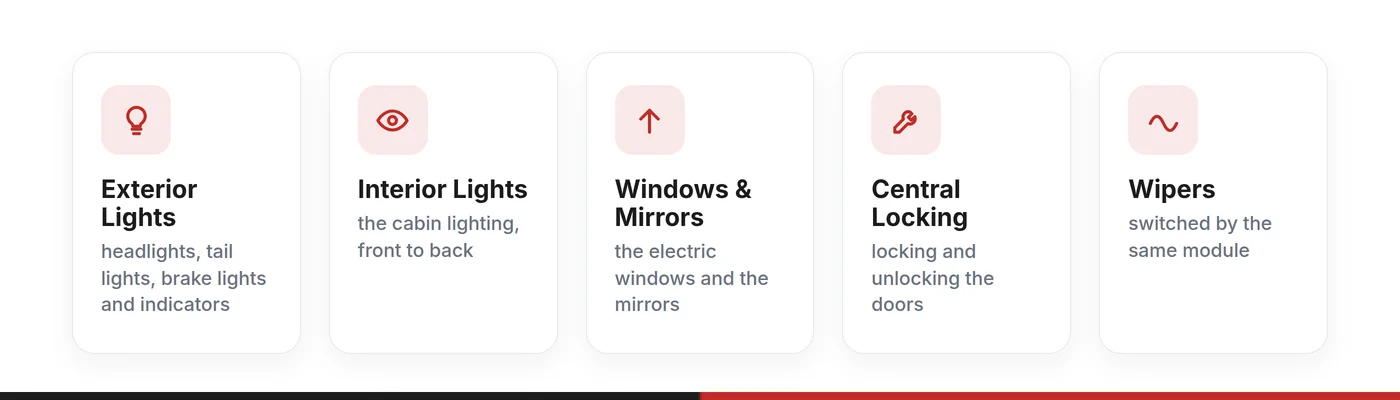
Your switches send requests; the FRM3 decides what should happen and powers the lamps and motors that do it. It also reports the state of those circuits to the rest of the car, which is how a lighting fault turns into a warning message on the dashboard. On other makes much of this job belongs to a body control module — our guide to what a body control module is explains the wider idea.
Lights out, windows stuck, locks ignored: is it the FRM3?
The clue is how much goes wrong at once. A single lamp out is usually just that lamp. Headlights, indicators and interior lights failing together, while the windows ignore their switches, is a different story: the thing those circuits share is the footwell module.
The faults FRM3 units come to us with:
- Headlights, tail lights or indicators not working
- Brake lights out
- Interior lights dead
- Electric windows not responding
- Central locking not working
- Wipers not working
- Dashboard warning messages about the lights or other electrical functions
Some of these are road-safety faults rather than nuisances. Brake lights and indicators are how other drivers read your intentions, and headlights that die after dark leave you unable to see or be seen. If the lighting is affected, have the car checked before it goes back on the road; the lamps are part of the MOT as well.
What does a diagnostic scan show when the footwell module fails?
There is no single FRM3 fault code to look up: what gets stored depends on the model and on which functions the module has dropped. These are the readings that point towards it.
| What you see | What it points to | Check first |
|---|---|---|
| The scan tool cannot talk to the footwell module | The FRM3 has stopped responding on the car’s network | The battery and the module’s supply; if both are sound, the module itself |
| Lighting warnings on the dashboard, with bulbs that are fine | The module is no longer powering those lamps | One lamp: its bulb and wiring. Several at once: the FRM3 |
| Communication faults stored in other modules | Other units have lost contact with the FRM3 | Treat them as a knock-on of the footwell module fault, not as separate failures |
| Everything failed at once after battery work or a jump start | A supply-voltage event has left the module unresponsive | Battery condition, then have the module tested |
Write down every stored code — from the footwell module and from the other units — before anything is cleared, and send them with the module. Once cleared, the best record of what happened has gone.
Sinspeed · BMW and MINI footwell modules
Lost several functions at once? List them for usTell us what stopped working, whether it started after battery work or a jump start, and the number on the module’s label. We will say whether it reads as the FRM3 before anything is removed.
Outputs tested under load on HIL rigs · Returned coded to your car · Unlimited-mileage lifetime warranty
Which BMW and MINI models use the FRM3, and which part numbers?
The module and its failure pattern are shared across these cars, each of which has its own page:
- BMW 1 Series, first generation pre-facelift (2006–2011)
- BMW 3 Series, fifth generation (2004–2013)
- BMW X1, first generation (2008–2015)
- BMW X5, second generation (2009–2015)
- BMW Z4 (2008–2015)
- MINI Cooper (2006–2015)
The MINI Clubman and MINI Cabrio are covered by the same repair and have dedicated pages: MINI Clubman footwell module repairs (2006–2014) and MINI Cabrio footwell module repairs (2007–2015).
Every FRM3 carries its part number on a label. Check yours against the table below, which lists the numbers that reach our workshop most often. If it is not there, send the details anyway: put the number on the repair form and we will check it against your car first.
| FRM3 part numbers we see most often | |||
|---|---|---|---|
| 61353455895 | 61353455896 | 61353456034 | 61353456051 |
| 61353456393 | 61353456394 | 61353456394-01 | 61353456395 |
| 61353456586 | 61353456587 | 61353456588 | 61353456951 |
| 61353456952 | 61353456953 | 61353456986 | 61353456987 |
| 61353456988 | 61353457029 | 61353457031 | 61353457387 |
| 61353457389 | 61353457390 | 61353457392-01 | 61353457400 |
| 61353457401 | 61353457402 | 61353457403 | 61353457426 |
| 61353457427 | 61353457428 | 61353457429 | 61353457526 |
| 61353457528 | 61353457586 | 61353457587 | 61353457596 |
| 61356827064 | 61356827072 | 61359146058 | 61359153779 |
| 61359159808 | 61359166708 | 61359187559 | 61359197159 |
| 61359204536 | 61359224588 | 61359224589 | 61359224590 |
| 61359224591 | 61359224592 | 61359224593 | 61359224594 |
| 61359224594-01 | 61359224595 | 61359224596 | 61359224597 |
| 61359224598 | 61359224616 | 61359224617 | 61359224618 |
| 61359225496 | 61359230432 | 61359230433 | 61359230438 |
| 61359230444 | 61359230445 | 61359230446 | 61359230447 |
| 61359230448 | 61359230450 | 61359230451 | 61359230453 |
| 61359230454 | 61359230455 | 61359240523 | 61359240524 |
| 61359240527 | 61359240528 | 61359240529 | 61359240530 |
| 61359240532 | 61359240533 | 61359241002 | 61359241003 |
| 61359241004 | 61359241005 | 61359241006 | 61359241007 |
| 61359241008 | 61359241011 | 61359241012 | 61359242522 |
| 61359249074 | 61359249080 | 61359249081 | 61359249082 |
| 61359249083 | 61359249084 | 61359249085 | 61359249086 |
| 61359249092 | 61359251486 | 61359251486-01 | 61359251487 |
| 61359251489 | 61359263791 | 61359263793 | 61359263794 |
| 61359263797 | 61359263798 | 61359263800 | 61359263801 |
| 61359263803 | 61359269815 | 61359269830 | 61359269830-01 |
| 61359286887 | 61359287250 | 61359287251 | 61359308361 |
| 61359308371 | 61359340331 | 61359340333 | 61359340339 |
| 61359383050 | 61359390483 | 61359390484 | 61359390491 |
| 61359813878-01 | 5350538C200 | 6135345730 | 613592230445 |
| 63159263793 | |||
Why do footwell modules fail, and why is the fault chased elsewhere first?
Supply voltage is the usual trigger. The FRM3 does not cope well with an unstable supply. A battery left to run flat, a jump start, a battery change or a voltage dip while the car is being worked on can leave the module unresponsive, and every function it runs goes with it. That is why these faults so often start on a particular day rather than creeping in. Software faults inside the module belong to the same family: nothing looks damaged, yet the unit has stopped doing its job.
Water and corrosion work more slowly. The module sits low in the footwell, where any water that gets into the cabin ends up. Moisture corrodes the unit and its connector over time, and the faults it causes are usually intermittent before they become permanent. Finding and curing the leak is part of the job, or a repaired module goes back into the same damp.
A short on a circuit it drives comes back to the module. The FRM3 powers lamps, window motors and locks all round the car. An electrical short in one of those circuits loads the module beyond what it is built for, so the circuit needs checking as well as the unit.
Age and workload add up. The newest cars on our list were built in 2015, and the module has switched lighting and motor loads on every journey since.
The fault gets chased elsewhere because of where the FRM3 sits: between every switch and every lamp or motor it runs. When the module stops powering a circuit, whatever is on the end of it appears to have failed, so the first move is often a bulb, a switch or a window motor — and the new part changes nothing. With locking, lighting and warnings all affected at once, it can even pass for a security fault. The question is settled on the module rather than on the car: powered up on our bench with its outputs under load, the FRM3 shows exactly which functions it can and cannot drive.
Repair your FRM3 or fit another: what changes at refit?
A footwell module does not arrive blank and ready. It is configured for the car it came from, and a module from anywhere else has to be coded and matched to your car before it will work properly.
| Route | At refit | What you are relying on |
|---|---|---|
| Your own FRM3, repaired by us | Goes back already coded to your car | A unit tested under load, with a lifetime, unlimited-mileage warranty |
| A used module from another car | Set up for its donor; has to be coded and matched to yours | A unit of unknown history, the same age and design as the one that failed |
| A new module | Has to be coded and matched to your car first | The same design, going into the same conditions that stopped the original |
Repairing your own module also deals with what actually went wrong inside it, with the known weak points reinforced rather than carried over — something a like-for-like replacement cannot offer. The module that comes back is the one that came out, still matched to the car it left.
Five steps from a dead footwell module to a working car
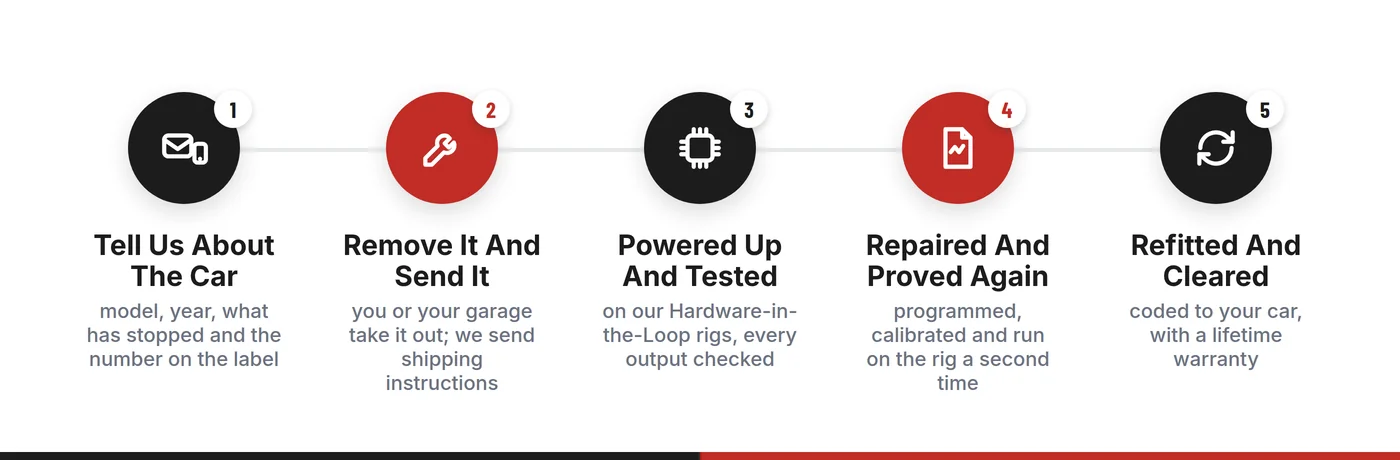
- Tell us about the car
The repair form asks for the model and year, what has stopped working, any stored codes and the number on the module’s label. Mention any recent battery work or jump start; it helps.
- Remove the FRM3 and send it
You or your garage take the module out, and we send shipping instructions so it travels safely. Keep the connector covered and pad the unit so it cannot move about in the box.
- Powered up and tested
On arrival the module goes onto our in-house Hardware-in-the-Loop rigs, which simulate the load, heat and vibration it meets in the car, and every output is checked.
- Repaired, calibrated and proved again
Our electronic engineers repair it at circuit level in a cleanroom-standard workshop, program and calibrate it with dealer-level diagnostic tools, and run it on the rig a second time. We keep you updated as it goes.
- Refitted and cleared
The module comes back coded to your car. Your garage refits it and clears the stored faults, and the repair is covered by a lifetime, unlimited-mileage warranty.
FRM3 footwell module: what BMW and MINI owners ask us
Everything electrical went dead after a jump start. Is that the footwell module?
It fits the classic FRM3 pattern. The module is sensitive to supply voltage, and a jump start, a flat battery or a battery change can leave it unresponsive, taking the lights, windows and locking with it. Check the battery, note any stored codes, then have the module tested.
Does the repaired module need a dealer to set it up?
No. It is the module your car left with, so it goes back already coded to that car. A new or used replacement is the one that has to be coded and matched first. Your garage refits ours and clears the stored faults.
The number on my module is not in your table. Should I still send it?
Yes, but tell us first. The table lists the FRM3 numbers we see most often, not every one we can take. Put the number and your car’s details on the repair form and we will check the match before you post it.
Can I keep driving while the lights are playing up?
Not if the brake lights, indicators or headlights are affected: other road users depend on them, and they are checked at the MOT. A window that sticks is a nuisance; a lighting fault is a safety problem, so have it looked at first.
My garage found water in the footwell. Is the module still worth sending?
It is worth having assessed: we test every unit on the bench and report what we find. Fix the leak as well, though, because a repaired module refitted into a wet footwell faces the same conditions that stopped it.
Do you repair the footwell module on the MINI Clubman and Cabrio?
Yes. Both are covered by the same repair and have their own pages, for the MINI Clubman (2006–2014) and the MINI Cabrio (2007–2015). The process is the same as for every car on this page.
Final thoughts
A BMW or MINI that loses its lights, windows and locks in one go rarely has five separate faults. It usually has one failed module, and quite often one bad day for the battery.
Rule out the battery and supply, write down what stopped working and every stored code, note the number on the module’s label, and have the FRM3 tested before buying bulbs, switches or a replacement unit. Repaired, your own module goes straight back into the car it was set up for.
Sinspeed · FRM3 repair by post
Get the lights, windows and locks answering againBook it online and post the module in. What comes back has been through our load tests and still belongs to your car, with nothing to set up beyond the refit.
Circuit-level repair by in-house engineers · Calibrated with dealer-level tools · Lifetime cover with no mileage ceiling