
Summary: The VGS on a Mercedes 722.9 7G-Tronic gearbox — the unit the trade calls the conductor plate — is programmed to one car’s immobiliser and chassis number. A second-hand one cannot be made to work in your car, whatever condition it is in: the only unit that will ever run your gearbox without a programming exercise is the one already bolted to its valve body. We rebuild that unit on the bench and return it with its original programming intact, so it refits plug and play. Your garage takes it out and posts it; the car stays where it is.
- The unit: VGS — Mercedes’ own name for the transmission control unit on the 722.9 7G-Tronic. The trade calls it the conductor plate
- Where it sits: bolted onto the valve body, inside the gearbox sump, permanently in the oil
- Versions: VGS1, VGS2, VGS3 and VGS4 — which one you have decides what a replacement would involve
- What fails: the internal speed sensing degrades after a working life spent in hot gearbox oil
- Why a used one is no help: every VGS is programmed to a single car’s immobiliser and chassis number
- The service: your garage removes the unit and posts it; we rebuild it and return it with its original programming intact
What is the VGS on a Mercedes 722.9, and where does it sit?
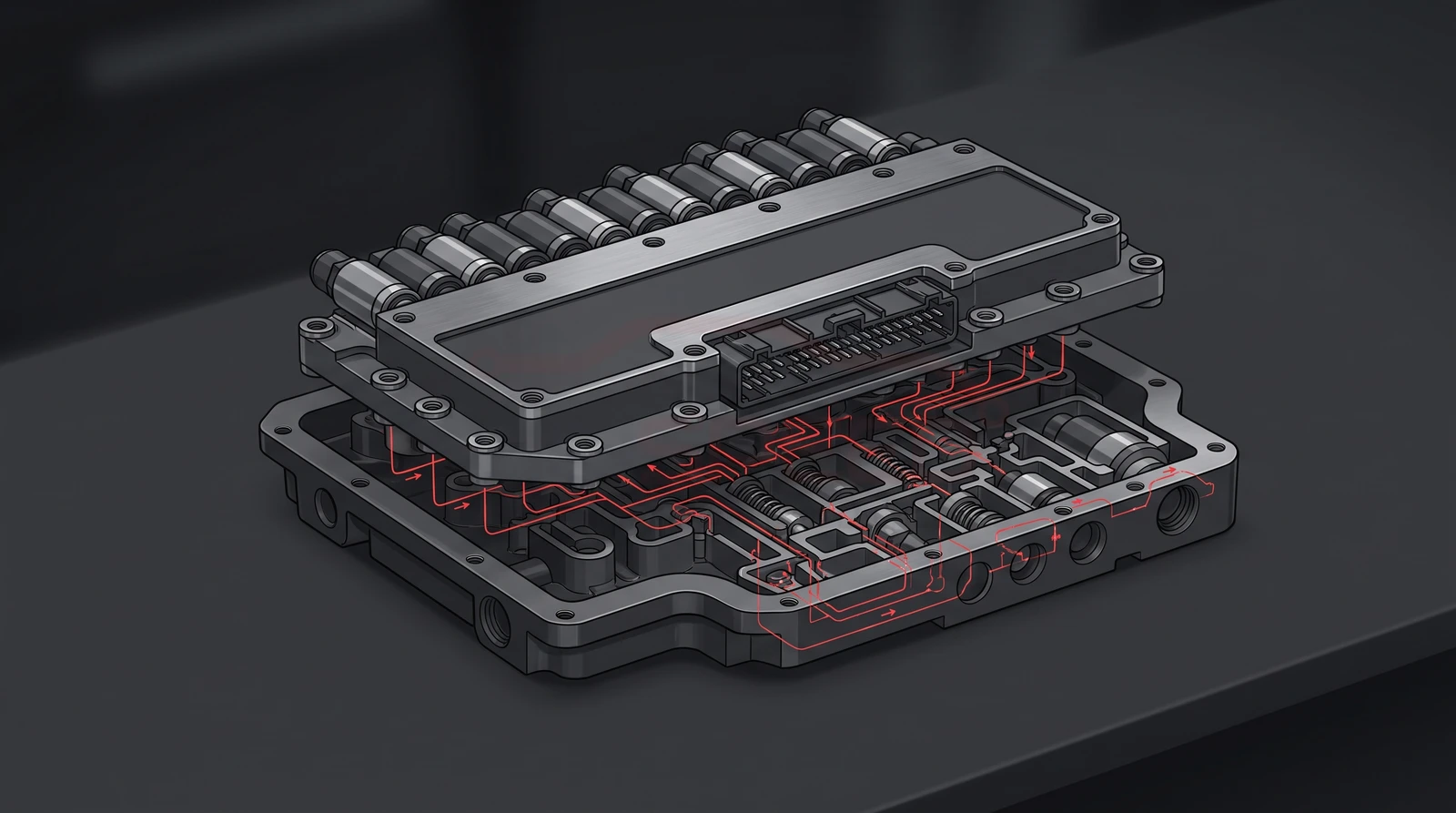
VGS is Mercedes’ own name for the transmission control unit on the 722.9 — the seven-speed 7G-Tronic, known internally as NAG2. It is not a box in the engine bay or under a floor panel. It bolts directly onto the valve body, centre-mounted inside the gearbox sump, and it spends its entire working life submerged in hot gearbox oil.
Almost nobody calls it a VGS. To the trade it is the conductor plate, and you will also see the same part sold as a 722.9 TCU, a TCM or a mechatronic. They are all the one component.
Mercedes built it in four generations — VGS1, VGS2, VGS3 and VGS4. Which one is in your car changes nothing about rebuilding your own unit. It changes a great deal for anyone trying to fit a different one, which is the subject of a later section.
Because the control unit and the hydraulic block are a single assembly, a scan tool reporting a transmission fault is not telling you which half has failed. The electronics and the hydraulics are bolted together, share the same oil and produce overlapping symptoms. Separating the two is most of the diagnostic work on this gearbox, and it is why the fault-code table below is worth reading before anything is ordered. The hydraulic half — the valve body and its solenoids — is covered by our transmission valve body repair service.
Why a second-hand conductor plate will not work in your car
This is the single fact that decides how a 722.9 job goes, and it is the one most owners find out late.
Every 722.9 control module is programmed to the vehicle’s immobiliser and chassis number. This is not a unit being awkward to adapt to another car. A plate out of a breaker’s Mercedes is married to that Mercedes and it stays married to it — fitting it to yours is not a shortcut with a catch, it is not something the module will do.
That closes off the route most people try first, which is why a 722.9 with a dead conductor plate feels like a far bigger problem than it is. The gearbox is usually fine. The hydraulics are usually fine. The one component that has failed happens to be the one component you cannot buy used.
What that leaves is a better answer than it sounds. Your own unit already carries the programming your car recognises. Rebuild it rather than replace it and that programming never leaves the module — it comes back, it goes on, and the gearbox accepts it because it is the same unit it has always run. No SCN coding, no virginising, no appointment to make the car accept a stranger.
The symptoms a failing VGS produces, and why they read as a worn gearbox
A failing VGS behaves like a gearbox wearing out. That is the whole problem.
- Holding a gear far too long, then slamming the next one in.
- Flaring between changes — the engine rises and the car does not.
- Limp mode: one forward gear only, most often second.
- Sticking in gear, or refusing to select a gear at all.
- The car will not start.
- Sudden, complete loss of drive.
These start intermittently. A fault that appears once on a cold morning and then behaves for a fortnight is the classic early stage, and the documented pattern is that it always becomes permanent if it is left. Dropping to one gear on a slip road is not a fault to live with while you decide.
Why it reads as mechanical wear. The mechanism is documented, and it is entirely electronic. As the control unit breaks down internally it loses the ability to monitor the rotational speed of the input shaft accurately. Without a dependable input speed it cannot work out how much the torque converter is slipping, so it cannot control lock-up properly — and the result is a gear change that will not go through smoothly, or in some cases no gear selection at all.
From the driving seat that is indistinguishable from worn clutches. It is why 722.9 cars get quoted for gearbox rebuilds they do not need, and why the stored codes matter more on this gearbox than on almost any other.
Which 722.9 fault codes a rebuild can fix, and which it cannot
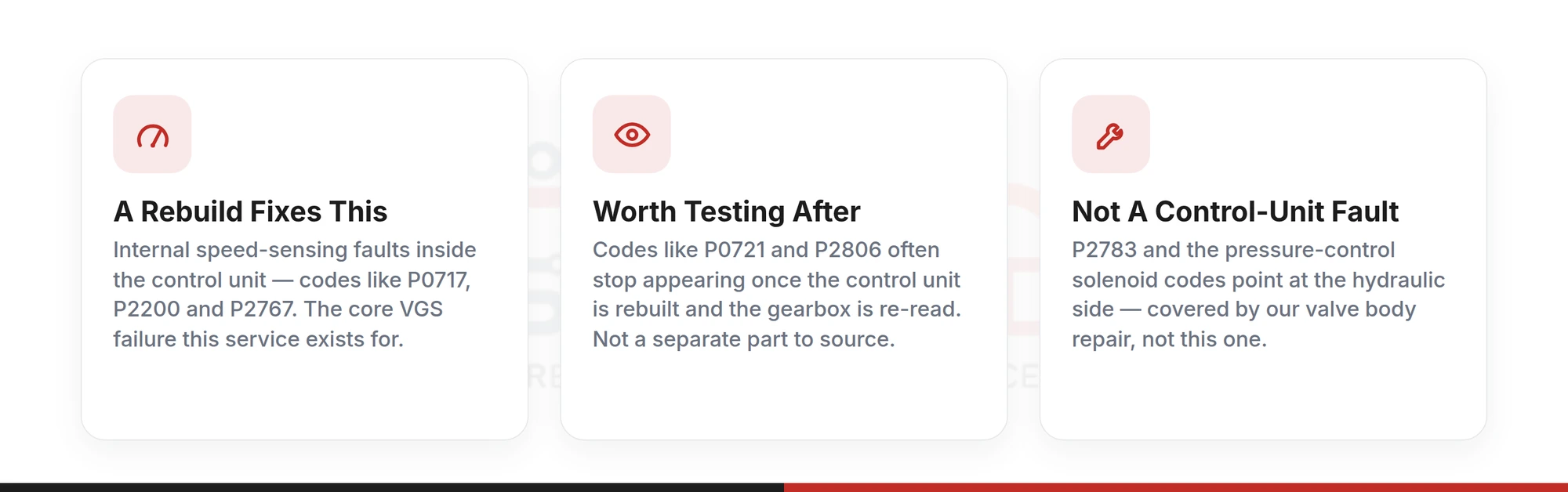
Mercedes codes this gearbox precisely, and the codes divide cleanly. The split below follows the taxonomy published by a major European remanufacturer of these units, and it is the most useful thing a 722.9 owner can have in front of them before anything is removed.
| Verdict | Fault codes | What they point at |
|---|---|---|
| A rebuild addresses these | P0717, P0718 (Y3/8n1, turbine speed sensor), P0720, P2200, P2201 (Y3/8n2, internal speed sensor), P2204, P2205 (Y3/8n1), P2767, P2768 (Y3/8n2) | Internal speed sensing inside the control unit — the core VGS failure, and the one this service exists for |
| Often resolved — worth testing | P0721, P0722, P0723, P0894, P2206, P2207, P2550 (Y3/8n3, output speed sensor), P2502, P2505, P2711, P2806 (Y3/8s1 not learned) | Sensing and supply faults that frequently stop appearing once the control unit has been rebuilt. P2806 is a selector position the gearbox has not learned, and needs re-teaching with dealer-level tooling |
| Not a control-unit fault | P0606, P0705 (Y3/8s1, selection-range sensor), P2783 (clutch actuator temperature), P0748, P0778, P0798, P2716, P2725, P2734, P2810, P2759 | The pressure-control solenoids, the selector sensor and the lock-up clutch — the hydraulic side of the same assembly, or the gearbox beyond it |
Note what the bottom row is not saying. Those are not faults we cannot help with: the pressure-control solenoids and the valve body they sit in are the other half of the same assembly, and they are covered by our valve body repair service. What the row tells you is that rebuilding the control unit on its own will not clear them.
Three things go with that table, and each of them stops a wasted job.
Read the middle row together with the top one. Where a middle-row code appears alongside any of the top-row codes, the recommendation from the same source is to have the control unit rebuilt first, clear every stored code once the unit is back together, and then re-read. There is a good chance the middle-row codes stop appearing on their own.
P2783 means inspect the sump magnets before anything else. It reads as clutch actuator temperature too high, and if those magnets are loaded with iron swarf the damage is mechanical and has already spread. The FAQs below set out what that actually means for the car.
Speed-sensor codes are not always the sensor. Damage or iron grinding on the magnetic sensor rings produces the same codes, so they are always worth checking properly while the gearbox is open.
A wider list across other makes and gearboxes sits in our guide to transmission control module fault codes.
Sinspeed · Mercedes gearbox electronics
Send us the codes before the sump comes off
Fill in the repair form with your vehicle details and every stored fault code. We will tell you whether the VGS is the part at fault, what a rebuild will and will not clear, and what your garage needs to take out.
Returned with the programming your car already runs on · Bench-tested under simulated heat, vibration and load before dispatch
Which Mercedes the 722.9 is fitted to, and how it differs from the 722.6
The 722.9 arrived on the eight-cylinder cars and spread across the range from there, reaching the six-cylinder diesels that make up most of its UK parc. Seven forward gears and two reverse — worth knowing, because it is a fair measure of how much work the control unit is doing.
| Model | Fitted |
|---|---|
| C-Class | 2004–2014 |
| CL | 2003–2010 |
| CLK | 2005–2009 |
| CLS | 2005–2014 |
| E-Class | 2002–2015 |
| GL | 2006–2009 |
| GLK | 2008–2009 |
| M-Class (ML) | 2005–2012 |
| R-Class | 2005–2009 |
| S-Class | 2003–2016 |
| SL | 2006–2008 |
| SLK | 2004–2015 |
One clarification, because these two get confused constantly. The 722.6 five-speed that came before it also has a part the trade calls a conductor plate, and on that gearbox it is not the control unit at all — different gearbox, different part, different repair. If your car is a 722.6, that gearbox is covered too: our valve body and control module repair page sets out where its control unit actually lives and how it reaches us.
The 722.9 VGS sits alongside the rest of our transmission control module repairs.
Virgin, SCN-coded and the right version: what replacing a VGS actually requires
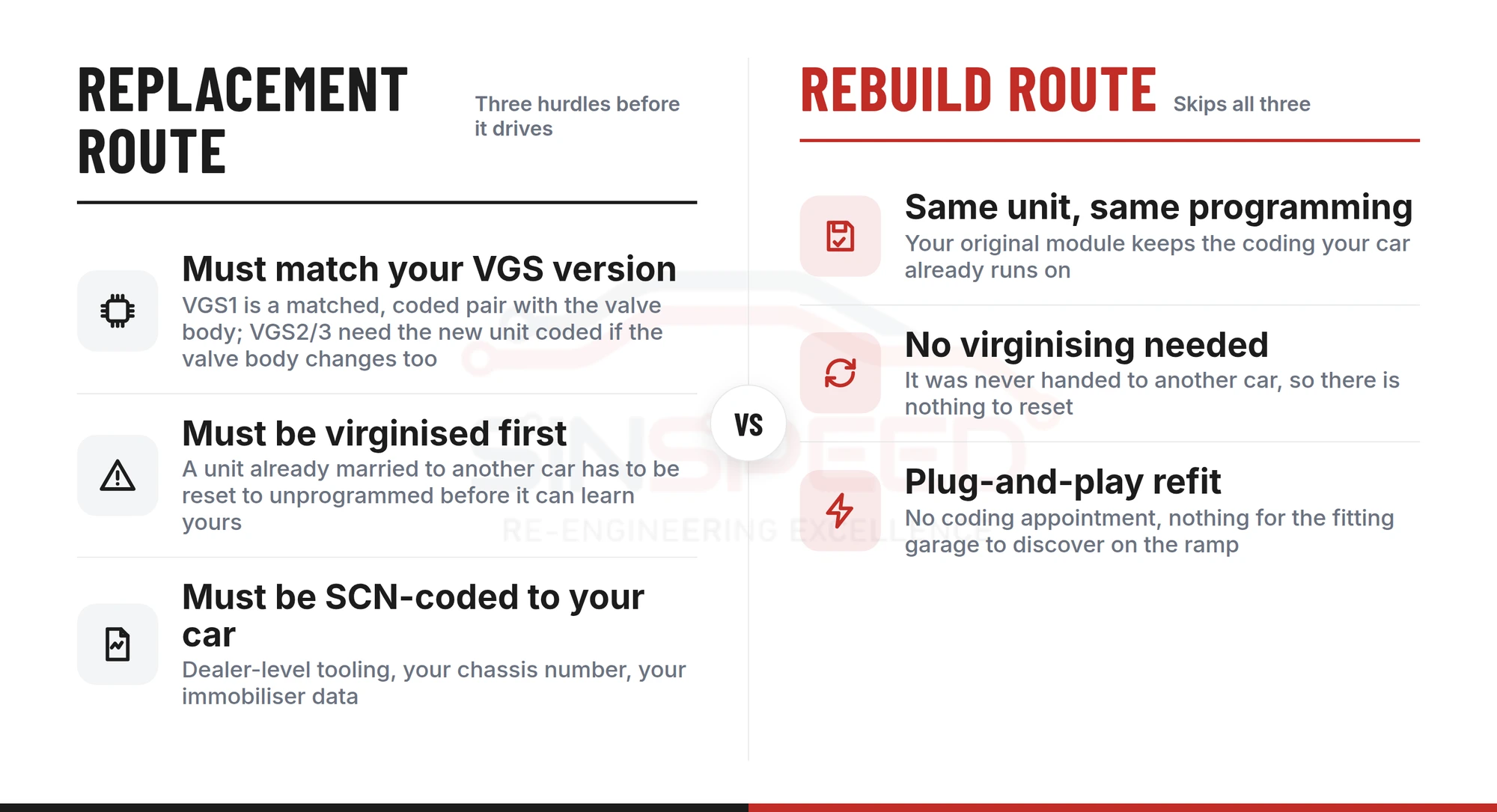
If a rebuild is genuinely off the table, a replacement VGS has three hurdles to clear before the car will drive. None of them is optional and the middle one is where jobs stall.
It has to be the same VGS version. Trade practice, consistent across the specialists doing this work, treats the generations as non-interchangeable. On a VGS1 car the valve body and the control unit are handled as a matched, coded pair and are replaced together. On VGS2 and VGS3 the conductor plate can be changed while the original valve body stays — but if the valve body is replaced as well, the new control unit has to be coded to the vehicle.
It has to be virgin. A unit that has already been married to another car must be returned to an unprogrammed state before it can be taught yours. This is the step that catches people out. Plenty of workshops can perform SCN coding; far fewer can virginise a unit to start the process, and a coding appointment booked without that capability ends with the car no closer to driving.
Then it has to be SCN-coded to your car. Dealer-level tooling, your chassis number, your immobiliser data.
Set against that, a rebuild of your own unit skips all three. The programming stays in the module throughout, so what comes back is not a new unit that has to be taught your car — it is your unit, which already knows it. That is the reason this repair exists as a mail-in service rather than a dealer one.
From your garage’s ramp to our bench and back
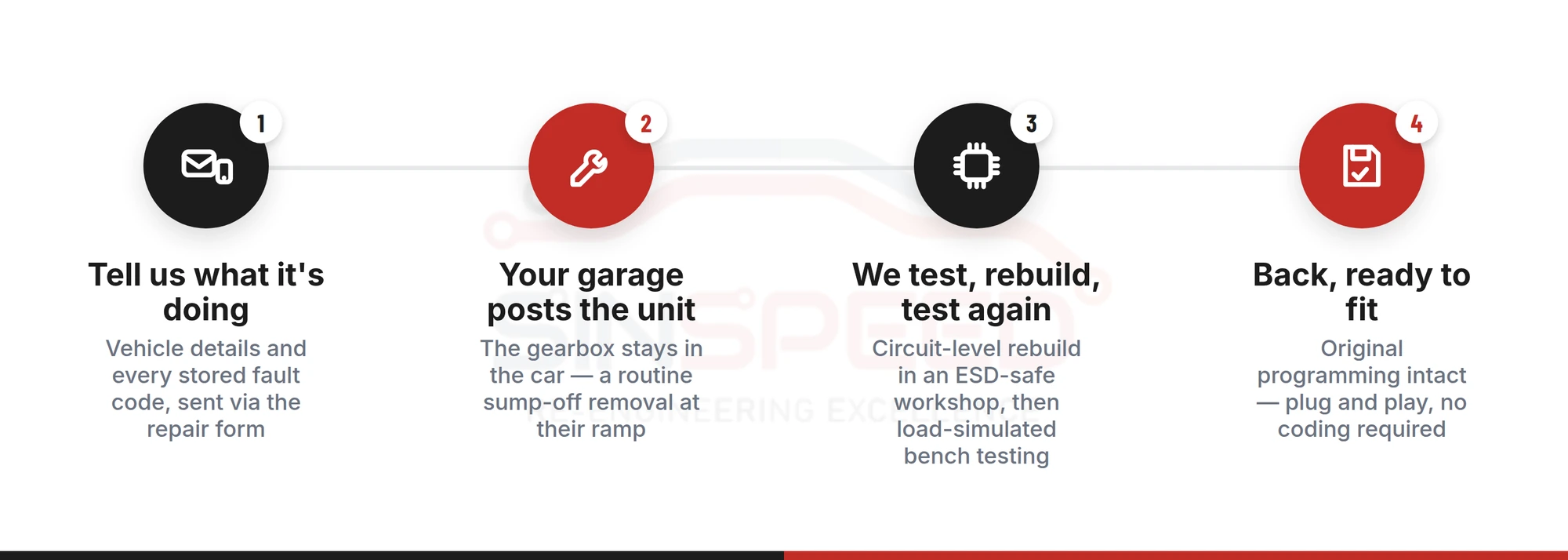
Your car does not travel. The VGS does.
- Tell us what it is doing
Complete the repair form with the vehicle details, every stored fault code and what the car is doing on the road. If you cannot tell whether the fault is electronic or hydraulic, that is the normal position to be in on this gearbox, and it is what the codes are for.
- Your garage removes the unit and posts it
The gearbox stays in the car. The sump comes off from underneath and the VGS comes out with it. That removal is your garage’s work and a routine job for them; what reaches us is the control unit on its own.
- We test it, rebuild it, and test it again
Behaviour is measured against known-good data rather than inferred. The unit is rebuilt at circuit level by our in-house engineers in an ESD-safe, cleanroom-standard workshop, then run on bespoke Hardware-in-the-Loop rigs that simulate the heat, vibration and load it sees inside a gearbox. That is how an intermittent fault is made to repeat on a bench instead of on a motorway.
- It comes back ready to fit
With its original programming intact, so it refits plug and play. No SCN coding, no virginising, nothing for the fitting garage to discover on the ramp.
One thing to get right before it is posted. A conductor plate is an electronic assembly, and static discharge damages control modules. It should travel in an antistatic bag, with nothing pressing on the connector pins and packed so it cannot move inside the box. Transit damage is the one avoidable way a repairable unit turns into a replacement.
Mercedes 722.9 VGS repair: FAQs
Can a Mercedes 722.9 conductor plate be repaired, or does it have to be replaced?
It can be repaired, and on this gearbox that is usually the better engineering answer. The dominant 722.9 failure is electronic — the internal speed sensing inside the control unit degrades after a working life in hot gearbox oil. That is measurable and repairable on a bench, and rebuilding your own unit keeps the programming your car already recognises. Where the stored codes point instead at the pressure-control solenoids, or at mechanical damage inside the gearbox, we will tell you after testing rather than rebuild something that was never at fault.
Will the repaired VGS need SCN coding when it goes back in?
No. The original programming stays in the module throughout the rebuild, so it goes back on as a direct refit. SCN coding is what a replacement unit needs, because a replacement arrives either knowing a different car or knowing none. Your own unit already knows yours, which is the practical advantage of a repair over a swap on this particular gearbox.
The VGS is inside my gearbox. Is that still something I can send in?
Yes, and it is the normal way this repair is done. The gearbox stays in the car; your garage drops the sump, takes the unit out from underneath and posts it to us. Where a part sits only changes who removes it. It does not change what we can do with it once it arrives, and a VGS is no less a mail-in repair than a module that unbolts from an engine bay.
Which VGS version do I have, and does it change what you can do?
Send the vehicle details with the repair form and we will confirm the generation. For a rebuild of your own unit the version matters far less than people expect, because nothing has to be matched or coded — the module goes back to the car it came from. It matters a great deal on the replacement route, where a VGS1 car is handled as a matched valve-body-and-control-unit pair while VGS2 and VGS3 allow the plate to be changed on its own.
My scan shows P2783. What does that mean?
P2783 is clutch actuator temperature too high, and it is the one code on this page worth acting on immediately. Have the sump magnets inspected. If they are carrying iron swarf, the lock-up clutch has genuinely been damaged and the debris has already spread through the transmission — at which point the control unit is not the fault, and rebuilding it will not fix the car. The recognised answer there is that the gearbox and torque converter need attention, and that the oil cooler has to be flushed or, if it has a thermostat, replaced. It is a worse answer than a conductor plate, but it is the true one, and it is much better found at the start.
Sinspeed · 7G-Tronic VGS rebuilds
Your unit already knows your car. Keep it.
Post the conductor plate to the workshop and it is stripped, measured, rebuilt and tested under simulated load before it comes back — carrying the same programming your 722.9 has always run on.
Most remanufactured parts carry a lifetime, unlimited-mileage warranty · Returned ready to fit, with no coding required
Final thoughts
Everything awkward about a 722.9 conductor plate comes from one design decision: Mercedes tied the control unit to the car. That rules out the used-unit route and it rules out the quick swap, and it is why so many of these cars get quoted for a gearbox they do not need.
It also points straight at the answer. The unit your car needs is the one already in it. Have the codes read before the sump comes off and send them to us with the vehicle details, and we will tell you whether the electronics are at fault, whether the hydraulic side is involved, or whether the magnets are telling a different story altogether.
If it is the VGS, you get your own unit back, still programmed to your car. If it is not — if the iron in the sump says the damage has spread — that is mechanical work inside the gearbox, and we would rather say so at the start than rebuild a unit that was never the problem.