
 In short
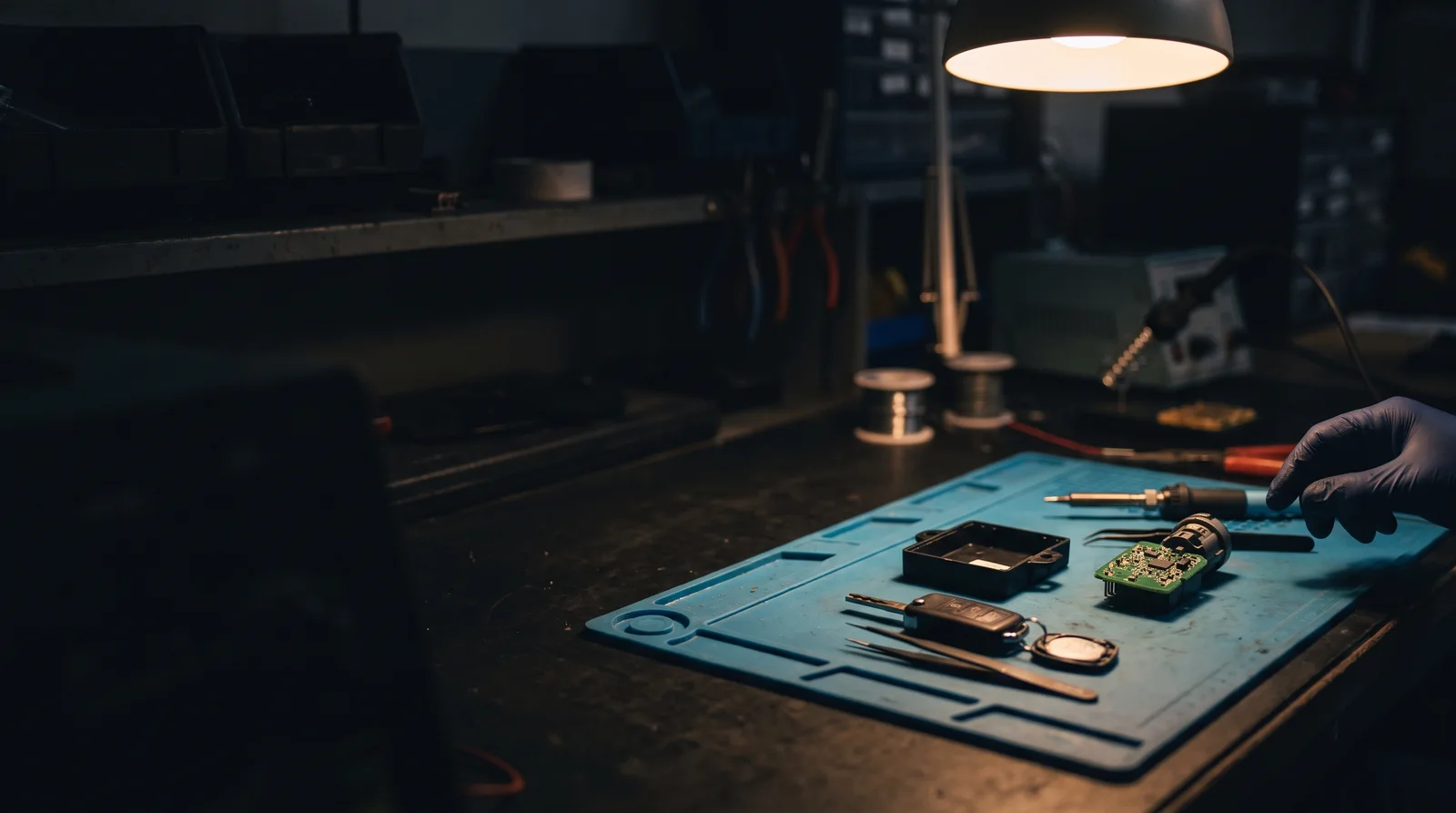
The BMW CAS3 (Car Access System) is the immobiliser and ignition-authorisation module that lets your BMW recognise its key and start. When it fails — no-start, key not recognised, immobiliser warnings — we repair your original unit and return it plug and play, with your keys, coding and mileage retained and a lifetime warranty.
What is the BMW CAS3 (Car Access System), and how does it work?
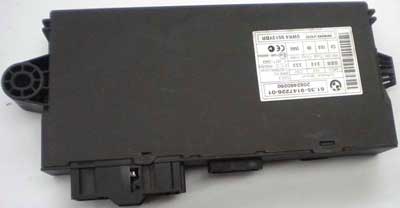
The CAS3 — Car Access System, third generation — is the immobiliser and ignition-authorisation module fitted across a wide range of BMW and MINI vehicles. It is the electronic gatekeeper between your key and your engine: nothing starts until the CAS3 has confirmed that the key belongs to the car.
Inside every BMW key there is an integrated transponder chip, and around the ignition lock there is a coil ring. The chip carries no battery of its own — it is powered by that coil from the CAS module. When you insert the key, the transponder is energised through the loop antenna and its key data is sent to the CAS control module.
If the key data is correct, the CAS3 sends an enable signal to the starter and passes a fresh random code to the engine control unit — the DME on petrol engines, the DDE on diesels. The DME or DDE then checks that random code against the one it has stored. Only when the two match is fuel injection released and the engine allowed to start. Because that code is regenerated every cycle, the system is difficult to defeat — and a correctly functioning CAS3 is essential to the car running at all.
The CAS3 also holds security and configuration data that is married to your specific vehicle, which is why it cannot simply be swapped for a unit from another car. That single design fact shapes everything that follows on this page.
Symptoms of a failing CAS3 module
A CAS3 rarely fails all at once. More often it gives warning signs that come and go before it finally leaves you stranded. The symptoms we see most often are:
- No crank, no start — you turn the key or press the start button and nothing happens, even with a healthy battery.
- Intermittent starting — the car fires on the third or fourth attempt, behaves for a week, then does it again.
- Key not recognised — the dashboard reports the key as missing or invalid, or the immobiliser warning stays lit.
- Starts then stalls — the engine catches briefly and cuts out as the immobiliser fails to release.
- No communication with the CAS module — a diagnostic scan tool cannot talk to the unit at all.
- Electrical gremlins — flickering interior or tail lights, a relay clicking repeatedly from behind the dashboard, or windows and central locking behaving oddly.
Intermittent faults are the ones owners most often dismiss, and they are exactly the ones worth acting on early. A CAS3 that starts the car nine times out of ten is already failing — the tenth time is usually at the worst possible moment.
Common CAS3 fault codes
When a garage reads your BMW with diagnostic equipment, the CAS module stores fault codes that point to where the problem lies. These are read via BMW diagnostics and are common across CAS-equipped models — treat them as indicators of the area at fault rather than a single guaranteed diagnosis. The codes we see most often on a failing CAS3 are:
- A0A9 — CAS: Control Unit Fault. A fundamental problem inside the module itself, often affecting its ability to communicate with other systems or to manage access and starting.
- A0B4 — CAS: Engine Start / Starter Operation. The CAS is failing to manage or send the start signal to the starter motor, so the engine will not crank or start.
- A0BE — CAS: Terminal 15 Output 1. Terminal 15 is the ignition-on power feed; this points to a fault in the circuit that powers up the vehicle’s electrical systems when the ignition is on.
- A0BF — CAS: Terminal 15 Output 2. The same Terminal 15 power fault on a second output circuit.
- A0C0 — CAS: Terminal 15 Output 3. The same fault affecting a third Terminal 15 circuit.
- CAS 14 to CAS 17 — Door Open codes (front-right, front-left, rear-left, rear-right). These flag a door reported as open; when the doors are genuinely shut, the cause is usually a lock actuator or its wiring, but they commonly appear alongside the codes above when the module hardware is at fault.
It is the combination that matters. A0A9 appearing with one or more of the Terminal 15 outputs (A0BE, A0BF or A0C0) is a classic signature of CAS3 hardware failure — and, tellingly, these faults often surface once the car has warmed up, which points straight to the underlying cause covered in the next section. If you have these codes, the unit needs testing and repair, not guesswork.
Sinspeed · mail-in repair
Send us the module rather than replacing the locking setReplacing an immobiliser module means new keys, new barrels and dealer programming. Repairing yours keeps the car’s existing keys working. Send it in with your vehicle details and we repair it at circuit level.
Lifetime, unlimited-mileage warranty on all remanufactured parts · Mail-in, UK-wide · Tested on Hardware-in-the-Loop rigs before dispatch
What causes CAS3 failure?
CAS3 modules fail for a small number of well-understood reasons, and heat is the most common of them.
The module sits low in the cabin, in the driver’s-side footwell — on many BMWs tucked behind the trim pocket on the driver’s side. That keeps it out of sight, but it also exposes it to repeated heat cycling. Over time, the heat degrades the electronics inside: the board drifts out of specification and fatigues as it repeatedly expands and contracts. The result is a module that works when cold and starts throwing faults once the car is warm — exactly the intermittent pattern owners describe. On MINIs, where the module lives in the dashboard and bakes in direct sunlight, the same heat-related failure is even more common.
Heat is not the only culprit. Water ingress and corrosion, voltage spikes and overvoltage events — often during a jump-start or from a failing alternator — and corrupted internal software, frequently introduced by botched key programming or interrupted updates with the wrong tools, all push a CAS3 towards failure. The symptoms overlap heavily, which is why a proper diagnosis matters before anyone reaches for a replacement.
When we repair a CAS3, we test it on bespoke in-house Hardware-in-the-Loop rigs that simulate real-world heat, vibration and load — so a unit that only misbehaves once it is hot is caught on the bench rather than after it is back in your car.
Can the CAS3 be repaired or must it be replaced?
Most general workshops and main dealers will tell you the CAS3 cannot be repaired and must be replaced. That is true for them — it is not true in general. They replace because they are not set up to repair at component level; a remanufacturer is.
A replacement CAS3 brings its own problems. A second-hand unit is locked to the car it came from and will not work in yours. A new module — unless supplied as part of a complete immobiliser kit with matched keys — has to be programmed and coded to your vehicle before the car will start. Either route means dealer-level programming, with the cost and delay that go with it.
We take a different approach. Our in-house engineers carry out circuit-level repair on your original unit, renewing what has failed with new genuine OEM components and, where it improves reliability, uprated parts, then proving the unit under load before it is returned. Because we are rebuilding the board rather than fitting a like-for-like new unit, we reinforce the very weak points that caused the failure — so the repaired module is built to meet and exceed the original specification, instead of carrying the same design flaw forward.
The practical upshot is simple: repairing your original module keeps the car’s existing security marriage intact, which is what makes the rest of this page possible.
Will I keep my keys and coding?
Yes. This is the single biggest advantage of repairing your original CAS3 rather than replacing it.
Because we rebuild the unit that is already married to your car, your existing keys continue to work, your coding and configuration are retained, and your recorded mileage is untouched. The module comes back as your module — repaired, not substituted.
That means no reprogramming, no re-coding and no trip to a dealer to marry a new unit to the vehicle. The repaired CAS3 is returned plug and play: you refit it and the car starts. A replacement unit, by contrast, almost always has to be programmed to the car before it will do anything at all.
Every remanufactured unit is returned with a lifetime, unlimited-mileage warranty, ready to fit with no coding required.
Which BMW and MINI models and years use CAS3?
CAS3 was fitted across much of the BMW range from the mid-2000s through to around 2014, and on MINIs of the same era. If your BMW or MINI sits in roughly that window, there is a good chance it uses a CAS-family module. The chassis we most commonly repair include:
- 5 Series — E60 saloon and E61 Touring (the models the older E60-specific version of this page covered).
- 3 Series — E90 saloon, E91 Touring, E92 coupé and E93 convertible.
- 1 Series — E81, E82, E87 and E88.
- X5 (E70) and X6 (E71).
- Z4 (E89).
- MINI — R55, R56 and related models, where the unit is often referred to as a BMW/MINI CAS module.
We have deliberately not published an exact year-by-chassis table here. There is an overlap around 2006 to 2007 where some cars left the factory with the earlier CAS2 and others with CAS3, and the precise cut-off points vary by model. Rather than risk sending you the wrong information, we confirm the exact system from your vehicle details or from the unit itself — see the next section.
Some later cars use a CAS3+ variant, which introduced additional encryption at the security level. The repair principle is the same, but correct identification matters — another reason we check the unit before any work begins.
CAS2 or CAS3 — how to tell
If your car sits in that mid-2000s overlap, you may not know whether you have a CAS2 or a CAS3 — and it matters, because they are different modules.
The most reliable way to tell is not to guess from the year alone. The part number on the unit, the chassis and build date of the car, and a diagnostic read will each confirm which generation you have. If you are not sure, send us your details or the unit and we will identify it for you before any work is quoted.
We repair the CAS2 generation as well: if you have established that yours is a CAS2, see our BMW CAS2 immobiliser module repair service. For the wider range of immobiliser and Car Access System work across other makes and models, our immobiliser repair category lists every service we offer.
How our repair service works
Our CAS3 repair is a mail-in, repair-and-return service. You do not need to bring the car anywhere — you send us the unit and we return it ready to fit.
- Get in touch. Tell us your vehicle and symptoms through our repair form, or contact us if you are not sure which module you have, and we will confirm what to send.
- Remove and send your unit. For a CAS repair we usually need the CAS module together with a working key, and on some cars the DME, so we can test and validate against your vehicle’s security data. We tell you exactly what to include.
- We test and diagnose. Your unit is bench-tested on our Hardware-in-the-Loop rigs to confirm the fault — including faults that only appear under heat or load — and we report what we find.
- We remanufacture. Our engineers carry out the circuit-level repair, replacing failed components with genuine OEM and uprated parts and reinforcing the known weak points.
- We return it plug and play. The repaired CAS3 comes back married to your car, keys and coding retained, with a lifetime warranty. You refit it and the car starts.
All of this is carried out in a cleanroom-standard, ESD-safe workshop using dealer-level diagnostic tools, by an in-house team trusted by independent garages and trade workshops as well as private owners. Sending us your original unit is almost always faster and less disruptive than sourcing, fitting and programming a replacement.
FAQs
Can a CAS3 really be repaired instead of replaced?
Yes. The reason dealers replace is that they are not equipped for component-level board repair. We rebuild your original unit, which keeps your keys and coding intact and avoids the reprogramming a replacement would need.
Will my keys still work after the repair?
Yes. We repair the module that is already married to your car, so your existing keys, coding and mileage are retained. The unit comes back plug and play, with no recoding needed.
How do I know if it is the CAS3 and not something else?
The common signs are a no-start or intermittent starting, a “key not recognised” message, or no communication with the module on a diagnostic scan. Fault codes such as A0A9 together with A0BE, A0BF or A0C0 are a strong indicator. We confirm the fault on the bench before any repair, so you are not paying to replace a healthy part.
My fault only happens when the car is hot — is that the CAS3?
Very possibly. Heat-related CAS3 failure is the most common pattern we see: the unit works cold and fails once warm, because the fault only appears at temperature. We test under simulated heat specifically to reproduce that kind of intermittent fault.
How do I know whether I have CAS2 or CAS3?
Cars from around 2006 to 2007 can have either. We identify the exact generation from the part number, your vehicle details and a diagnostic read before quoting — just ask, and we will confirm it for you.
What do I need to send you?
Typically the CAS module and a working key, and on some vehicles the DME as well. We confirm exactly what to include when you get in touch, so nothing is missed and we can validate the repair against your car.
Is the repaired unit guaranteed?
Yes. Every remanufactured CAS3 is returned with a lifetime, unlimited-mileage warranty, ready to fit.
Sinspeed · mail-in repair
Not sure which unit has failed?Send us your fault codes and vehicle details and we will tell you which unit is at fault before you remove anything.
Cleanroom-standard, ESD-safe workshop · Circuit-level board repair by in-house engineers · Most units returned ready to fit