
Summary: Vauxhall Mokka dashboard symbols include the familiar red and amber warnings, but the Mokka handbook adds a group that a small hatchback often goes without: forward collision alert, lane departure warning, descent control, adaptive forward lighting and parking assist. Several of them change meaning with their colour, or with whether they are steady or flashing — a green lane departure lamp means the system is ready, a steady yellow one means it has failed. This page separates the lamps that report what a system is doing from the ones reporting a fault, gives every symbol in the first-generation Mokka and Mokka X handbook with a safe-to-drive verdict, and shows which lamps point at an electronic unit we can test and repair.
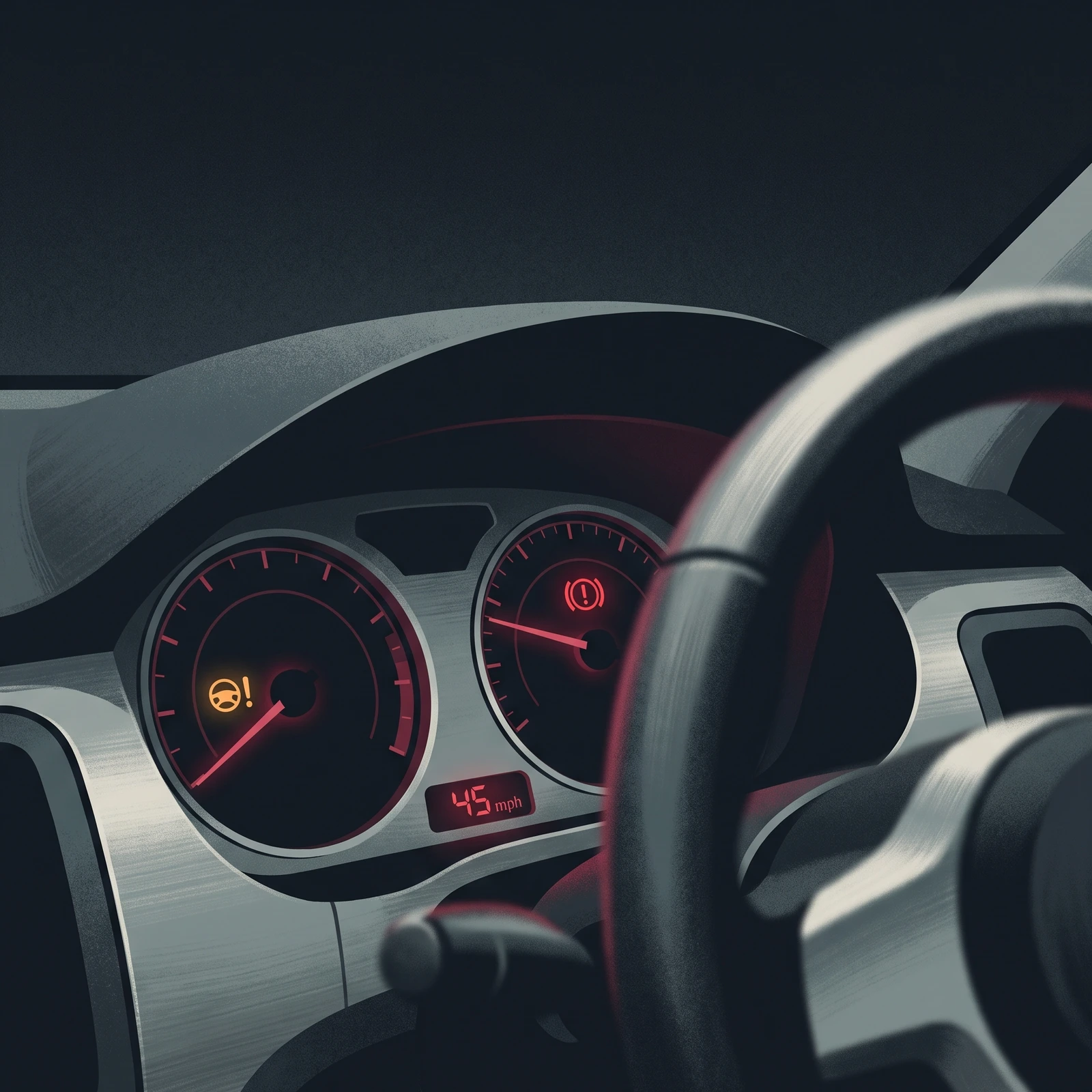
- Vauxhall Mokka dashboard symbols: the full table
- Driver assistance or a fault: reading the Mokka’s extra lamps
- First-generation Mokka and Mokka X, or the 2021-on Mokka
- Which Mokka lamps point at a failed electronic unit
- What to do when a warning light comes on in your Mokka
- Vauxhall Mokka warning lights FAQs
- Final thoughts
Vauxhall Mokka dashboard symbols: the full table
The Mokka follows the colour rule every car uses — red for stop, amber for a fault that needs attention, green, blue or white for something switched on — and our guide to what dashboard warning lights mean covers that code in full. The table below is built from the Mokka’s own owner’s manual, so each verdict carries Vauxhall’s instruction for that lamp rather than a generic one.
Which rows your car shows depends on engine and equipment: preheating and the particle filter are diesel lamps, and the assistance lamps appear only where those systems are fitted. The handbook calls amber lamps yellow, and we use both words. Lamps that other Vauxhalls carry and the Mokka does not are on our Vauxhall warning lights and symbols page. A row with no icon is one where we could not match a symbol exactly, so it runs in words only.
| Colour | Symbol | What it means on a Mokka | Is it safe to drive? |
|---|---|---|---|
| Red |  Brake and clutch system — the ! in a circle between two brackets Brake and clutch system — the ! in a circle between two brackets | On with the manual parking brake applied: normal. On with it released: the brake and clutch fluid level is too low. | No, once the brake is released. Vauxhall’s instruction is to stop and not continue the journey. |
| Red | 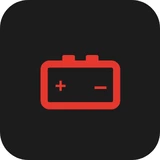 Charging system — a battery with its two terminals Charging system — a battery with its two terminals | With the engine running, the battery is not charging. Engine cooling may be interrupted and the brake servo may stop working. | No. Stop, switch off the engine and call a workshop. |
| Red |  Engine oil pressure — an oil can dripping from its spout Engine oil pressure — an oil can dripping from its spout | Lubrication may be interrupted, risking engine damage and locked drive wheels. | No. Clutch down, neutral, out of the traffic, ignition off — and expect heavier brakes and steering once the engine stops. Check the oil level. |
| Red |  Airbag and belt tensioners — a seated figure facing an inflated airbag Airbag and belt tensioners — a seated figure facing an inflated airbag | A fault: the airbags and pretensioners may not fire in a crash. Lit continuously after a collision, it shows they have deployed. | It drives, but the protection may be missing. Vauxhall says have it put right immediately. |
| Red | 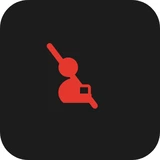  Seat belt reminder, and door open Seat belt reminder, and door open | A front belt is unfastened, or a door or the tailgate is open. Rear belts show in the Driver Information Centre. | Fasten it or shut it before moving off. |
| Amber |  Power steering — a steering wheel with an exclamation mark Power steering — a steering wheel with an exclamation mark | Should go out soon after the engine starts. Still on after that, or lit while driving: a failure in the power steering system. | Steering stays possible but heavy. Drive gently, keep the journey short and have it seen promptly. |
| Amber | 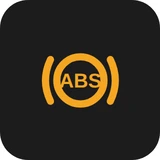 ABS — the letters ABS in a circle ABS — the letters ABS in a circle | The brakes still work, but without anti-lock regulation. | Carefully, if the red brake lamp is out, allowing more stopping distance. An ABS fault also fails the MOT. |
| Amber |  Electronic Stability Control and Traction Control — a car above two skid marks Electronic Stability Control and Traction Control — a car above two skid marks | Flashing: the system is working and may cut engine output or brake the car slightly. Steady: a fault in the system. | Flashing: yes, ease off. Steady: driving on is possible, but stability may suffer on a poor surface. Have it seen. |
| Amber | 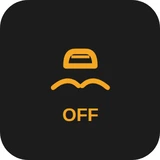 Electronic Stability Control off — the skid car with OFF beneath it. Traction Control off has a separate lamp of its own. Electronic Stability Control off — the skid car with OFF beneath it. Traction Control off has a separate lamp of its own. | The system has been switched off. | Yes, if you switched it off. Switch it back on for normal roads. |
| Amber |  Malfunction indicator light — an engine outline Malfunction indicator light — an engine outline | Steady: a fault in the emission control system. Flashing: a fault that could damage the catalytic converter. | Steady: gently, to a workshop straight away. Flashing: ease off the accelerator until the flashing stops, then the same. |
| Amber | Service vehicle soon — lit together with a message or a code number | The car needs attention, and the message says what. The codes are listed in the next section. | Usually, but read the message first: some codes mean steering, gearbox or reduced engine power. |
| Amber |  Tyre pressure monitoring — a tyre cross-section with an exclamation mark Tyre pressure monitoring — a tyre cross-section with an exclamation mark | Steady: tyre pressure loss. Flashing for 60 to 90 seconds, then steady: a system fault, or a wheel without a sensor such as the spare. | Steady: stop immediately and check the pressures. Flashing: yes, then a workshop. |
| Amber |  Diesel particle filter — a box with a row of dots Diesel particle filter — a box with a row of dots | Steady: the filter is full and needs to clean itself. Flashing: it has reached its limit and needs cleaning at once to avoid engine damage. | Yes — keep driving until it goes out, ideally without dropping below 2,000 rpm. See how a DPF works. |
| Amber |  Preheating — a coiled filament Preheating — a coiled filament | Diesel preheating, which only runs when it is cold outside. | Yes. It is working as intended. |
| Amber | Immobiliser — flashing | A fault in the immobiliser system. The engine cannot be started. | It will not start. Try the spare key, then have the system diagnosed. |
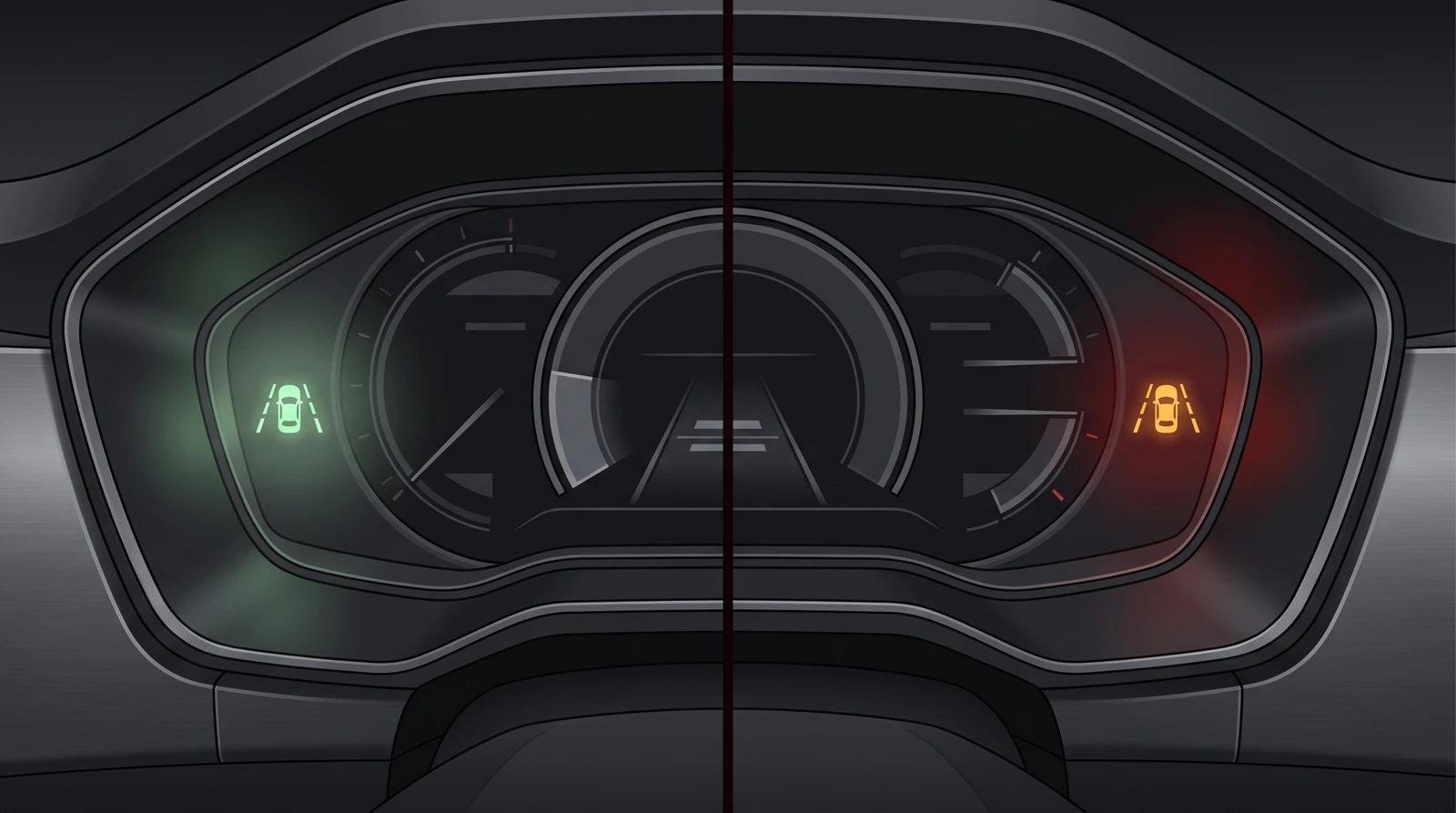
| Green or amber |  Lane departure warning — a car between two lane lines Lane departure warning — a car between two lane lines | Green: on and ready. Flashing yellow: an unintended lane change detected. Steady yellow: a failure in the system. | Yes. Steady yellow means it is no longer watching, so book it in. |
| Amber | Ultrasonic parking assist | A system fault, sensors dirty or covered by ice or snow, or interference from another source of ultrasound. | Yes, without relying on the sensors. Clean them; if it stays on, a workshop. |
| Amber | Adaptive forward lighting | Steady: the system needs a service. Flashing: switched to symmetrical low beam. A four-second flash at start-up is only a reminder that it is active. | Yes, but book the steady version in. |
| Amber | Operate pedal | Stop-start: press the clutch to restart from an Autostop. Flashing: press it for a normal start. | Yes — an instruction, not a fault. |
| Amber |  Low fuel — a fuel pump Low fuel — a fuel pump | Steady: the tank is low. Flashing: the fuel is used up. | Flashing: refuel at once. Never run the tank dry. |
| Amber | 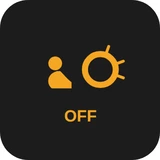 Front passenger airbag — the OFF lamp shown; a separate lamp shows it is on Front passenger airbag — the OFF lamp shown; a separate lamp shows it is on | Whether the front passenger airbag is active or deactivated. | Match it to the passenger. An active airbag with a child restraint, or a deactivated one with an adult, risks fatal injury. |
| Green, blue and amber tell-tales |     Turn signals, high beam, front and rear fog lights Turn signals, high beam, front and rear fog lights | On as selected. Turn signals flashing rapidly: a failed bulb or fuse, or a trailer lamp out. | Yes. Replace a failed indicator promptly, and switch the rear fog off when visibility returns. |
| Green and white | Vehicle detected ahead, descent control, cruise control, upshift and exterior lights | Information only — explained in the next section. | Yes. None of these reports a fault. |
Driver assistance or a fault: reading the Mokka’s extra lamps
Most of the extra lamps on a Mokka are not warnings at all. They report what a driver-assistance or lighting system is doing, and they sit beside versions of themselves that mean something quite different. Three questions sort them: what colour is it, is it steady or flashing, and did a message arrive with it?
Lamps that only tell you what a system is doing
- Vehicle detected ahead (green): forward collision alert has picked up a vehicle in your lane. It confirms the system can see.
- Lane departure warning (green, or flashing yellow): green means switched on and ready; flashing yellow means it has recognised an unintended lane change — the system doing its job.
- Descent control (green): steady when ready, flashing when active.
- ESC and Traction Control (flashing): the system is intervening. Engine output may drop and the car may brake itself slightly, which is normal on a slippery road.
- Cruise control: white when switched on, green when it is controlling the speed.
- Adaptive forward lighting (four-second flash at start-up): a reminder that the system is active.
- Operate pedal, and bonnet open: both belong to stop-start. The clutch restarts the engine from an Autostop, and a bonnet lamp shows on cars with the system.
The same systems when they report a fault
The fault versions are mostly yellow and steady. Lane departure lit steady yellow is a failure in the system. Adaptive forward lighting lit steady needs a service. ESC and Traction Control lit steady is a fault rather than an intervention: the handbook allows driving on, but stability may be worse on a poor surface. Each of these is a workshop visit, not an emergency stop.
Parking assist lit yellow deserves a look before a booking. It can be a system fault, but it can equally be sensors that are dirty or iced over, or interference from another source of ultrasound — the display even has a “Parking assist fault, clean bumper” message for exactly this.
Tyre pressure monitoring is the one to get the right way round. Steady means a tyre is losing pressure, and Vauxhall says stop immediately and check. Flashing, then turning steady after 60 to 90 seconds, means a fault in the system or a wheel without a sensor, such as the spare, and is a job for a workshop rather than the hard shoulder.
When the display shows a number instead of words
On a Mokka with the Midlevel display, vehicle messages appear as code numbers, sometimes with a chime; the Uplevel and Uplevel-Combi displays spell them out. Write the number down before you confirm it with SET/CLR. An S in front means “Service vehicle soon”, and Vauxhall’s instruction for every S code is to seek a workshop immediately.
| Code | Message | What it points at |
|---|---|---|
| 54 | Water in diesel fuel filter | The fuel filter needs draining before water travels further. |
| S68 | Service power steering | The power steering system — see the next-but-one section. |
| S73 | Service all-wheel drive system | The four-wheel-drive system, on cars that have it. |
| S75 | Service air conditioning | The air conditioning system. |
| S79 | Top up engine oil | The oil level. Check it and top up. |
| S81 | Service transmission | The gearbox or its control side; the diagnostic codes separate the two. |
| S84 | Engine power is reduced | A stored engine fault. The diagnostic codes say which. |
| 25 to 28 | Turn signal failure, by corner | A failed indicator at the front or rear, left or right. |
| S136 | Service parking assist | The parking assist system. |
| 174 | Low battery | Switch off heated seats, the heated rear window and anything else you can, then charge by driving or with a charger. It clears after two consecutive starts without a voltage drop. |
First-generation Mokka and Mokka X, or the 2021-on Mokka
Everything on this page comes from the handbook for the first-generation Mokka, the car later sold as the Mokka X. It has conventional dials with the Driver Information Centre between the speedometer and rev counter, in Midlevel, Uplevel or Uplevel-Combi form — which is why one owner sees a code where another reads a sentence.
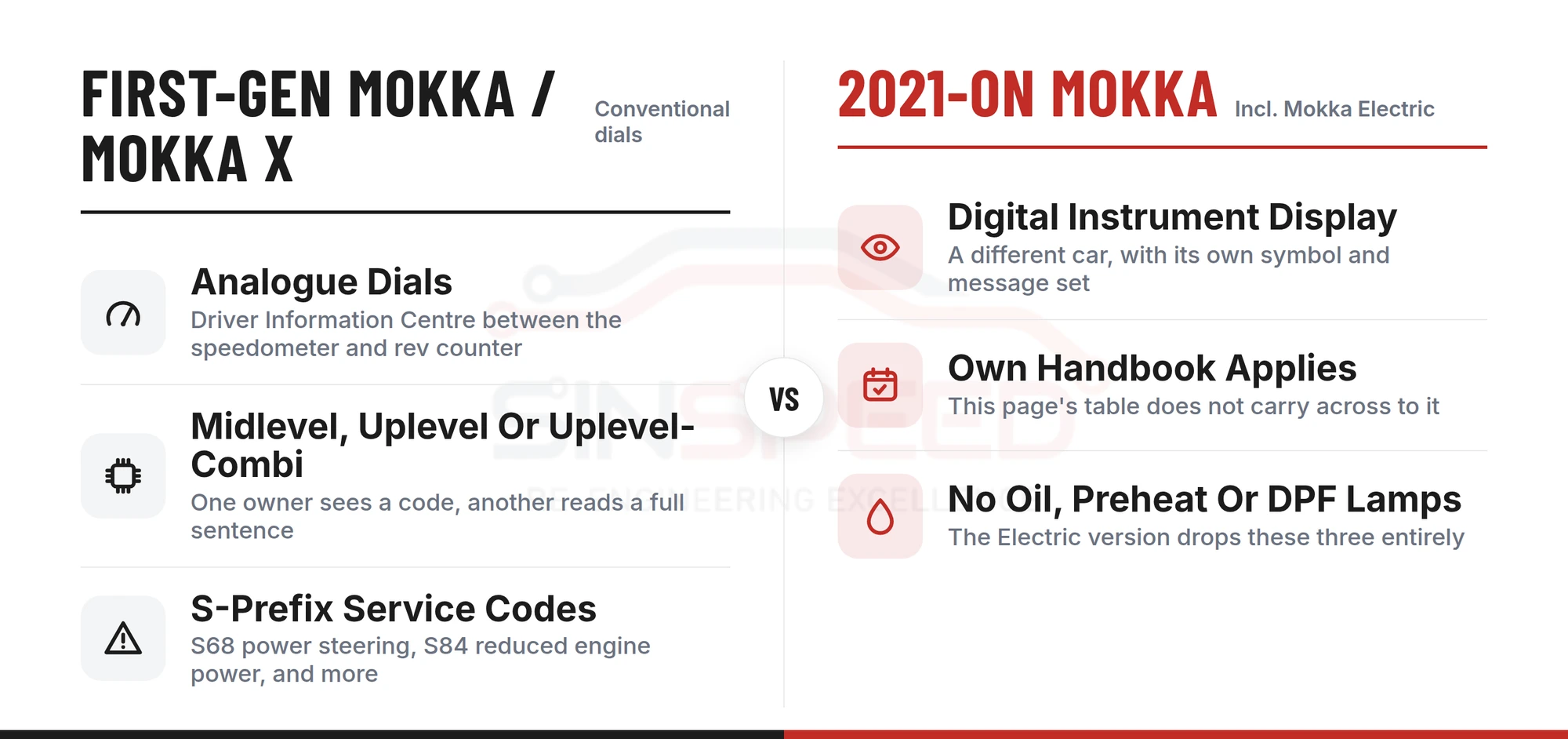
The Mokka sold from 2021, including the Mokka Electric, is a different car with a digital instrument display. Its symbols and messages are not the ones in this table, and the electric version has no oil pressure, preheating or particle filter lamps at all. If yours is the later car, use its own handbook — Vauxhall publishes them on its owner’s manuals page — and our Vauxhall Astra warning lights page, which deals with how Vauxhalls changed as the brand moved into Stellantis.
Which Mokka lamps point at a failed electronic unit
Most lamps in the table come down to a fluid, a tyre, a bulb, a dirty sensor or a service interval. A smaller group sits in front of an electronic control unit, and those are worth understanding before any part is bought. The full range of units we work on is on what we repair.
The reason is the way a control unit fails. It rarely stops dead. Heat, vibration and supply-voltage swings wear it gradually, so it may work on a cool morning and drop out on a warm afternoon, and the symptom it produces looks mechanical: steering that feels tight, brakes that seem to grab, an engine that loses power as if something were blocked. A garage chasing that symptom can replace sound parts one at a time while the fault sits in the unit. The diagnostic codes, and which module stored them, are how you avoid that.
Power steering: the yellow wheel and S68
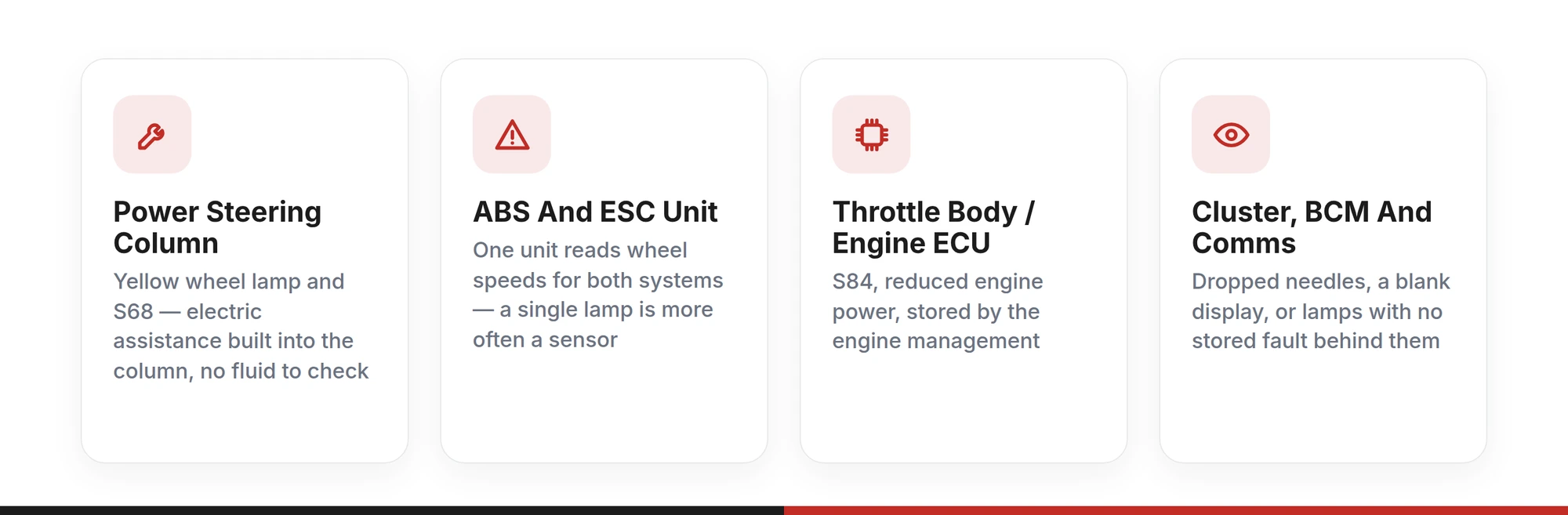
The first-generation Mokka uses electric power steering, with the assistance built into the steering column rather than supplied by a hydraulic pump. So there is nothing to top up. When its lamp stays on after start-up or lights on the move, the handbook calls it a failure in the power steering system, and a Midlevel display can add S68, Service power steering.
A failing column does not always announce itself cleanly. Steering that is heavier one way than the other, or assistance that comes and goes, can pass for a tyre or suspension problem. Because the system runs on electrical power, rule out the battery and charging first — a low battery has its own message, 174 — then have the steering codes read. If the column or its control unit is at fault, your garage removes it and sends it in: units like this are what we test, repair and calibrate, under steering and EPS repairs. For the symptoms that tend to come with the lamp, see electric power steering fault symptoms; for why a cleared lamp returns, read what clearing an EPS warning light involves.
ABS and stability control
The ABS lamp and the ESC and Traction Control lamp share a source. The ABS unit reads the wheel speeds and modulates brake pressure for all three systems, so one fault in it can light one lamp, two or all of them. A single ABS lamp is more often a wheel speed sensor or its wiring than the unit, and the codes tell the two apart.
On Vauxhalls fitted with the ATE MK60 unit, a recognised pattern is the stability lamp staying lit, the ESC off button doing nothing, and the ABS and handbrake lamps sometimes joining in — set out on our Vauxhall ESP fault and brake-pressure sensor page. Whether a given Mokka carries that unit is a question for the part label and the codes, not the symptom alone. How an ABS pump works sets out what the unit does, and whether an ABS light fails the MOT answers the question most owners ask next; our ABS pump and module repairs cover the rest. If the red brake lamp lights alongside the ABS lamp, stop and have the car recovered.
Reduced power and the throttle body
S84, Engine power is reduced, means the engine is running on limited output because of a fault the engine management has stored. One unit that can cause it is the electronic throttle body, which opens and closes on the engine management’s instruction and wears through heat, contamination and constant movement. Throttle body fault codes explains how the codes separate it from the long list of other causes. If the codes lead to a fault inside the engine ECU itself, that repair is a job for the independent specialists at ecu-repairs.com.
The instrument cluster, the body control module and lost communication
The cluster is an electronic unit too, and when it misbehaves every lamp on it becomes less trustworthy. Needles that drop or stick, a Driver Information Centre that blanks or flickers, or lamps with no stored fault behind them point at the cluster; that work is under instrument cluster repairs, and repairing the fitted unit keeps its recorded mileage.
Lighting faults point elsewhere. The Mokka reports a failed indicator by corner, and a failed brake light by message. If those appear with every bulb working, the unit switching the lamps — the body control module — is worth considering. And when unrelated lamps light together and a diagnostic tool reports modules that will not answer, read our guide to lost communication fault codes before replacing anything: the fault can sit in one unit, its supply, or the network between them.
Sinspeed · Vauxhall electronics
One lamp, several possible units — let us narrow it downA yellow steering lamp with S68, a stability lamp that will not go out, and S84 with reduced power each point at a different unit. Send us the display code, any diagnostic codes and when the lamp appears, and our engineers will tell you which unit to look at before anything is removed.
Units run on in-house Hardware-in-the-Loop rigs that recreate heat, vibration and load · Lifetime, unlimited-mileage warranty on most remanufactured parts
What to do when a warning light comes on in your Mokka
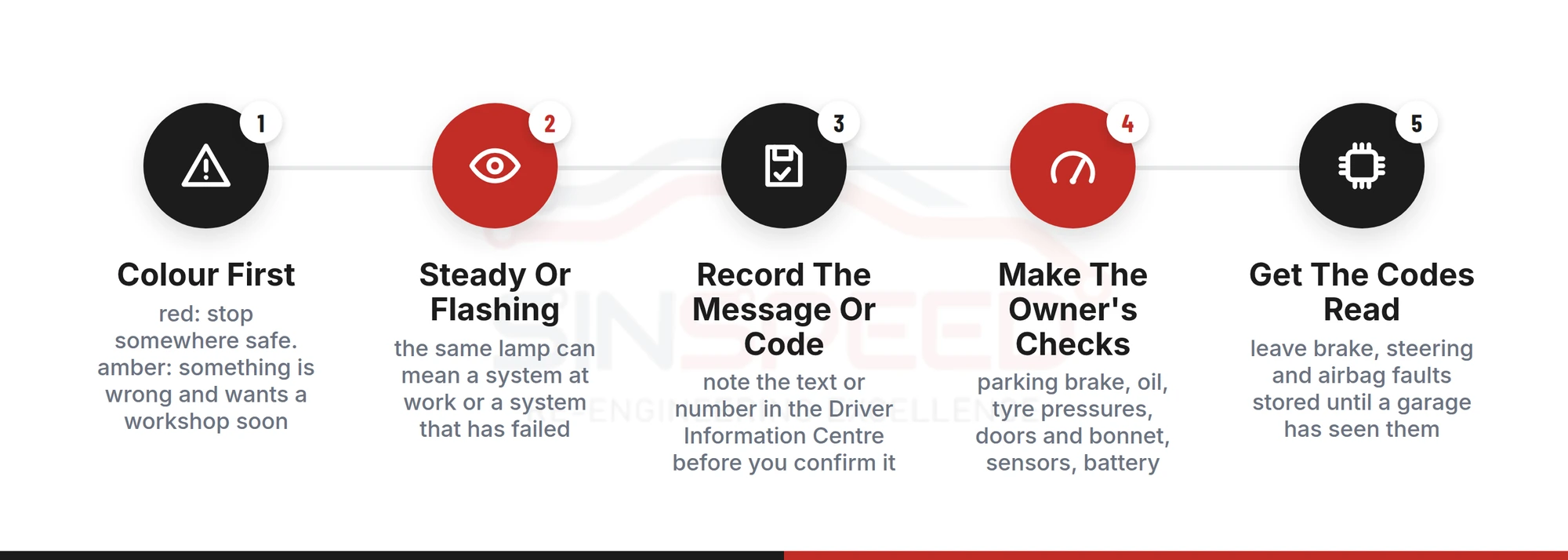
- Colour first. Red: stop somewhere safe. Yellow: something is wrong and wants a workshop soon.
- Then steady or flashing. The same Mokka lamp can mean a system at work or a system that has failed — and for tyre pressure, steady is the urgent state.
- Record the message or code. Note the text or number in the Driver Information Centre before you confirm it.
- Make the owner’s checks. Parking brake, oil level, tyre pressures, doors and bonnet, a dirty parking sensor, and the battery if the low-battery message has shown.
- Get the diagnostic codes read. Leave brake, steering and airbag faults stored until a garage has seen them; clearing them removes the evidence and mends nothing.
The general version is on our parent guide above, and our Vauxhall Corsa warning lights and Vauxhall Meriva warning lights pages cover other Vauxhalls you may have on the drive.
Vauxhall Mokka warning lights FAQs
What do the symbols on a Vauxhall Mokka dashboard mean?
Take the colour first, then whether it flashes. Red lamps on a Mokka — brake and clutch system, charging, oil pressure, airbag, seat belt and door open — mean stop or put it right before driving on. Yellow lamps report a fault or something needing attention, from ABS and power steering to tyre pressures and the particle filter. Green, blue and white lamps confirm that a system is on or working, including vehicle detected ahead and descent control. The table on this page gives each one a safe-to-drive verdict.
What does the yellow steering wheel light mean on a Vauxhall Mokka?
It is the power steering lamp. It should go out shortly after the engine starts; if it stays on or comes on while driving, the handbook describes a failure in the power steering system and says to seek a workshop. A Midlevel display may also show S68, Service power steering. The first-generation Mokka uses electric power steering, so there is no fluid to check. The car still steers, but it can take much more effort, so drive gently and have it looked at promptly, ruling out a weak battery first.
What does a code starting with S mean on a Mokka’s display?
On the Midlevel display, vehicle messages appear as numbers, and an S in front means “Service vehicle soon”. The number says what needs attention: S68 is the power steering, S73 the all-wheel drive system, S75 the air conditioning, S79 top up engine oil, S81 the transmission, S84 reduced engine power and S136 the parking assist. Vauxhall’s instruction for any S code is to seek a workshop immediately. Write the code down before you confirm it.
Why is the lane departure warning light yellow on my Mokka?
Because its colour and state tell you different things. Green means lane departure warning is switched on and ready. Flashing yellow means it has recognised an unintended lane change, which is the system warning you rather than a fault. Steady yellow is the fault: the handbook calls it a failure in the system and says to seek a workshop. Until it is put right, the car is not watching your lane position, so do not rely on it.
What does the flashing tyre pressure light mean on a Vauxhall Mokka?
Flashing is the less urgent state. It means a fault in the tyre pressure monitoring system, or a wheel without a sensor fitted, such as the spare; after 60 to 90 seconds the lamp stays on, and the handbook says to consult a workshop. A lamp that is steady from the moment it appears is the one to act on: it means pressure loss, and the handbook says stop immediately and check the tyres.
How do I clear the DPF light on a Vauxhall Mokka diesel?
By letting the filter clean itself. A steady particle filter lamp means the filter is full and should be cleaned as soon as possible: keep driving until the lamp goes out and, where you can, do not let engine speed fall below 2,000 rpm. A flashing lamp means the filter has reached its maximum and needs cleaning immediately to avoid engine damage. If the lamp keeps coming back, or will not clear on a suitable run, have the car diagnosed.
Do these warning lights apply to the new Vauxhall Mokka?
Not directly. This page follows the handbook for the first-generation Mokka and the Mokka X. The Mokka sold from 2021, including the Mokka Electric, is a different car with a digital instrument display, and its symbols and messages differ; the electric version has no oil pressure, preheating or particle filter lamps. Core warnings such as brakes, ABS, airbags and power steering follow familiar conventions, but check your own car’s handbook before acting on any lamp.
Sinspeed · repair and return
The car stays with your garage. The unit comes to us.Once the codes point at a unit — a steering column, an ABS unit, a cluster, a throttle body — your garage removes it and posts it in. We put it on the bench, reproduce the fault under simulated operating conditions, repair and calibrate it, and return it for refitting; any coding or calibration after fitting is simply part of the job. Most remanufactured parts carry a lifetime, unlimited-mileage warranty. Not sure yet? Send us the display code and the lamps first.
Cleanroom-standard workshop with ESD-safe benches · Dealer-level tools used to program and calibrate before dispatch
Final thoughts
A Mokka’s dashboard says more than most, because it carries lamps that describe systems at work as well as systems that have failed. The colour gets you most of the way. The rest is in whether the lamp is steady or flashing, and in the text or number beside it.
So treat a lamp as three facts rather than one: its colour, its state and its message. Note all three before you switch off or press SET/CLR, because that record is what turns a yellow steering wheel into S68, and S68 into a starting point a garage can act on. The lamps reporting a failing electronic unit will not improve with time. The ones describing a system at work need nothing from you at all, and knowing which is which is most of the job.