
Summary: On an automatic BMW Mini R50 or R52, the CVT’s transmission control unit is a common failure, and its signature is the car jumping into gear or picking the wrong one — worst on a cold morning, easing as the engine warms. Rough changes, warning lights, no drive and lost communication with the unit follow. We repair your own TCU by post, and it goes back plug and play, with no programming and a lifetime warranty.
This page covers one unit in one car: the Motorola-made TCU that runs the CVT in the first BMW-era Mini. For the other gearbox controllers we repair, see transmission control module repairs.
- The unit: the transmission control unit (TCU, also called the TCM or gearbox ECU) for the Mini’s continuously variable transmission
- The cars: BMW Mini R50 hatchback and R52 Convertible automatics, 1999–2006
- Signature fault: jumping into gear, or into the wrong one, mostly from cold
- Also seen: no gear at all, rough changes, dashboard warning lights, no communication
- What comes back: your own unit, plug and play, with no programming
- Warranty: lifetime
- What are the signs of a failing Mini CVT control unit?
- What does P1611 mean on a Mini CVT, and what else points to the TCU?
- Which Minis use this transmission control unit?
- Why does the TCU fail, and why is it taken for a worn CVT?
- Should you repair your own TCU or buy a replacement?
- From repair form to refit: how the postal repair runs
- Mini CVT TCU repair: questions owners ask
- Final thoughts
What are the signs of a failing Mini CVT control unit?
Owners tend to describe the same thing: a lurch. Drive is selected on a cold morning and the car jumps into gear with a thump, or engages something other than what the lever asked for. Once the engine has warmed up it may behave almost normally, which is exactly why the fault gets lived with until it gets worse.
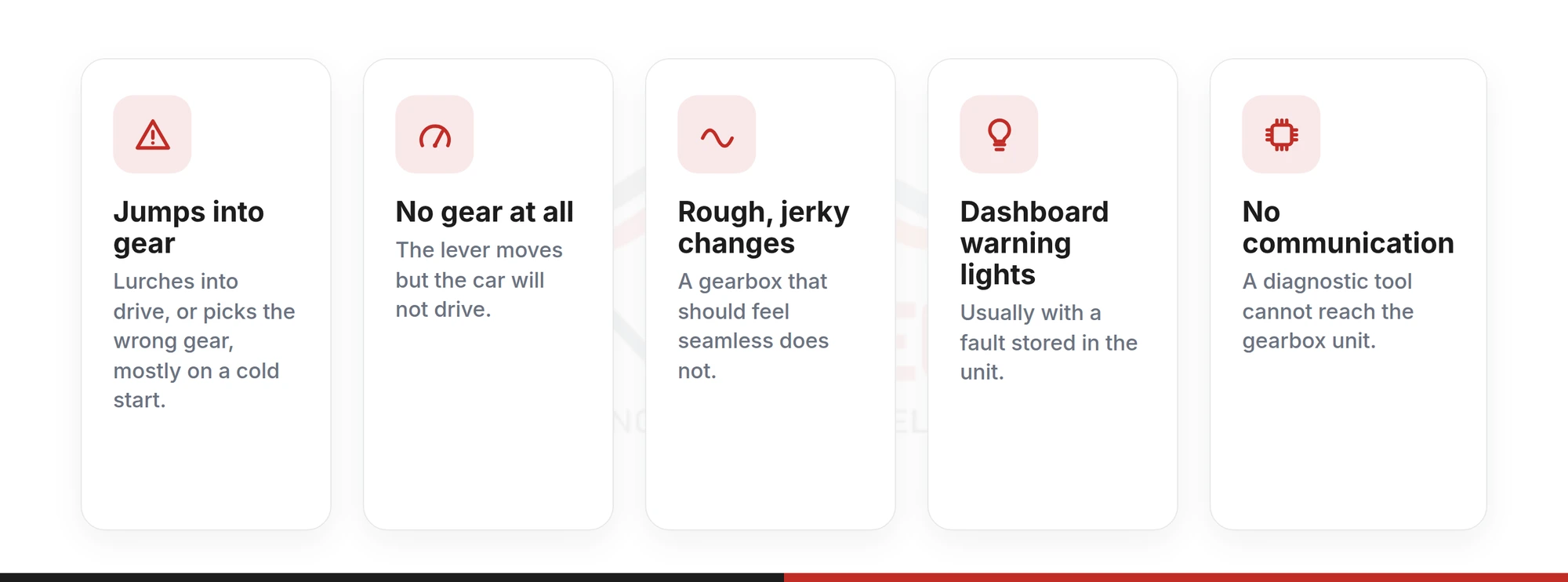
The complaints these units arrive with:
- Jumping into gear, or selecting the wrong one — most often while the engine is still cold
- No gear at all — the lever moves, but the car will not drive
- Rough, jerky changes from a gearbox that should feel seamless
- Warning lights on the dashboard, usually with a fault stored
- No communication — a diagnostic tool cannot reach the gearbox unit
A car that lunges forward when drive goes in is a hazard on a driveway or in a car park, not just an annoyance. Hold the brake firmly whenever you select a gear, and if engagement is unreliable, have the car checked before it goes back into daily use.
What does P1611 mean on a Mini CVT, and what else points to the TCU?
Two readings come up repeatedly on these cars. Each has its own row below, with what it means and where it points.
| Code or message | What it means | What it points to |
|---|---|---|
| P1611 | Serial communication link, transmission control module: the engine ECU has lost its data link with the TCU | The TCU’s supply, earth or wiring, or the TCU itself. Check the battery and connections first; if they are sound, the transmission unit is the next suspect |
| No communication with the transmission control unit | The diagnostic tool, or other units on the car, cannot talk to the TCU | Check the battery, earths and the TCU’s connector first; with a sound supply, the unit itself becomes the suspect |
An engine scan that shows nothing else does not clear the gearbox. The TCU keeps its own fault record, so write down everything it has stored — and whether the car was cold or warm when the problem appeared — before anything is cleared. Our guide to transmission control module fault codes covers reading gearbox codes more generally.
Sinspeed · Mini CVT control units
Tell us what it does from coldA few lines on how the car behaves at a cold start and once warm, any codes you have and the number on the TCU’s label are enough for us to say whether it reads as the control unit.
Tested under simulated heat, vibration and load · Plug and play at refit · Lifetime warranty on the repaired unit
Which Minis use this transmission control unit?
The unit is fitted to the automatic versions of the first BMW-built Mini: the R50 hatchback and the R52 Convertible, across the 1999–2006 range we list here. Manual cars have no TCU, and later Mini automatics use different gearboxes with their own control units.
The part number is printed on the label on the unit. Add it to the repair form and we will confirm the match before anything is posted. If your Mini falls outside this range, send the details anyway: we test and repair all types of TCU and TCM, and we will tell you what you have.
Why does the TCU fail, and why is it taken for a worn CVT?
Temperature and vibration wear it down. Every journey takes the unit from cold up to working temperature and back again, with drivetrain vibration running through it the whole way. Over many thousands of journeys, that is what ages an electronic unit — and the youngest of these cars was built in 2006.
Cold starts are where it shows. An ageing unit is at its least dependable when cold, and a cold morning is also when the battery is weakest and the voltage dip during cranking is deepest. The TCU makes its first engagement decision in exactly that window, so a marginal unit misjudges it then and settles as everything warms up.
Supply and moisture add to it. A tired battery or a poor earth starves the unit of the steady voltage it needs, and damp reaching the connector over many winters does the rest. Both are worth ruling out before the unit comes off.
The TCU gets overlooked because of the job it does. It decides when and how drive engages, so when its judgement slips, the gearbox simply carries out a bad instruction — and a lurch, a rough change or a refusal to drive all feel like a gearbox wearing out. CVTs have a reputation that makes that diagnosis easy to accept.
The CVT’s mechanical side can genuinely wear as well, and internal gearbox repair is a separate job from ours. That does not rule the TCU out. The unit is tested on its own, so you find out whether the control side is part of the fault before anyone commits to gearbox work.
Should you repair your own TCU or buy a replacement?
Once the TCU is confirmed as the fault, the real difference between the options shows up at refit.
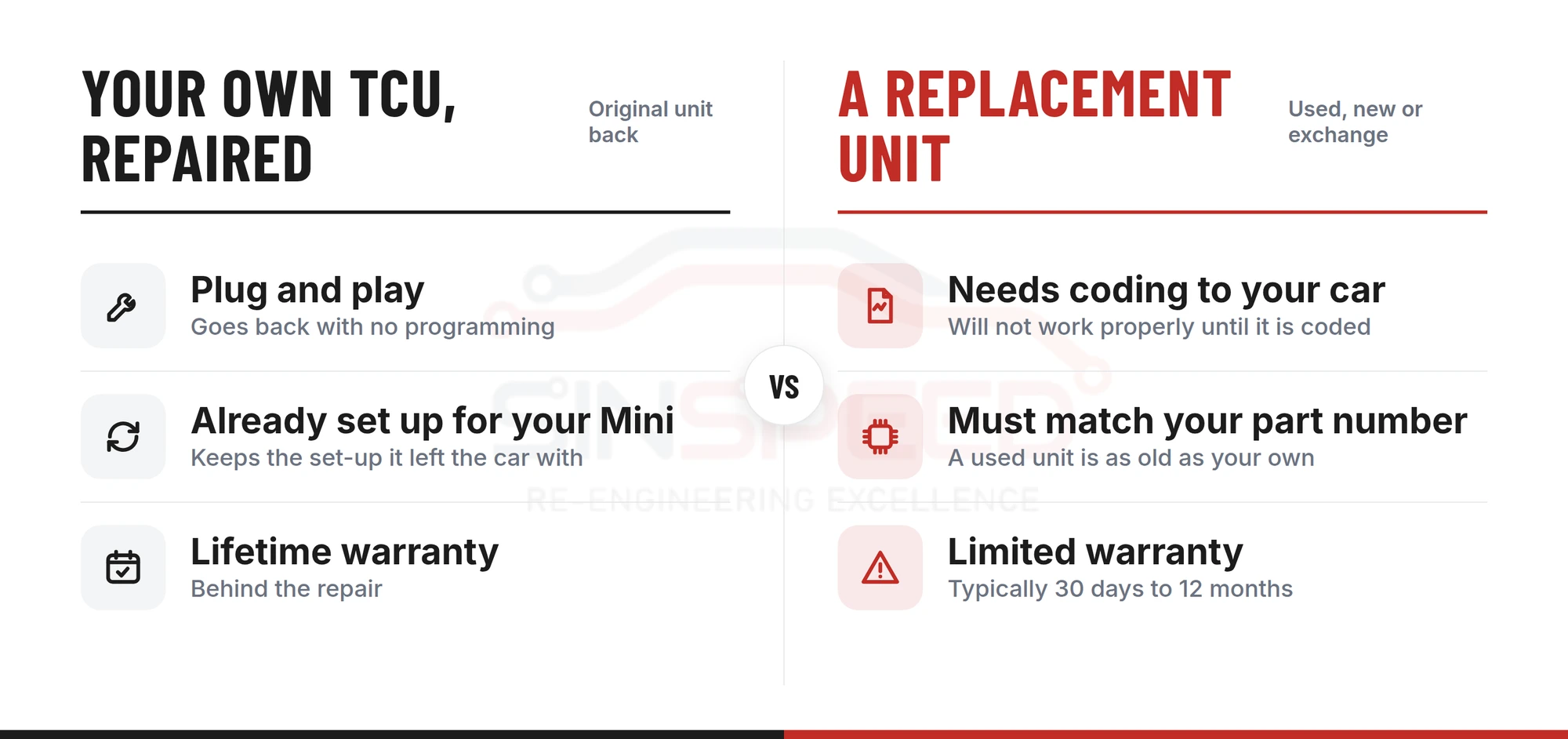
| Route | At refit | Warranty |
|---|---|---|
| Your own TCU, repaired by us | Plug and play — no programming | Lifetime |
| A used unit from another Mini | Needs coding to your car, and has to match your part number | Whatever the seller offers, on a unit as old as yours |
| A new or replacement unit | Needs coding to your car before it will work properly | Limited — typically between 30 days and 12 months |
Repairing the original means the car gets back the unit it left with, already set up for it, with a lifetime warranty behind the repair.
From repair form to refit: how the postal repair runs
Only the unit makes the journey. Your part is a short form and a parcel.
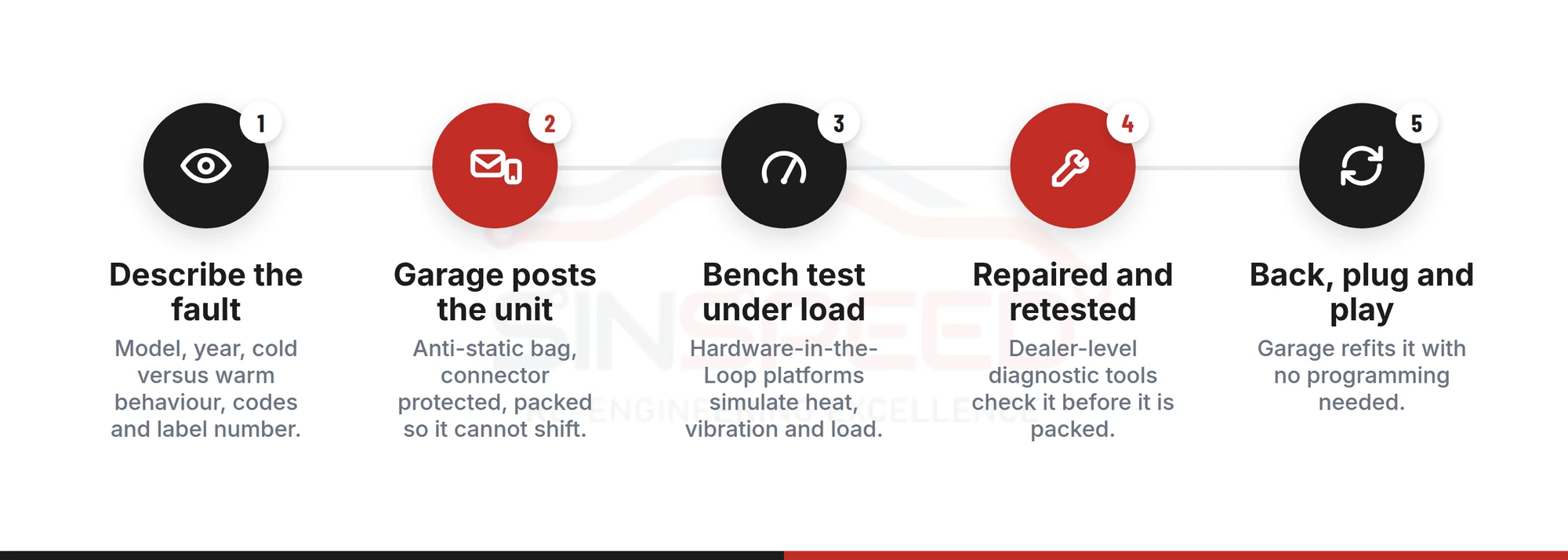
- Describe the car and the fault
The repair form asks for the model and year, what happens from cold and once warm, any stored codes and the number on the TCU’s label. If it sounds more like a battery or earth problem, we will say so before the unit comes out.
- Your garage takes the TCU out and posts it
Wrap the unit in an anti-static bag, keep the plug protected and pack it so it cannot shift in the box. If you would rather not arrange removal yourself, ask about our fitting service.
- Put through its paces on the bench
The unit is powered up and run on our in-house Hardware-in-the-Loop platforms, which simulate the heat, vibration and load it meets in the car, so a fault that only shows at certain temperatures can be reproduced away from the vehicle.
- Repaired and retested
Our engineers repair it using new genuine OEM components, to meet and exceed the original specification, and the unit is tested again with dealer-level diagnostic tools before it is packed.
- Back in, plug and play
Your garage refits the unit and clears the stored faults. No programming is needed; if the car asks for its gearbox adaptations to be reset, that is a routine fitting step.
Mini CVT TCU repair: questions owners ask
My Mini thumps into drive on cold mornings but is fine once warm. Is that the TCU?
It is the classic sign of a failing TCU on the R50 and R52 CVT. The unit decides how drive engages, and a tired one misjudges it most at a cold start, when the battery is also at its weakest. Rule out the battery and earths, have the transmission unit’s own memory read, then get the TCU tested.
What does P1611 mean on my Mini?
P1611 is logged as a serial communication fault with the transmission control module: the engine ECU has stopped hearing from the TCU. A weak battery, a poor earth or a wiring fault can cause it, so rule those out first. If they check out, the TCU itself is the likely cause, and that is the unit we test and repair.
My garage thinks the CVT itself is worn. Is the TCU still worth testing?
Yes. A misbehaving TCU produces the same lurches, rough changes and loss of drive that get blamed on gearbox wear. Because we test the unit on its own, you find out whether the control side is involved before any gearbox work is agreed.
Does a repaired TCU have to be programmed to my car?
No. It is your own unit, so it goes back plug and play with no programming. Replacement units are different: they need coding to the car and usually carry a limited warranty, typically between 30 days and 12 months.
Can you fit the unit as well as repair it?
Most owners have their own garage remove and refit it. If that is not convenient, we also offer a professional fitting service — contact us with the car’s details and location and we will talk it through.
Final thoughts
The cold-start lurch is the most useful clue a Mini CVT gives, because it points at the unit that makes the engagement decision rather than the gearbox that carries it out.
Before a gearbox is condemned, rule out the battery and earths, have the transmission unit’s own memory read, note what the car does cold against warm, and get the TCU tested on its own. If it proves to be the fault, your original unit goes back in plug and play, and the CVT it was misdirecting may have had plenty of life left in it.
Sinspeed · BMW Mini R50 and R52 automatics
Test the TCU before the CVT is written offTell us the car, how it behaves cold and warm, and the number on the unit’s label. We will reply with whether it looks like the control unit and how to get it to us.
Repaired with new genuine OEM components · Checked with dealer-level diagnostic tools · Your original unit, back in the same car