
Summary: When the ESP light stays on, the ESP button does nothing and a diagnostic scan shows C0040, C1301 or C1302, the usual cause on a Citroen, Peugeot or Renault is the brake pressure sensor built into the ATE Mk60 ABS pump. That sensor cannot be bought on its own, so the dealer route is a complete new pump carrying the same design. We remanufacture your unit with our own external brake pressure sensor, calibrated to it, so it self-calibrates on refit and carries a lifetime warranty.
This is one specific fault within our ABS pump and module repair service, and this page follows it from the first warning light to the refitted unit.
- Unit: ATE Mk60 ABS pump and later versions, with the brake pressure sensor built in
- Signs: ESP light or ESP button lit, the button has no effect, ABS light sometimes on too
- Codes: C0040, C1301 and C1302
- Makes: Citroen, Peugeot and Renault, with the same failure on many other makes
- Our repair: remanufactured with our own calibrated external brake pressure sensor
- Refit: self-calibrating, with no programming needed
- Warranty: lifetime
- What does the brake pressure sensor fault look like on the dashboard?
- Which fault codes point to the sensor inside the ABS pump?
- What does fault code C0040 mean on a Peugeot or Citroen?
- Why does the sensor inside a Mk60 unit fail when the old external ones rarely did?
- Which Citroen, Peugeot and Renault models and part numbers are affected?
- New, used or remanufactured: which option ends the fault?
- How does our pressure sensor repair work by post?
- Questions owners ask about the ESP pressure sensor fault
- Final thoughts
What does the brake pressure sensor fault look like on the dashboard?
The stability system is the first to object. The ESP warning lamp comes on and stays on — on most cars it is the amber car with skid marks trailing behind it — or the light in the ESP button stays lit. Pressing the button changes nothing, because the system has already taken itself offline.
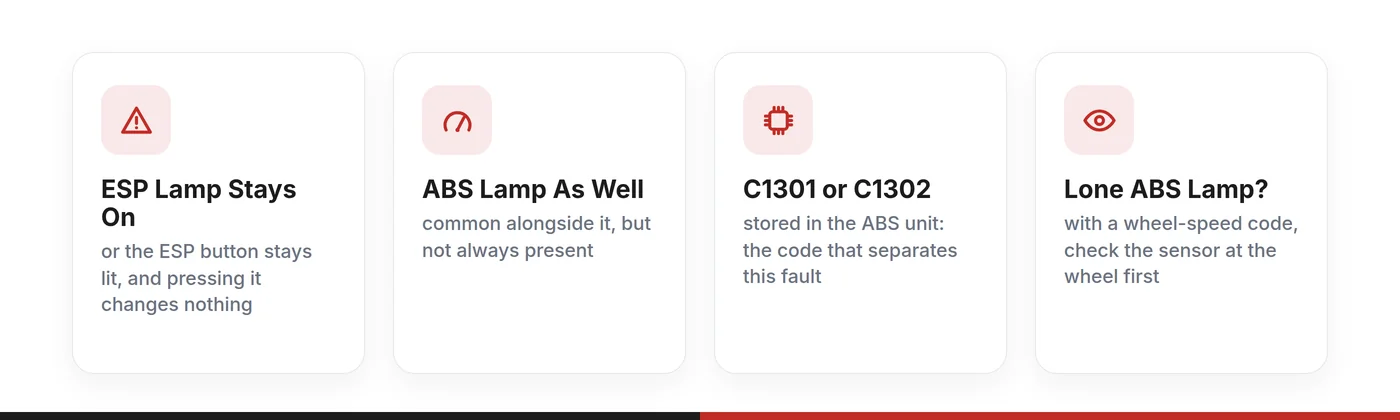
The ABS light may come on alongside it. Together the two lamps can look like a wider braking failure, but on these cars the combination very often traces back to a single sensor inside the ABS pump.
- ESP lamp or ESP button lit, button unresponsive. The signature of this fault, and the reason it is widely known as the ESP fault.
- ABS lamp lit as well. Common, but not always present.
- C1301 or C1302 stored in the ABS unit. The code is what separates this fault from others that light the same lamps.
- A lone ABS lamp with a wheel-speed sensor code. A different fault. A sensor at the wheel or its wiring is the likelier cause, and our wheel speed sensor guide covers it.
While ESP is off the car has no stability control, and with the ABS light lit the anti-lock assistance has gone too. Normal braking usually remains, so the car still stops, but the systems that step in on a wet road or in an emergency stop are not there. Have it checked promptly rather than living with the lights. Our guide to how an ABS pump works explains what the unit does when it is healthy.
Which fault codes point to the sensor inside the ABS pump?
A diagnostic machine plugged into an affected car will usually report one of three codes from the ABS unit. All three name the brake pressure sensor directly.
| Code | What the scanner reports | What it usually means on a Mk60 unit |
|---|---|---|
| C0040 | Brake pedal switch fault: coherence with the pressure sensor | The brake switch and the pressure reading disagree. When the switch and its wiring test good, the pressure sensor inside the pump is the usual cause, as with C1301. |
| C1301 | Incoherence between the brake light switch and the pressure sensor | The pressure the unit measures no longer agrees with the brake light switch. When the switch checks out, the internal sensor is the usual cause. |
| C1302 | Braking pressure sensor signal fault: open circuit, short circuit to positive, short circuit to earth | The sensor signal has gone out of range. On these units the sensor sits inside the pump, so the circuit being reported is inside the casing. |
All three codes read like a wiring or switch problem, and a sensible garage will look at the brake light switch and the connections first. That is reasonable and quick to rule out. When those are sound, the fault is inside the unit, and no amount of work on the car’s wiring will clear it.
The same internal-sensor failure logs under different codes on other makes: C1028 on Suzuki, and C0131 on Vauxhall and Opel. Those are covered on our Suzuki brake pressure sensor page and our Vauxhall and Opel brake pressure sensor page.
What does fault code C0040 mean on a Peugeot or Citroen?
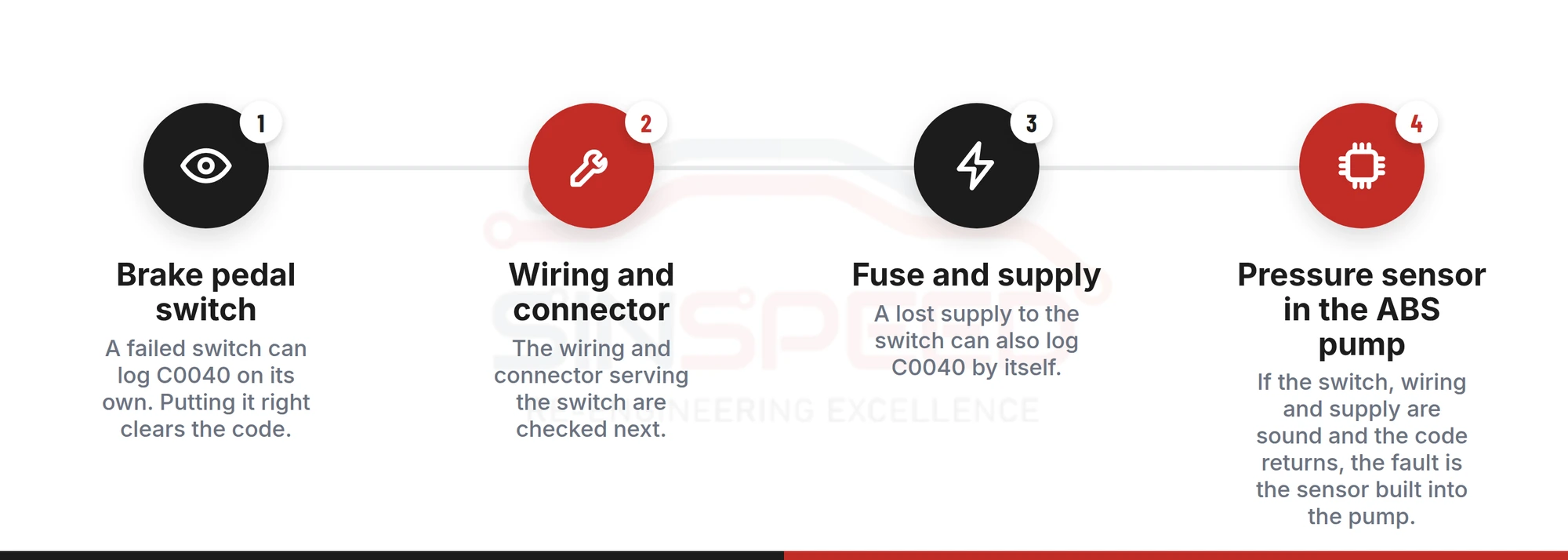
What C0040 means: On Peugeot and Citroen cars, C0040 is logged by the ABS unit as a brake pedal switch fault: coherence with the pressure sensor. The switch and the pressure reading no longer agree. When the switch and its wiring test good, the cause is usually the pressure sensor built into the ABS pump, the same failure behind C1301.
The code describes a disagreement, not a culprit. Each time the pedal goes down, the unit expects the brake switch to register the press and the pressure sensor to see the pressure rise with it. C0040 says the two have stopped telling the same story. It does not say which one is wrong.
That is why the switch end is checked first, and rightly so. Your garage will look at the brake pedal switch, the wiring and connector that serve it, and the fuse that supplies it. A failed switch or a lost supply can log C0040 on its own, and putting that right at the car clears it.
When the switch, its wiring and its supply are all sound and C0040 keeps coming back, the other half of the comparison is the one at fault. On these cars that is the pressure sensor inside the ABS pump, living with the same engine-bay heat, vibration and pressure pulses that lie behind C1301. It also explains a familiar pattern: a new brake switch goes in and the code returns, because no switch can correct a pressure reading that has drifted inside the pump.
From that point C0040 is handled exactly like C1301 and C1302. Your garage removes the pump and posts it to us in Epsom, the sensor fault is confirmed on our own test equipment before any work is done, and the unit is remanufactured with our external pressure sensor in place of the internal one.
Sinspeed · C0040, C1301 and C1302 on the scan
Before anyone orders a new ABS pumpA new unit puts the same internal sensor back in the car. Give us the code and the number on your unit, and we will confirm the remanufacture before it comes off.
Our own external pressure sensor, calibrated to your unit · Refits without programming
Why does the sensor inside a Mk60 unit fail when the old external ones rarely did?
Earlier ABS pumps did not have this weakness, because the brake pressure sensor lived outside them — mounted on the pump body, or near the brake master cylinder or servo. In that position it was far more reliable, and if one did fail it could be bought from a dealer or parts factor as a part in its own right.
The ATE Mk60 and the units that followed it moved the sensor inside the pump. It now shares a housing bolted to the hydraulic block in the engine bay, where it lives with engine heat, constant vibration and a pressure pulse every time the brakes are applied. It is a known manufacturing weakness, and on these units it is less a question of whether the sensor fails than when.
Building it in has two consequences. There is no longer a sensor to buy, so the dealer answer is a complete new ABS pump. And that new pump carries the same internal sensor as the one it replaces, so the same countdown starts again.
It also explains why the car reacts so strongly. The system relies on the pressure reading to judge how hard you are braking; when that reading stops making sense, it cannot trust its own stability calculations and switches ESP off. The hydraulics may be in good order, yet the dashboard behaves as though the braking system has a serious fault.
Which Citroen, Peugeot and Renault models and part numbers are affected?
These are the models we are most often contacted about with this fault. The list is not exhaustive: the Mk60 unit was fitted widely across all three makes, and across most other manufacturers too.
| Make | Models we see most often |
|---|---|
| Citroen | C2, C3, C4 |
| Peugeot | 1007, 206, 207 |
| Renault | Laguna II |
The model name only gets you so far. There are hundreds of part numbers across the Mk60 units fitted to these cars, and the number on your unit’s label is what identifies it. These are the numbers sent to us most often for repair or exchange, grouped by style so you can match your label quickly.
| Number style | Part numbers |
|---|---|
| ATE numbers (10.0206, 10.0399, 10.0960) | 10.0206-0014.4, 10.0206-0015.4, 10.0206-0168.4, 10.0206-0252.4, 10.0206-0253.4, 10.0206-0256.4, 10.0206-0315.4, 10.0206-0317.4, 10.0206-0328.4, 10.0206-0329.4, 10.0206-0334.4, 10.0206-0346.4, 10.0206-0383.4, 10.0399-2976.4, 10.0960-1169.3, 10.0960-1170.3, 10.0960-1173.3, 10.0960-1184.3, 10.0960-1185.3, 10.0960-1188.3, 10.0960-1191.3, 10.0960-1195.3, 10.0960-3920.3 |
| Citroen and Peugeot style (96… and short references) | 9648606980, 9661691380, 9662150480, 9662150780, 9662295580, 9662295780, 9662295880, 9663703280, 9663703380, 9663703980, 9663841580, 9664383580, 9665345380, 4542Z2, 5139E0 |
| Renault style (8200…) | 8200001333B, 8200001333C, 8200053422, 8200053423B, 8200053423C, 8200159837E, 8200183452B, 8200345940B, 8200345940C, 8200426953A, 8200426953B, 8200808145 |
| Other | 00401635C2 |
If your number is not listed, that does not mean we cannot repair it. Add it to the repair form, or ask us to check it before the unit comes off. For the rest of our ABS work on each make, see our Citroen ABS repairs, Peugeot ABS repairs and Renault ABS repairs.
New, used or remanufactured: which option ends the fault?
Once the code points at the sensor, you will normally be advised to replace the ABS pump. That advice is right about where the fault is, and less helpful about what happens next.
| Option | Internal sensor design | At refit | What to expect |
|---|---|---|---|
| New pump from the dealer | The same design as the failed unit | Programming to the car after fitting | The fault clears, but the same sensor is back inside the casing and can be expected to fail again |
| Used pump | The same design, with an unknown history | Coding to the car | A like-for-like part that may fail again soon, and its part number has to match first |
| Standard like-for-like rebuild | The same sensor design, renewed | Depends on who rebuilt it | Not a superseded part, so the design weakness stays |
| Sinspeed remanufacture | Internal sensor out of service; our own external sensor, calibrated to the unit | Self-calibrates, with no programming | Built to stop the internal-sensor failure coming back, and covered by a lifetime warranty |
The refit matters as much as the design. A replacement unit, new or used, arrives knowing nothing about your car and has to be programmed or coded to it, which takes equipment able to talk to the car at manufacturer level. Our remanufactured units self-calibrate to the vehicle they are fitted to — and that includes an exchange unit, if you would rather receive one of ours than send yours in.
We do not simply renew the sensor, because that would put the weakness straight back. The remanufacture takes the internal sensor out of the job altogether, which is why we can warranty the unit for life.
How does our pressure sensor repair work by post?
The ABS pump is the only thing that travels. Your garage removes it and posts it to our workshop, and the car stays where it is.
- Code and part number on the form
The repair form asks for the model, what the dashboard is showing, any C0040, C1301 or C1302 reading and the number on the unit’s label. If something does not add up, we say so before the unit is removed.
- Your garage lifts the unit out
The ABS pump comes off the car and is posted to us, packed so the ports and connector are protected.
- The fault is proved, not assumed
The unit is tested before any work starts, so the sensor fault is confirmed on our equipment rather than taken from the code alone.
- Remanufactured, calibrated, tested again
Our external brake pressure sensor is fitted and calibrated to the unit, which then goes onto our Hardware-in-the-Loop rig to be run under simulated heat, vibration and load.
- Back to the garage, ready to calibrate itself
It refits without programming. The brake lines were opened to remove it, so the garage bleeds the brakes and clears the stored codes as part of the refit.
The work is carried out in a cleanroom-standard, ESD-safe workshop by our own team of electronic and hydraulic engineers.
Questions owners ask about the ESP pressure sensor fault
Is it safe to keep driving with the ESP and ABS lights on?
Normal braking usually remains, so the car will still stop, but stability control is off and, with the ABS light lit, so is anti-lock assistance. Have it checked promptly rather than treating the lights as something to live with.
Can I replace just the brake pressure sensor?
Not on a Mk60 unit. The sensor is built into the ABS pump and is not sold as a separate part, which is why the dealer route is a complete new pump with the same design inside it.
Will the repaired ABS pump need programming?
No. Our remanufactured units self-calibrate to the car they are fitted to, and that applies to an exchange unit from us as well as to your own unit returned. Your garage bleeds the brakes and clears the stored codes on refit.
My part number is not on your list. Can you still repair it?
Very likely. There are hundreds of part numbers across the Mk60 units on these cars, and the list shows only the ones we see most. Put the number on the repair form, or contact us to check it first.
Is the pressure sensor fault only found on French cars?
No. It affects almost every make fitted with the Mk60 unit. It logs as C1028 on Suzuki and C0131 on Vauxhall and Opel, but the cause and the repair are the same.
What does C0040 mean on a Peugeot or Citroen?
The ABS unit logs C0040 as a brake pedal switch fault: coherence with the pressure sensor. The switch and the pressure reading disagree. A garage should test the switch, its wiring and its fuse first; when they are sound, the pressure sensor built into the ABS pump is the usual cause, the same failure that logs as C1301.
Is C0040 the same fault as C1301?
Both point at the agreement between the brake switch and the pressure sensor, and on these units the cause is usually the same internal sensor. Our remanufacture treats both the same way: the internal sensor comes out of service and our own calibrated external sensor takes over.
Can I keep driving with C0040 stored?
Normal braking usually remains, so the car will still stop, but ESP is usually switched off and, if the ABS light is lit, so is anti-lock assistance. Get it looked at soon rather than getting used to the warning lamps. Once the switch side has been ruled out, your garage can take the pump off and post it to us.
Final thoughts
The brake pressure sensor fault is not bad luck, and it is not a sign that the car has been neglected. It is the predictable result of putting a sensor where heat, vibration and constant pressure will eventually beat it.
That is why the answer that looks most complete, a brand-new pump, is the one most likely to bring you back to this page. The fix that lasts is the one that takes the weak point out of the design instead of renewing it.
Sinspeed · Mk60 pressure sensor repairs
End the ESP fault instead of resetting itTell us the car, the code and the number on the unit, and we will confirm the repair before anything comes off.
External pressure sensor in place of the internal one · Self-calibrating on refit · Lifetime warranty on the remanufactured unit