
Summary: A Land Rover Discovery 3 (L319, 2004 to 2009) whose instrument cluster cuts out, whose hazard lights flash on the move, whose display goes blank or which refuses to start often has a failing cluster rather than several separate faults. Your garage removes the cluster and posts it to us; we prove the fault on our bespoke Land Rover test equipment, repair it and return it with its recorded mileage unchanged, under a lifetime warranty.
This page is about the Discovery 3 and nothing else: what its cluster does, how it fails, the code that gives it away and how the repair reaches us. Every make we handle is gathered in our instrument cluster repair hub, and the Land Rover range sits under Land Rover instrument clusters.
- The unit: the instrument cluster of the Land Rover Discovery 3, model code L319
- Years: 2004 to 2009
- Faults we see: intermittent or total loss of the cluster, erratic gauges, no backlighting, a blank or pixelated display, non-start, and lights flashing on the move
- Code to note: U0155-87, lost communications with instrument cluster control
- How it reaches us: your garage takes it out and posts it; the Discovery stays where it is
- At refit: your own cluster keeps its recorded mileage
- Cover: lifetime warranty on every repaired cluster
What does the Discovery 3 instrument cluster do?
The cluster is the panel behind the steering wheel. It drives the speedometer, the fuel gauge and the other dials, lights the warning lamps, and runs the LCD display that carries messages and warnings. It also keeps the record of how far the Discovery has travelled, which becomes important the moment anyone suggests swapping it.
It is not a stand-alone gauge panel. The cluster exchanges messages with the Discovery’s other control units over the vehicle network. The clearest proof is the code that turns up when it fails: other modules log U0155-87, lost communications with instrument cluster control, because the cluster has stopped answering them.
That network role explains why a Discovery 3 cluster fault so often surfaces somewhere other than the dials. A failing cluster can take the hazard lights, the locks and the starting with it, which is why so many of these faults are first chased as something else.
What are the signs of a failing Discovery 3 cluster?
The signs fall into two groups. Some show on the cluster itself:
- The whole cluster switching off and back on, sometimes several times in one journey
- Gauges flicking or misreading, with the speedometer and fuel gauge often among the first to go
- No backlighting, so the dials disappear after dark
- A display that is blank or has dead pixels
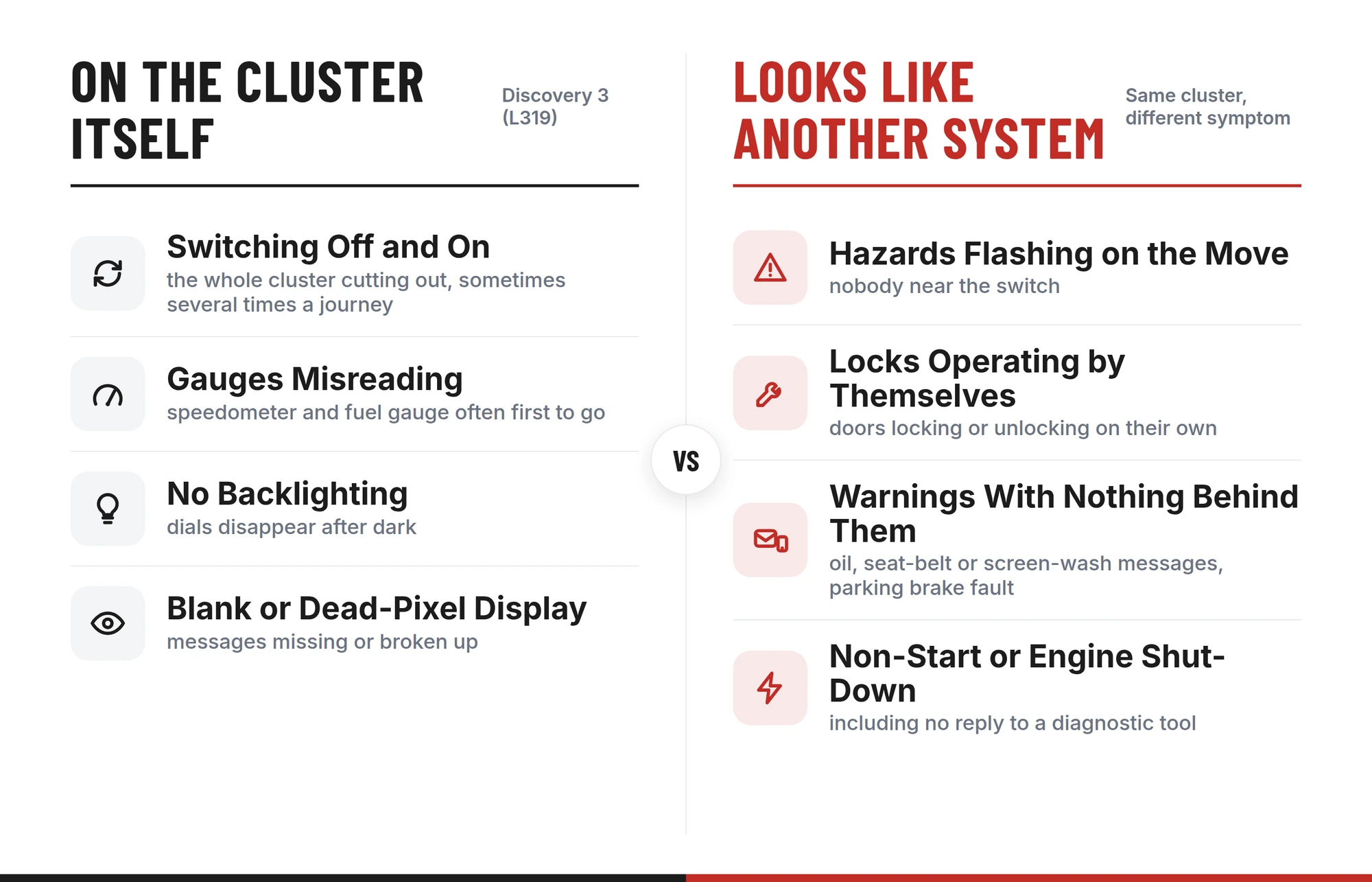
Others look as though they belong to a different system altogether:
- Hazard or dash lights flashing while you drive
- Doors locking or unlocking by themselves
- Warning lamps or messages with nothing behind them, such as an oil warning, a seat-belt warning or a low screen-wash message
- The radio or the heater blower cutting out on the move
- A parking brake fault message
- A car that will not start, or an engine that shuts down while driving
- No response from the cluster when a diagnostic tool tries to talk to it
Two things mark these out as one cluster fault rather than a string of separate failures. They tend to arrive together, and they come and go. A Discovery that flashes its hazards, loses the radio and then behaves itself after a restart is far more likely to have one failing unit than four.
Why are the dash lights flashing on my Discovery 3?
Dash lights flashing, or the hazards blinking on the move with nobody near the switch, is one of the recognised Discovery 3 cluster faults. It is also one of the most unsettling, because it looks like a lighting or wiring problem and sends people looking in the wrong place.
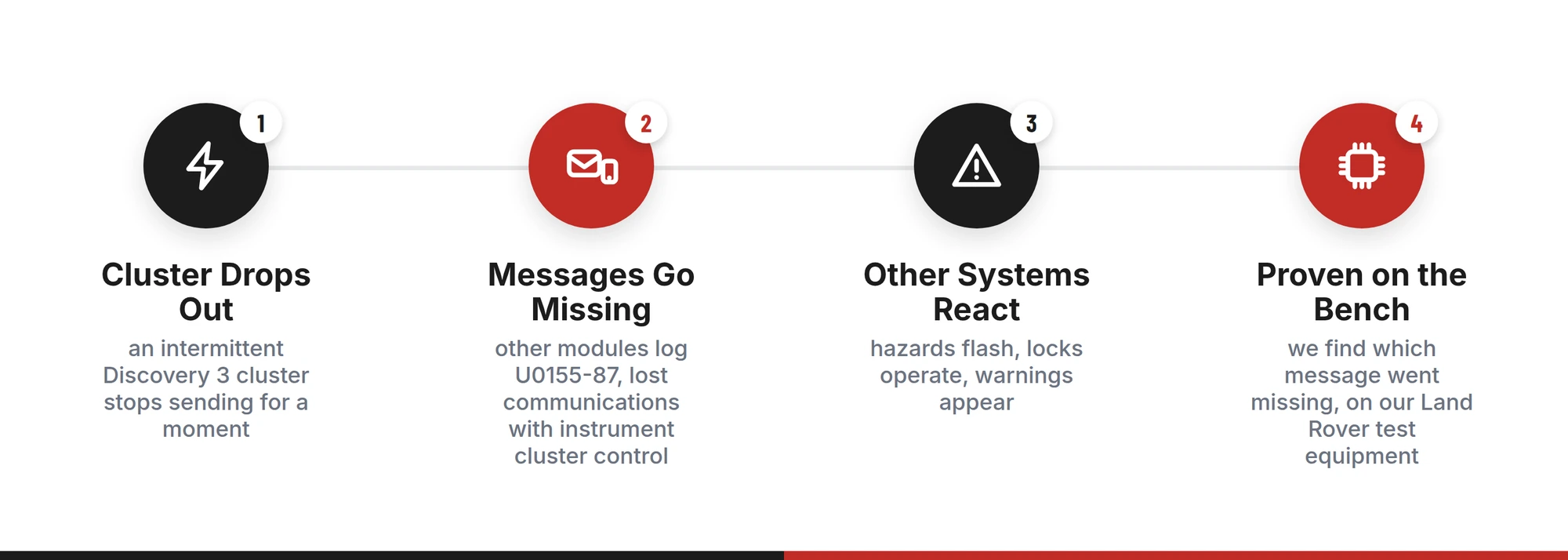
The likely mechanism is the network role described above. As an intermittent cluster drops out and comes back, the messages other systems expect from it are interrupted, and those systems can react in ways that seem unrelated: lamps flashing, locks operating, warnings appearing for no reason. From a description alone nobody can say which message went missing. On the bench, with the cluster under test, we can.
Before any bulb, switch or lighting module is replaced, it helps to note:
- When it happens: from cold, once the cabin is warm, over rough ground or at random
- What else misbehaves at the same moment: the display, the gauges, the locks or the radio
- Whether a restart clears it
Hazards flashing on a moving car can confuse other road users, so treat this as a fault to sort promptly rather than one to live with.
Which fault codes point to the Discovery 3 cluster?
The code most associated with these clusters is U0155-87, lost communications with instrument cluster control. It is logged by the modules that expect to hear from the cluster, so it can sit in the memory of a unit that is working perfectly while pointing at the one that is not.
A second clue needs no code at all. If the diagnostic tool can see the Discovery’s other modules but gets no reply from the cluster, the cluster, or the supply and wiring feeding it, is the place to look.
For the repair form, ask the garage for every stored code from every module, in the scan tool’s own wording, marked current or historic. A U0155-87 alongside a non-start or a parking brake message tells a much clearer story than a single code read in isolation, and the full set is what lets us judge whether the cluster is the unit to send.
Why do Discovery 3 instrument clusters fail?
Three conditions do most of the damage, and none of them is a sign of neglect.
Heat cycling. Each journey warms the cluster and each night cools it again. Across thousands of those cycles the electronics inside gradually lose their reliability, which is why so many faults begin intermittently, show up only from cold or only once warm, and get steadily worse.
Vibration. Plenty of Discovery 3s tow, cross fields or work on rough tracks as well as covering motorway miles, and every bump shakes the dashboard. Vibration adds to the strain heat has already put on the unit, and it is the reason some faults appear over rough ground and vanish on smooth tarmac.
Supply voltage. The cluster expects a steady supply. A weak battery, a charging fault or a poor earth exposes it to dips and spikes, which can make a healthy cluster flicker and reset, and can hurry along the failure of one that is already tired.
Is it the cluster, or something else on the Discovery?
Because so many of these symptoms belong to other systems on paper, a short round of checks makes sure the right unit reaches us.
- Battery and charging: a load test on the battery and a check of the charging voltage, since low or unstable voltage produces flickers, resets and odd warnings on its own
- Fuses and earths on the cluster’s supply
- A full code read across every module, saved or written down
- The cluster’s connector, for damage or a poor fit
- The part number from the cluster’s label
None of these is a reason to leave the cluster in the dashboard. If the checks come back clear and the faults carry on, or if they leave you unsure, send the cluster. Should our bench find it healthy, you will know before buying anything else, and we will tell you where we would look next.
Sinspeed · Land Rover clusters
Hazards flashing and a U0155 stored? Tell us what you havePut the registration, every stored code and the symptoms on the form, including the ones that seem to belong elsewhere. We will tell you whether the cluster is the unit to post.
Bespoke Land Rover cluster test equipment · Mail-in, UK-wide · Lifetime warranty on repaired clusters
Repair the cluster you have, or fit a used one?
A second-hand Discovery 3 cluster can look like the quick answer. The trouble starts once it is in the car.
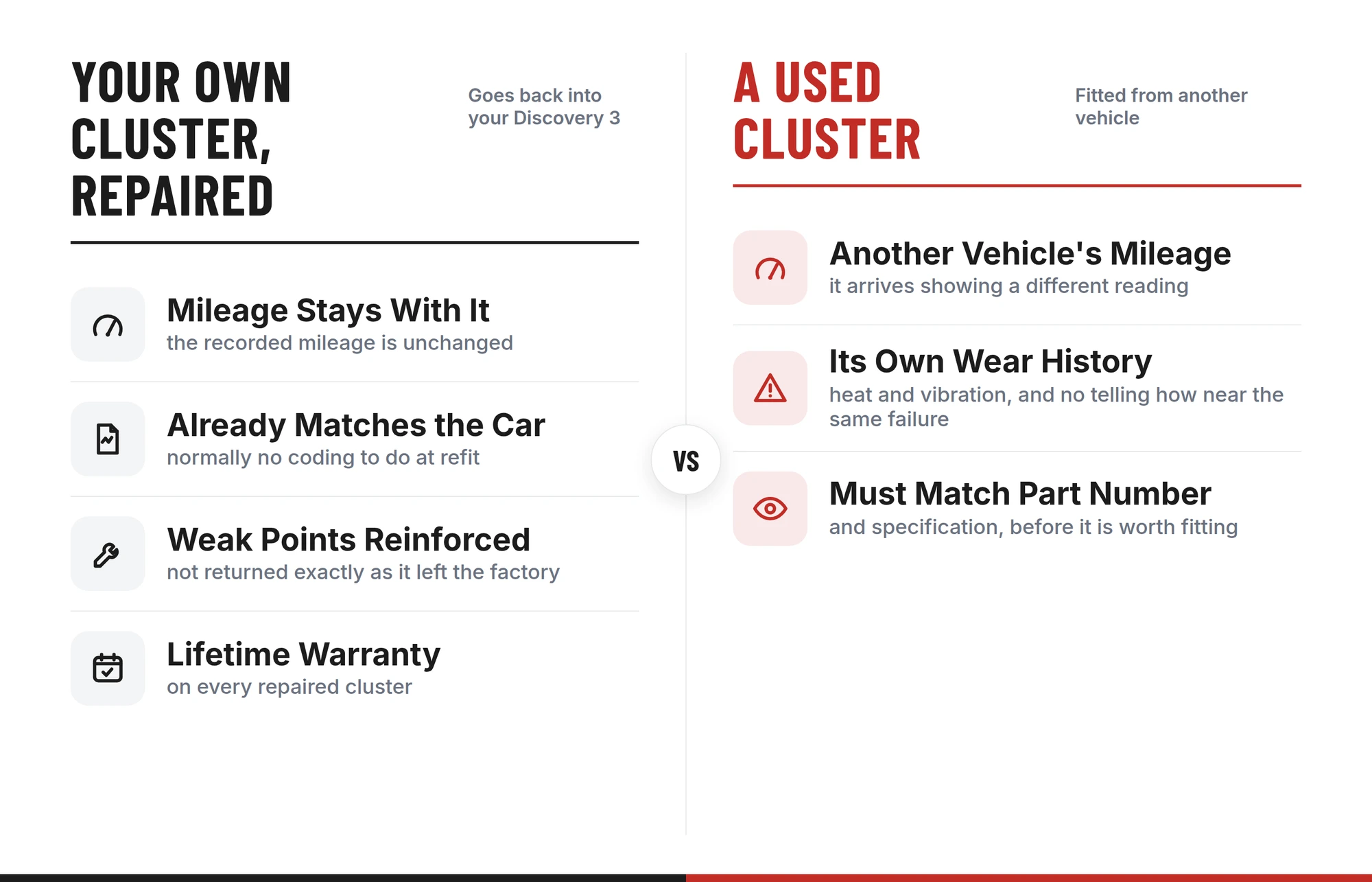
A used cluster arrives showing another vehicle’s mileage, carrying its own history of heat and vibration, and with no way of telling how close it is to the same failure. It also has to match your Discovery’s part number and specification before it is worth fitting at all.
Your own cluster, repaired, goes back into the car it came out of. The recorded mileage stays with it, it already matches the vehicle, and in normal circumstances there is no coding to do at refit. We also reinforce the weak points behind the failure rather than returning the unit exactly as it left the factory, so the repair does more than wind the same fault back to the start.
If anything does need setting after refit, it is a fitting step for the garage with dealer-level diagnostic equipment, not a reason to pick one route over the other.
Which cluster part numbers do we see?
Discovery 3 clusters do not all carry the same part number. The table lists the Land Rover cluster part numbers that come through our workshop most often. A number on the list is a unit we know well; it is not by itself proof that a cluster fits your car.
Read the number from your cluster’s label and give it to us with the registration. If yours is not in the table, send the details anyway and we will confirm the unit before anything is posted.
| Part Numbers | Part Numbers |
|---|---|
| YAH500190 | T050708 |
| YAC502588 | YAC502190 |
| YAH500190 | LR018481 |
| YAC502560 | CH1210849AF |
| YAC500028 | YAC500445 |
| 8H2210849BA | BH5210849ED |
| 6H5210849EH | AH5210849EB |
| BH1210849AA | YAC502910 |
| YAC500444 | 8H3210849PB |
| 6H5210849EE | YAC502460 |
| YAH500210 | 8H2210849DB |
| YAC500027 | YAC500026 |
| YAC502210 | 6H5210849ED |
| 6G5210849EG | YAC502780PUY |
| 6H5210849EG | YAC502240 |
| 9H5210849EA | YAC502130 |
| FH1210849AB | YAC502610 |
| 8H3210849VA | YAC500095 |
| YAC500025 | 8H3210849YA |
| YAC502630 | 9H5210849FA |
| YAC502930 | LR0026005M0C0 |
| YAC502590 | 7H1214C226AD |
| 6H5210849LE | 6H5214C226LC |
| YAC500046 | 8H2210849DA |
| YAC500023 | YAC502500 |
| YAC500465 | LR0030006KOCO |
| YAC500042 | LR0025001M0C0 |
| YAC502430 | YAC500434 |
| YAC500443 | LR0020002M0C0 |
| YAC502100 | LR0024001M0C0 |
| LR0019004K0C0 | BH5210849EF |
| YAC502070 | LR0022002MOCO |
| 8H3210849SA | 8H3210849PA |
| LR024301M0 | YAH500131 |
| LR0030005MOCO | BH5210849ED |
| 8H2210849BB | LR0028005MOCO |
| YAC502440 | BH1214C026AA |
| CH1210849AE | LR0025004KOCO |
| 6H5210849EF | YAC502090 |
| LR0024081M0C0 | 7H1210849AD8PUY |
| CH1210849BF | YAC500464 |
| LR0025002MOCO | LR0019009MOCO |
| AH5210849EA | LR0019002MOCO |
| LR0026009MOCO | LR0027906KO |
| 8H3210849TA | YAC500435 |
| LR0020001M0C0 | LR8024061M0C0 |
| LR0021011MOCO | 6H5210849FH |
| LR0019004KOCO | YAC500097 |
| LR0019002MOCO | LR0025009MOCO |
| BH5210849EE | LR0030005MOCO |
| LR0020004KOCO | 5H2210849TA |
| BH5210849FE | LR0021003MOCO |
| 6H5210849CE | LR0019004K0C0 |
| LR0022005M0C0 | YAC500045 |
How does the Discovery 3 cluster repair work by post?
We never need to see the Discovery. Your garage handles removal and refit; everything in between happens in our workshop.
- Describe the fault
Complete the repair form with the registration, the part number, every stored code and all the symptoms, including the hazards, locks or radio if they have been playing up.
- Your garage removes the cluster
They take the cluster out, pack it firmly with padding around the face and the connector, and enclose a note with your name and registration. The car stays with you or with them.
- The fault is proven first
On our bespoke Land Rover cluster test equipment and Hardware-in-the-Loop platforms, the cluster is powered and fed the signals it would see in the vehicle, under simulated heat, vibration and load. Every fault it shows is recorded before any repair begins.
- Repaired, then tested again
Our in-house engineers carry out the repair in a cleanroom-standard, ESD-safe workshop, reinforcing the weak points behind the failure. The full bench test then runs again, and the cluster is released only once the gauges, the lamps and the display have all passed.
- Back to your Discovery
It returns with its recorded mileage unchanged and covered by our lifetime warranty, ready for your garage to refit.
Which other Land Rover clusters do we repair?
The Discovery 3 is one of several Land Rover clusters we handle, and each has its own page. For other models, see Defender 2007-2016 instrument cluster repair, Range Rover 2005-2015 instrument cluster repair and Freelander 2 2006-2014 instrument cluster repair.
Discovery 3 instrument cluster: FAQs
Sinspeed · Discovery 3 cluster repair
One cluster, already matched to your DiscoveryYour garage sends us the unit. We prove the fault, repair it and send it back with the mileage it left with.
In-house engineers · Cleanroom-standard, ESD-safe workshop · Tested under simulated heat, vibration and load
Final thoughts
A Discovery 3 that flashes its hazards, locks its own doors and then refuses to start looks like a car with several faults at once. The cause is frequently a single unit: the cluster, dropping off the network and taking other systems with it.
Read every code, rule out the battery, and let the bench settle it. If the cluster is to blame, the one already matched to your Discovery can be repaired and refitted, mileage and all.