
Summary: On a front-wheel-drive Audi A4 or A6 built between 2001 and 2005, a failing Multitronic transmission control module shows itself as a lit or flashing gear-selector display, stored codes for implausible sensor or selector signals, and a car that drives badly — or, at worst, will not come out of Park. Because the codes name a sensor rather than the module, it is often blamed on something else. We repair the original module by post, so it goes back with its own coding and a lifetime warranty.
This page deals with one unit only: the Multitronic CVT control module in the 2001–2005 A4 and A6. The broader picture — Multitronic, DSG and CVT controllers across Audi, SEAT, Škoda and Volkswagen — is on our Multitronic, DSG and CVT transmission controller repairs page, and every gearbox control unit we work on is listed under transmission control module repairs.
- The unit: the transmission control module for the Multitronic CVT (continuously variable transmission)
- The cars: Audi A4 and A6, 2001–2005, front-wheel drive; quattro versions were fitted with a different module
- Part numbers: mostly the 01J 927 156 series, plus 8E0 910 155 F
- Typical faults: selector display lit or flashing, implausible-signal codes, poor driveability, stuck in Park
- What comes back: your own module, repaired and tested, still carrying its coding
- Warranty: lifetime, with no mileage limit
- What does a failing Multitronic module do to an A4 or A6?
- Multitronic or S tronic: which gearbox does your Audi have?
- Which fault codes does the A4/A6 Multitronic module store?
- Which A4 and A6 cars and part numbers does this cover?
- Why does the module fail, and why does it pass for a sensor or gearbox fault?
- Is it better to repair the module or fit another one?
- How does the mail-in repair work?
- Audi A4 and A6 Multitronic module: your questions
- Final thoughts
What does a failing Multitronic module do to an A4 or A6?
Most owners see it on the dashboard before they feel it. The gear-selector strip in the instrument cluster — P, R, N, D — lights up or starts to flash, and the car stops driving the way it used to. The module is the unit that decides the CVT’s ratio from moment to moment, so when it falters, every part of the drive feels it. Our explainer on what a transmission control module does covers that job in general terms.
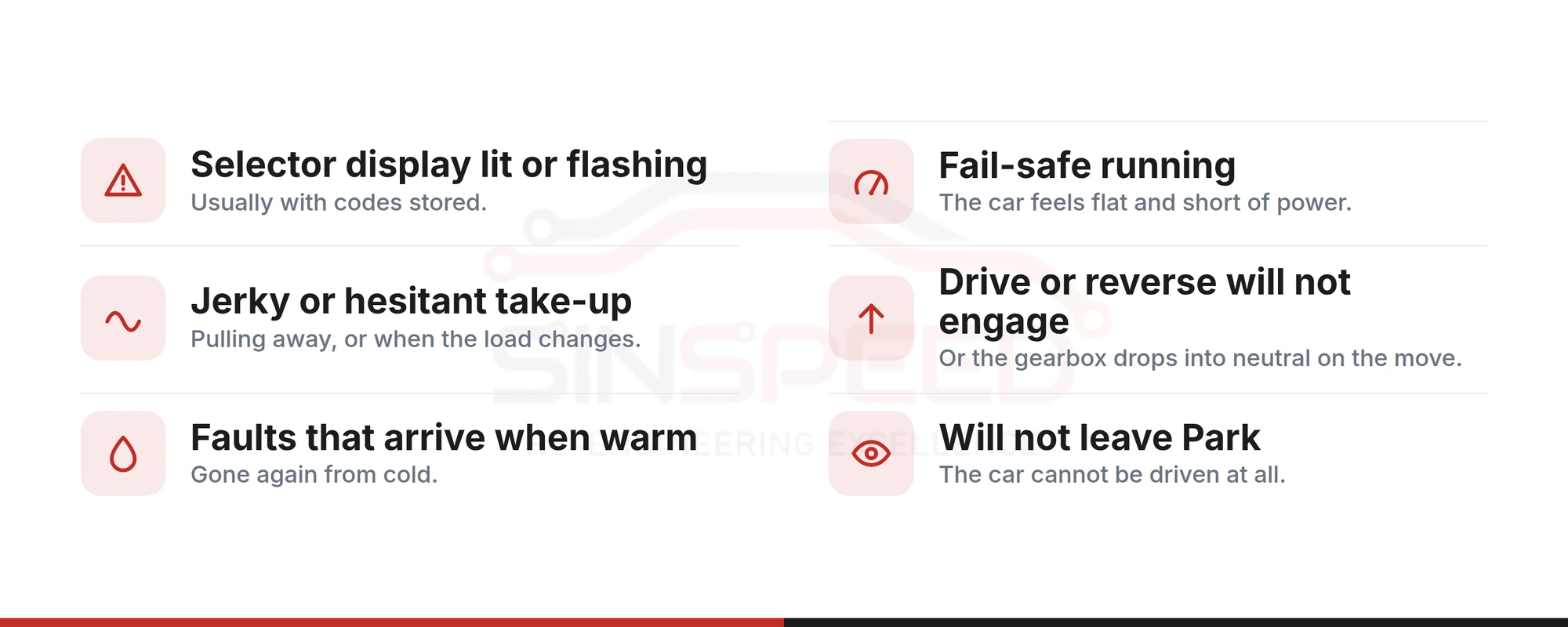
These are the complaints A4 and A6 Multitronic modules arrive with:
- Selector display lit or flashing in the instrument cluster, usually with codes stored
- Fail-safe running — the gearbox protects itself and the car feels flat and short of power
- Jerky or hesitant take-up when pulling away or when the load changes
- Drive or reverse refusing to engage, or the gearbox dropping into neutral on the move
- Faults that arrive once the car is warm and are gone again from cold
- The selector will not leave Park, and the car cannot be driven at all
Several of these are safety matters rather than annoyances. A car that loses drive pulling out of a junction, or slips into neutral in traffic, needs to come off the road. If the display is flashing, drive gently to wherever the car will be checked and do not carry on using it in fail-safe.
Multitronic or S tronic: which gearbox does your Audi have?
Audi has sold two quite different automatic gearboxes under names that are easy to mix up, and what goes wrong with one tells you little about the other. The 2001–2005 front-wheel-drive A4 and A6 covered here use Multitronic.
Multitronic is a CVT. Audi introduced it in late 1999, first in the European A6. In place of a set of gears it uses a steel link-plate chain, so the ratio between engine and wheels can vary continuously across its range instead of jumping from one gear to the next. Electronics choose that ratio from moment to moment, working from the driver’s use of the throttle, the driving conditions and the engine load.
S tronic is a dual-clutch gearbox. It is Audi’s version of the Volkswagen Group’s DSG: in effect two manual gearboxes, each with its own clutch, sharing one housing and operated electronically. It has fixed gears, and the two clutches let it change between them quickly. A seven-speed longitudinal S tronic went into series production in late 2008, and Audi has since dropped Multitronic in favour of dual-clutch gearboxes.
Telling them apart from the driver’s seat. Left in D, a Multitronic has no gear changes to feel — the ratio simply alters underneath you without steps. An S tronic works its way up and down through distinct gears, each change brisk but there. Multitronic does offer a handful of pre-set ratios when the lever or paddles are used manually, so judge it in D.
Why the difference matters. A chain-driven CVT and a dual-clutch gearbox are built and run in different ways, so they fail in different ways and call for different repairs; a diagnosis made for one cannot be borrowed for the other. On a Multitronic A4 or A6 from these years, the control module is the unit setting every ratio, and it is the one this page is about. We put it on the bench and prove the fault before any work begins, our engineers carry out the repair, and it comes back to you as your own module with its coding still in place.
Which fault codes does the A4/A6 Multitronic module store?
The codes a failing module leaves are about the signals it reads: implausible readings from its sensors, or from the gear selector itself. The table below lists the input, supply and ratio codes from our own Multitronic records. Record every code before anything is cleared, and note whether the car was hot or cold when the fault appeared.
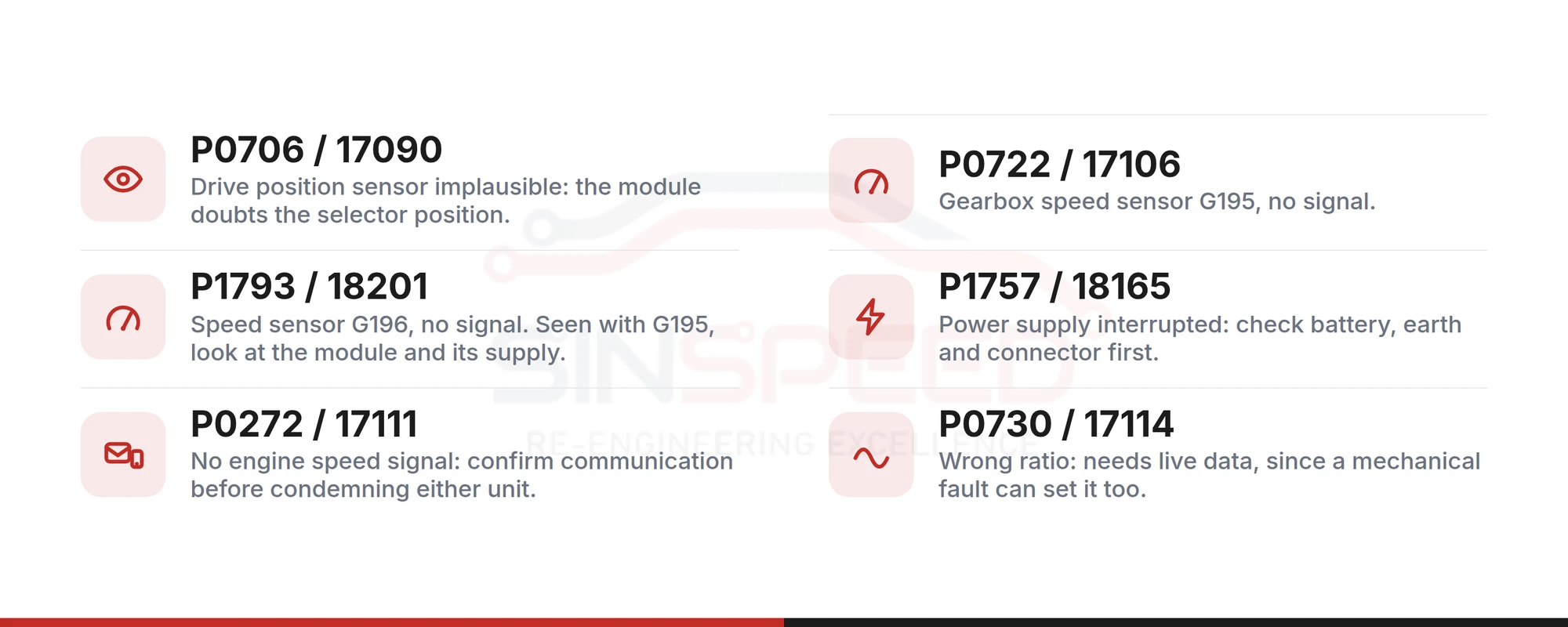
| VAG code | OBD code | What the scan tool reports | What to take from it |
|---|---|---|---|
| 17090 | P0706 | Drive position sensor (F125), signal implausible | The module doubts the selector position it is reading — a code that fits a flashing display or a car reluctant to leave Park |
| 17106 | P0722 | Gearbox speed sensor (G195), no signal | An output-speed reading has gone missing as far as the module is concerned |
| 18201 | P1793 | Gearbox speed sensor 2 (G196), no signal | The second output-speed reading; logged together with G195, look at what the two share — the module and its supply — before two sensors |
| 18165 | P1757 | Power supply, interruption | The module’s own supply dropped out; check the battery, earth and connector, then the module |
| 17111 | P0272 | Engine speed signal from the engine ECU, no signal | An input from the engine side is not arriving; confirm the communication before condemning either unit |
| 17114 | P0730 | Transmission monitoring, wrong ratio | The ratio the module sees does not match the one it asked for; needs live data, because a mechanical fault can set it too |
Keep one thing in mind when reading these. Each code is the module’s own verdict on a signal, so a module that is misreading a healthy sensor writes exactly the same code as a sensor that has failed. For reading gearbox codes more widely, see our guide to transmission control module fault codes.
Sinspeed · Multitronic control units
Send the codes before you buy a sensorGive us the stored codes, the number on the module’s label and a line on how the car behaves hot and cold. We will tell you whether it reads as the module before anything is removed or ordered.
Heat, vibration and load simulated on our own test platforms · Original coding left in place · Lifetime warranty with no mileage limit
Which A4 and A6 cars and part numbers does this cover?
This module is fitted to the Audi A4 and A6 with the Multitronic CVT, built between 2001 and 2005. It applies to the front-wheel-drive cars only. Quattro versions of the same models were fitted with a different module and do not carry the same faults — if yours is a quattro, send us the number from its unit and we will tell you what you have.
The part number is printed on the label on the module itself. These are the numbers that fail most often:
| Common A4 and A6 Multitronic module part numbers | ||
|---|---|---|
| 01J 927 156 AH | 01J 927 156 BG | 01J 927 156 CG |
| 01J 927 156 CN | 01J 927 156 DB | 01J 927 156 FH |
| 01J 927 156 FK | 01J 927 156 GN | 01J 927 156 HH |
| 01J 927 156 HN | 01J 927 156 HF | 01J 927 156 HT |
| 01J 927 156 JJ | 01J 927 156 JK | 8E0 910 155 F |
We repair all known part numbers for this module, so a number missing from the table is a question for us, not a refusal. Add it to the repair form and we will confirm it before you post anything.
Why does the module fail, and why does it pass for a sensor or gearbox fault?
Heat and vibration do most of the damage. The module is mounted on the gearbox, so every journey takes it from cold up to the gearbox’s working temperature and back down again, with drivetrain vibration running through it the whole time. Repeated over thousands of journeys, that is what wears an electronic unit out — and it is why the early faults come and go with temperature before they settle in for good.
Supply voltage matters more than it looks. A tired battery, a poor earth or the dip while the engine cranks all reach the module. It needs a steady supply to judge its sensors accurately, and a marginal one produces exactly the implausible readings these cars log.
Moisture and age finish the list. Damp reaching the connector over many winters takes its toll, and so does simple age: the youngest of these cars left the factory in 2005.
The reason the module gets missed is its job. It is the unit that judges every signal, so when its own judgement goes, the code it writes names the sensor or the selector rather than itself. The selector switch is replaced, then a speed sensor, and the display carries on flashing. A CVT that is sluggish, loses reverse or sits in fail-safe also feels like a gearbox on its way out, and a module fault can end up treated as grounds for a replacement transmission.
The mechanical side of a Multitronic can genuinely wear, and internal gearbox work is outside what we do. But the module can be tested on its own, away from the car, so it is the part to rule in or out first.
Is it better to repair the module or fit another one?
Once the module is confirmed as the fault, there are three ways to go. What separates them is what happens when the unit goes back on the car.
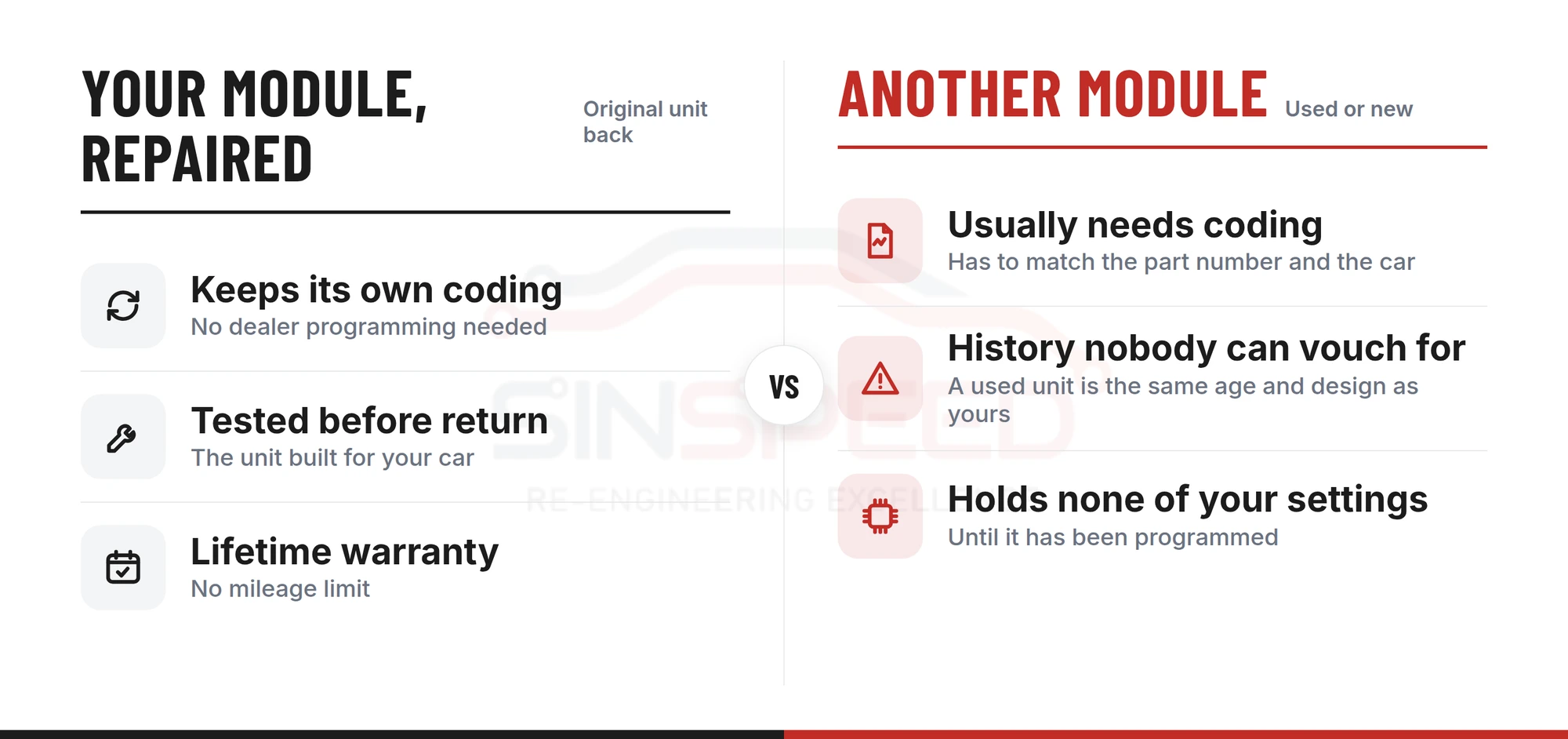
| Route | At refit | What you end up with |
|---|---|---|
| Your module, repaired by us | Goes back on with its own coding — no dealer programming needed | The unit built for your car, tested before return, with a lifetime warranty |
| A used module from another car | Usually needs coding, and has to match your part number | A unit of the same design and age as yours, with a history nobody can vouch for |
| A new module | Needs coding to the car before it works properly | A unit holding none of your car’s settings until it has been programmed |
Repairing the original keeps the coding and the settings it already holds for your A4 or A6, which is why it can go straight back on. That is the whole case for the repair: the car gets back the unit it was built with, working again.
How does the mail-in repair work?
The car stays put and only the module travels. From your side it is a form and a parcel.
- Tell us about the car and its codes
The repair form asks for the model and year, the part number from the module’s label, every stored code and what the car is doing. If the picture points at the battery, an earth or the wiring instead, we say so before the module comes off.
- Your garage removes it and sends it in
Because the module sits on the gearbox, removal is a job for your garage, and the car stays with them meanwhile. Bag it against static, protect the connector and pad it so it cannot move in the box. If you have no garage to hand, ask us about fitting.
- We make the fault show itself
The module is powered on the bench and fed the signals it would read in the car, then run on our in-house Hardware-in-the-Loop platforms, which simulate heat, vibration and load. That is how a fault that only appears on a warm car is brought out on a bench.
- Repaired, then tested again
Our own engineers carry out the repair, and the module goes back through the same testing, using dealer-level diagnostic tools, before it is packed.
- Refitted as it came off
Your module returns ready to fit, with its coding untouched. Your garage refits it and clears the stored codes; any adaptation the car asks for is a normal part of refitting.
Audi A4 and A6 Multitronic module: your questions
My A4 will not come out of Park. Could that be the Multitronic module?
Yes. A car stuck in Park is the most severe fault these modules cause, and it usually comes with the selector display lit or flashing. Have the codes read first — a selector-position or power-supply code alongside it points towards the module.
The code says a sensor signal is implausible. Should I replace the sensor first?
Not automatically. The code is the module’s own judgement of the signal, so a failing module can report a healthy sensor as implausible. If several sensor codes appear together, or a new sensor changes nothing, the module is the likelier cause.
Will the repaired module need coding when it goes back on?
No. It is your own module, so it keeps the coding it had. Your garage refits it and clears the stored codes. A used or new module is different and usually has to be coded to the car.
Does this cover the quattro versions of the A4 and A6?
This page covers the front-wheel-drive Multitronic cars. Quattro versions were fitted with a different module that does not share these faults. Send us the number from the unit on your car and we will tell you what it is.
Can you fit the module for me?
Most owners have their own garage remove and refit it, since the module sits on the gearbox. Fitting is also available — contact us with the car’s details and where it is, and we will talk it through.
My part number is not in your table. Can you still repair it?
Very likely. The table shows the numbers that fail most often, and we repair all known part numbers for this module. Add yours to the repair form and we will confirm it before you post the unit.
Final thoughts
The A4 and A6 Multitronic module is easy to overlook because it never names itself. It reports a sensor, a selector or a ratio problem, and the obvious response is to replace whatever it named — or, when the car barely drives, to start looking at replacement gearboxes.
Work the other way round. Write down every stored code, read the part number off the module’s label and have the module tested on its own before anything else is bought. If it is the fault, your own unit goes back on with its coding untouched, and the gearbox it controls may never have been the problem.
Sinspeed · Audi A4 and A6 CVT
Get the module checked before the gearbox is blamedTell us the car, the codes and the number on the label. We will confirm whether we can take the unit and what your garage needs to remove.
Tested and calibrated with dealer-level diagnostic tools · Repaired by in-house electronic engineers · Returned ready to refit