
Summary: A Ford Transit BCM fault usually shows as body electrics failing in combination: central locking that turns erratic, exterior lights or indicators out, wipers ignoring the stalk, heater functions dropping out and a battery that goes flat while the van is parked, often with lost-communication faults in other modules. On the Mk8 2.0L diesel, your garage removes the body control module and posts it to us; we repair the van’s own unit, and it goes back holding its configuration and immobiliser data, with a lifetime warranty.
This page is for owners, fleet managers and garages looking at that pattern on a Transit. It covers the symptoms and what a scan usually shows, the faults to clear before the module comes out, why a working van’s BCM fails, and how repairing the original compares with fitting another. Other vehicles are on our body control module repair hub.
- The unit: the body control module (BCM), which runs the Transit’s locking, lighting, wipers, windows and comfort functions
- Typical faults: erratic locking, lights or indicators out, wipers or heater dropping out, a battery flat after standing, lost-communication codes
- Listed fitment: Ford Transit Mk8 2.0L diesel, 2016 to 2024; other Transits confirmed by the label number
- How it reaches us: by post, once your garage has taken it out
- At refit: the van’s own configuration and immobiliser data kept, so replacement coding is not normally needed
- Cover: lifetime, unlimited-mileage warranty on the repaired module
- What are the signs of a Ford Transit BCM fault?
- What does the BCM do on a Transit Mk8?
- What does a scan show when a Transit BCM fails?
- What should be ruled out before the BCM is blamed?
- Why do Transit BCMs fail on working vans?
- Which Transit does this repair cover?
- Repair the Transit’s own BCM or fit another?
- How does our by-post Transit BCM repair work?
- Transit BCM fault FAQs
- Final thoughts
What are the signs of a Ford Transit BCM fault?
The giveaway is breadth. The BCM sits behind most of the Transit’s body electrics, so its faults seldom stay on one circuit. These are the symptoms listed for Mk8 units, and two or more together is what makes the module worth suspecting.
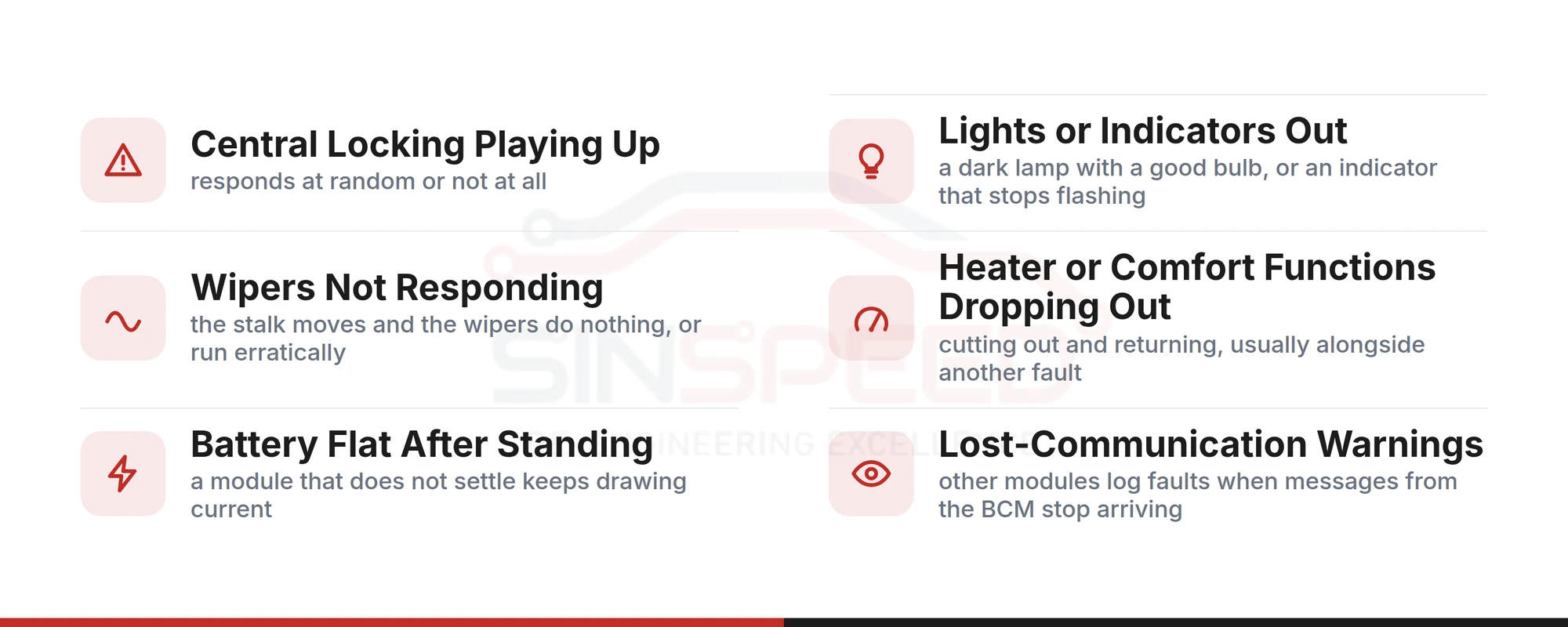
- Central locking playing up. Locking that responds at random or not at all, often blamed first on the fob battery.
- Lights or indicators out. A lamp stays dark with a good bulb in it, or an indicator stops flashing, and the fault may come and go with nothing changed.
- Wipers not responding. The stalk moves and the wipers do nothing, or they run erratically. In rain that is a safety problem before it is an electrical one.
- Heater or comfort functions dropping out. Functions the BCM switches cut out and return, usually alongside one of the faults above.
- Battery flat after standing. A module that does not settle when the van is locked keeps drawing current, and a new battery soon goes flat the same way.
- Warnings and lost-communication codes. Other modules store faults because messages from the BCM have stopped arriving properly.
Intermittent behaviour is typical: a fault shows on one run and is gone by the next, so vans carry on with a glitch until several arrive together.
The Transit’s BCM also holds immobiliser data, so a starting complaint that arrives with body faults belongs on the repair form. The simplest link between the two is a battery drained by a module that would not sleep.
Lights, indicators and wipers come first. A fault that has reached any of them makes the van a hazard on the road, so keep it parked until the module or its cause is put right.
What does the BCM do on a Transit Mk8?
On the Mk8, the BCM takes requests from the switches, stalks and key fob and turns them into actions. It runs the central locking, exterior lighting and indicators, wipers, windows and comfort functions such as the heater, and reports the state of each to the other control units on the van’s data network.
That role explains the symptoms. A fault inside the module can reach any circuit it runs, so problems surface in places that seem unconnected, and the modules that expect to hear from it log faults when it goes quiet. Our guide to how a body control module works covers the unit in general, including how it differs from the engine ECU.
What does a scan show when a Transit BCM fails?
A Transit BCM rarely hands you one neat code to look up. More often the fault shows in the other modules, which store lost-communication faults (U-codes) because messages from the BCM have stopped arriving or arrive garbled. Sometimes the scan tool cannot reach the BCM at all.
A U-code names the module that went missing, not the reason it did. A failing BCM, an unstable supply or a damaged connection can all produce one, so the codes are read alongside the symptoms rather than on their own. Our guide to lost communication fault codes explains how they work.
The most useful thing your garage can send us is the full scan report from every module, as it stood when the van came in. It shows how the fault behaved on the road, and that history is gone once the codes are cleared.
What should be ruled out before the BCM is blamed?
Several faults outside the module produce the same picture on a Transit, and they are quicker to check. These are the ones to clear first.
| What you notice | Check first | Points back to the BCM when |
|---|---|---|
| Battery flat after standing | Battery health and charging voltage | The battery tests healthy and still drains with nothing left on |
| Warnings from several systems at once | Charging voltage and the main earths | The supply holds steady and the warnings stay |
| One function dead | The fuse for that circuit, and the bulb or motor itself | Those are sound and other functions are failing too |
| Faults that began with towing or new equipment | Trailer electrics and anything wired into the van | The faults remain with that equipment out of the picture |
| Faults after rain or a wash | Water in the cabin or at a connector | The van is dry and the faults carry on |
| Faults that come and go over bumps | Wiring and connectors, for damage or corrosion | The wiring is sound and the pattern continues |
The battery needs testing in both directions. A tired battery or low charging voltage can make a healthy BCM misbehave, and a BCM that will not sleep can flatten a healthy battery; only a test of each shows which came first.
If those checks pass and the faults persist, the BCM is the unit to test, off the van and with every circuit under load.
Why do Transit BCMs fail on working vans?
A Transit that earns its keep gives its electronics a harder life than a family car. Three things wear on the BCM, and none of them shows on the outside of the unit.
- Vibration. Loaded running, rough site access and long motorway days pass vibration into everything fixed to the van.
- Electrical load. Towing electrics and equipment wired into the van ask more of the circuits the BCM controls, for the whole working day.
- Moisture. Doors opened in the rain, wet clothing and boots, and water finding a way past a seal or into a connector bring damp into the cabin, where body modules are usually fitted.
The damage builds slowly, so the faults come and go, showing first after a long loaded day or a wet week.
It is also why the cause matters at refit. If water reached the module, the route it took is still there, and sealing it is part of making the repair last.
Sinspeed · Transit Mk8 body electrics
Checks done and the faults still there?Put the registration, the faults the van shows and the full scan report on the repair form, then have your garage post the BCM to us. Want the pattern looked at first? Send us the details before the module is removed.
Locking, lighting and wiper circuits driven on the rig, not just powered up · Electronic engineers in-house
Which Transit does this repair cover?
Our repair is listed for the Ford Transit Mk8 with the 2.0L diesel engine, 2016 to 2024, and you can book it against our Transit Mk8 2.0L diesel BCM listing.
The Transit name covers more than one van. The Transit Custom, the earlier Mk7 and other engine options do not necessarily share the same module, and the badge and year will not confirm a match on their own. The number on the unit’s label will.
Running a Transit Custom or another Transit that is not on the listing? Put the label number and the van’s details on the repair form and we will confirm whether we can take it before anything is posted.
Repair the Transit’s own BCM or fit another?
Every Transit’s BCM carries that van’s configuration and works with its immobiliser. A different module, new or taken from another vehicle, therefore has to be coded and matched to the van and its keys before everything works, and a used one arrives set up for its donor, with no record of why it came out.
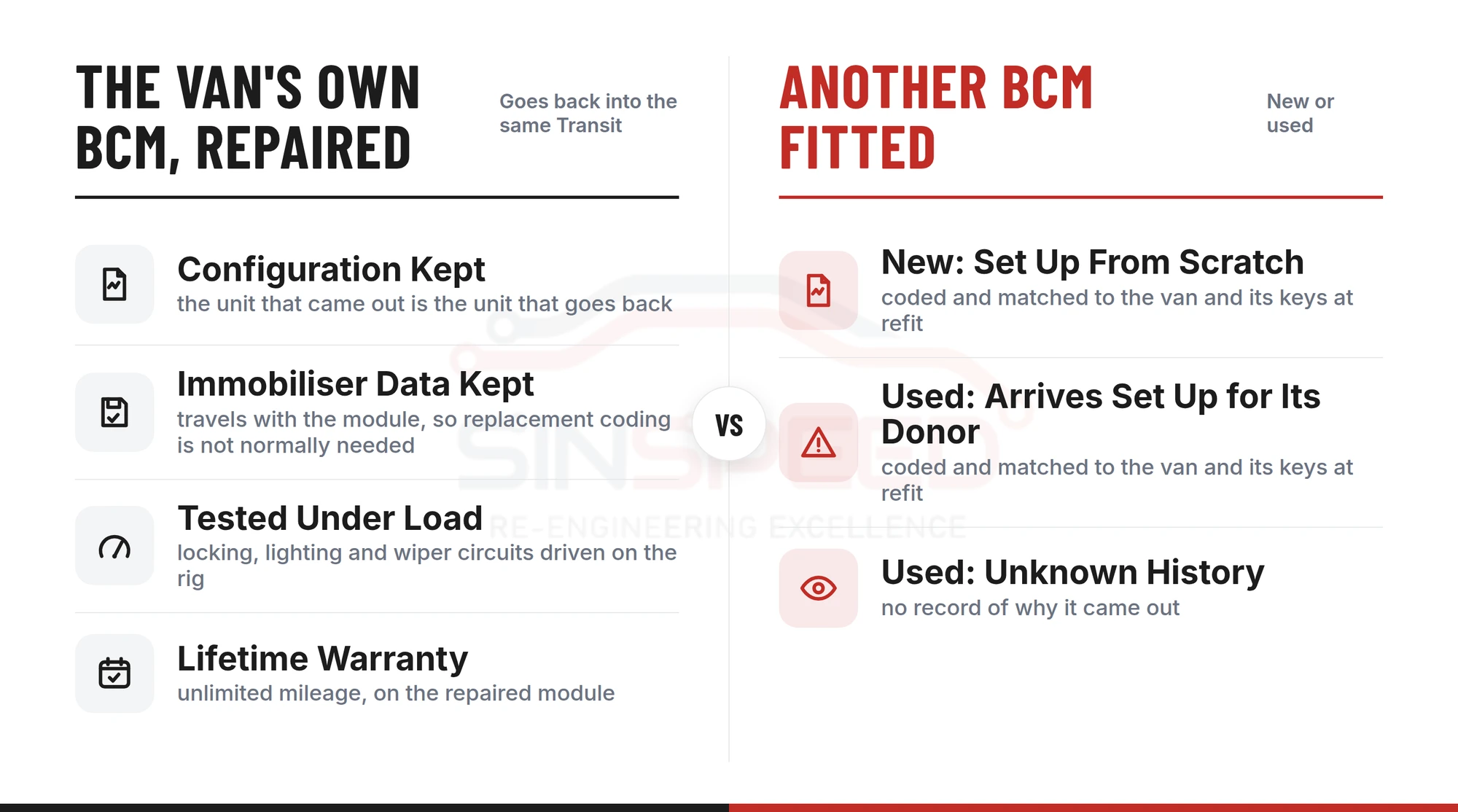
| Route | At refit | What goes back in the van |
|---|---|---|
| New BCM | Coded and matched to the van and its keys | A new module, set up from scratch |
| Used BCM | Coded and matched; arrives carrying its donor’s set-up | A module with an unknown history |
| The van’s own BCM, repaired by Sinspeed | Replacement coding not normally needed | The original module, tested under load, with a lifetime warranty |
Repairing the original keeps all of that in place. The module that goes back is the one that came out, so the van’s configuration and immobiliser data travel with it. Clearing the stored codes and a function check at refit are ordinary fitting steps for your garage.
How does our by-post Transit BCM repair work?
Your garage looks after the van; we look after the module.
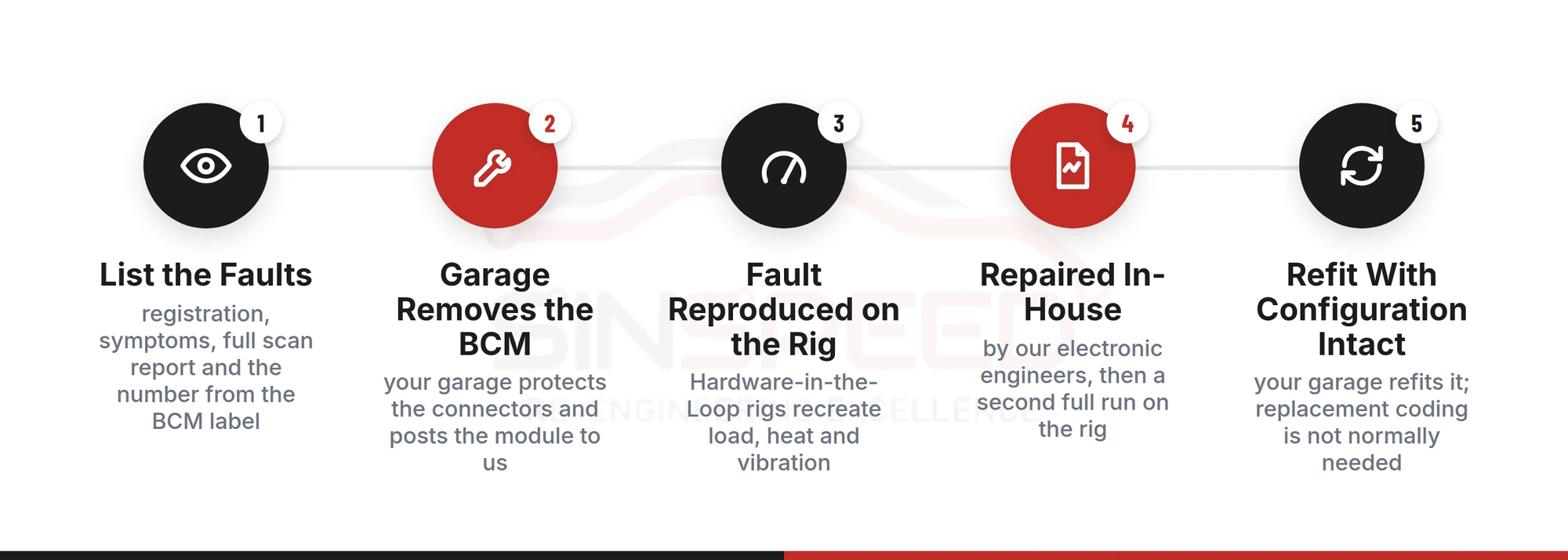
- List the faults, the codes and the label number
On the repair form, give us the registration, each fault the van shows and when it shows it (cold, wet, loaded or after standing), the full scan report and the number from the BCM’s label. Send the form with the unit.
- Out of the van and into the post
Your garage removes the module, protects its connectors and posts it to us. Removal is their part of the job; everything after it is ours.
- Every circuit driven as the van would drive it
We connect the BCM to our in-house Hardware-in-the-Loop rigs, which recreate the electrical load, heat and vibration it meets in the van, with its locking, lighting and wiper circuits loaded. The fault is reproduced before any repair starts, so an intermittent one is found rather than guessed at.
- Repaired in-house, then back on the rig
Our electronic engineers repair the module in a cleanroom-standard, ESD-safe workshop, and it goes through a second full run on the rig before it is packed.
- Refit at your garage, configuration intact
Your garage plugs the module back in, clears the stored codes and checks each function. Because it is the van’s own BCM, replacement coding is not normally needed.
The repaired BCM is covered by our lifetime, unlimited-mileage warranty.
Transit BCM fault FAQs
Final thoughts
On a Transit, a BCM fault is recognised by its spread rather than by any one symptom: locking, lights, wipers and a draining battery misbehaving together, with network codes stored in modules that are otherwise healthy. A single fault on its own still deserves the simple explanation first.
Clear the battery, charging, fuses, water and wiring before the module comes out. If the pattern survives those checks, have the BCM tested; repairing the one already set up for the van is the route that leaves its configuration and immobiliser data where they belong.
Sinspeed · Ford Transit Mk8 BCM repair
Get the Transit’s body electrics answering againFill in the repair form with the registration, the faults and the scan report, and have your garage post the module to us. If you would like the pattern checked first, tell us what the van is doing.
Configuration and immobiliser data stay with the van · Faults recreated on our HIL rigs · Lifetime warranty, whatever the mileage