
Summary: A DPF, or diesel particulate filter, is a ceramic filter in a diesel car’s exhaust that traps engine soot before it leaves the tailpipe. As it fills, the car burns that soot off at high temperature — a process called regeneration — leaving a little ash behind. On a diesel that rarely gets a long enough run, regeneration never finishes, the filter blocks and the DPF light comes on — and the road-legal way back is finding the cause and having the original filter professionally cleaned.
How does a DPF work?
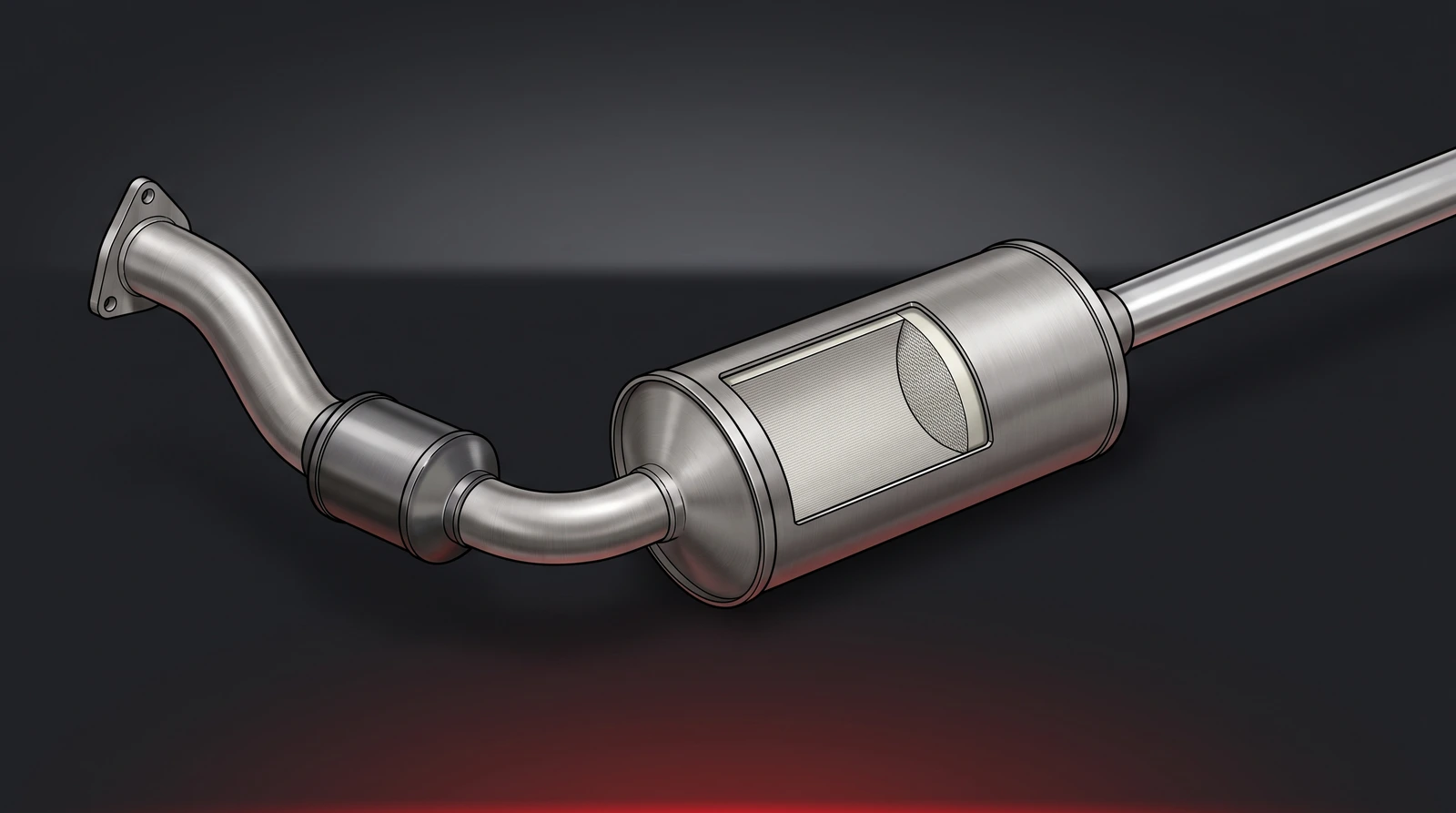
A DPF sits in the exhaust close behind the engine, often sharing a housing with an oxidation catalyst. It works mechanically rather than chemically: it stops soot particles, holds them, then burns them off in batches. This is the path one pulse of exhaust gas takes through it.
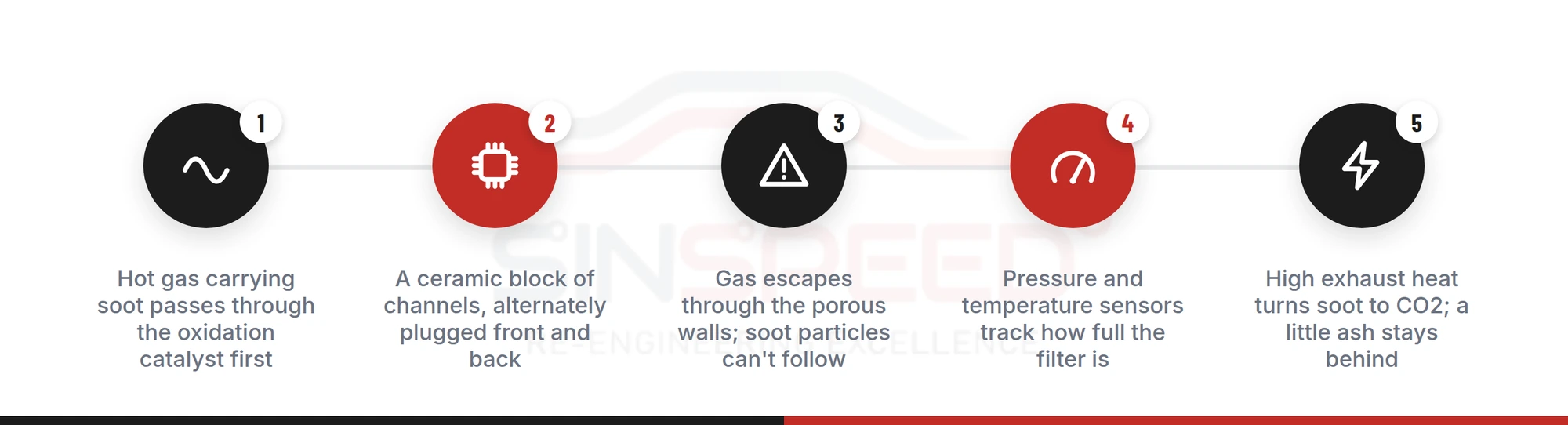
- Exhaust leaves the engine
Diesel combustion produces hot gas carrying fine particles of carbon soot. Most systems pass it first through a diesel oxidation catalyst, which treats other pollutants and adds heat the filter can use later.
- It enters a wall-flow filter
Inside the can is a ceramic block, usually cordierite or silicon carbide, made up of thousands of fine parallel channels. Each channel is plugged at one end, alternating front and back, so gas that enters a channel has no straight way out.
- Soot is caught on the channel walls
The gas escapes by passing through the porous walls into the neighbouring channels. The soot particles are too large to follow, and they build up as a layer on the inlet side.
- Sensors measure the load
A differential pressure sensor compares exhaust pressure before and after the filter, while temperature sensors watch the gas. As soot builds, the pressure difference rises, and the engine ECU uses it alongside its own soot model to decide when the filter needs emptying.
- Regeneration burns it away
At a high enough exhaust temperature the soot oxidises into carbon dioxide and leaves with the gas. A fine ash that cannot burn — much of it from additives in engine oil — stays behind.
A working wall-flow filter is designed to cut particulate emissions by 80 per cent or more, and diesel cars have had to carry one from 2009. The ash is what gives a DPF a working life: regeneration can clear soot over and over, but ash only accumulates, until back-pressure stays high even straight after a burn.
Passive, active and forced regeneration explained
Regeneration is the filter emptying itself, and the different ways it happens explain most DPF trouble.
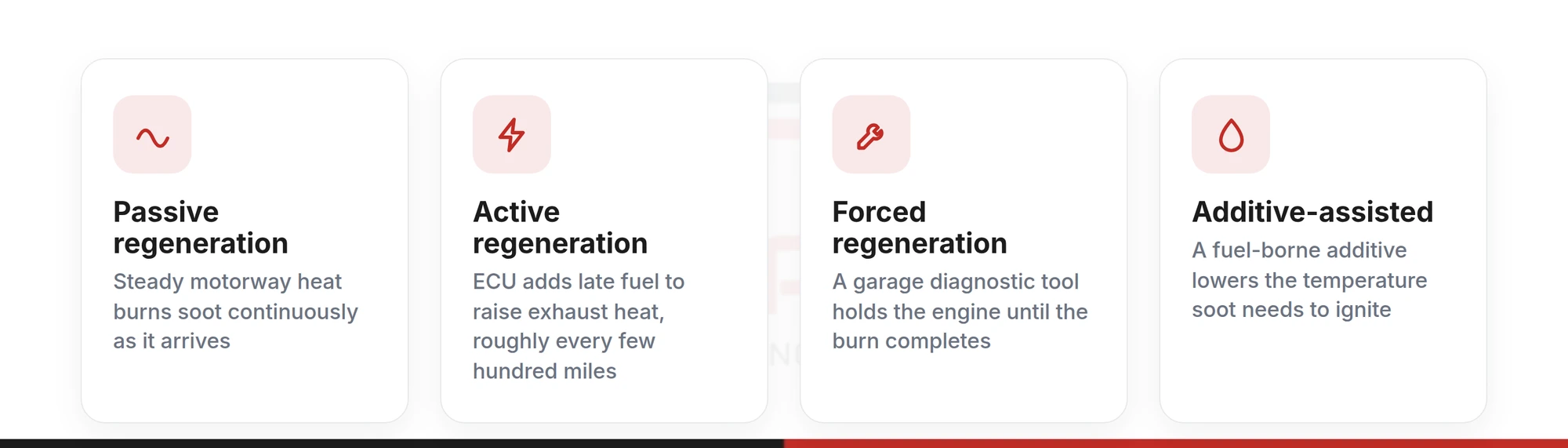
- Passive regeneration. On a steady motorway or fast A-road run, the exhaust stays hot enough for soot to burn continuously as it arrives, helped by the catalyst upstream. The engine management does nothing special, and a car that regularly covers long distances may seldom need anything more.
- Active regeneration. When the soot load reaches a set threshold, the ECU alters injection — usually adding fuel late in the cycle — to raise exhaust temperature and start a burn the driving alone would not. It typically recurs every few hundred miles and needs several minutes of steady running. A raised idle, a cooling fan that runs on after switch-off or a hot smell are the usual clues; switching off mid-cycle aborts it, and the soot carries over to the next attempt.
- Forced, or service, regeneration. When active attempts keep failing, a garage can command a regeneration with a diagnostic tool, holding the engine at controlled conditions until the burn completes. It is a recovery step rather than routine maintenance, and it burns soot only — never ash.
- Additive-assisted systems. Where the filter sits further from the engine and runs cooler, some manufacturers dose a fuel-borne additive from a separate reservoir at each fill-up. It lowers the temperature at which soot ignites; only small amounts are used, so the reservoir lasts many thousands of miles, but on these cars its level is part of keeping the DPF working.
Why does a DPF block, and what are the warning signs?
A DPF blocks when soot arrives faster than regeneration can burn it, or when ash has filled the filter. Five causes account for most cases.
- Short, slow journeys — town driving and school runs never hold the exhaust hot for long enough for an active regeneration to finish.
- Interrupted regenerations — each burn abandoned at the end of a trip leaves the next one starting from a higher load.
- An engine making excess soot — a sticking EGR valve, a leaking injector, a turbo fault or a boost leak pushes soot output past what the filter was sized for.
- A false reading — a failing differential pressure sensor, or a split or blocked sensor pipe, can report a full filter that is not full, or miss one that is.
- Ash — late in a filter’s life, regeneration can no longer bring back-pressure down.
The false reading deserves the most attention, because it is the cause that gets healthy filters condemned. A bad measurement and a genuine blockage bring up the same light and the same limp mode, so the reading has to be proved before anything is decided about the filter.
The warning builds in stages. An amber DPF light that clears after a longer run is the system doing its job. If it stays lit, the engine management light can follow, some makes flash the glow plug lamp, and the car drops into limp mode with power cut to protect the engine. From there, more driving will not clear it — the car needs its codes read and the cause found.
Sinspeed · DPF diagnosis
DPF light on and refusing to clear?Send us the vehicle, the codes a scan has stored and what the car is doing on the road. We will tell you whether the evidence points at soot, ash or a sensor reading that cannot be trusted, and what that means for the filter.
Codes interpreted by an in-house diagnostic team · Dealer-level diagnostic equipment
DPF regeneration vs cleaning vs removal
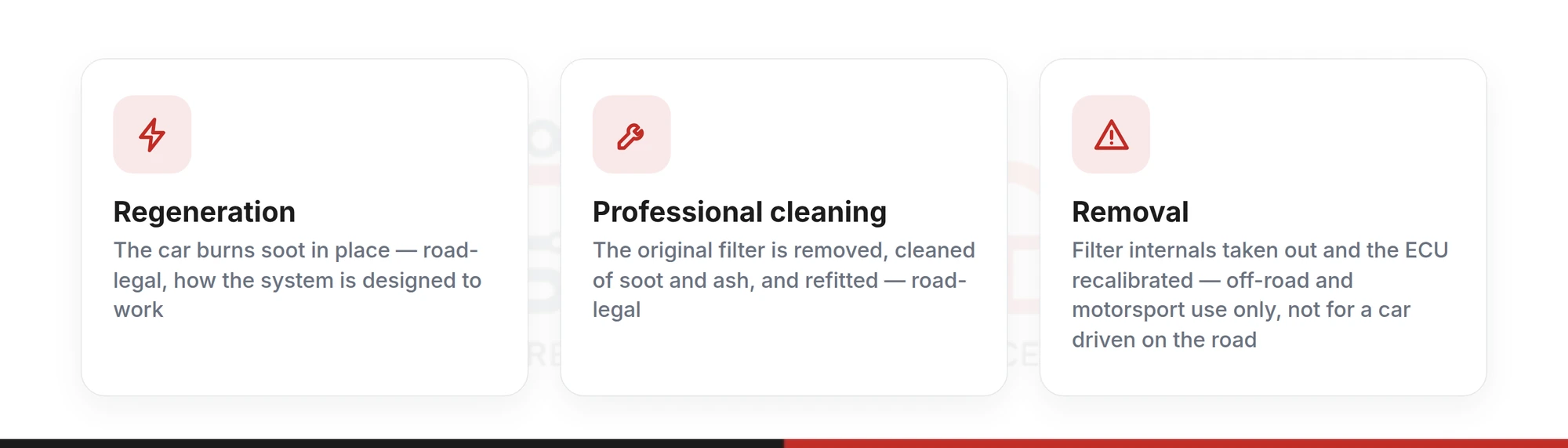
These three terms get used as though they were interchangeable, and they are not. Regeneration is something the car does to itself, cleaning is workshop work on the filter you already have, and removal takes the filter out of the picture altogether.
| Route | What happens | What it clears | Who does it | Road and MOT position |
|---|---|---|---|---|
| Regeneration (passive, active or forced) | The filter is heated in place until the trapped soot burns off | Soot only — the ash stays in the filter | The car itself, given a suitable run; a garage with a diagnostic tool for a forced regeneration | Road-legal: it is how the system is designed to work |
| Professional cleaning | The filter comes off the car, is cleaned in a workshop and goes back on | Soot, plus the ash that heat cannot shift | A DPF cleaning specialist, with your garage removing and refitting the filter | Road-legal: the original filter stays with the car and keeps doing its job |
| Removal | The filter internals are taken out and the ECU is recalibrated so it no longer expects a filter | Nothing — the filtering stops altogether | A specialist, with the engine software recalibrated by hand | Off-road and motorsport use only. Driving the vehicle on a UK road is an offence under the Road Vehicles (Construction and Use) Regulations, an MOT fail, and can mean a fine of up to £1,000 for a car or £2,500 for a light goods vehicle. |
On a road car the real choice is between the first two rows, and it comes down to what is in the filter. Soot on a car that can still complete a regeneration calls for a regeneration, with whatever is producing the excess soot put right first. Ash, or a filter that keeps failing to regenerate, calls for a professional clean. A ceramic core that has cracked or melted, usually after an engine fault fed raw fuel into the exhaust, is past cleaning and needs replacing.
DPF removal, the MOT and UK law
Most of the confusion about DPF removal clears once you see what the law targets: the vehicle on the road, not the job in the workshop. Under the Road Vehicles (Construction and Use) Regulations, using a vehicle on a public road after it has been modified so it no longer meets the emissions standard it was built to is an offence — and a diesel without its filter is exactly that.
The MOT enforces the same line. From February 2014 the test has included a visual check for the DPF on any vehicle built with one, and a missing filter is a fail. That check exists because the smoke test alone misses a great deal: a diesel can emit harmful fine particulate without producing enough visible smoke to fail. A filter emptied but left looking intact does not change the position, because the regulations are about emissions, not appearance.
Using such a vehicle on the road can bring a fine of up to £1,000 for a car or £2,500 for a light goods vehicle.
We carry out DPF removal only for vehicles used away from the public road — motorsport, competition and off-road use. For any car or van driven on the road, cleaning the original filter is the road-legal answer, and it is the one we will recommend.
Where removal does apply, the software half decides whether the vehicle runs properly afterwards. Our DPF removal and smoke-correction service recalibrates the ECU by hand and finishes with a smoke-correction session, and the truth about DPF removals sets out why automated deletes so often end in limp mode. The full range sits in our DPF removals category.
How to keep a DPF healthy
Most blocked filters are avoidable, and prevention comes down to how the car is used rather than anything done to it.
- Give it regular longer runs. A steady stretch on a motorway or dual carriageway lets passive regeneration work and active cycles finish; the handbook states what your vehicle needs.
- Let a regeneration finish. A raised idle or a fan running on after a short trip can mean a burn is under way, and a few more minutes of driving, where it is safe to do so, lets it complete.
- Use the oil the handbook specifies. Many DPF-equipped diesels need a low-ash oil, because oil additives are the main source of the ash that eventually fills the filter.
- Treat a returning light as a warning. An amber light that appears now and then is normal; one that keeps coming back means soot is winning, and the time to find out why is before limp mode.
- Fix what feeds it. EGR, injector, turbo and sensor faults keep sending the filter more soot than it can burn, so any clean or regeneration that ignores them is only temporary.
Diesel particulate filter FAQs
Is DPF removal legal in the UK?
Not for a vehicle that is used on the road. The Road Vehicles (Construction and Use) Regulations make it an offence to drive a vehicle on a public road once its emissions equipment no longer meets the standard it was built to, a missing DPF has been an MOT fail from February 2014, and the fine can reach £1,000 for a car or £2,500 for a light goods vehicle. Removal is carried out for off-road and motorsport vehicles only; for a road car, the legal route is cleaning the original filter.
What does DPF stand for?
Diesel particulate filter. You will also see it called a soot trap, and on Peugeot and Citroën models an FAP, from the French filtre à particules. Whatever the label, it is the same part: the filter in the exhaust that catches soot and burns it off through regeneration.
Is a DPF the same as a catalytic converter?
No, although the two often share a housing. A catalytic converter — on a diesel, the oxidation catalyst — changes exhaust gases chemically as they flow through it. A DPF physically traps solid soot particles and has to be emptied by regeneration. Most diesels have both, with the catalyst ahead of the filter so the heat it adds helps the soot burn.
How long does a DPF last?
It depends on how the car is used and how quickly ash builds up. On a diesel that gets regular longer runs and the specified oil, a DPF is built for a long life — commonly well past 100,000 miles. A filter that blocks early on a car used for short trips is usually full of soot the car never got the chance to burn, not a filter that has worn out.
Do petrol cars have a particulate filter?
Many newer petrol cars do, especially those with direct-injection engines, which produce fine particles of their own. The petrol version is called a gasoline particulate filter, or GPF, and works on the same wall-flow principle. Our guide to whether your petrol car has a particulate filter explains how to tell.
Final thoughts
A DPF is a filter with its own cleaning cycle built in, and almost everything that goes wrong with one traces back to that cycle not getting the conditions it needs. Grasp passive and active regeneration and it becomes obvious why a diesel used for short hops struggles while one that cruises the motorway rarely gives trouble.
When the light does come on, keep the three words apart. Regeneration burns soot, cleaning clears soot and ash, and removal takes the filter away — and only the first two belong on a car that is driven on the road.
Sinspeed · diesel particulate filters
Want to know what your DPF actually needs?Tell us the vehicle, the warning lights and any stored codes. We will work out whether you are looking at a regeneration the car cannot finish, a filter loaded with ash or a sensor giving a false reading, and point you to the road-legal fix.
In-house engineers and diagnostic specialists · Programming and calibration on dealer-level tools