
Summary: A brake pressure sensor fault means the ABS/ESP control unit can no longer read the brake pressure it uses to judge how hard you are braking. On ATE/Teves MK60 units the sensor is built into the hydraulic unit, so the fault sits in the ABS/ESP unit itself. It lights the ESP warning, and often the ABS and traction lights too. We repair your own unit by post, it keeps its coding, and it comes back with a lifetime warranty.
This page covers the fault family as a whole: what the sensor reports, how the warnings behave, why the failure usually sits inside the unit and how a garage confirms it. Each make stores the fault under its own codes, so the table further down sends you to the page written for your car. Ford, Mazda and Volvo models are covered here. For any other ABS fault, start at our ABS pump and module repairs hub.
- The fault: the ABS/ESP unit has lost, or no longer believes, its brake pressure reading
- Where the sensor sits: sealed inside the hydraulic unit on ATE/Teves MK60; mounted outside the unit on some other designs
- The warnings: ESP light on, ESP OFF button ignored, ABS and traction lights often lit as well
- The brakes: normal braking remains; stability control, and often ABS and traction control, are off
- The codes: different on every make, listed in the table below
- Our repair: your own unit, bench tested, coding kept, lifetime warranty
- What does a brake pressure sensor fault mean?
- The symptoms: ESP, ABS and traction lights, and an ESP button that does nothing
- Brake pressure sensor fault codes by make
- Why the sensor fails inside the ABS/ESP unit
- Ford, Mazda and Volvo: the models this page covers
- Sensor, wiring or unit: how a garage tells them apart
- Repair your own unit, or replace it?
- How the repair works by post
- Brake pressure sensor fault FAQs
- Final thoughts
What does a brake pressure sensor fault mean?
Press the brake pedal and the pressure in the system rises. A sensor measures that rise, and the ABS/ESP unit uses the figure to work out how hard the driver is braking. It then weighs it against wheel speed, steering input and how the car is moving before deciding whether to step in.
Take away a believable pressure reading and that judgement is no longer possible. The unit switches stability control off, lights the warning and stores a code. The wording varies by manufacturer: a missing signal, an implausible one, or a reading that disagrees with the brake light switch. All of them say the same thing underneath. The unit has stopped trusting its own pressure measurement.
Where the sensor lives decides what happens next. Some braking systems mount it outside the unit or near the master cylinder, as a separate part. On the ATE/Teves MK60 family, fitted across many makes, it is built into the sealed hydraulic unit and is not sold on its own. On those cars a “sensor” fault is, in practice, a unit repair.
The symptoms: ESP, ABS and traction lights, and an ESP button that does nothing
The fault shows itself on the instrument cluster, and the pattern barely changes from one make to the next:
- ESP light on and staying on. It lights at start-up and is still there on the next journey, and the one after.
- An ESP OFF button that does nothing. Pressing the stability control button has no effect. On some cars the button’s own lamp stays lit as well.
- ABS and traction lights alongside. Many cars light one or both, because those functions run through the same unit.
- Make-specific extras. Older BMWs often sound a double-tone chime when the ignition is switched on; Citroen, Peugeot and Renault can log a disagreement between the brake light switch and the pressure sensor.
- Intermittent at first. Some cars show the warning now and again before it settles in for good.
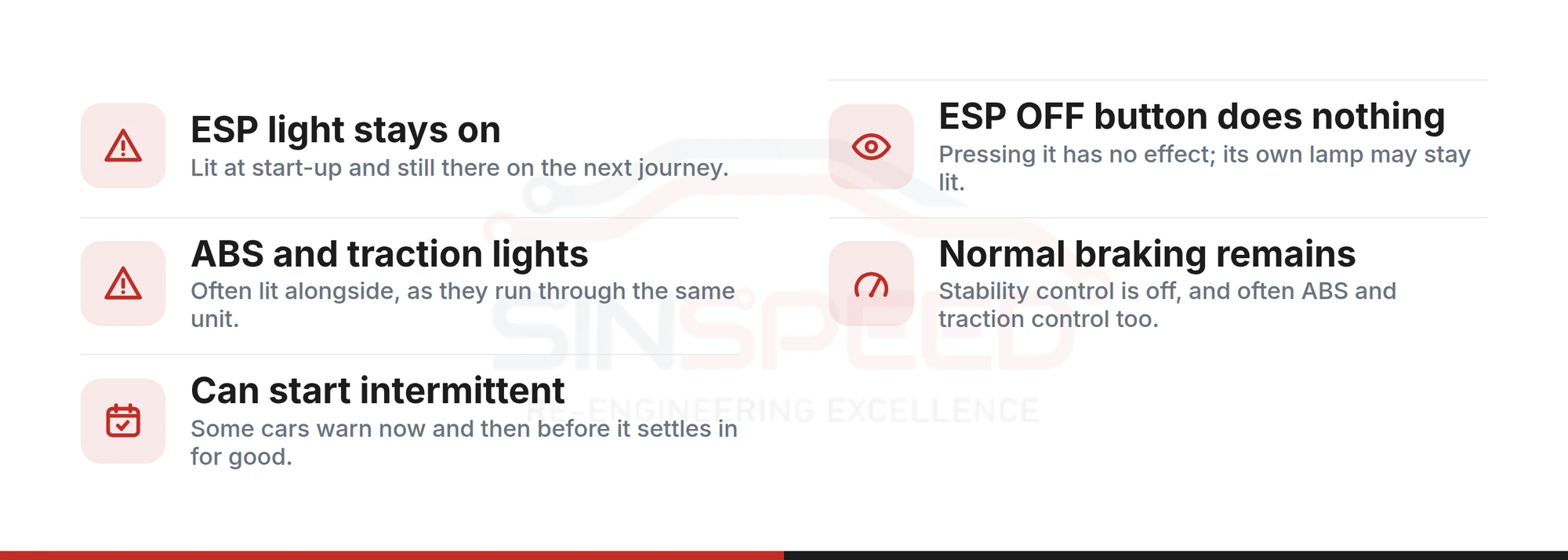
Normal braking stays; the systems around it go. The car still stops when you press the pedal, but stability control is off and, on many cars, ABS and traction control with it. Drive gently, leave more room when grip is poor, and get the unit checked soon. If the red brake warning lights up or the pedal feels different, stop and have the car checked before going further. In the UK an ABS warning light that stays on is also an MOT failure.
Brake pressure sensor fault codes by make
Each manufacturer gives this fault its own code, and several log more than one. The table lists the codes named on our make pages, worded as those pages word them. Note down the full description your scan tool shows, not just the number, then follow the link for your car.
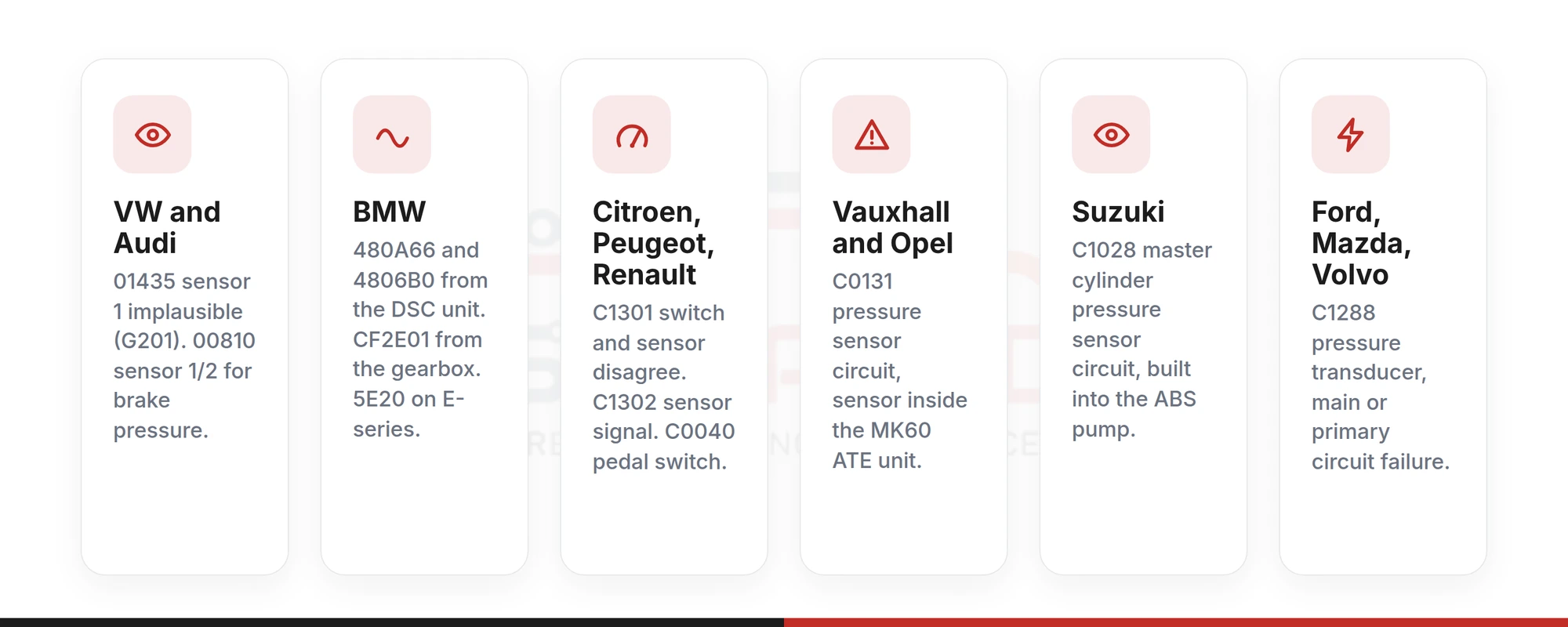
| Make | Code(s) | How the make page describes them | Full guide |
|---|---|---|---|
| VW and Audi (also Seat and Skoda) | 01435, 00810 | 01435: Brake Pressure Sensor 1 (G201), implausible signal. 00810: Sensor 1/2 for Brake Pressure. | VW and Audi brake pressure sensor fault |
| VW Touran | G201, 01435 | ESP, traction and ABS lights with G201 and/or 01435 stored. | VW Touran ESP fault |
| BMW | 480A66, 4806B0, CF2E01, 5E20 | 480A66 and 4806B0 are stored by the F-series DSC unit; CF2E01 is stored by the gearbox when the brake pressure signal from DSC is invalid; 5E20 is the E-series ATE MK60 code. | BMW brake pressure sensor fault |
| Citroen, Peugeot and Renault | C0040, C1301, C1302 | C1301: incoherence between the brake light switch and the pressure sensor. C1302: braking pressure sensor signal fault. C0040: brake pedal switch fault, coherence with the pressure sensor. | Citroen, Peugeot and Renault pressure sensor fault |
| Vauxhall and Opel | C0131 (C0131 to C0139 range) | C0131: brake pressure sensor circuit fault, sensor built inside the MK60 ATE unit. C0136, in the same range, is a base brake system pressure circuit fault. | Vauxhall brake pressure sensor fault |
| Suzuki | C1028 | Master cylinder pressure sensor circuit failure; the sensor is built inside the ABS pump. | Suzuki ESP pressure sensor fault |
| Ford, Mazda and Volvo | C1288 | Pressure transducer main/primary circuit failure. | Covered on this page |
Two cautions before anyone acts on a code. A wheel-speed code is a separate fault: on a Suzuki, C1032 and C1036 are wheel-speed sensor codes, not the pressure sensor, even though they light similar warnings. And on a BMW, CF2E01 lives in the gearbox memory, so a scan that reads the brakes alone will miss it. Have every module read.
Sinspeed · ABS/ESP pressure sensor faults
Got a pressure sensor code on the scan?Put the code, its full wording and the number from the unit’s label on the repair form. If you are unsure the unit is to blame, send us the scan first.
Every unit tested before it leaves our workshop
Why the sensor fails inside the ABS/ESP unit
On MK60 units the pressure sensor shares a sealed housing with the hydraulic block, with no ventilation. Every brake application sends a pressure pulse through it, and over time that cycling damages the sensor. The unit also sits in the engine bay, so it heats up and cools down on every journey and takes vibration on every mile.
A new MK60 unit is built to the same design. Fitting one puts the same internal sensor back into the car, which clears the light without changing the reason it came on.
Why does a unit fault read like a sensor fault? Because the code names the circuit the unit is watching. With the sensor inside the casing, that circuit is inside the unit as well. Work on the car’s wiring cannot restore a good reading from a sensor sealed in the housing, which is why a garage that has already cleared the connector and the brake light switch ends up looking at the unit.
Ford, Mazda and Volvo: the models this page covers
These three makes use the same MK60 ATE/Teves unit, fitted with brake pressure sensors that differ slightly from the VW Group versions. The two are not interchangeable, so a unit from a Golf is no answer for a Focus.
| Make | Models |
|---|---|
| Ford | Focus, C-Max |
| Mazda | Mazda 2, Mazda 3, Mazda 5, Mazda 6 |
| Volvo | C30, C70, S40, V50 |
The symptoms match the rest of the family: the ESP light lit permanently and the ESP OFF button doing nothing, sometimes with the button’s own lamp lit. The code we see recorded against these cars is C1288, a pressure transducer main/primary circuit failure. There are many unit part numbers across the three makes, so send us the number from your label and we will confirm it before anything comes off the car.
For other ABS faults on these cars, see our Ford ABS pump repairs, Mazda ABS unit repairs and Volvo ABS unit repairs.
Sensor, wiring or unit: how a garage tells them apart
Before the unit comes off, a garage can narrow the cause down with a scan tool and a look at live data. Each check below happens outside the unit, so none of them takes long, and together they stop the wrong part taking the blame.
| What the garage finds | What it points to |
|---|---|
| A wheel-speed code stored with the warning | A sensor or its wiring out at the wheel. A different fault from the pressure sensor. |
| A brake light switch or pedal switch code beside the pressure code | Check the switch and its connections first. If they test sound, the pressure sensor is next in line. |
| A weak or recently flattened battery | Low supply voltage can unsettle any control unit and throw up warnings that mimic a failed one. Charge and retest. |
| The scan tool cannot reach the ABS unit at all | A communication fault, which is diagnosed differently. |
| The pressure code returns straight after clearing | Move to live data and read the brake pressure value. |
| Brake pressure in live data sits at maximum with no foot on the pedal | It should read zero at rest and climb as the pedal goes down. Stuck at maximum, the internal sensor has failed and the unit needs repairing. |
On a car with the sensor mounted outside the unit, sound wiring leaves that external sensor as the suspect, and it is a separate part. On an MK60 unit the sensor cannot be bought on its own, so once the outside checks are clear, the unit is the repair.
Repair your own unit, or replace it?
Once the fault is traced to the unit, there are three ways forward. They differ in what goes back on the car and what has to happen when it does.
| Option | What goes back on the car | On refit | Warranty |
|---|---|---|---|
| New unit | The same MK60 design, with the same internal sensor | Needs programming to the car | Limited manufacturer warranty |
| Used unit | A second-hand unit of the same design, with an unknown history | Needs re-coding where possible | Typically 30 to 90 days |
| Your own unit, repaired | The unit that came off your car, repaired and tested | No programming; the car’s coding is still on it | Lifetime warranty |
A replacement unit arrives knowing nothing about your car and has to be told. Your own unit already holds that information, which is what lets it go straight back on.
How the repair works by post
This is a mail-in repair from first form to final refit. The ABS/ESP unit comes to us by courier, and the car waits at your garage.
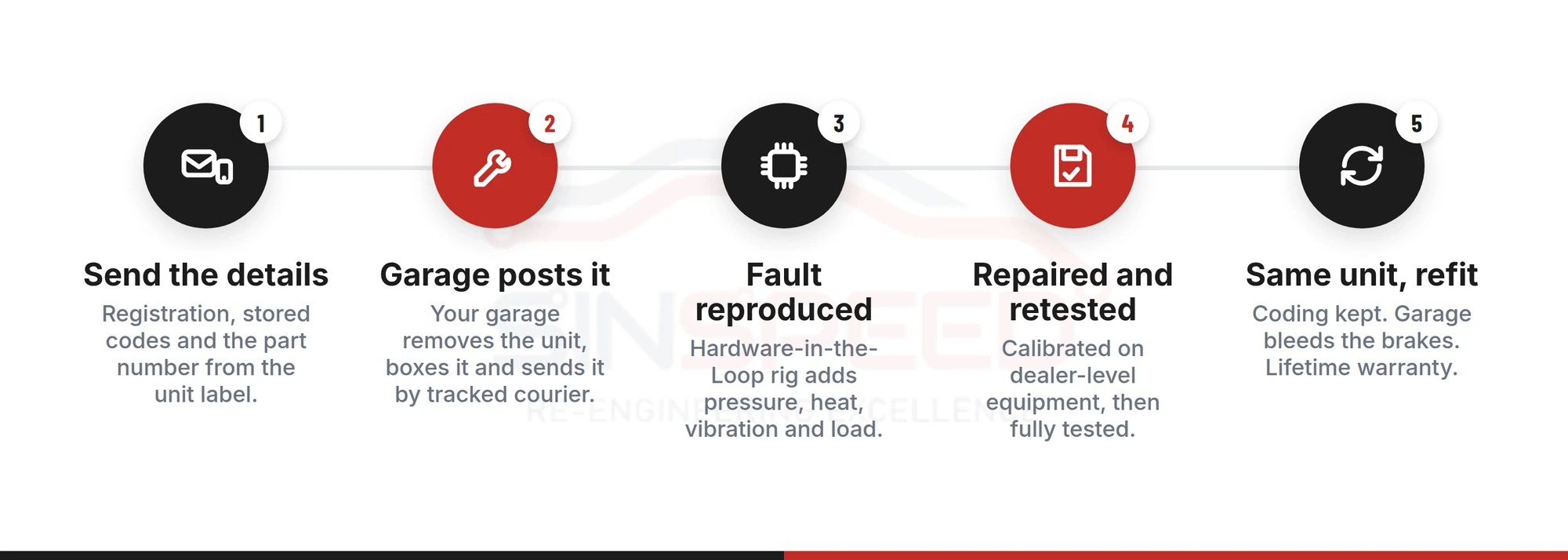
- Start with the label
Use the repair form to give us the registration, the stored codes with their wording and the part number printed on the unit. We check it against the fault family before anyone picks up a spanner.
- Removed locally, posted to Epsom
Your garage unplugs the unit and takes it off the car, blanking the pipe openings so no dirt or fluid gets in. Wrapped well and boxed with a copy of the form, it travels to us by tracked courier.
- The pressure fault reproduced
On arrival the unit is connected to one of our in-house Hardware-in-the-Loop platforms. It is put through brake pressure, heat, vibration and electrical load as it would meet them on the road, until the fault on your form shows itself.
- Repair, calibration, full retest
Our electronic and hydraulic engineers carry out the repair in an ESD-safe, cleanroom-standard workshop. The unit is calibrated on dealer-level diagnostic equipment, then the full test runs again before it is packed.
- Same unit, same car
It goes back onto the car it came from with the coding untouched, so there is nothing to program. The brake lines were opened to remove it, so your garage bleeds the brakes and clears the stored codes as part of the refit. The lifetime warranty starts there.
Should testing turn up anything else wrong with the unit, you hear about it from us before any further work is done.
Brake pressure sensor fault FAQs
Final thoughts
A brake pressure sensor fault sounds like one small part giving up. On most of the cars that log it, that part is sealed inside the ABS/ESP unit, and the code is the unit reporting on itself.
Find your make’s codes, have the wheel-speed, switch and wiring causes ruled out, and let the live pressure reading settle the question. When it points inside the unit, repairing the one already matched to your car is the straightforward way back to a clear dash.
Sinspeed · ABS and ESP unit repairs
Put the ESP light out at its sourceFill in the repair form with your codes and part number, and have your garage post the unit to our Epsom workshop. Not sure the unit is the cause? Contact us with the scan before anything comes off the car.
Pressure fault found on the bench · Back on the car it came from · Lifetime warranty