
Summary: Ford sold two completely different gearboxes under one name. The wet-clutch 6DCT450 — Ford’s MPS6, Volvo’s Powershift — controls its twin clutches hydraulically, through a mechatronic unit. The dry-clutch 6DCT250, the DPS6, has no hydraulics at all and is run by a control module with electric actuators built into it. They fail for different reasons, and the part you send us is not the same part. We rebuild both on the bench and return them ready to fit, so your garage removes the unit and the Ford stays where it is.
- The wet unit: Getrag 6DCT450 — Ford MPS6, Volvo Powershift. Valve body and control unit permanently bonded into one mechatronic assembly
- The dry unit: Getrag 6DCT250 — Ford DPS6, Renault EDC. A transmission control module with integrated electric actuators, and no valve body at all
- What fails: on the wet unit, pressure control — sticking solenoids and valve-bore wear. On the dry unit, the input-shaft seal and the control module
- The service: mail-in repair and return, UK-wide — your garage removes the unit and posts it in
- On the way back: the rebuilt unit keeps its own software, so there is nothing to configure or transfer on refit
PowerShift is two different gearboxes — which one is in your Ford?
PowerShift is a marketing name, not a gearbox. Ford applied it to two Getrag dual-clutch transmissions that share a badge and very little else, and most of the confusion in this field starts there.
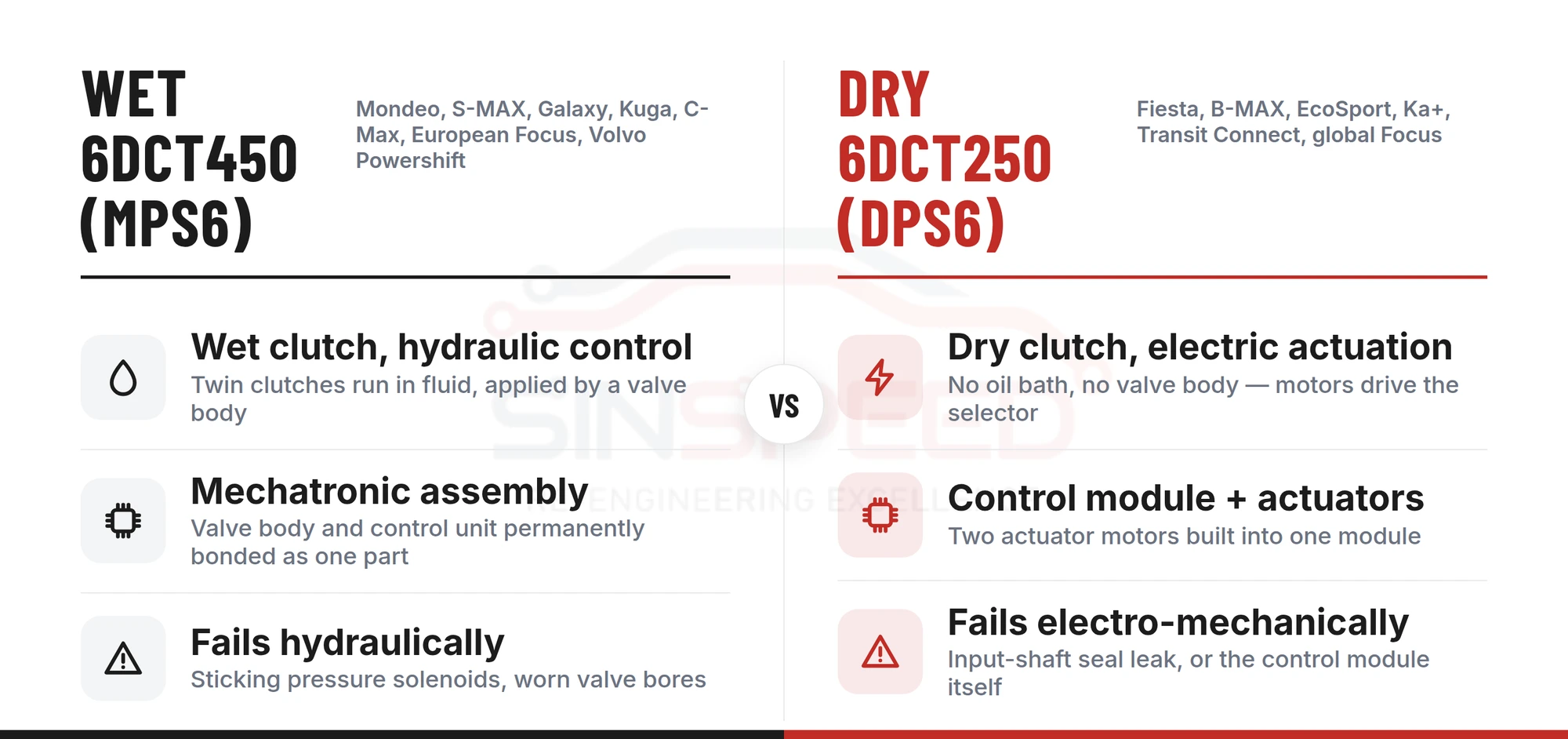
- The wet 6DCT450, which Ford call the MPS6. Twin clutches running in fluid, applied hydraulically. Mondeo Mk4 and Mk5, the European Focus, C-Max, S-MAX, Galaxy, Kuga Mk1 and Mk2, and the European diesel Edge. The same unit is the Volvo Powershift in the C30, C70, S40, V40, V50, S60, V60, S80, V70, XC60 and XC70; Mitsubishi’s TC-SST is the closely related 6DCT470.
- The dry 6DCT250, which Ford call the DPS6. Clutches running dry, with no oil bath and no hydraulic pressure control anywhere in the gearbox. Fiesta Mk7, the global Focus Mk3, B-MAX, EcoSport, Ka+, Transit and Tourneo Connect, Transit Courier. The same gearbox is Renault’s EDC in the Clio IV, Captur and Mégane III, and is fitted to the Dacia Duster and the Mercedes Citan.
Two ways to tell which you have. The car is the first: the wet unit went into the larger models, the dry unit into the small ones. Fluid is the second — the 6DCT450 takes a dedicated oil to Ford’s WSS-M2C936-A specification because its clutches live in it, and the 6DCT250 has no equivalent because its clutches do not.
The naming trap is worth spelling out. You will see the 6DCT450 called a DPS6, including by people selling parts for it, and it is wrong. DPS6 is the dry 6DCT250; MPS6 is the wet 6DCT450, which is what Ford and Volvo both call it. The two have entirely separate part numbers, so anything listed against the wrong one will not fit.
The same confusion attaches to PowerShift’s reputation. The extended coverage and the legal actions reported under the name concern the dry 6DCT250 only — none of it applies to the wet unit in a Mondeo, a Kuga or a Volvo.
What fails on the wet 6DCT450 (MPS6) mechatronic?
On the wet PowerShift the hydraulic valve body and the control unit are a single assembly, correctly called the mechatronic, and they are not separable. Mitsubishi, documenting the same Getrag design in the Evolution X, puts it plainly: the valve body and the TCM are permanently attached and cannot be replaced separately. So when a fault is traced to pressure control, the part that travels is the whole mechatronic assembly.
Failure on this gearbox is hydraulic first. The dominant mode is a pressure-control solenoid sticking; the second is wear in the precision bores of the aluminium body. The control side fails too, but it is the secondary story here, and anyone selling you an electronics fault on a 6DCT450 has the order the wrong way round.
The reason is the fluid. Clutch friction material and fine wear debris circulate in hot oil, and the machined bores and solenoid plungers are the parts least able to tolerate it. Once a bore no longer seals against the valve inside it, pressure cross-leaks away instead of reaching the clutch that needed it — and the debris that caused the wear is still circulating, so it compounds. The external filter cartridge is a service item for exactly that reason.
Heat is why the symptoms come and go. Hot fluid is thinner, a worn bore leaks more of it, and a gearbox that drives acceptably from cold turns jerky or slow to engage once it is warm. A fault that appears hot and has gone by morning is not an electrical gremlin; it is a pressure fault behaving as pressure faults do.
And this is why the wrong part gets fitted. Pressure applied too slowly feels identical from the driver’s seat to a slipping clutch — judder pulling away, slip under load, flare between gears. That is how a set of clutches ends up in a car whose mechatronic was the problem, and it is the thing worth settling first. What a hydraulic control body does, and how it fails across other gearboxes, is set out on our transmission valve body repair page.
One more reason to rebuild the original: a new mechatronic arrives with its control unit unprogrammed and has to be given software before the car will move. Yours already has it.
What fails on the dry 6DCT250 (DPS6)?
The dry PowerShift has no valve body. That is worth being blunt about, because the term is used for it constantly and it is simply wrong: no oil bath, no pump pressure, no hydraulic control circuit, so nothing for a valve body to do. What people are looking for when they search for a DPS6 valve body is a transmission control module with integrated electric actuators — a module carrying two brushless DC motors that drive the gear selector drums directly.
That changes the whole failure picture. The 6DCT250 fails electro-mechanically, and there are two distinct stories behind almost every complaint.
- The input-shaft seal, and the clutch behind it. When that seal leaks, oil reaches the faces of a clutch designed to run dry. The result is the shudder the DPS6 is known for, worst pulling away and through the first-to-second change. The clutch also wears and overheats in its own right, because a dry clutch in traffic has nothing to carry the heat away.
- The control module itself. It fails thermally and at its connections, logging P0606, and the clutch actuator motors inside it fail in their own right, logging P090B and P0901. A module losing accurate control of an actuator produces slipping, missing gears and refused engagement — which from the driver’s seat looks exactly like a worn clutch. That unit has its own page: Ford PowerShift TCM repair.
Separating the two is what the fault codes are for, and it is worth doing properly: they are two different jobs, and each one gets blamed for the other’s symptoms.
Programming is the other thing to know. A replacement Ford control module has to be configured to the car before it will work — Ford’s programmable module installation, with the configuration read out of the old module or pulled by VIN as as-built data. Rebuilding your original removes that step, because the software on it is already yours. The clutch adaptation the gearbox learns afterwards is carried out on the car by the fitting garage, and it is part of what the job involves.
One clarification for Fiesta owners: if yours is the earlier 1.4 with an automated manual rather than a PowerShift, that is a different gearbox with a separate clutch and gear actuator, and we repair those too — see Ford Fiesta 1.4 clutch and gear actuator repairs.
Symptoms and fault codes, gearbox by gearbox
The complaints are similar across both gearboxes. What sits behind them is not. This is the same symptom read against each unit in turn.
| What you feel | On the wet 6DCT450 / MPS6 | On the dry 6DCT250 / DPS6 | Codes commonly stored |
|---|---|---|---|
| Shudder pulling away | Clutch pressure applied too slowly — a sticking pressure-control solenoid | The signature fault: the input-shaft seal leaking onto a clutch meant to run dry | Wet: P0750–P0766. Dry: often nothing for the shudder itself |
| Harsh, jerky or thumping changes | Bore wear and contaminated fluid — pressure not held where it should be | Actuator position control degrading, or an adaptation that has drifted | P0766, P0771 / P090B, P0901 |
| Delay after selecting D or R | Line pressure slow to build in the hydraulic body | A selector drum actuator slow to reach its commanded position | P0750–P0765 / P0901 |
| Missing gears — reverse and first go first | Circuits in the hydraulic body no longer holding pressure | Gear selection lost through the actuator side of the module | P073E (no reverse), P073F (no first) |
| Slipping, engine speed floating under load | Clutch pressure not maintained once the fluid is hot | Worn or contaminated dry clutch, or an adaptation that will not complete | Wet: P0750–P0766. Dry: P090B, P0901 |
| Transmission malfunction warning or limp mode, usually warm | Hot fluid thins, worn bores leak more — faults appear warm, clear overnight | Thermal and connection-related failure inside the control module | Dry: P0606 |
Codes that return straight after being cleared are worth taking seriously on either gearbox: that is the unit reporting a condition it can still measure, not a glitch a battery disconnect will tidy up. A fuller reference sits in our guide to transmission control module fault codes, and the symptom-level read on this family is in Ford PowerShift problems.
Sinspeed · Ford PowerShift unit repairs
A gearbox specialist needs your Ford on site. We only need the unit.Send the vehicle details and the stored fault codes through the repair form. We will tell you which unit is at fault, what it is called on your gearbox and what your garage needs to remove — before anything comes off the car.
Rebuilt by our own in-house electronic and hydraulic engineers · Returned with its own software intact
What we take on, and the one job we do not
Both PowerShift control units are ours, and so are their siblings.
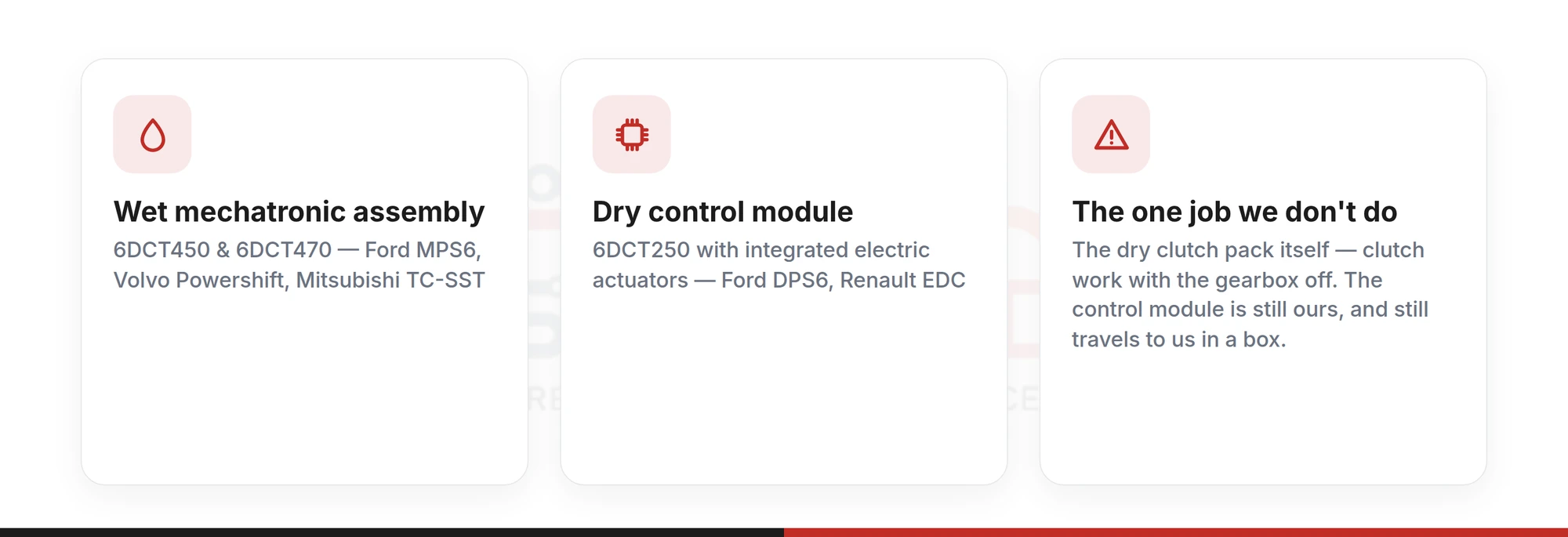
- The wet mechatronic assembly from the 6DCT450 and 6DCT470 — Ford MPS6, Volvo Powershift and the Mitsubishi TC-SST, which is the same Getrag design family with a closely related hydraulic control architecture.
- The dry control module from the 6DCT250, with its integrated electric actuators — Ford DPS6 and the Renault EDC version of the same gearbox.
The one thing we do not do is the dry twin clutch itself. Replacing a worn or oil-contaminated clutch pack in a 6DCT250 is clutch work carried out with the gearbox off the car, and it belongs with a transmission specialist. If the input-shaft seal has leaked you may need both jobs — and the module is still ours, and it still travels to us in a box while the clutch work happens where the car is.
Every unit above sits under our transmission control module repair services, where the rest of the per-make work lives.
How the mail-in repair works
Search for PowerShift repair and you will find regional gearbox garages — Essex, Bournemouth, the Midlands, Bedfordshire. Every one of them needs the car: driven in, recovered in, or on a transporter. We work the other way round. The Ford stays where it is, and one unit makes the journey.
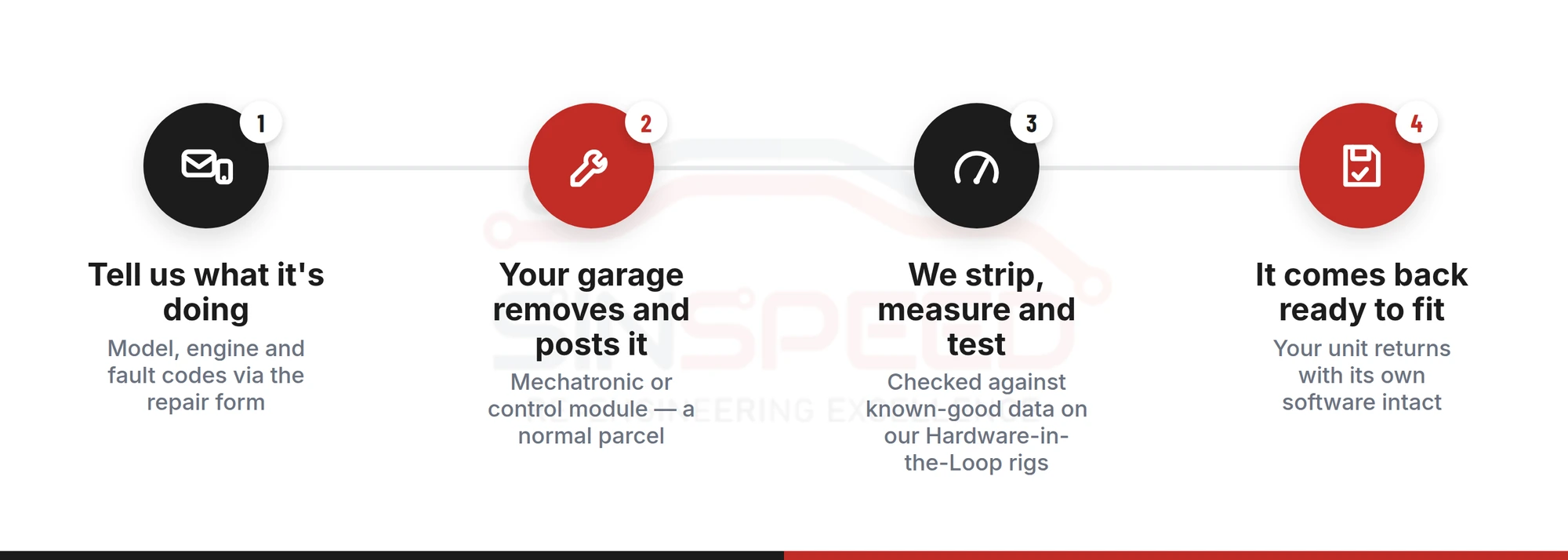
- Tell us what it is doing
Complete the repair form with the model, the engine and any stored fault codes. If you do not yet know which PowerShift you have, describe the car and the symptoms and we will confirm which unit to send.
- Your garage removes the unit and posts it
On the wet 6DCT450 that is the mechatronic assembly; on the dry 6DCT250 it is the control module with its actuators. Either way it is normal removal work, and then it is a parcel.
- We strip, measure and test it
Hydraulic and electrical behaviour is measured against known-good data rather than inferred, and the unit is run on our in-house Hardware-in-the-Loop platforms, which simulate the heat, vibration and load it sees in service. That is how a fault that only appears warm is made to repeat on a bench.
- It comes back ready to fit
Your unit returns with its own software intact, so it goes back on as a direct refit. Where a step on the car follows — the clutch adaptation on the dry unit — we name it before dispatch.
One thing before it is posted: treat it as an electronic assembly rather than a lump of aluminium. It should travel in an antistatic bag, with nothing pressing on the connector pins and firm packing around it.
Ford PowerShift repair: FAQs
How do I know whether I have the wet MPS6 or the dry DPS6?
Start with the car. Mondeo, S-MAX, Galaxy, Kuga, C-Max and the European Focus have the wet 6DCT450, as do the Volvos badged Powershift. Fiesta, B-MAX, EcoSport, Ka+, Transit Connect and the global Focus have the dry 6DCT250. If you are still unsure, send us the model, the engine and the year and we will confirm it.
My garage says the unit is inside the gearbox. Can it still be posted to you?
Yes. Your garage removes the unit, posts it in, and refits it when it comes back — the normal route for both PowerShift gearboxes and for every other transmission control unit we rebuild. Where a unit sits changes who takes it out. It does not change what we can do with it once it arrives.
Is the fault the mechatronic or is it the clutches?
That is the question worth settling first, because both produce the same symptoms. On the wet MPS6, clutch pressure applied too slowly feels exactly like a slipping clutch; on the dry DPS6, a module losing control of an actuator feels exactly like a worn one. Codes narrow it, and bench testing settles it, because the behaviour can be measured against known-good data rather than guessed at.
Will a repaired unit need programming when it goes back on?
No. Your unit comes back with its own software, so there is nothing to transfer, clone or configure. A new mechatronic arrives unprogrammed, and a replacement Ford module has to go through Ford’s programmable module installation first. Repairing the original avoids both. The dry gearbox still learns its clutch adaptation on the car, which is part of the fitting work.
Do you repair Volvo Powershift and Renault EDC units as well?
Yes. Volvo’s Powershift is the same wet 6DCT450 mechatronic assembly Ford badge as the MPS6, and Renault’s EDC is the same dry 6DCT250 as the DPS6. The Mitsubishi TC-SST is the closely related 6DCT470 from the same Getrag family. Tell us the vehicle and we will confirm the unit.
Sinspeed · post the unit, keep the car
Your Ford does not need to go anywhereSend the mechatronic assembly or the control module to the workshop and it is stripped, measured and tested under simulated heat, vibration and load before it goes back to you — with its own software intact.
Cleanroom-standard, ESD-safe workshop · Lifetime, unlimited-mileage warranty on most remanufactured parts
Final thoughts
Almost everything difficult about a PowerShift comes from the badge: two gearboxes, one name, and advice, listings and quotes that routinely apply one to the other. Work out whether yours is the wet 6DCT450 or the dry 6DCT250 and the fog clears — the codes start pointing somewhere, and the part that has to move is the size of a parcel rather than the size of a car.
Have the codes read before anything is taken off, and send them to us with the model and engine. If the fault is in the mechatronic assembly or the control module, that is our work, and the car can stay exactly where it is while we do it.