
Summary: An ECU remap replaces the factory calibration inside your engine’s control unit with a map developed for your particular car, changing how fuel, boost and timing are delivered so the engine answers the pedal sooner and pulls harder through the mid-range. Before anything changes we check the car is a sound candidate, road-test it and save its original file, so the remap can always be reversed. The work is done at your home or workplace, by collection and return, or while you wait at our garage.
Road-legal maps for road cars, and a plain answer when a fault has to be fixed first.
- What it is: a custom calibration for your make, model, engine and ECU, in place of the factory map
- Vehicles: petrol and diesel cars and vans
- Before any change: condition check, first road test, original file saved
- Where: at your home or workplace, by collection and return, or while you wait at our garage
- Time: most sessions take between one and three hours
- Road cars: emissions equipment stays fitted and working
- Reversible: the standard map can be reinstated whenever you need it
- What will a remap change about the way your car drives?
- Economy, diesel or Stage 1: which remap does your car need?
- Who is a remap right for, and when should you not have one?
- How does a remap with Sinspeed work?
- Can you remap my car at home? Mobile, collection and while-you-wait
- How long does an ECU remap take?
- Insurance, warranty and the MOT: what to know before you book
- What should you ask before anyone remaps your car?
- Common questions about booking a remap
- Final thoughts
What will a remap change about the way your car drives?
Your engine control unit decides, many times a second, how much fuel each injector delivers, how much boost the turbo may build and when combustion should happen. It works from tables written at the factory, and those tables have to suit every market the car is sold in, every grade of fuel and every owner, however well or badly the car is maintained. A remap swaps them for a calibration set up for one vehicle: yours.
Nothing is bolted on and nothing is removed. The injectors, the turbo and the emissions equipment stay exactly as they were; they simply receive different instructions. From the driving seat, the changes tend to show up as:
- Quicker response. The engine reacts to the pedal without the hesitation many factory maps build in.
- Flat spots smoothed out. The dips in pull at particular revs, often felt just after a gearchange, are filled in.
- More mid-range strength. Overtaking, joining a motorway or climbing a long hill takes less effort and fewer downshifts.
- Easier work under load. A car towing a caravan, or a van carrying a full payload, holds its gear instead of hunting for a lower one.
- Better economy, on the right map. An economy-biased calibration can cut fuel use, provided the extra torque is used to drive at lower revs rather than to drive harder.
How much of each you get depends on the engine, its condition and any other modifications already fitted, such as an uprated intake or exhaust. Two cars with the same engine can respond differently, which is why we do not print percentage gains here: a figure given before the car has been seen is a guess.
Remapping sits at the centre of our ECU remapping and engine tuning services, and this page covers how a session with us runs. For the background on the unit itself — what it reads, what it controls and how it differs from the other modules in the car — see our guide to what an ECU is.
Economy, diesel or Stage 1: which remap does your car need?
The word remap covers several different jobs, and the right one depends on what you want more of. Most requests fall into one of the rows below. A map can also lean one way while still improving the other: the low-down torque that makes a diesel easier to tow with is the same torque that lets it cruise at lower revs.
| Type of remap | What it prioritises | Who it tends to suit | More detail |
|---|---|---|---|
| Economy remap | Low-down torque and efficient fuelling, with power gains kept modest | High-mileage commuters, motorway drivers and vans on long routes | Economy remapping |
| Diesel remap | Mid-range torque and throttle response from a turbo-diesel, with the emissions system kept in place | Tow cars, diesel estates and working vans | Diesel remapping |
| Stage 1 performance | More power and torque within the tolerances of the standard hardware | Drivers who want a quicker, sharper car with no parts changed | All remapping options |
| Stage 2 and beyond | A map matched to supporting hardware such as an uprated intake, intercooler or exhaust | Cars already carrying, or about to get, upgraded parts | Talk to us before buying the parts |
Individual vehicles show how differently the same idea plays out. A BMW 530d remap is about easier pace from a large six-cylinder diesel, while a Mercedes Sprinter remap is about a working van that carries its load without labouring. If your vehicle has no page of its own on the site, that does not mean it cannot be done — tell us the make, model and engine and we will confirm.
Who is a remap right for, and when should you not have one?
A remap suits a mechanically healthy car that is serviced on time and that you intend to keep: a commuter covering big miles, a tow car, a working van, or a car that simply feels flat for its size. It works within headroom the engine already has, so the better the engine’s condition, the better the result.
There are also times when a remap is the wrong answer, and we would rather say so than take the booking:
- A warning light is on, or faults are stored. The engine is already reporting a problem. A new map does not fix it, and it can bring a marginal fault to the surface sooner.
- The car is in limp mode, smoking or misfiring. These are symptoms, not a shortage of tuning, and the cause needs finding first.
- The clutch is slipping or the flywheel is noisy. More torque puts more load through both, and a worn clutch that copes with the factory map may not cope with a remapped one.
- A service is overdue. A clogged air filter or tired injectors blunt the result, and are better put right before any change.
- The manufacturer’s warranty still has a long way to run. Check the terms first; some owners sensibly wait until the cover ends.
If the pre-remap check turns up any of these, you hear about it before anything is changed, and the remap waits until the car is ready for it.
How does a remap with Sinspeed work?
Every session follows the same order, wherever it takes place. The checks at either end matter as much as the map in the middle.
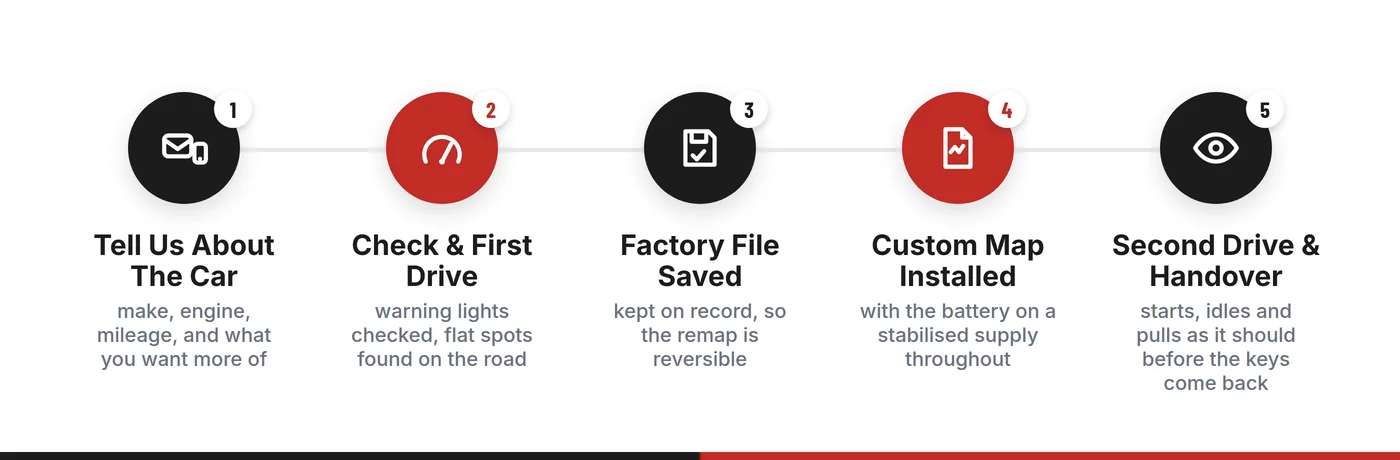
- Tell us about the car and what you want from it
Make, model, engine, mileage and service history, plus what you want more of: economy, towing strength or sharper response. The enquiry form takes all of it in one go.
- We recommend a map and agree where the work happens
You get our view on which type of remap suits the car, whether anything should be looked at first, and whether the session is best done at your address, by collection or at our garage.
- Condition check and a first road test
We look over the car and its warning lights, then drive it through the gears to find the flat spots and hesitation the new map should remove. That drive is the baseline the result is judged against.
- The factory file is read and stored
Your original calibration is saved and kept on record before anything changes. It is what makes the remap reversible.
- The custom map is installed
The calibration developed for your car goes on with the battery supported on a stabilised supply for the whole of the install.
- Second road test and handover
The car is driven again to confirm it starts, idles and pulls as it should, with any adjustment made before the keys come back to you.
Some newer engine ECUs are protected and cannot be remapped in the car. Where that applies, the unit is removed and sent to us; the original file is saved and the new map installed before it goes back to be refitted.
Can you remap my car at home? Mobile, collection and while-you-wait
Yes, and there are three ways to arrange a session, depending on how much of your day you want to give to it.
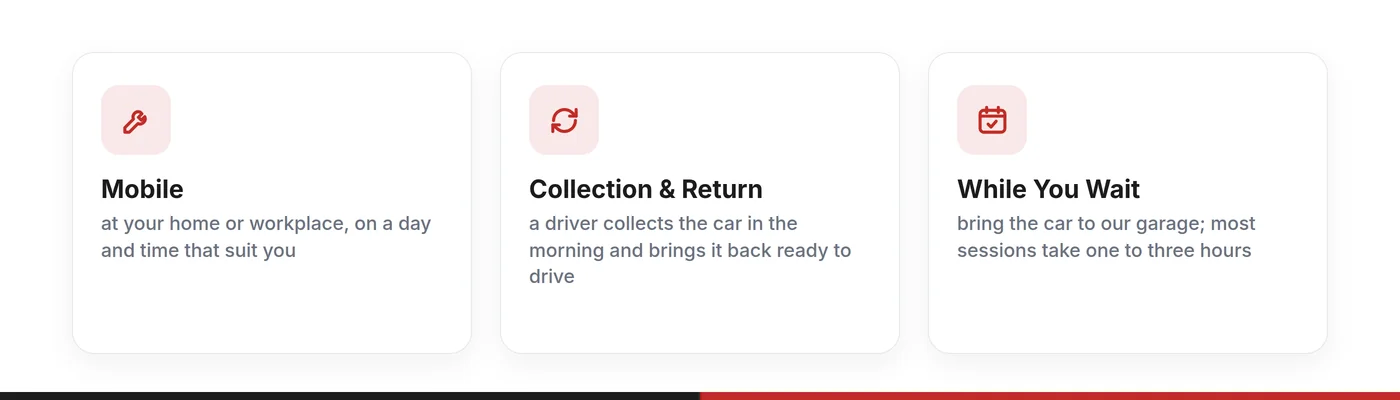
- Mobile, at your home or workplace. We come to the car on a day and at a time that suit you. You do not need to stay for the session: hand over the keys and collect them when the work is done, or stay and watch if you are curious.
- Collection and return. A driver collects the vehicle on the morning of the booking, the remap is carried out at our garage, and the car comes back to you ready to drive. Business and trade customers often choose this route.
- While you wait. Bring the car to us and wait while it is done. The drive home is usually where the difference first makes itself felt.
If you searched for a remap near you, the mobile option is the one that comes closest: the work travels to where the car is parked. Tell us where the car is kept when you get in touch, and we will confirm which options are available at your location.
Sinspeed · engine tuning
Get a remap recommendation for your carTell us the vehicle, its mileage and how it is used. We will suggest the type of map that fits, say whether anything should be looked at first, and set out the booking options for where the car is kept.
Mobile, collection or while-you-wait · Most sessions one to three hours
How long does an ECU remap take?
Most sessions take between one and three hours, start to finish. Much of that time goes on the work either side of the install — the first road test, saving the original file and the second drive — rather than on the map itself.
Allow longer where the ECU has to come out of the car, or where the first drive finds something that needs a closer look. With a mobile session or a collection, the time is ours rather than yours: you do not need to wait with the car.
Insurance, warranty and the MOT: what to know before you book
Insurance. A remap is a modification, and your insurer should hear about it before you drive the car on the new map. Declaring it is usually a short conversation. Leaving it out can put a future claim at risk, and the insurer may adjust the premium once it knows.
Manufacturer warranty. If the car is still covered, expect a remap to affect the powertrain side of that cover, and read the terms or ask the dealer before booking. Reinstating the original file restores the standard map, but it does not erase the fact that the car was remapped, so be open with the dealer about it.
MOT. A road remap leaves the DPF, EGR valve and catalytic converter fitted and working, so the car is tested exactly as a standard one would be and has to meet the same emissions limits. We cannot promise any MOT result, which depends on the whole car on the day, but the remap itself removes nothing the test looks at.
DPF or EGR delete, decat and pops-and-bangs maps remove or override emissions equipment, so a vehicle carrying them is for off-road and motorsport use only, not for the public road. None of this is part of a road remap. For off-road and competition vehicles, the work is explained on our DPF and EGR delete remap page.
What should you ask before anyone remaps your car?
Remaps are sold on price more than anything else, and price is the easiest thing to compare and the least useful. A badly judged file on an engine nobody checked can leave a car running worse than before, with no way back if the original was never saved. These are the questions that separate a careful job from a quick one, with our answer to each.
| Ask this | Why it matters | Our answer |
|---|---|---|
| Will my original file be saved? | It is the only route back to standard, for a sale, a dealer visit or a change of mind | Yes — read and kept on record before anything changes |
| Is the car checked before the map goes on? | A fault left in place does not disappear because the map changed | A condition check and a first road test, with anything found raised before work starts |
| Is the map made for my car, or taken from a library? | Cars with the same engine differ in mileage, condition and fitted hardware | A custom calibration for your make, model, engine and ECU |
| Does the emissions equipment stay? | A road car needs it fitted and working | On every road remap, yes |
| Is the car driven afterwards? | It proves the car starts, idles and pulls properly before you rely on it | Road-tested before and after the install |
| Who do I speak to if something feels wrong later? | Aftercare is worth little if nobody who knows the car picks up | The team that carried out your remap |
If a remapper cannot give a clear answer to the first two, that tells you most of what you need to know.
Common questions about booking a remap
Do I have to stay with the car while it is remapped?
No. For a mobile session you hand over the keys and collect them when the work is finished, and with collection a driver brings the car back to you remapped. You are welcome to stay and watch, and the while-you-wait option is there if you would rather bring the car to us.
Can the car go back to its factory map later?
Yes. Your original calibration is read and stored before the new map is installed, so it can be reinstated for a sale, a dealer visit or simply a change of mind. Going back to standard restores the factory map; it does not undo the record that the car was modified.
Will I feel the difference straight away?
Usually, from the first drive. Sharper throttle response and the absence of flat spots are the changes most owners notice first, along with needing fewer downshifts to gather speed. How pronounced it feels depends on the engine and the type of map.
Can you remap a car with a warning light on?
Not until the cause has been found and put right. A warning light means the engine is already reporting a problem, and a new map neither fixes it nor makes it safer to ignore. We will tell you what the check found, and the remap can go ahead once the car is ready for it.
My car is still under manufacturer warranty. Should I wait?
Check the warranty terms, or ask the dealer, before you book. A remap is likely to affect powertrain cover, and it is better to know that in advance than to find out when you make a claim. Waiting until the warranty ends is a sensible choice for some owners.
Do you remap vans as well as cars?
Yes. Diesel vans are among the vehicles that gain most from a remap, particularly when they work loaded or cover long routes, because the extra low-down torque reduces how hard the engine has to work. Tell us the make, model and engine and we will confirm what is available.
Why is there no price or power figure on this page?
Both depend on the exact vehicle. Gains vary between engines, and even between two cars with the same engine, depending on condition and any other modifications, and the work involved varies by make and model. Tell us the car and we will confirm what is realistic and what the job involves.
Final thoughts
A remap is a change of instructions, not of hardware, and that is both its appeal and its risk. Done on a healthy engine, with the original file kept and the car driven before and after, it makes a car or van easier and more satisfying to drive, working within headroom the engine already has.
The part worth paying attention to is everything around the map. Whether the car was checked, whether the factory file still exists and whether anyone drove it afterwards decide how a remap turns out far more than any figure on a quote. Choose on those, and on the condition of your car, and the right map follows.
Sinspeed · remap bookings
Book a remap that starts with a checkGive us the make, model, engine and mileage, and tell us what you want the car to do better. We will recommend a map, flag anything that needs attention first and confirm where the session can take place.
Original calibration kept on record · Road test before and after · Aftercare once the job is done