
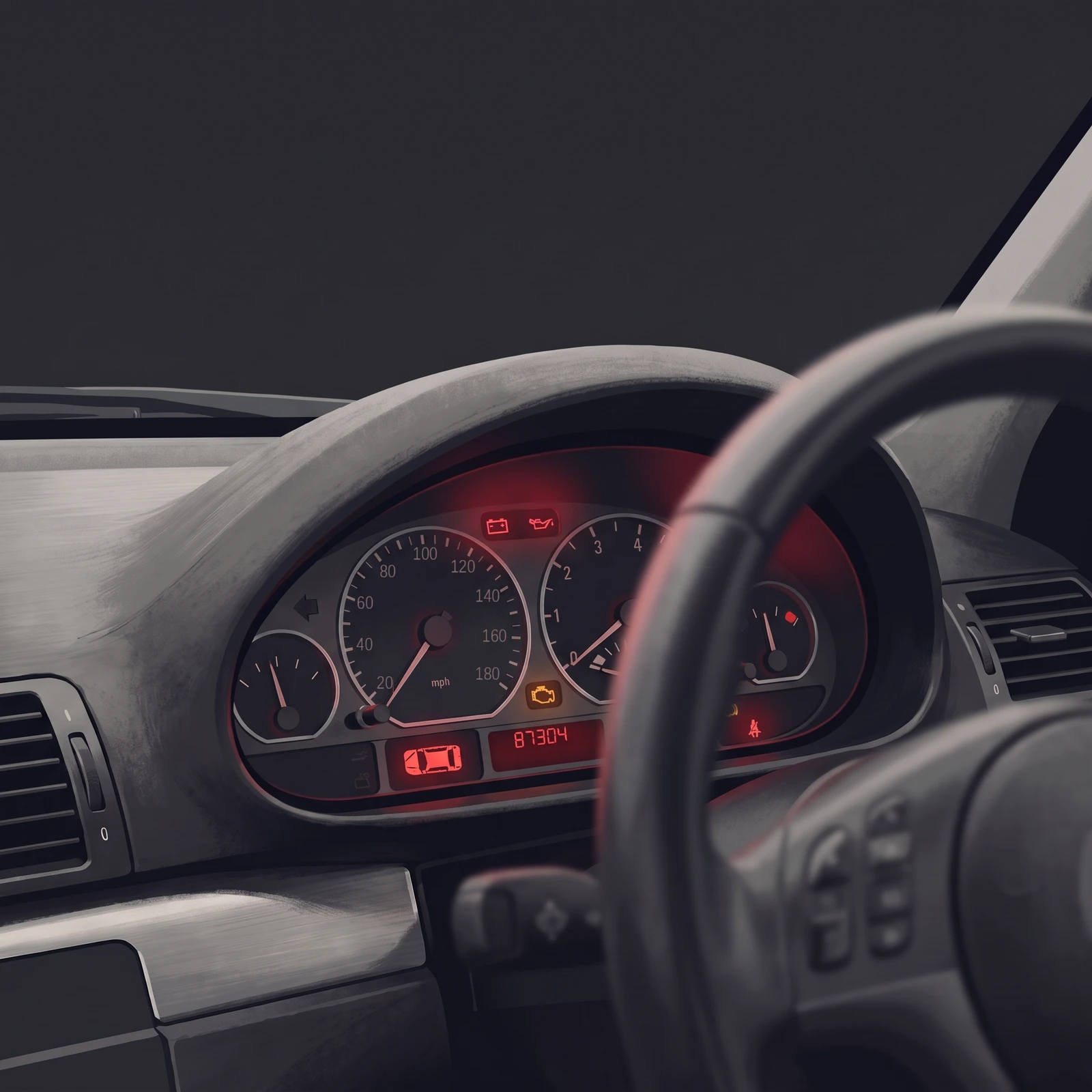
Summary: Ford no longer builds the Mondeo, so every one on a UK road is a used car, and the oldest are more than twenty years old. That changes what a warning lamp asks of you. After “is it safe to drive?” comes “repair the unit or replace it?” — on a car where some of the units behind those lamps are not even sold on their own. This page gives every Mondeo dashboard symbol from the Mk3 to the Mk5 with a safe-to-drive verdict, then shows which lamps point at a failed electronic unit, and why repairing the one already fitted is often the practical answer.
- Why a warning lamp asks a different question on a Mondeo
- Ford Mondeo dashboard symbols and meanings: the full table
- Which Mondeo you are in, and what it changes
- Which lamp means a failed module on a Mondeo
- Repair the unit or replace it: the choice on a Mondeo
- What to do when a warning light comes on in your Mondeo
- Ford Mondeo warning lights FAQs
- Final thoughts
Why a warning lamp asks a different question on a Mondeo
The colours work as they do on every car. Red means stop as soon as it is safe, amber means a fault has been stored and wants attention, and green or blue only confirm that something is switched on — our guide to what dashboard warning lights mean sets that out in full. What is different about a Mondeo is the car the lamp is lit on.
Every Mondeo has a history. The electronics behind its dashboard have lived through every heat cycle, pothole and cold start the car has made, and heat and vibration are what wear a control unit out. So an ageing unit is a genuine suspect behind an amber lamp, and once the safety question is answered, the next one is what to do about it. Three things follow.
- The cheap checks still come first. Age does not change the order: fluids, bulbs, tyres and the battery are ruled out before any module is blamed.
- A replacement is not automatically newer than what failed. A used unit from another Mondeo is the same age, has done similar work, and may need programming to your car before it will work at all.
- Some units are not sold on their own. The dealer does not sell the 2.0 TDCi’s electronic turbo actuator without the turbocharger, or the early diesel pump’s control unit without the pump — so repairing the failed part is often the only way to avoid replacing the assembly around it.
None of this softens a red lamp. Brakes, steering, oil pressure, overheating and airbags mean exactly what they mean on any other car, however many miles this one has covered.
Ford Mondeo dashboard symbols and meanings: the full table
Filtered to lamps a Mondeo can show, Mk3 to Mk5. Tyre-pressure monitoring, stop-start, driver assistance and the diesel lamps depend on generation, engine and trim, so a row that does not match your car is simply not fitted to it. Where a fault could be trivial or serious, the verdict assumes serious.
| Colour | Symbol | What it means on a Mondeo | Is it safe to drive? |
|---|---|---|---|
| Red | 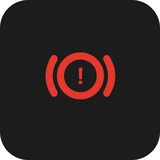 Brake system — an exclamation mark in a circle with a bracket each side Brake system — an exclamation mark in a circle with a bracket each side | The handbrake is still on, brake fluid is below minimum, or the braking system has a fault. | No, unless it goes out when the handbrake is fully released. Otherwise stop and arrange recovery. |
| Red | 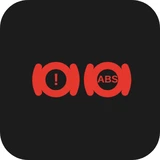 Brake system and ABS lit together Brake system and ABS lit together | Both braking warnings at once. The ABS unit also balances braking front to rear, and that balance may be lost. | No. Brake gently, stop as soon as it is safe, and have the car recovered. |
| Red | 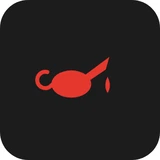 Oil pressure — an oil can with a drip Oil pressure — an oil can with a drip | Oil pressure has fallen. This is the pressure lamp, not the amber level warning further down. | No. Switch the engine off. Bearings are damaged in seconds without oil pressure. |
| Red | 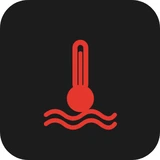 Coolant temperature — a thermometer in waves Coolant temperature — a thermometer in waves | The engine is overheating: coolant lost or not circulating, or the cooling fan not running. | No. Stop, switch off and let it cool. Never open a hot expansion tank. |
| Red | 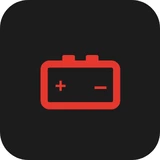 Charging system — a battery with plus and minus terminals Charging system — a battery with plus and minus terminals | The battery is no longer being charged, so the car is running on stored charge. | Only as far as somewhere safe. When the charge is gone, the car stops. |
| Red | 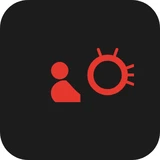 Airbag and restraints — a seated figure facing an inflated circle Airbag and restraints — a seated figure facing an inflated circle | The restraint system has a stored fault. An airbag or belt pretensioner may not fire in a collision. | It drives normally, but the protection is not there. Have it diagnosed now, and never worked on at home. |
| Red and amber | 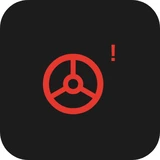  Power steering — a steering wheel with an exclamation mark Power steering — a steering wheel with an exclamation mark | Assistance reduced (amber) or lost (red). A car with a steering fluid reservoir has hydraulic assistance; one without it is electric. | Red, no — the wheel can go heavy without warning. Amber, with care and not far. |
| Red |   Seat belt, and a door, bonnet or boot open Seat belt, and a door, bonnet or boot open | A belt is unfastened, or a closure is not properly latched. | Stop and put it right before driving on. |
| Red |  Theft indicator — a car outline with a key Theft indicator — a car outline with a key | Ford’s PATS immobiliser lamp. A slow flash with the ignition off is normal; rapid flashing means the key was not recognised. | If the engine is running, yes for now. If it cranks and dies, try the spare key. |
| Amber |  Engine management — an engine block outline Engine management — an engine block outline | Steady: a stored engine or emissions fault. Flashing: an active misfire that can damage the catalyst. | Steady and driving normally: gently, with the codes read within days. Flashing: stop. |
| Amber |  Diesel preheat — a coiled filament Diesel preheat — a coiled filament | Lit briefly before a cold start: normal preheating. Flashing while you drive: the engine reporting a fault, often with limp mode. | Preheat, yes. Flashing with power lost: get off the road and have the codes read. |
| Amber |  Powertrain fault — a plain spanner Powertrain fault — a plain spanner | Not a service reminder. On a Ford it covers the engine and driveline electronics, including gearbox faults on an automatic. | Driving normally: short journeys, then have it read. Refusing gears or in limp mode: stop using it. |
| Amber |  ABS — the letters ABS in a circle with a bracket each side ABS — the letters ABS in a circle with a bracket each side | Anti-lock has switched itself off. Ordinary braking still works. | With care, if the red brake lamp is out. Leave more room. It is also an MOT failure. |
| Amber |   Stability and traction control, and the OFF version Stability and traction control, and the OFF version | Flashing: the system is working. Steady: switched off or faulty. OFF: the button has been pressed. | Flashing on a slippery road is normal. Steady in ordinary driving: have it read. |
| Amber |  Tyre pressure — a horseshoe with an exclamation mark Tyre pressure — a horseshoe with an exclamation mark | A tyre is below pressure, or the system cannot read a sensor. Later cars only. | Only as far as somewhere you can check all four. Avoid hard braking until then. |
| Amber |  Particulate filter — a box with a row of dots Particulate filter — a box with a row of dots | Soot has built up in the diesel particulate filter and a regeneration has not finished. | Yes. A sustained run at a steady speed often lets the regeneration complete. |
| Amber |   Water in fuel, and AdBlue Water in fuel, and AdBlue | Water has collected in the diesel fuel filter; or AdBlue is running low, on diesels that use it. | Water: only briefly. AdBlue: top it up before it runs out, or the engine will not restart. |
| Amber |   Low oil and low coolant — each with a level line Low oil and low coolant — each with a level line | A level is below minimum. Neither is the red pressure or temperature lamp. | Yes, briefly. Check cold, top up, and treat a level that falls again as a leak. |
| Amber |  Brake pad wear — a dashed ring Brake pad wear — a dashed ring | The pads have worn down to the wear sensor. | Yes, but book it in now. The margin left is finite. |
| Amber |   Lighting — a broken bulb, and a headlamp with an exclamation mark Lighting — a broken bulb, and a headlamp with an exclamation mark | An exterior lamp is out, or the circuit or headlamp control behind it has a fault. | Yes, but a lamp that is out is an MOT failure and a hazard after dark. |
| Amber |  Stop-start — the letter A in a circular arrow Stop-start — the letter A in a circular arrow | The system has taken itself out of use, most often because of the battery. | Yes. Have the battery and its monitoring sensor checked. |
| Amber |  Driver assistance — a car between lane lines Driver assistance — a car between lane lines | A driver-assistance system is unavailable, usually because its camera or sensor cannot see. | Yes. Do not rely on the system until the lamp clears. |
| Amber |  General warning — an exclamation mark in a triangle General warning — an exclamation mark in a triangle | A message is waiting in the display. The text is the warning; the triangle only flags it. | Read the message and treat it as whatever it names. |
| Green, blue and amber tell-tales |    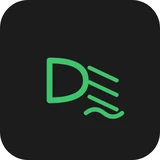  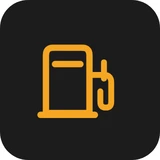 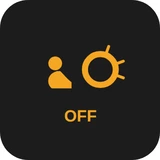 Dipped beam, main beam, indicators, front and rear fog lights, low fuel, passenger airbag off Dipped beam, main beam, indicators, front and rear fog lights, low fuel, passenger airbag off | These confirm that something is switched on, or that fuel is low. Indications, not faults. | Yes. A lit rear fog light dazzles the car behind, and a passenger airbag shown as off should be off deliberately. |
Which Mondeo you are in, and what it changes
The date of first registration on the V5C settles the generation, and the engine is on the same document. On a Mondeo both matter more than the badge, because several of the units that light lamps on this car belong to one engine or one gearbox rather than to the model as a whole.
| Generation | Built | What it changes on the dashboard |
|---|---|---|
| Mk3 | 2000 to 2007 | The oldest Mondeos on the road. The first diesel, the 2.0 TDDi, carries an injection pump with its own control unit on top; the 2.0 TDCi that followed controls its turbocharger with an electronic actuator. Both announce a failure on the dashboard. |
| Mk4 | 2007 to 2014 | A larger car. Automatic versions include the wet-clutch PowerShift gearbox that the S-Max and Galaxy also use — a different gearbox from the dry-clutch unit in a Fiesta or Focus. |
| Mk5 | 2014 to the end of production | Petrol, diesel and Hybrid. PowerShift continues on many automatics, tyre-pressure and driver-assistance lamps become common, and the Hybrid adds a high-voltage system with warnings of its own. |
On the Hybrid, a warning naming the hybrid or high-voltage system is not a roadside job or general-garage work: it needs a technician trained for high-voltage systems. The Hybrid does not use PowerShift either, so PowerShift advice does not transfer to it. Our Ford Kuga warning lights page shows how a drivetrain changes the meaning of the same lamp.
Which lamp means a failed module on a Mondeo
Most Mondeo lamps are a fluid, a bulb, a tyre or a sensor, and those are worth ruling out first. The units below are different. Each sits behind a lamp, each has aged with the car, and each has a Mondeo or Ford page of its own on this site.
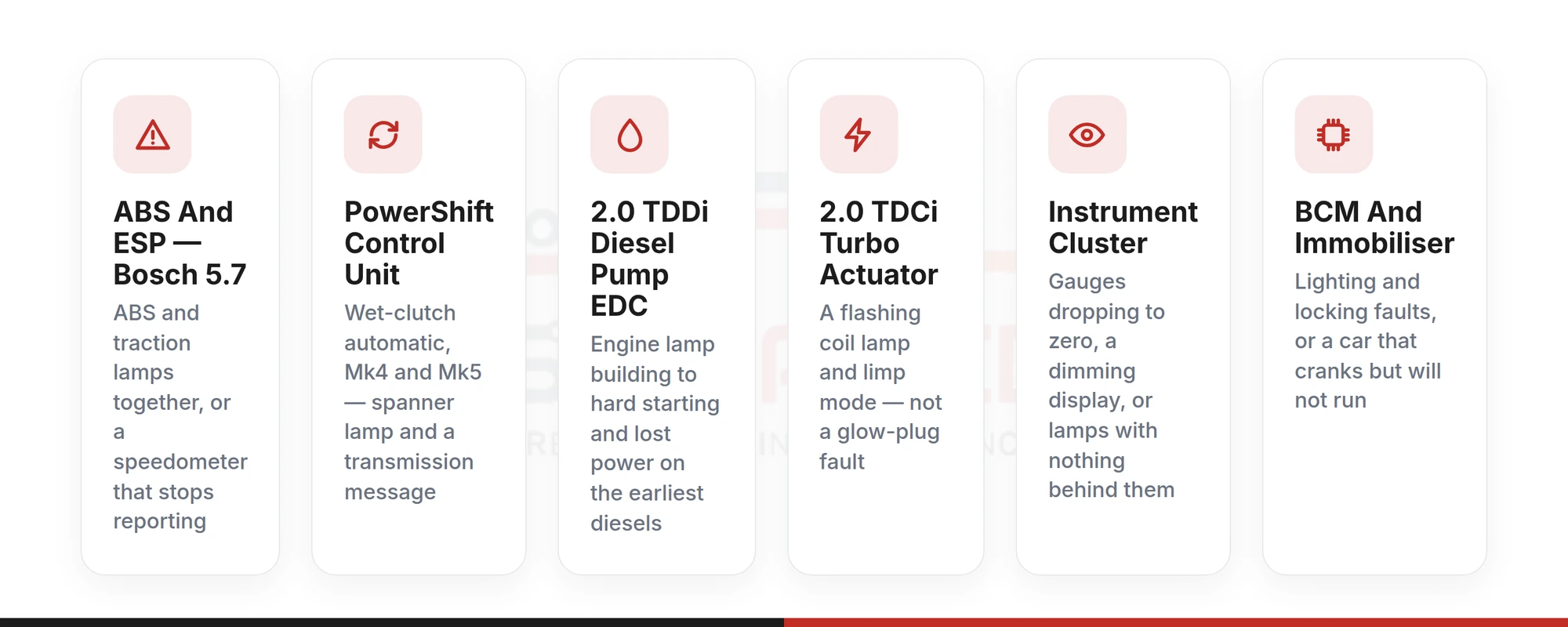
They share one habit: a degraded control unit rarely fails cleanly. It drifts, drops out when hot, recovers when cold, and mimics mechanical faults — lost power that looks like a tired turbocharger, a non-start that looks like a fuel problem, a dead speedometer that looks like a broken cluster. That is how parts get replaced around a fault that was in a unit all along, and why reading the codes before buying anything saves the most wasted effort.
ABS and ESP: the Bosch 5.7, and a speedometer that stops
The Mondeo’s Bosch 5.7 unit pairs the hydraulic block that modulates brake pressure with the control module that decides when to. The faults we see on it are the ABS and traction lamps lit together, a module that will not communicate with a diagnostic tool, and a speedometer that stops working. That last one catches people out: when the road-speed signal comes from a failing ABS unit, the instrument cluster looks broken while it is only showing what it has been sent.
A wheel speed sensor is still the first suspect for an ABS lamp on its own, and the codes separate the two. Our Mondeo Bosch 5.7 ABS and ESP module page sets out the testing and repair, the wider work sits under ABS pump and module repairs, and whether an ABS light fails the MOT is covered separately. If the red brake lamp is lit as well, the car is recovered, not driven.
The PowerShift automatic and its control unit
Mk4 and Mk5 automatics with PowerShift use the wet-clutch version of the gearbox, and its failure pattern is its own: gears dropping out, harsh or delayed shifts, and limp mode that tends to arrive once the gearbox is warm, usually with the spanner and a transmission message. Much of the PowerShift reputation you will read about belongs to the dry-clutch unit in the smaller Fords — our Ford Focus warning lights page deals with that car — and our guide to Ford PowerShift problems separates the two gearboxes properly.
The codes decide between a mechanical fault and one on the control side. When they point at the control side, your garage removes the unit and posts it to us, and our Ford PowerShift TCM repair page covers what happens next. Any adaptation the gearbox needs after refitting is part of fitting it. More gearbox electronics sit under transmission control module repairs.
The diesel pump control unit on the 2.0 TDDi
The first diesel Mondeos — the 2.0 TDDi built between late 2000 and 2002 — use a Bosch VP44 injection pump with its electronic diesel control unit mounted on top. Sitting on the pump exposes it to heat and vibration for every mile the car does, and that is what wears it out. The symptoms build from an engine lamp and rough running to hard starting, lost power and, finally, a car that will not start at all.
The control unit is not sold separately from the pump, which is why the usual quote covers both. Our Fiesta, Focus and Mondeo diesel pump EDC repair page covers the unit, diesel pump EDC fault codes explains what the codes are telling you, and a repaired unit goes back ready to fit, with no coding.
The electronic turbo actuator on the 2.0 TDCi, and a flashing coil
On a Mondeo diesel the coil lamp lights for a few seconds before a cold start as a matter of course. Flashing while you drive is a different message, and on the 2.0 TDCi built between 2001 and 2007 one documented cause is the electronic actuator that controls the turbocharger on the engine ECU’s instruction. When it fails, the glow-plug lamp flashes, the engine drops into limp mode, and power disappears under acceleration — sometimes intermittently, sometimes with smoke — with codes stored for charge-air pressure control or turbo performance.
The dealer does not sell the actuator on its own, so the usual answer is a complete turbocharger for a fault in the part bolted to it. We rebuild the actuator itself — see our Mondeo 2.0 TDCi electronic turbo actuator repairs — and it goes back ready to fit, with no programming. If the codes and a physical inspection show the turbocharger itself is damaged, that is one for our turbo specialists at turbo-repairs.com — our sister site for everything turbo.
The instrument cluster
A cluster that misreports makes every other lamp unreliable, so rule it in or out early — after the ABS speed signal, for the reason above. Gauges that drop to zero or stick, a display that dims or comes and goes with temperature, dashes where the mileage should be, or unrelated lamps with nothing behind them are cluster faults. The work sits under instrument cluster repairs, and our Ford Focus, Galaxy and S-Max cluster page shows how a Ford cluster of the same period is rebuilt. Repairing your own unit keeps your recorded mileage where it is.
The sat-nav and multi-function display
Not a warning lamp, but on a Mondeo with Ford’s factory multi-function display navigation the centre screen is an electronic unit that fails in recognisable ways: a display that stays dark or will not turn on, a touchscreen that stops responding, navigation that stops working, software that will not load. Ford’s answer is a replacement unit. Ours is to bench-test and repair the one you have, which comes back with no programming needed — see Ford MFD sat-nav screen problems.
The body control module, the immobiliser and the engine ECU
If the complaints are lighting, indicators, wipers or central locking rather than gauges — a bulb warning that survives a new bulb, indicators flashing at the wrong rate with nothing blown — the body control module is the unit to consider. A Mondeo that cranks but will not run, with the theft lamp flashing rapidly, is usually the immobiliser refusing the key: try the spare first, then see the Ford PATS no-start and theft light. And where diagnosis points at an internal failure of the engine ECU itself, that work belongs with the independent specialists at ecu-repairs.com.
Sinspeed · Ford electronics
Tell us the engine before you tell us the symbolSinspeed repairs and remanufactures vehicle electronic units in the UK. On a Mondeo the engine narrows the suspects faster than the lamp — an engine lamp on a 2.0 TDDi and a flashing coil on a 2.0 TDCi point at different units. Send the engine, the fault codes and what the car did, and we will tell you which unit is behind the lamp before anything is removed.
Units tested on in-house Hardware-in-the-Loop rigs that simulate heat, vibration and load · Work carried out by our own electronic and hydraulic engineers
Repair the unit or replace it: the choice on a Mondeo
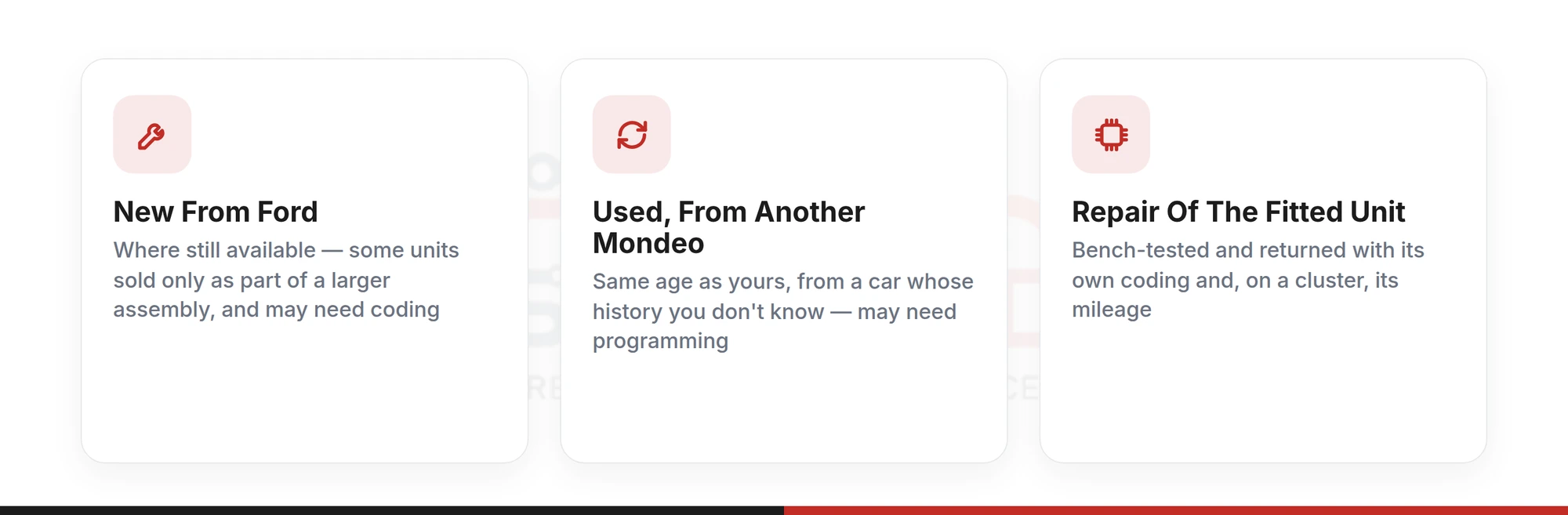
On a car still in production the default is a new part. On a Mondeo the three options look different, and it is worth seeing them side by side before anything is ordered.
| Option | What you are actually getting | What to check first |
|---|---|---|
| New from Ford | Where it is still available, a new unit — but some are sold only as part of a larger assembly: the turbo actuator with the turbocharger, the diesel pump’s control unit with the pump. | Whether it needs coding to the car, and how much of the assembly has to come off. |
| Used, from another Mondeo | A unit the same age as yours, from a car whose history you do not know. | Whether it needs programming to your car, which many do, and whether it carries the same weakness that failed yours. |
| Repair of the unit already fitted | Your own unit, bench-tested, repaired and returned. | That the fault genuinely sits in the unit — which is why the codes come first — and the warranty that comes back with it. |
Repair has one more advantage on a car of this age: the fitted unit carries the car’s coding and, in a cluster’s case, its mileage, and on the lines above it goes back ready to fit. Taking it out is your garage’s job, and it travels to us by post while the car waits. Where refitting involves coding, calibration or an adaptation run, that is a step in the job, not an obstacle to it.
What to do when a warning light comes on in your Mondeo
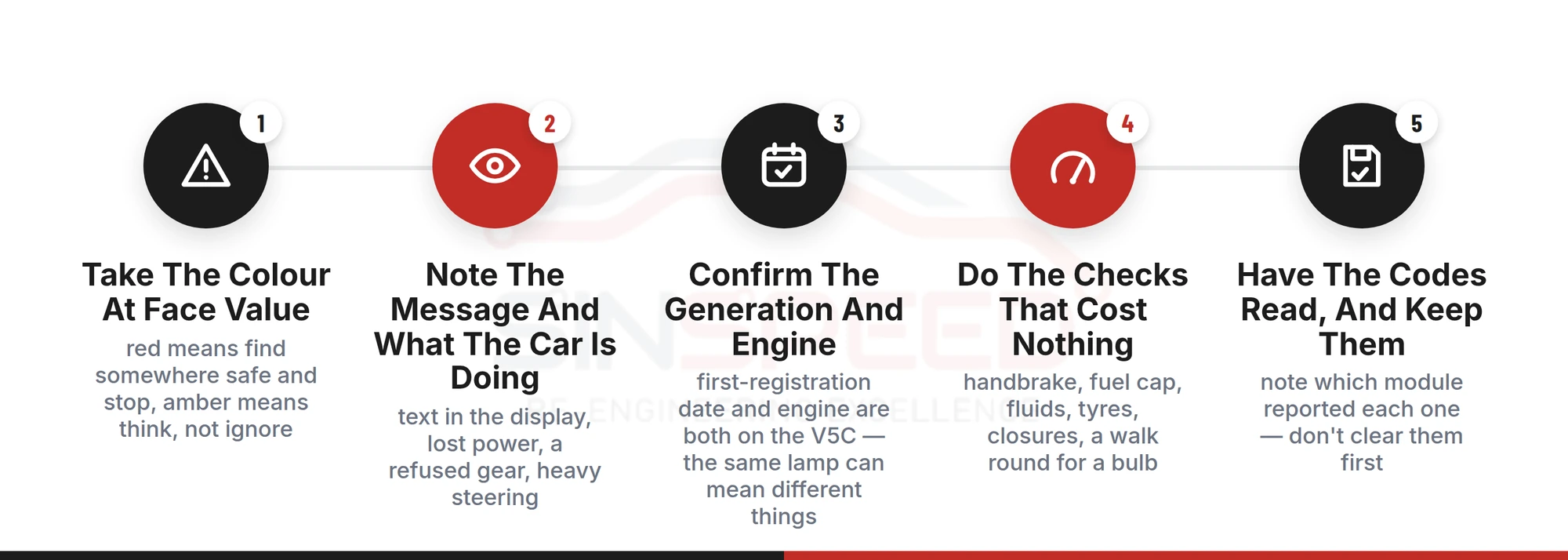
- Take the colour at face value. Red: find somewhere safe and stop. Amber: you have time to think, but not unlimited time.
- Note the message and what the car is doing. Write down any text in the display before you switch off, and whether the car has lost power, refused a gear or gone heavy to steer.
- Confirm the generation and the engine. Both are on the V5C. A TDDi, a TDCi and a Hybrid can light the same lamp for entirely different reasons.
- Do the checks that cost nothing. Handbrake fully off, fuel cap shut, oil and coolant with the engine cold, tyre pressures, doors and boot latched, and a walk round for a dead bulb.
- Have the codes read, and keep them. Note which module reported each one, and do not clear them first — clearing a brake, steering or airbag lamp repairs nothing and throws away the evidence.
The generic sequence is on our parent page, and the same method runs through our Ford Ka warning lights and Ford Puma dashboard symbols pages if there is another Ford on the drive.
Ford Mondeo warning lights FAQs
What do the symbols on a Ford Mondeo dashboard mean?
Read the colour before the shape. Red symbols — brakes, oil pressure, coolant temperature, charging, airbags, power steering — mean stop as soon as it is safe. Amber means a stored fault that needs attention, from engine management and ABS to the powertrain spanner and the diesel lamps. Green and blue only confirm that something is on. The table on this page covers every Mondeo symbol from the Mk3 to the Mk5, each with a safe-to-drive verdict.
What does the flashing coil light mean on a Ford Mondeo diesel?
Lit for a few seconds before a cold start, the coil is normal glow-plug preheating. Flashing while you drive, it is the engine reporting a fault, usually with limp mode reducing power. On the 2.0 TDCi a failing electronic turbo actuator is a documented cause: the lamp flashes, power drops away under acceleration, and codes for boost or charge-air pressure control are stored. It is not a glow-plug fault just because the symbol is a coil. Have the codes read before anything is replaced, and certainly before a turbocharger is condemned.
Why has my Mondeo’s speedometer stopped working with the ABS and traction lights on?
Because it may be one fault rather than two. On the Mondeo’s Bosch 5.7 ABS and ESP unit, the faults we see include the ABS and traction lamps lit together, a module that will not communicate with a diagnostic tool, and a speedometer that stops. When the road-speed signal comes from a failing ABS unit, the cluster looks faulty while it is only displaying what it has been sent. Have the ABS unit’s codes read before the cluster is blamed.
Can I drive my Ford Mondeo with the ABS light on?
With care, provided the red brake warning lamp is not lit as well. Normal braking still works, but anti-lock has switched itself off, so the wheels can lock under hard braking and stopping distances grow on a wet or greasy road. Leave more room, brake earlier and get the codes read; an ABS lamp showing a fault is also an MOT failure. If the red brake lamp is lit alongside it, the braking balance front to rear may be affected too. Stop as soon as it is safe and have the car recovered.
My Mondeo automatic is in limp mode with a warning light on. Is it the gearbox?
It may be. Mk4 and Mk5 automatics with PowerShift use the wet-clutch version of the gearbox, and a fault there usually arrives with the amber spanner and a transmission message, along with gears dropping out, harsh or delayed shifts, or limp mode once the gearbox is warm. The codes separate a mechanical fault from one on the control side. If they point at the control unit, your garage removes it and sends it to us for repair. Do not keep driving a car that refuses gears or drops out of drive.
My Mondeo 2.0 TDDi is hard to start and the engine light is on. What could it be?
On the 2.0 TDDi built between late 2000 and 2002, one strong suspect is the electronic control unit mounted on top of the Bosch VP44 injection pump. Heat and vibration from the pump wear it out, and the symptoms build from an engine lamp and rough running to hard starting, lost power and eventually a non-start. The control unit is not sold separately from the pump. Have the codes read to confirm it; if the unit is at fault, it can be repaired and returned ready to fit, with no coding.
Is it worth repairing the electronics on an older Mondeo?
Often, yes, for mechanical reasons. A used replacement is the same age as the unit that failed and may need programming to your car. Some parts are not sold on their own: the dealer supplies the 2.0 TDCi turbo actuator only with a turbocharger, and the TDDi pump’s control unit only with the pump. Repairing the fitted unit keeps its coding and, on a cluster, its mileage. The deciding step is confirming the fault really is in the unit, which is what the codes are for.
Sinspeed · mail-in repair
Keep the unit that already knows your MondeoYour garage takes out the unit the codes point at and posts it to us. We bench-test it under simulated load, repair it and calibrate it, then send it back to be refitted — and most remanufactured parts carry a lifetime, unlimited-mileage warranty. If you are not sure which unit to send, tell us the engine, the lamps and the codes, and we will confirm it first.
Repaired in a cleanroom-standard, ESD-safe workshop · Many units go back ready to fit, with no coding
Final thoughts
A Mondeo speaks the same dashboard language as every Ford. What has changed is the car doing the talking: it is out of production, it has a history, and some of the units behind its lamps cannot be ordered on their own.
So read it in two passes. The first is the one every car gets: colour, symbol, message, and whether it is safe to carry on. The second belongs to this car: which engine and gearbox you have, which unit the codes name, and whether that unit is better repaired than swapped for another of the same age. On a car Ford no longer builds, the best unit for the job is often the one already fitted — it knows the car’s coding, carries its mileage, and a repair can deal with the weakness that failed it rather than inheriting it from a used one.