
Summary: Start with the steering lamp, because on a Vauxhall Meriva it has a fault pattern of its own. On a Meriva A the power assistance comes from an electric power steering column, and when the column begins to fail the EPS light typically comes on after a long drive, goes out again, and returns more and more often until the steering turns heavy. This page explains that lamp first, then gives every Meriva A and Meriva B dashboard symbol with a safe-to-drive verdict, and shows which lamps point at a failed electronic unit that can be repaired rather than replaced.
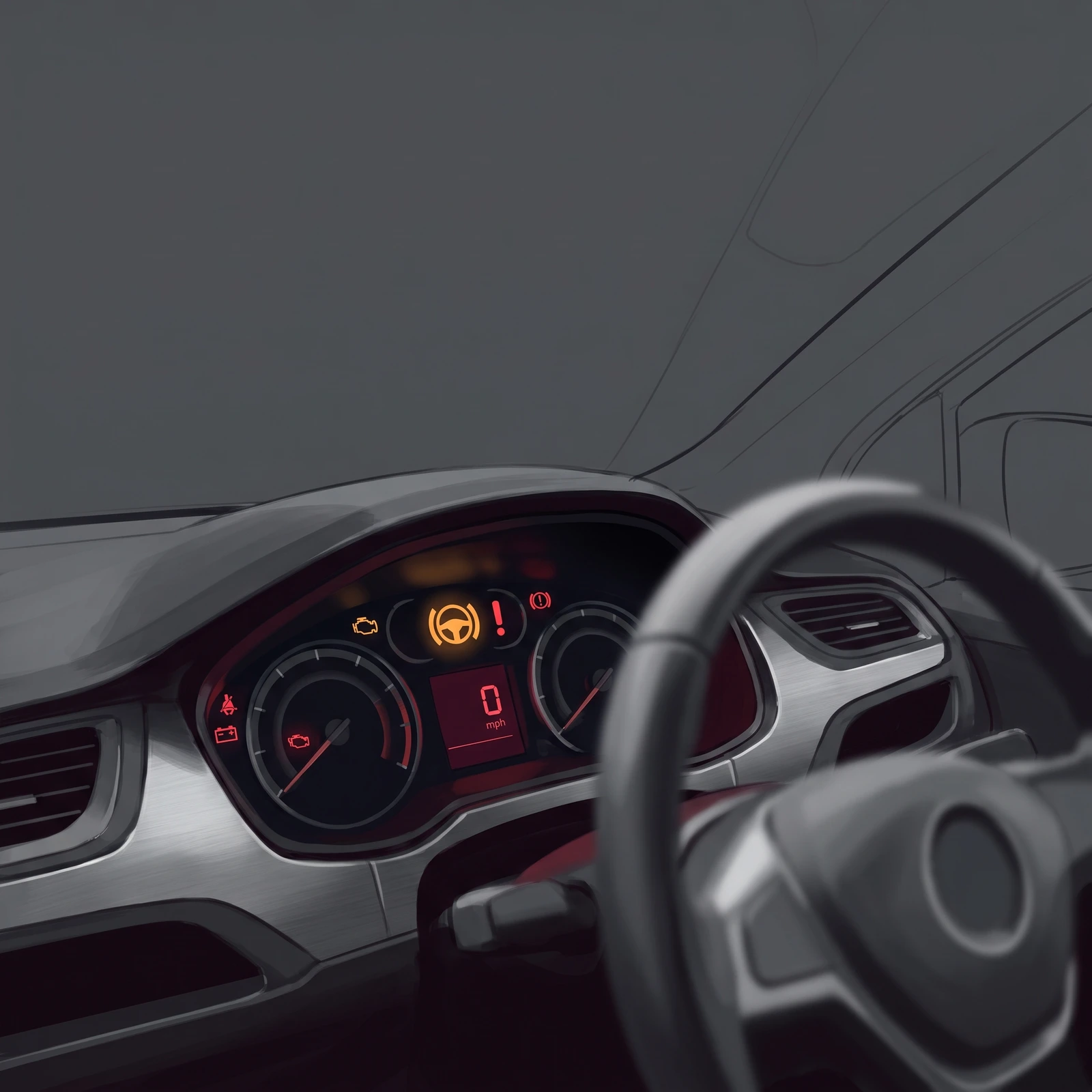
The EPS light on a Meriva: what it is telling you
The colours on a Meriva dashboard work as they do on every car: red means stop as soon as it is safe, amber means a fault has been stored and wants attention, and green or blue only confirm that something is switched on. Our guide to what dashboard warning lights mean covers the colour code in full. The steering lamp is the one that does not behave as neatly as that code suggests.
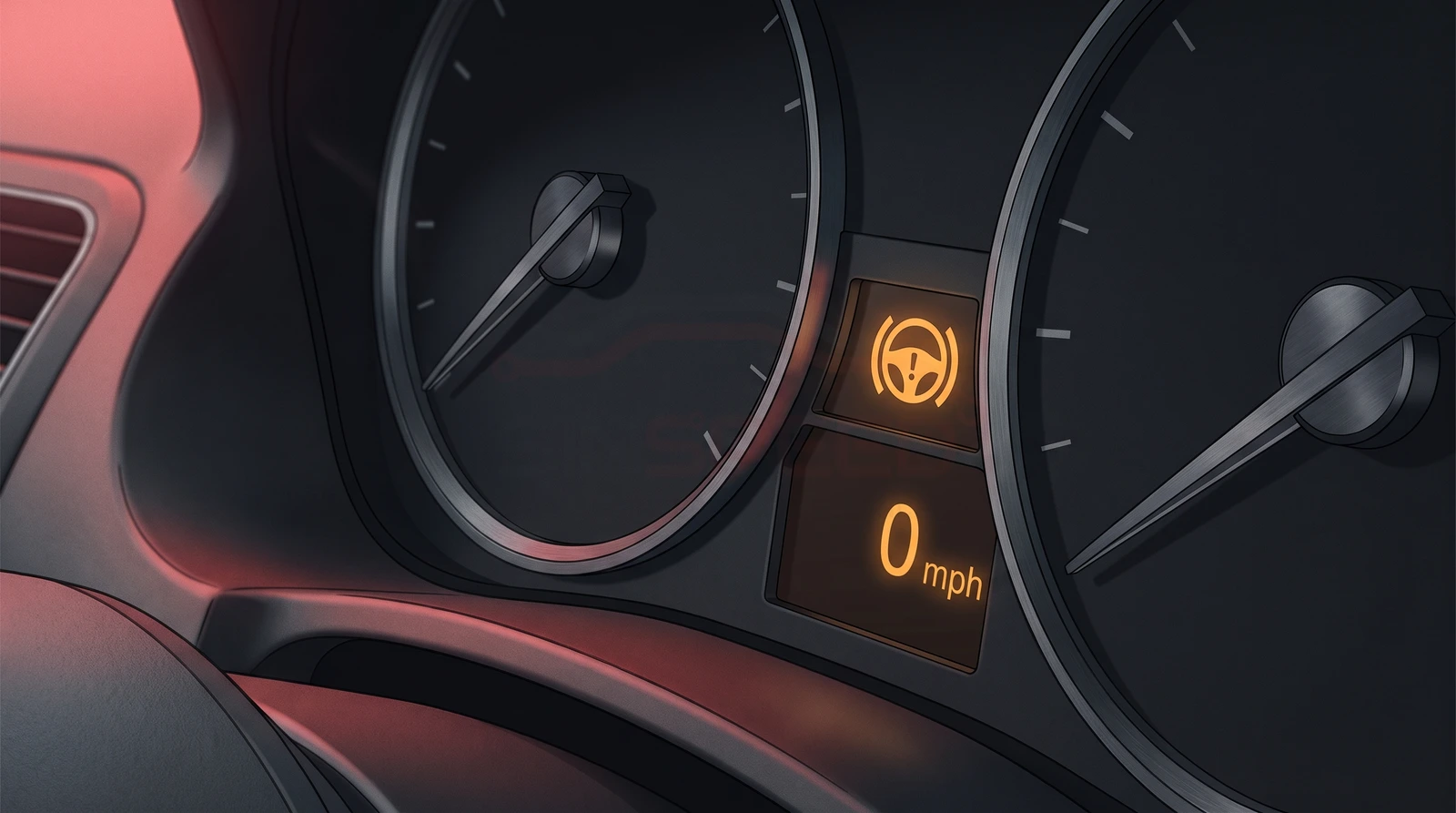
EPS stands for electric power steering. On a Meriva A there is no hydraulic pump and no fluid reservoir behind the lamp: the assistance comes from an electric power steering column, so the light is reporting electronics, and topping anything up will not move it.
The column fault tends to arrive in stages. First the EPS light comes on now and then, often after a long drive, and has gone again by the next start. Then it stays on, and the steering turns heavy in one direction or both — at its worst when you are parking at full lock — until the assistance is lost altogether. That is the pattern our Meriva A electric power steering column repair page describes, and it is why an intermittent lamp deserves attention rather than relief when it goes out.
The timing has a mechanical logic. The column does its hardest work at low speed and full lock, and it lives with the car’s heat and vibration on every journey. A unit that has started to degrade copes while it is cool and drops out once it is heat-soaked, which fits a lamp that appears late in a long run. A fault that clears itself overnight has not gone away.
Can you keep driving? The car still steers without assistance, but it takes far more effort, and on an intermittent fault that effort can arrive in the middle of a manoeuvre. A red steering lamp means stop when it is safe. An amber one means drive carefully, keep the journey short and have it looked at promptly — it is not a lamp to live with.
When the codes are read, the two our column page lists are C1500, a torque position sensor fault, and C1532, a steering position sensor fault; both point at the column rather than the mechanical rack. An electric system also depends on a healthy supply, so rule out a weak battery or a charging fault first, particularly if other electrical lamps are lit. Our guides to electric power steering fault symptoms and what clearing an EPS warning light involves go further.
On a Meriva B, do not assume the A’s column pattern carries across. Have the codes read, send us what they say, and we will confirm which unit sits behind the lamp; steering work across the range is under steering and EPS repairs.
Vauxhall Meriva warning lights and symbols: the full table
Filtered to lamps a Meriva A or B can show. Our Vauxhall warning lights and symbols page covers the whole range, including descent control and air suspension lamps no Meriva carries. Diesel, gearbox and tyre-pressure rows depend on the car, so a row that does not match yours is simply not fitted to it. Where a lamp could mean something trivial or something serious, the verdict assumes serious.
| Colour | Symbol | What it means on a Meriva | Is it safe to drive? |
|---|---|---|---|
| Red |  Brake system — an exclamation mark in a bracketed circle Brake system — an exclamation mark in a bracketed circle | The handbrake is on, the fluid is below minimum, or the braking system has a fault. | Only if it clears the moment the handbrake is fully off. If it stays lit, stop and have the car recovered. |
| Red | 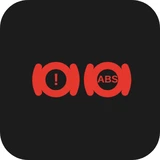 Brake system and ABS together Brake system and ABS together | Both braking warnings at once. The ABS unit also shares braking effort between front and rear, and that balance may be gone. | No. Brake gently, stop when it is safe, and have it recovered. |
| Red and amber |   Power steering (EPS) — a steering wheel with an exclamation mark Power steering (EPS) — a steering wheel with an exclamation mark | Electric assistance reduced or lost. On a Meriva A it is often intermittent at first, then constant with heavy steering. | It still steers, with far more effort. Red: stop when safe. Amber: short, careful journeys, and have it checked promptly. |
| Red |  Oil pressure — an oil can with a drip Oil pressure — an oil can with a drip | Oil pressure has dropped. Not the amber oil-level warning. | No. Switch off at once; bearings are damaged in seconds. |
| Red |  Coolant temperature — a thermometer in waves Coolant temperature — a thermometer in waves | The engine is overheating: coolant lost or not circulating, or the fan not running. | No. Stop, switch off and let it cool. Never open a hot expansion tank. |
| Red |  Charging — a battery with plus and minus terminals Charging — a battery with plus and minus terminals | The battery is not being charged, so everything electrical — the steering assistance included — runs on stored charge. | Only as far as somewhere safe. When the charge is gone, the car stops. |
| Red |  Airbag and belt tensioners — a seated figure facing an inflated circle Airbag and belt tensioners — a seated figure facing an inflated circle | A restraint-system fault. An airbag or pretensioner may not fire in a collision. | It drives normally, but the protection is missing. Have it diagnosed now; never work on it at home. |
| Red |   Seat belt, and a door, bonnet or tailgate open Seat belt, and a door, bonnet or tailgate open | A belt is unfastened, or something is not latched. | Stop and put it right. |
| Red |  Engine and transmission electronics — a car outline with a spanner through it Engine and transmission electronics — a car outline with a spanner through it | Vauxhall’s powertrain electronics warning: a stored engine or gearbox control fault, not the service reminder. | Short journeys only, and only while it drives normally. Have the codes read. |
| Red or amber |  Immobiliser — a car outline with a key Immobiliser — a car outline with a key | Flashing: the key has not been recognised and the engine will not start. Steady: a stored fault in the system. | If it is running, yes for now. If it will not start, try the spare key first. |
| Amber |  Engine management — an engine block outline Engine management — an engine block outline | Steady: a stored engine or emissions fault. Flashing: a misfire that can damage the catalytic converter. | Steady and driving normally: gently, with the codes read within days. Flashing: stop. |
| Amber |  Diesel preheat — a coiled filament Diesel preheat — a coiled filament | Briefly lit before a cold start is normal. Lit or flashing on the move, it is reporting an engine fault. | Preheat, yes. Flashing with power lost: leave the road and have it read. |
| Amber |  ABS — the letters ABS in a circle ABS — the letters ABS in a circle | Anti-lock has switched itself off. Ordinary braking remains. | With care, if the red brake lamp is out. Leave more room. It also fails the MOT. |
| Amber |   Stability and traction control, and the OFF version Stability and traction control, and the OFF version | Flashing: the system is working. Steady: switched off or faulty. Steady with an ESP OFF button that does nothing: see the ABS section below. | Flashing on a slippery road is normal. Steady in ordinary driving: have it read. |
| Amber |  Tyre pressure, where fitted — a horseshoe with an exclamation mark Tyre pressure, where fitted — a horseshoe with an exclamation mark | A tyre is low, or the system cannot read the wheels. On a Meriva B, an ABS unit fault can light it too. | Only as far as somewhere to check all four. Pressures right and still lit: have the codes read. |
| Amber |  Particulate filter — a box with a row of dots Particulate filter — a box with a row of dots | Soot has built up in the diesel particulate filter and a regeneration has not finished. | Yes. A sustained, steady run often completes it; if not, the filter needs cleaning — see how a DPF works. |
| Amber |  Water in diesel — a filter box with a droplet Water in diesel — a filter box with a droplet | Water has collected in the diesel fuel filter. | Only briefly. Have it drained before water reaches the injection system. |
| Amber |   Low oil and low coolant — each with a level line Low oil and low coolant — each with a level line | A level is below minimum. Neither is the red pressure or temperature lamp. | Yes, briefly. Check cold, top up, and treat a repeat as a leak. |
| Amber |  Service due — a plain spanner Service due — a plain spanner | A service interval has been reached. | Yes. This is the reminder; the car with a spanner through it is the fault. |
| Amber |  Brake pad wear — a dashed ring Brake pad wear — a dashed ring | The pads have worn down to the wear sensor. | Yes, but book it in now. |
| Amber |   Lighting — a broken bulb, and a headlamp with an exclamation mark Lighting — a broken bulb, and a headlamp with an exclamation mark | An exterior lamp is out, or the circuit behind it has a fault. | Yes, but a dead lamp fails the MOT and is a hazard after dark. |
| Amber | Easytronic gear display — an F or N where the gear number should be; no separate symbol | The Easytronic transmission electronics have logged a fault. The letter can be solid or flashing. | Limited. Gears may not engage and the car may not start. Do not pull out into traffic on it. |
| Amber |  General warning — an exclamation mark in a triangle General warning — an exclamation mark in a triangle | On cars with a message display, a warning is waiting there, and the text is the warning. | Read the message and treat it as whatever it names. |
| Green, blue and amber tell-tales |        Dipped beam, main beam, indicators, front and rear fog lights, low fuel, passenger airbag off Dipped beam, main beam, indicators, front and rear fog lights, low fuel, passenger airbag off | These confirm that something is on, or that fuel is low. Indications, not faults. | Yes. A rear fog light left on dazzles the driver behind, and a passenger airbag shown as off should be off on purpose. |
Meriva A or Meriva B: which one you are in
The first-registration date on the V5C settles it. The two generations share a name and a job, but not all the units behind their lamps, so a fault pattern that belongs to one does not automatically apply to the other.
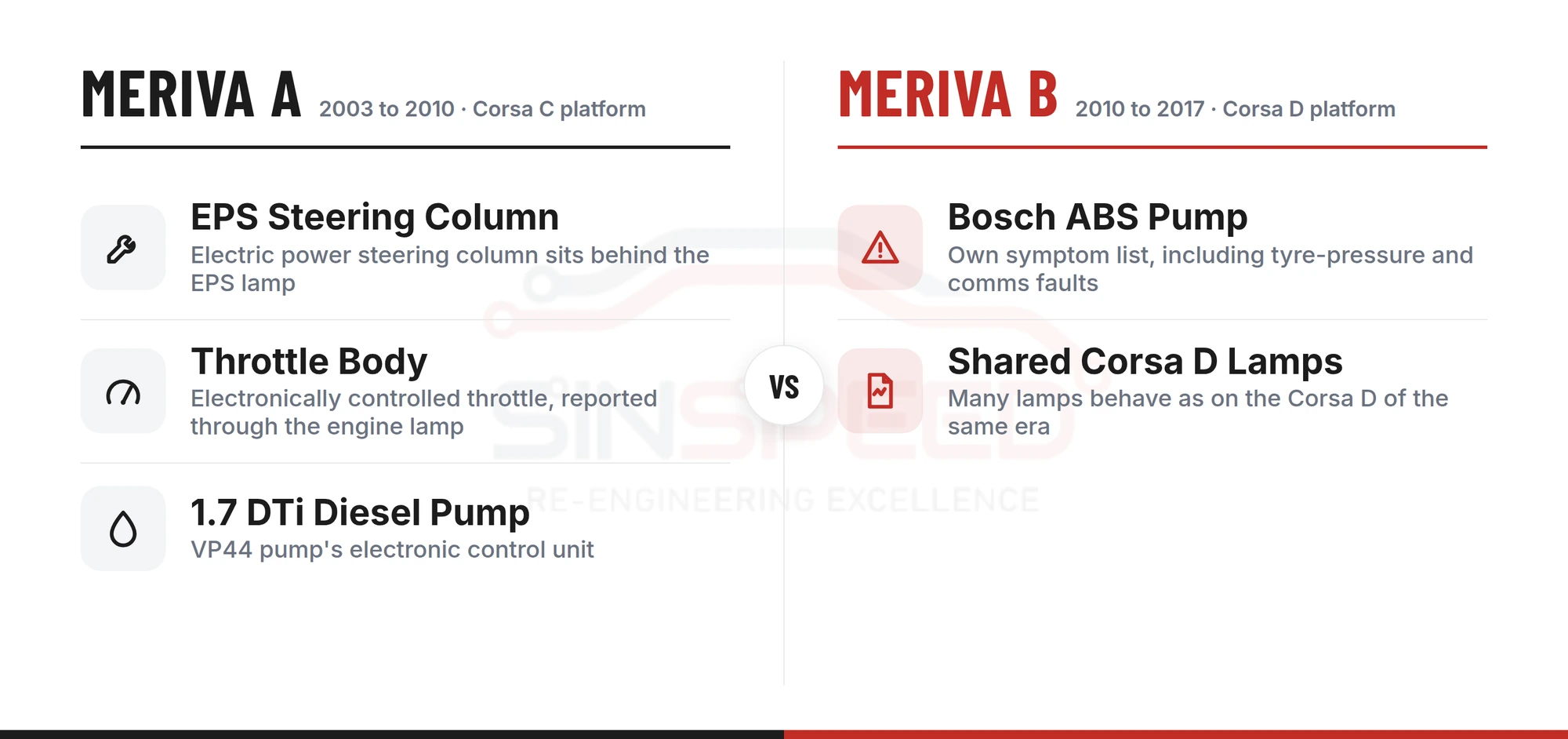
| Generation | Built | Platform relative | What it changes on the dashboard |
|---|---|---|---|
| Meriva A | 2003 to 2010 | Corsa C | The EPS light sits in front of an electric power steering column — the fault this page opened with. The throttle body and, on the 1.7 DTi diesel, the injection pump’s control unit are the other units behind its lamps that we repair. |
| Meriva B | 2010 to 2017 | Corsa D | A Bosch ABS pump with a symptom list of its own, tyre-pressure and communication faults among it. The A’s steering-column pattern should not be assumed to carry across. |
Because the Meriva A shares its underpinnings with the Corsa C, and the Meriva B with the Corsa D, many lamps behave on a Meriva exactly as they do on the Corsa of the same era. Our Vauxhall Corsa warning lights page covers those cars generation by generation, and this page does not repeat it. If your Meriva has the Easytronic automated manual gearbox, that adds a warning of its own, covered below.
Which lamp means a failed module on a Meriva
Most Meriva lamps are a fluid, a bulb, a tyre or a sensor, and those come first. The units below are the exceptions: each sits behind a lamp, each has a Meriva or Vauxhall page on this site, and each can be repaired and sent back rather than replaced.
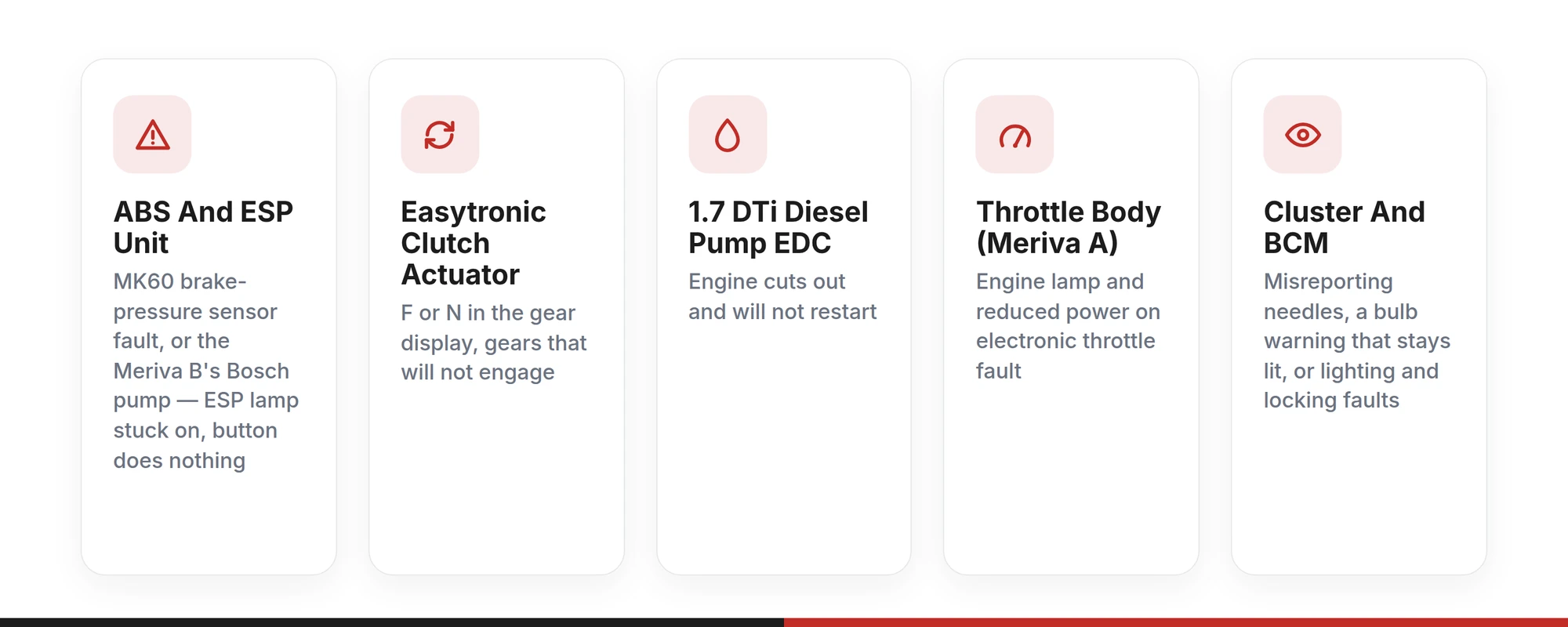
They share a habit that makes them hard to pin down. A control unit on its way out rarely fails in one go. It works when cold and drops out when hot, and it imitates mechanical wear — heavy steering that feels like a tight rack, uneven braking that feels like a sticking caliper, an engine that cuts out like a fuel problem. That is how good parts get replaced around a bad unit, and why the codes, and the module that stored them, come before any purchase.
ABS and ESP: a different unit on each generation
Which ABS unit a Meriva carries decides which fault pattern applies, and the codes and the unit’s part label settle it. On Vauxhalls with the ATE MK60 unit — the Meriva among them — the recurring fault is a brake-pressure sensor built inside the unit, logged as C0131. The tell is specific: the ESP lamp stays lit, the ESP OFF button does nothing, and the ABS and handbrake lamps often join in. Our Vauxhall ESP fault and brake-pressure sensor page covers the repair, which is carried out on the unit itself.
The Meriva B’s Bosch pump has its own list on our Meriva B ABS pump repair page: brake imbalance, binding brakes, brake fluid not reaching the calipers, wheel speed sensor faults, tyre-pressure monitoring faults and “no communication” errors on a diagnostic tool. Two deserve emphasis. Brakes that bind or pull are a stop-and-recover fault whatever colour the lamp is. And a tyre-pressure lamp that stays lit with the pressures correct can trace back to the ABS unit, which is why the ABS codes are worth reading before tyre sensors are ordered.
A wheel speed sensor is still a cheaper, common cause of an ABS lamp on its own, and the codes separate the two. How an ABS pump works explains the unit, whether an ABS light fails the MOT covers the test, and the wider work sits under ABS pump and module repairs.
The Easytronic clutch actuator
On a Meriva with the Easytronic automated manual, the warning is not a symbol: it is an F or an N where the gear number should be, solid or flashing, often with gears that will not engage or a car that will not start. Our Easytronic clutch actuator repairs page lists the Meriva among the Vauxhalls it sees most, and the actuator is the same failing part across the range. It is coded to the vehicle, so a used one is rarely a simple swap; a rebuilt original goes back needing no programming. Clutch actuator fault codes explains the codes, and our Vauxhall Astra warning lights page covers the same gearbox on that car.
The diesel pump on the 1.7 DTi
The Meriva 1.7 DTi appears on our Bosch VP44 application list. The VP44 carries its electronic diesel control unit on the pump itself, and when failed units are tested the fault is usually in that control unit rather than the mechanical pump. It shows in a blunt way: the engine cuts out and will not restart. Soak testing on the bench is what catches the intermittent version of the fault, and a repaired unit goes back with no programming needed. Diesel pump EDC fault codes explains what the codes say before a whole pump is condemned.
The throttle body on the Meriva A
The throttle body meters the air entering the engine in response to the accelerator. On an electronically controlled throttle, a fault is logged by the engine management system, so it shows through the engine lamp and can leave the engine in a reduced-power mode. Our Meriva throttle body repair bench-tests the unit and returns it working, and throttle body fault codes helps separate it from the many other causes of an engine lamp. Where diagnosis points at an internal failure of the engine ECU itself, that work belongs with the independent specialists at ecu-repairs.com.
The instrument cluster and the body control module
A cluster that misreports makes every lamp above unreliable, so rule it in or out early. Needles that drop to zero or stick, backlighting that fails in patches, a display that comes and goes with temperature, or several unrelated lamps lit with nothing behind them are cluster faults; that work sits under instrument cluster repairs, and repairing your own unit keeps its recorded mileage. If the trouble is lighting, indicators, wipers or central locking instead — a bulb warning that stays on with every bulb working is the classic case — the body control module is the unit to consider.
Sinspeed · Vauxhall Meriva electronics
Tell us when the lamp comes on, not just which oneAn EPS light after a long run, an ESP lamp that ignores its button and an F that comes and goes each point at a different unit. Send us the generation, the codes and when it happens, and our engineers will tell you which unit is behind the lamp before anything comes off the car.
Bench-tested on in-house Hardware-in-the-Loop platforms under simulated heat, vibration and load · Programmed and calibrated with dealer-level diagnostic tools
What to do when a warning light comes on in your Meriva
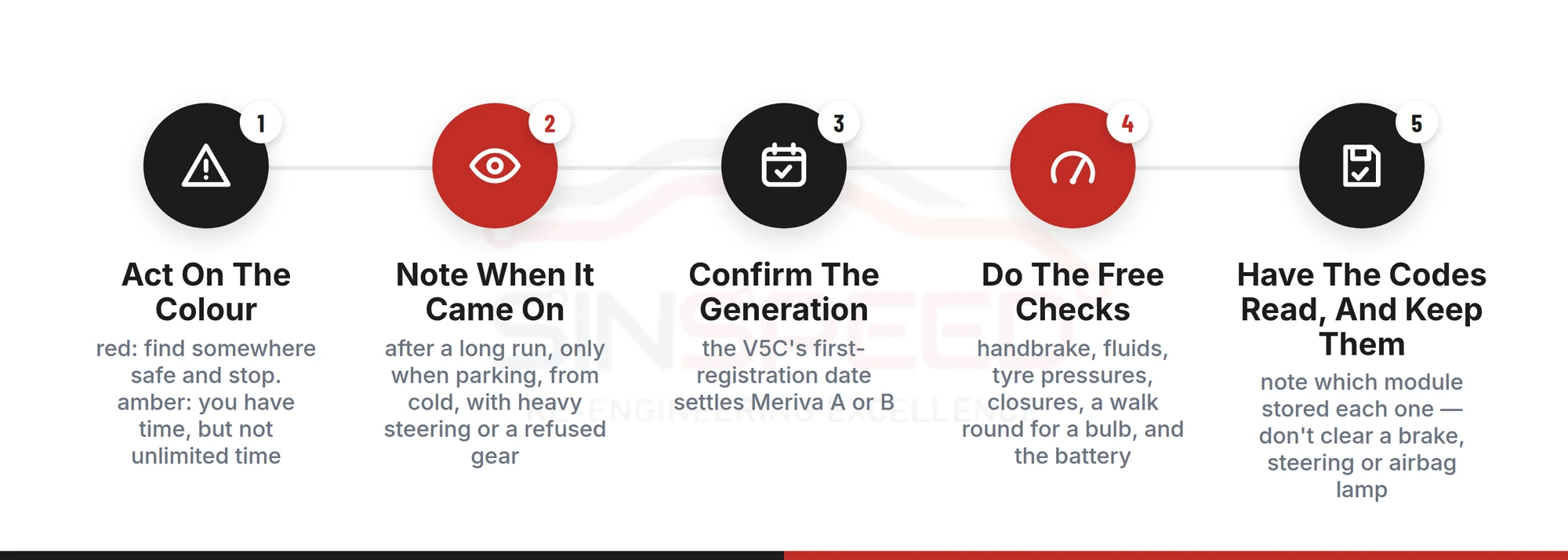
- Act on the colour. Red: find somewhere safe and stop. Amber: you have time, but not unlimited time.
- Note when it came on, and what the car was doing. After a long run, only when parking, from a cold start, with heavy steering or a gear that would not engage — on a Meriva the timing is evidence, and it is easily forgotten.
- Confirm the generation. The first-registration date on the V5C tells you A or B, and several fault patterns on this page belong to one only.
- Do the free checks. Handbrake fully off, oil and coolant with the engine cold, tyre pressures, doors and tailgate shut, a walk round for a dead bulb — and the battery’s condition, because electric steering depends on it.
- Have the codes read, and keep them. Note which module stored each one. Do not clear a brake, steering or airbag lamp to make it go away; that repairs nothing and deletes the evidence.
Vauxhall Meriva warning lights FAQs
What do the symbols on a Vauxhall Meriva dashboard mean?
Read the colour before the shape. Red lamps — brakes, oil pressure, coolant temperature, charging, airbags and power steering — mean stop as soon as it is safe. Amber lamps mean a stored fault that needs attention, from engine management and ABS to the tyre-pressure and diesel warnings. Green and blue only confirm that something is switched on. On an Easytronic Meriva, an F or N in the gear display is a warning too, even though it does not look like one. The table on this page covers every Meriva A and B symbol with a safe-to-drive verdict.
What does the EPS light mean on a Vauxhall Meriva?
EPS stands for electric power steering, and the lamp means the electric assistance has a fault. On a Meriva A the assistance comes from an electric power steering column, so there is no fluid to check and nothing to top up. The fault usually starts with the lamp coming on intermittently, progresses to a constant lamp with heavy steering in one or both directions, and ends with no assistance at all. The codes our Meriva A column page lists for it are C1500 and C1532. Have them read, and rule out a weak battery or charging fault first.
Why does my Meriva’s EPS light come on after a long drive and then go out?
Because that is how the column fault on a Meriva A typically begins. The lamp appears after a longer run, clears at the next start, and returns more often until it stays on and the steering goes heavy. The column works hardest at low speed and full lock and lives with the car’s heat and vibration, so a degrading unit tends to cope when cool and drop out when heat-soaked. A lamp that clears itself has not been fixed. It is the same fault, early, and the right moment to have the codes read.
Can I drive my Vauxhall Meriva with the EPS light on?
The car will still steer, but without assistance it takes much more effort, especially at low speed and when parking, and on an intermittent fault that effort can arrive mid-manoeuvre. Treat it as a fault to have looked at promptly, not a lamp to drive around. If the steering lamp is red, stop as soon as it is safe. If it is amber, keep journeys short and careful until the codes have been read. If the column is at fault, your garage removes it and sends it to us for repair and calibration.
Why is my Meriva’s ESP light on with the ESP OFF button doing nothing?
On Vauxhalls with the ATE MK60 ABS unit, the Meriva among them, that combination is a recognised fault rather than a stuck switch. The ESP lamp stays lit, the button has no effect, and the ABS and handbrake lamps often join in. The usual cause is a brake-pressure sensor built inside the ABS unit, logged as C0131, so it is not a part to unbolt. Ordinary braking remains while the red brake lamp stays out; if it comes on as well, stop and have the car recovered. Either way, have the unit repaired rather than living with the lamp.
My Meriva B’s ABS light is on and the brakes feel uneven. What could it be?
On the Meriva B, the Bosch ABS pump is a strong suspect. The faults our Meriva B ABS page lists include brake imbalance, binding brakes, brake fluid not reaching the calipers, wheel speed sensor faults, tyre-pressure monitoring faults and “no communication” errors on a diagnostic tool. Brakes that pull, bind or feel uneven are not an amber-lamp inconvenience: stop driving and have the car recovered. A garage can then read the ABS codes to separate a wheel speed sensor from the unit, and if the unit is at fault it comes out and is posted to us for repair.
What does a flashing F on my Meriva’s dashboard mean?
It is the Easytronic automated manual gearbox reporting a fault. Where the gear number should be, the display shows an F or an N, solid or flashing, often with gears that will not engage or a car that will not start. The usual culprit is the clutch actuator, a common failing part across the Vauxhall models with Easytronic, the Meriva included. It is coded to the vehicle, so a used unit from another car rarely works as a straight swap. A rebuilt original goes back needing no programming.
Sinspeed · mail-in repair
Your garage removes it, we repair it, your Meriva keeps its own unitYour garage takes out the unit the codes point at — the steering column, the ABS unit, the actuator — and posts it to us. We test it under simulated heat and load, repair and calibrate it, and send it back to be refitted, and most remanufactured parts carry a lifetime, unlimited-mileage warranty. Not sure which unit it is? Tell us the generation, the lamps and the codes first.
Cleanroom-standard, ESD-safe workshop · Repairs by an in-house team of electronic engineers and diagnostic specialists
Final thoughts
On most cars the colour of a lamp tells you nearly everything you need. On a Meriva the steering lamp adds a second question — when does it come on? — because the column fault on the Meriva A shows itself as an on-off nuisance long before it becomes a constant one.
That is the idea worth taking away. A lamp that lights after a long run and has gone by the morning has not fixed itself: it is the same fault, seen early. The same goes for an ESP lamp that ignores its button, a tyre-pressure lamp that ignores correct pressures, or an F that flashes once and disappears. Note when it happens, have the codes read while they are still stored, and make the decision while the car still steers, brakes and changes gear properly — not after it has stopped doing so.