
Summary: Common Citroën warning lights name a system, not a part, and the part behind them changes with the model. The amber ABS lamp on a Berlingo, a Relay and a DS3 points at three different ABS units; a steering lamp on a C3 means a column-mounted electric unit, while on a C4 it can mean an electric power steering pump. This page gives every lamp in Citroën’s own handbook with a safe-to-drive verdict, then shows which unit each warning points at on your Citroën.
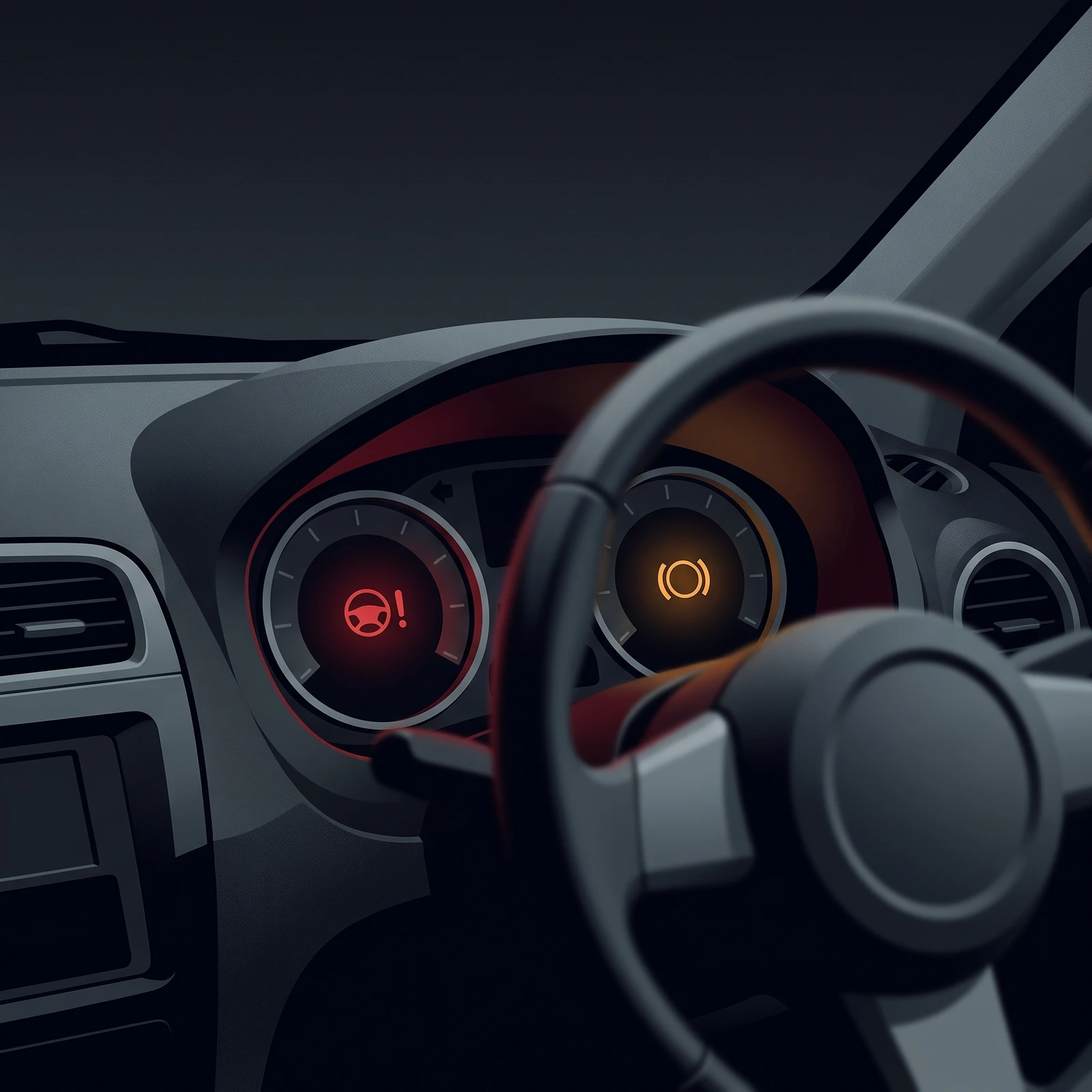
Common Citroën warning lights: the full symbol table
Citroën works to the same colour code as every other maker, and our guide to what dashboard warning lights mean sets that code out in full. What marks a Citroën out is how rarely a lamp arrives alone: it tends to bring a chime, a line of text in the display, or a second lamp such as STOP or Service. Citroën shares much of that behaviour and wording with Peugeot, and our Peugeot dashboard warning lights guide goes further into the messages than this page does.
The table is built from the warning and indicator lamp tables in Citroën’s C3 handbook, available through Citroën’s owner documentation site. The handbook says plainly that equipment depends on model and version, so your car may lack some rows or carry lamps not listed. Where a lamp belongs to one instrument panel only, the row says so, and a row with no icon is one we could not match to an exact symbol.
| Colour | Symbol | What it means on a Citroën | Is it safe to drive? |
|---|---|---|---|
| Red |  STOP — the word inside a circle STOP — the word inside a circle | A serious fault in the engine, the braking system or the power steering, or a major electrical fault. It lights with another lamp, a chime and a message. | No. Stop as soon as it is safe, park, switch off and call a dealer or qualified workshop. |
| Red |  Brakes — an exclamation mark inside a bracketed circle Brakes — an exclamation mark inside a bracketed circle | Steady: the brake fluid level has dropped significantly. | No. Stop when safe and top up with a fluid Citroën lists. If it persists, have the brakes checked. |
| Red | Parking brake | The parking brake is applied, or has not released properly. | Release it with your foot on the brake pedal; the lamp should go out. |
| Red | 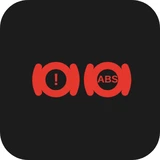 Brakes and ABS lit together Brakes and ABS lit together | A fault in the electronic brake force distribution (EBFD). | No. Stop as soon as it is safe and have it checked. |
| Red | 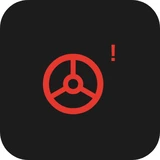 Assisted steering — a steering wheel beside an exclamation mark Assisted steering — a steering wheel beside an exclamation mark | A major failure in the power steering. The C3 handbook lists this lamp on the LCD Picto panel only; a serious steering fault also brings up STOP. | It still steers, but with much more effort. Drive carefully at reduced speed and have it checked promptly. |
| Red | 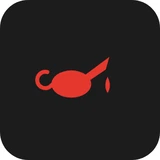 Engine oil pressure — an oil can with a falling drip Engine oil pressure — an oil can with a falling drip | Engine oil pressure is too low. | No. Stop as soon as it is safe, switch off the ignition and contact a workshop. |
| Red |  Maximum coolant temperature — a thermometer in waves Maximum coolant temperature — a thermometer in waves | The cooling system is too hot. Where a temperature gauge is fitted, its needle in the red zone brings up STOP too. | No. Stop, wait a few minutes before switching off, and open the bonnet cautiously; top up only once the engine has cooled. |
| Red |  Battery charge — a battery with two terminals Battery charge — a battery with two terminals | A fault in the charging circuit, such as dirty or loose terminals or a slack or broken alternator belt. | It should go out once the engine starts. If it stays on, contact a workshop before relying on the car. |
| Red |   Seat belt unbuckled, and door open Seat belt unbuckled, and door open | A belt is unbuckled, or a door or the boot is not properly shut. Above 6 mph a chime joins the door warning. | Buckle up or shut it before moving off. |
| Amber |  Engine self-diagnosis — an engine outline Engine self-diagnosis — an engine outline | Steady: an emission control fault. Flashing: an engine management fault. With Service: a minor engine failure. With STOP: a major one. | Steady: to a workshop without delay. Flashing: gently, as the catalytic converter is at risk. With STOP: no. |
| Amber | Service | Faults with no lamp of their own. On briefly with a message: minor. Staying on with a message: major. On BlueHDi diesels it also marks an overdue service. | Read the message first. A door ajar you can deal with yourself; a major fault needs a workshop. |
| Amber |  ABS — the three letters in a bracketed circle ABS — the three letters in a bracketed circle | The anti-lock braking system has a fault. Conventional braking remains. | Carefully, at reduced speed, and to a workshop without delay. |
| Amber |  Dynamic stability control (DSC/ASR) — a car over skid marks Dynamic stability control (DSC/ASR) — a car over skid marks | Flashing: the system is working to hold grip and direction. Steady: the system has a fault. | Flashing: yes, ease off. Steady: have the system checked. |
| Amber | Collision Risk Alert / Active Safety Brake | Flashing: the car is braking briefly ahead of a collision. Steady with a chime and message: a fault. Steady with a message only: switched off in the menu. | Yes, but do not count on it until a steady fault lamp has been checked. |
| Amber |  Under-inflation — a tyre section with an exclamation mark Under-inflation — a tyre section with an exclamation mark | Steady with a chime: one or more tyres is low. Flashing, then steady with Service: the system is faulty and pressures are not being monitored. | Check the pressures as soon as possible, cold, then reinitialise the system. |
| Amber (orange) |  Lane departure alert — a car between lane lines Lane departure alert — a car between lane lines | Flashing with a chime: you are crossing a line. Steady: the system is faulty. Listed for the LCD text panel. | Yes. Book a steady lamp in. |
| Amber |  Particle filter (diesel) — a box of dots Particle filter (diesel) — a box of dots | With a blockage message: the filter is starting to saturate. With an additive message: the additive tank is low. | Saturating: drive at 40 mph or more, traffic permitting, until it goes out. Additive: have it topped up soon. |
| Amber |  AdBlue (BlueHDi) — a nozzle with falling drops AdBlue (BlueHDi) — a nozzle with falling drops | Steady: 1,500 to 350 miles of range left. Flashing: under 350 miles. Flashing with starting prevented: the tank is empty. | Top up soon. An empty tank needs at least 4 litres before the engine will start. |
| Amber | SCR emissions control (BlueHDi) | With the Service and engine lamps: an emissions fault. Once it is confirmed, up to 650 miles remain before the engine is prevented from starting. | For now, but to a workshop without delay to avoid a no-start. |
| Amber |  Water in the diesel — a filter holding a droplet Water in the diesel — a filter holding a droplet | The diesel filter contains water, which risks damaging the injection system. Listed for the LCD Picto panel. | Contact a workshop as soon as possible. |
| Amber |  Diesel pre-heating — a coil Diesel pre-heating — a coil | The engine is cold enough to need pre-heating, for up to about 30 seconds in severe winter conditions. | Yes. Wait for it to go out before starting. |
| Amber |  Minimum fuel — a fuel pump Minimum fuel — a fuel pump | About 5 litres remain; the reserve is in use. | Refuel soon. Running dry can damage the emission control and injection systems. |
| Amber |  Service spanner Service spanner | A maintenance reminder: shown briefly within 1,800 miles of a service, lit under 600, flashing then steady once the date has passed. | Yes. Book the service. |
| Amber | Airbags — a seated figure facing an inflated bag | A few seconds at switch-on is normal. Staying on: a fault in an airbag or a seat belt pretensioner. | The car drives, but the protection may not work in a crash. Have it checked. |
| Amber |  Passenger airbag off Passenger airbag off | The passenger airbag control is at OFF, so the front airbag is deactivated. | Correct for a rearward-facing child seat. For an adult, set it to ON, and never fit a rearward-facing seat with it on. |
| Green, blue and amber |      Indicators, main beam, dipped beam, front and rear foglamps Indicators, main beam, dipped beam, front and rear foglamps | On as selected with the lighting stalk. | Yes. Switch the rear foglamp off when visibility improves. |
| Green and others | Stop & Start, foot on brake, foot on clutch, blind spot monitoring, automatic headlamp dipping, sidelamps | A system is on, or waiting for you: the clutch not fully down for a Stop & Start restart, for example. | Yes. None of these reports a fault. |
One lamp, different units: what each warning points at on your Citroën
The handbook tells you which system has a problem. It cannot tell you which part, because the same lamp sits in front of different hardware from one Citroën to the next. That matters most for lamps that point at an electronic unit, since a unit that is failing slowly tends to show up first as a mechanical complaint: steering that turns heavy now and then, brakes that feel wrong with no visible leak, a gearbox with a mind of its own.
Knowing which unit your model uses turns the lamp into a sensible first question for the garage. The four lamps below are the ones where that question matters most; the full range is on what we repair.
The ABS lamp: one system, a different unit on each model
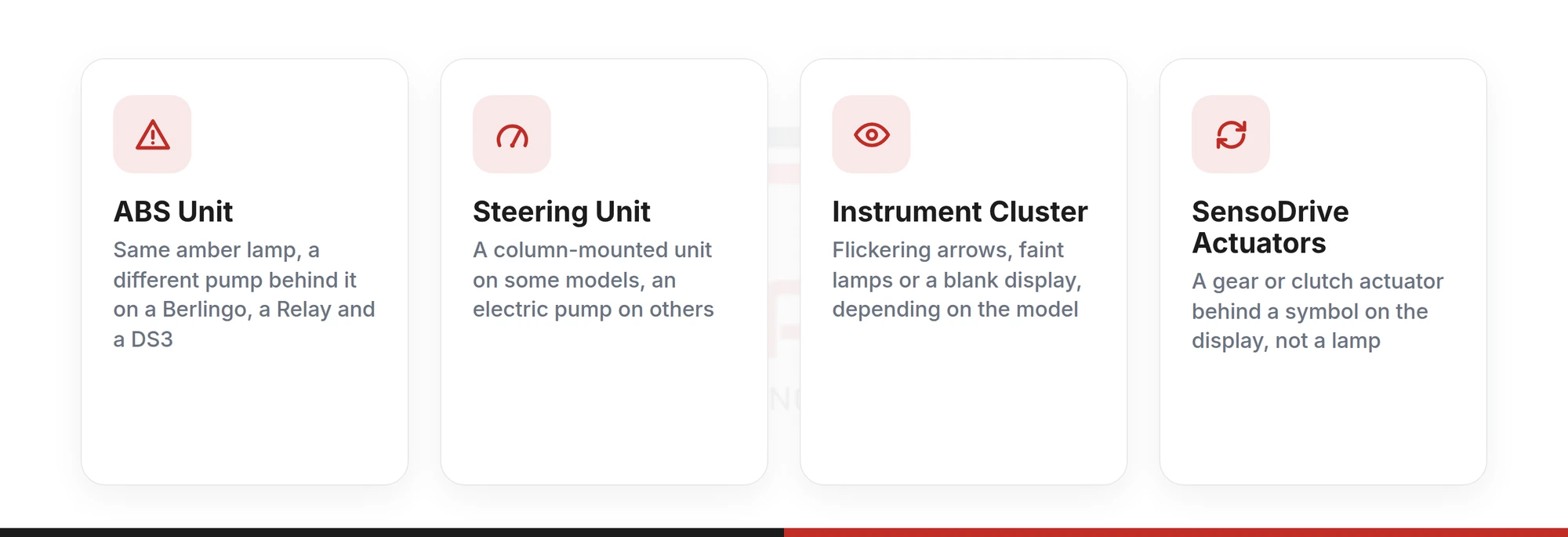
Take the amber ABS lamp on three Citroëns we repair units for. On a Berlingo (2008 to 2018), the fault often shows through a traction control lamp that will not go out as much as through the ABS lamp itself, and a calliper can stop receiving fluid pressure. On a Relay (2006 to 2014), the pattern is intermittent: the ABS drops out and returns, wheel-speed sensor faults clear and come back, and a diagnostic tool may fail to talk to the ABS module at all. On a DS3 (2016 to 2019), which uses an ATE Mk100 unit, the telling complaint is brakes that bind, typically on diagonally opposite corners.
A fourth pattern cuts across models: the stability lamp stays lit, the ESP button does nothing, and the ABS lamp may join in. On later ATE units the brake pressure sensor is built into the ABS unit rather than mounted outside it, which is why a dealer quotes a complete new unit for what used to be a separate part. Our page on the Citroën, Peugeot and Renault ESP pressure-sensor fault sets out how it presents.
For what the unit does, see how an ABS pump works; for the test itself, whether an ABS light fails the MOT; and for every unit we cover, ABS pump and module repairs. If the red brake lamp lights with the ABS lamp, that is the brake force distribution warning, and the answer is to stop.
The steering lamp: a column unit on one Citroën, a pump on another
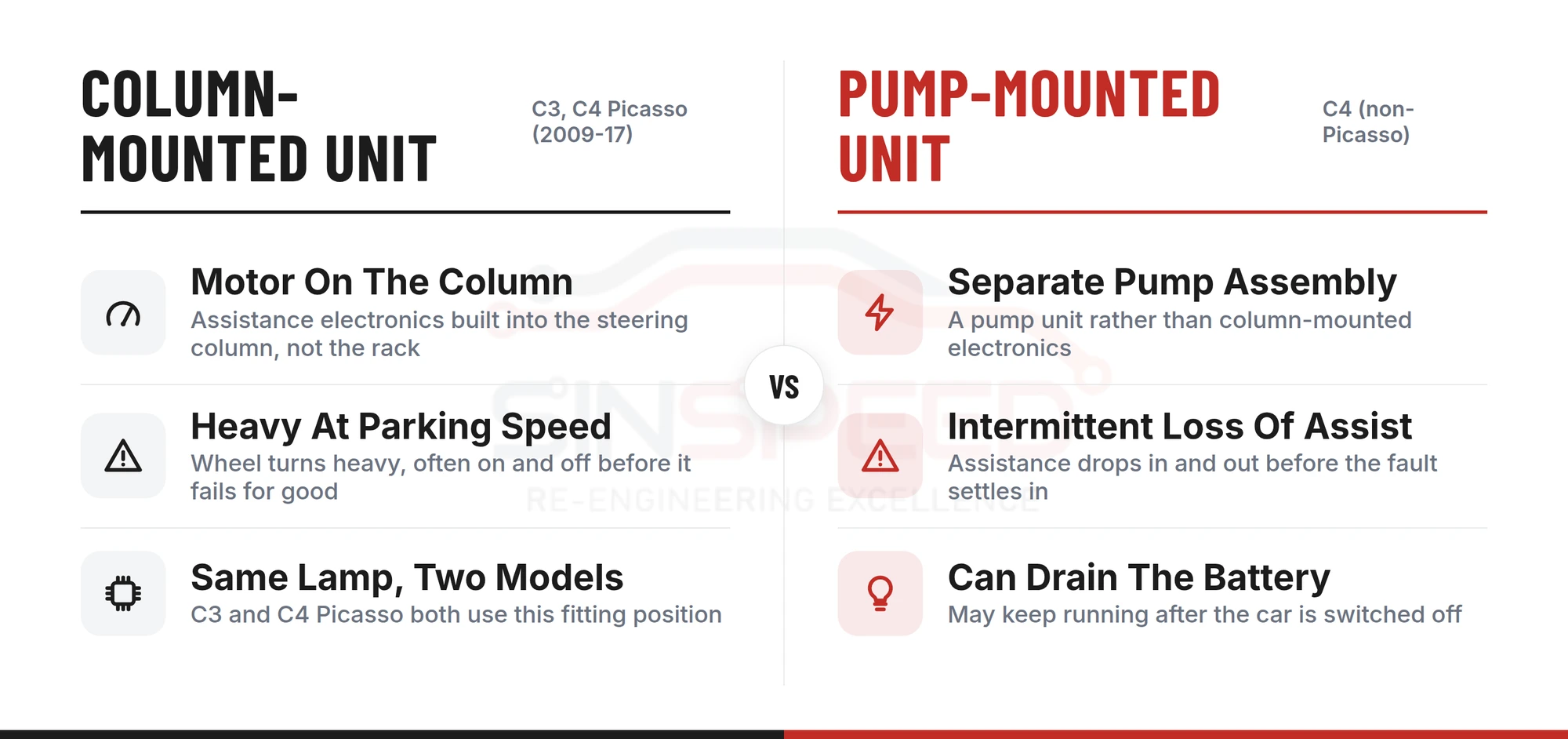
On the C3 (2009 to 2017) and the C4 Picasso (2009 to 2017), assistance comes from a motor and control electronics mounted on the steering column. When those electronics fail, the mechanical steering is usually sound and the wheel simply turns heavy, worst at parking speeds, and often on and off before it goes for good. Codes we see on these units include C1404 and C1414, alongside the internal-fault code P0606.
The C4 is different again. Its electric power steering pump tends to lose assistance intermittently at first, and it can keep running after the car is switched off, draining the battery. A steering lamp together with a battery that is flat after the car has stood points at the pump rather than a column. Since electric steering depends on supply voltage, rule out the battery and charging first, then read electric power steering fault symptoms and fixing an EPS warning light properly. Both kinds of unit sit under steering and EPS repairs.
A flickering or dead display: which cluster your Citroën has
When the instrument cluster fails, the lamps themselves stop being trustworthy, and how it fails depends on the model. On a C1 (2005 to 2014), whose cluster design is shared with the Peugeot 107 and Toyota Aygo, the early sign is usually indicator arrows that flicker or stay dark, followed by a failing backlight or a blank information display. Check the indicators outside the car first: a worn stalk can stop those too, and if they still flash, the cluster is the likelier cause.
On a Nemo (2008 to 2017), warning lamps that glow faintly with nothing wrong, or flash in time with an indicator, are the recognised sign, though a poor earth behind the dash can mimic them. The digital display in the C4 Picasso (2013 to 2018) can develop black spots and dead pixels before the whole dash goes blank while the car runs normally; our C4 Picasso instrument cluster repair guide covers it in depth. On the Xsara Picasso, look for a flickering backlight, a faded or pixelated screen, a speedometer stuck at 0 mph, or only one side of the display working.
Repairing the original cluster keeps its recorded mileage and security data. If several unrelated lamps light together and a scan tool reports modules that will not answer, read lost communication fault codes first, and consider the body control module when exterior lamps misbehave with every bulb intact. Our wider cluster work is under instrument cluster repairs.
A dash or a snowflake where the gear should be: SensoDrive
Citroëns with the SensoDrive semi-automatic gearbox have an electronically controlled manual gearbox, worked by a clutch actuator, a gear actuator and a gearbox ECU. When an actuator fails, the display often says so before any lamp does: a “–” where the gear number should be, a snowflake symbol nobody selected, or the car dropping in and out of auto mode. Gears that will not select, the wrong gear being chosen and no revs in reverse complete the picture.
Those faults sit most commonly in the actuators rather than the gearbox itself. Our SensoDrive clutch and gear actuator repairs page covers both units, and because we rebuild your own actuator, it refits without reprogramming. The wider range is under clutch actuator repairs.
Sinspeed · Citroën electronics
Tell us the model and the lamp. We will tell you the likely unit.Send the model, the year, which lamps lit together and any codes a garage has read. Our engineers will say which unit is the likely cause, and whether it is one we repair, before anything is taken off the car.
In-house electronic and hydraulic engineers · Many units returned ready to fit, with no coding required
The Citroën lamps worth a closer look
Most lamps in the table behave as they would on any car. A handful work in a way particular to Citroën’s instrument panel, and they are the ones most often misread.
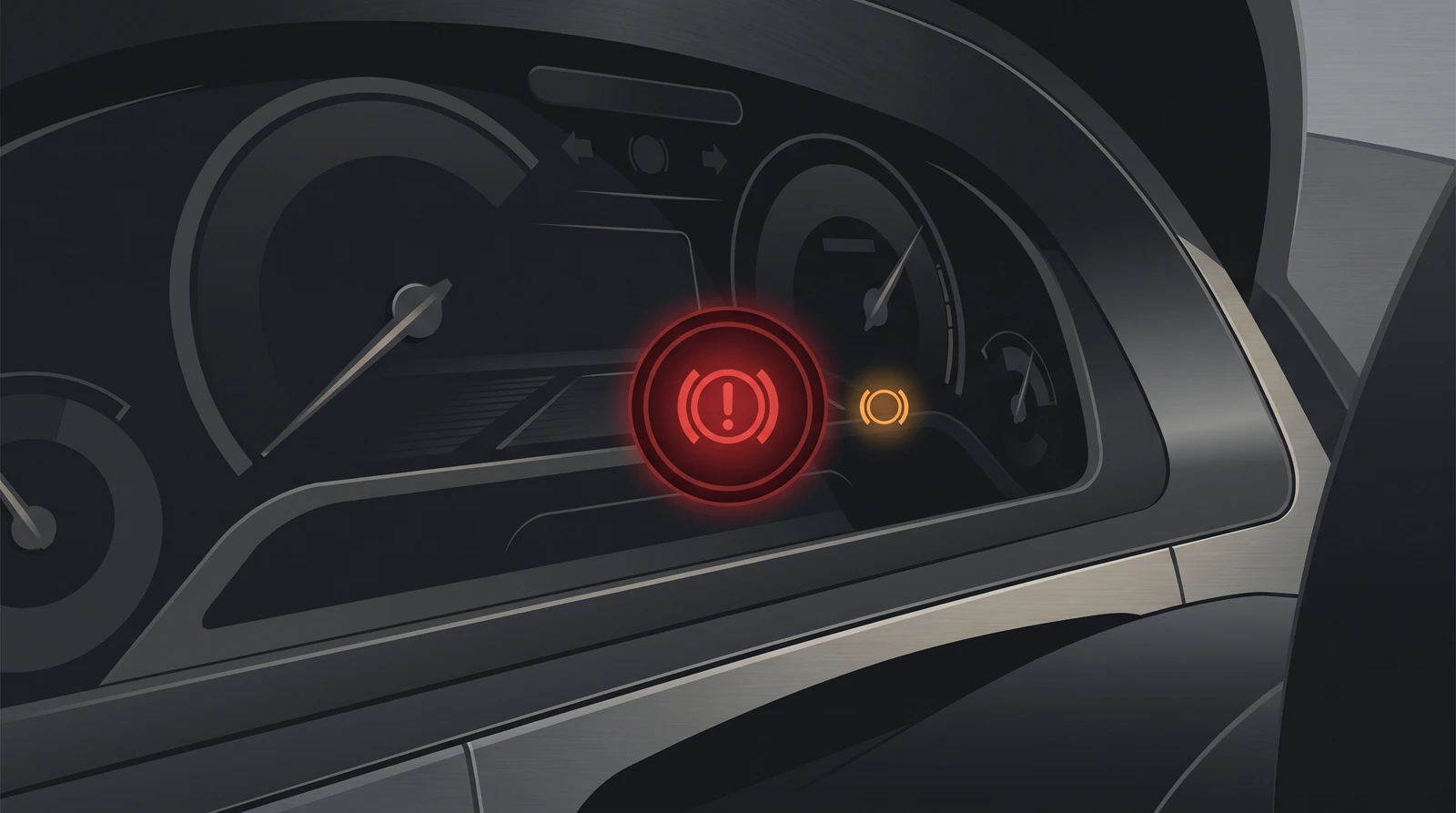
STOP never lights on its own
In the C3 handbook the red STOP lamp always arrives with a second lamp, a chime and a message. STOP says how serious; the second lamp says which system, whether that is engine self-diagnosis, the brakes, the power steering or a coolant gauge in its red zone. The amber Service lamp plays the same part one level down, and the Peugeot guide linked above explains that two-tier arrangement in more depth. So when STOP appears, note the second lamp and the message before you switch off: that pairing is what the garage will need.
Active Safety Brake and lane departure: working or faulty
Collision Risk Alert and Active Safety Brake share one lamp with three states. Flashing means the system is braking briefly to cut the speed of an impact with the vehicle ahead, which is it doing its job. Steady with a chime and a message is a fault. Steady with a message only means it has been switched off in the vehicle configuration menu.
Lane departure alert, listed for the LCD text panel, follows the same logic: flashing orange with a chime as you drift across a line, steady when the system itself has failed. A steady lamp on either is a workshop visit rather than an emergency, but until it is put right the car is not watching for you. The blind spot lamp, by contrast, only confirms that the function is on.
Tyre under-inflation: the reset owners forget
A steady under-inflation lamp with a chime and a message means one or more tyres is low, and the pressures should be checked with the tyres cold. The step the handbook insists on, and the one most often missed, is reinitialising the system after adjusting any pressure or changing a wheel. If the lamp flashes and then stays on beside the Service lamp, the system is faulty and is no longer monitoring the tyres at all.
Reading the oil level display
On versions with an electric oil level indicator, the level shows for a few seconds after the service information at switch-on. “OIL OK” or “Oil level correct” needs nothing. “OIL” or “Oil level incorrect”, with the Service lamp and a chime, means the level is low: confirm it on the dipstick and top up. “OIL_ _” or “Oil level measurement invalid” means the indicator itself has a fault, so use the dipstick until it is fixed. The reading only holds on level ground with the engine off for over 30 minutes.
Service, diesel and emissions lamps in brief
The service spanner is a countdown, not a fault, and is reset after each service. The diesel lamps (pre-heating, particle filter, additive, water in fuel and AdBlue) behave as they do on a Peugeot, and the Peugeot guide handles them in full. The Citroën figure worth keeping is that the filter regenerates at a steady 40 mph or more until the lamp goes out; for the filter itself, see how a DPF works. If the display reports an anti-pollution fault, our anti-pollution fault explainer applies to Citroëns as well.
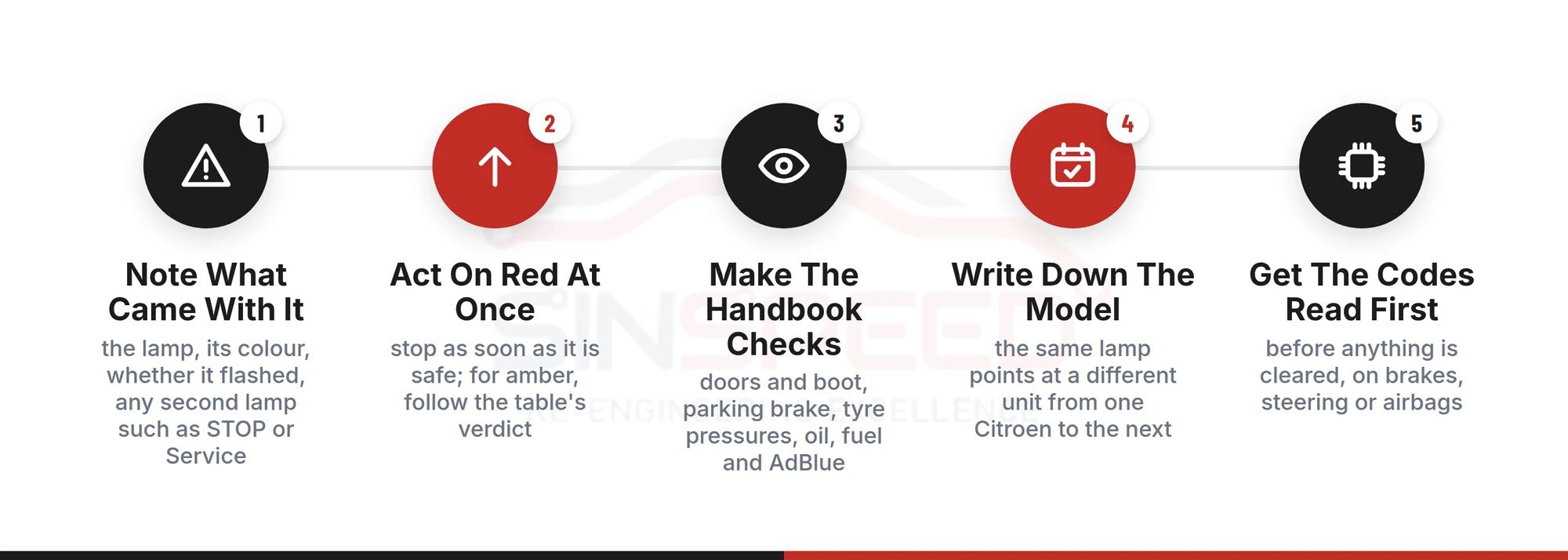
What to do when a warning light comes on in your Citroën
- Note what came with it. The lamp, its colour, whether it flashed, any second lamp such as STOP or Service, and the exact wording of the message.
- Act on red at once. Stop as soon as it is safe, switch off and call for help. For amber, follow the verdict in the table.
- Make the handbook’s own checks. Doors and boot, parking brake, tyre pressures when cold, oil on the dipstick, fuel and AdBlue.
- Write down the model and year. The same lamp points at a different unit on a C1 than on a C4 Picasso, so the model is part of the diagnosis.
- Get the codes read before anything is cleared. A cleared code tells the next garage nothing, and on brakes, steering or airbags it hides a fault that is still there.
The general version sits in the parent guide above, and if there is a Peugeot on the drive too, our Peugeot 3008 warning lights page covers its digital dashboard.
Citroën warning lights FAQs
What are the most common Citroën warning lights?
The ones owners ask about most are the engine self-diagnosis lamp, the ABS and stability control lamps, the power steering lamp, tyre under-inflation, the particle filter and AdBlue lamps on diesels, and the red STOP lamp. Red lamps, including STOP, brakes, power steering, oil pressure, coolant temperature and battery charge, mean stop or have it checked before relying on the car. Amber lamps report a fault or a job to do; the airbag lamp is amber on a Citroën, but a fault there still needs checking promptly. Green and blue lamps confirm that something is switched on. Each of them has its own row, and a verdict on driving on, in the table above.
What does the red STOP light mean on a Citroën?
It means a serious fault has been found in the engine, the braking system or the power steering, or there is a major electrical fault. Citroën’s handbook says it comes on together with another warning lamp, a chime and a message, and the instruction is always the same: stop as soon as it is safe, park, switch off the ignition and call a dealer or qualified workshop. The second lamp is the useful part, because it names the system the car is worried about.
Why is the power steering warning light on in my Citroën?
The handbook describes it as a major failure in the power steering. The car still steers, but it can take far more effort, especially at parking speeds, so drive carefully at reduced speed and have it checked promptly rather than carrying on. What has failed depends on the model: on the C3 and C4 Picasso of 2009 to 2017 it is usually the electronics of the column-mounted electric steering unit, and on the C4 it can be the electric power steering pump. The fault codes confirm which.
Can I drive my Citroën with the ABS light on?
Carefully, if the ABS lamp is on by itself. Citroën says the car keeps conventional braking but loses anti-lock, so drive at reduced speed and contact a dealer or qualified workshop without delay. If the red brake lamp lights with it, that is a fault in the electronic brake force distribution and the instruction changes: stop as soon as it is safe. An ABS lamp that stays on is also an MOT failure, so have the codes read before the test.
What does the flashing tyre pressure light mean on a Citroën?
A lamp that flashes and then stays on, together with the Service lamp, means the under-inflation detection system itself is faulty and tyre pressures are no longer being monitored. Check the pressures yourself as soon as possible and have the system checked. A steady lamp with a chime and a message is different: one or more tyres is low. Check the pressures when the tyres are cold, and reinitialise the system after adjusting them or changing a wheel.
What is the Active Safety Brake light on a Citroën?
It belongs to Collision Risk Alert and Active Safety Brake. Flashing means the system is working: it is braking briefly to reduce the speed of a collision with the vehicle ahead. Steady with a message and a chime means the system has a fault and needs checking. Steady with just a message means it has been switched off in the vehicle configuration menu. In the last two cases the car drives normally, but it is no longer watching the road ahead for you.
Are Citroën C3 warning lights the same as on other Citroën models?
Mostly, but not exactly. The table on this page is built from the C3 handbook, and the handbook itself says some lamps depend on the version and instrument panel: the power steering lamp, for example, appears only on the LCD Picto panel. Core warnings such as STOP, brakes, ABS, airbags and engine self-diagnosis follow the same pattern across the range, but the exact set on your car is in its own handbook, and the unit behind a lamp changes from model to model.
Sinspeed · repair by post
Your Citroën’s own unit, repaired and sent backOnce the codes and the model point at a unit, whether an ABS unit, a steering column unit, a cluster or a SensoDrive actuator, your garage takes it off and posts it to us. We load it on a rig that recreates the heat, vibration and electrical demand of the car, find the fault, repair it and return the same unit, so a cluster comes back with its own mileage and security data. Where refitting calls for coding or calibration, we tell your garage exactly what is needed.
Cleanroom-standard, ESD-safe workshop · Lifetime, unlimited-mileage warranty on most remanufactured parts
Final thoughts
Citroën’s lamps are honest about the system and silent about the part. The handbook will tell you the ABS has a fault, the steering has lost assistance or the display is showing something it should not, and it will tell you how urgently to act. It will not tell you that the ABS unit in a Relay is not the one in a DS3.
So carry two facts, not one: the lamp and the model. Together they tell a garage where to look first, and they stop the wrong unit being bought on the strength of a symbol. Then let the codes settle it before anything comes off the car.