
Summary: Every warning lamp on a Kia Picanto dashboard has two jobs: to report a fault while you drive, and to prove it works in the few seconds after the ignition goes to ON. Kia’s own guide treats a lamp that stays lit, one that never lights and one that blinks as signs of trouble, lamp by lamp. This page gives every symbol a safe-to-drive verdict, shows how to read that key-on check, and traces the warnings that lead to an ABS unit, the power steering, the instrument cluster or the gearbox electronics, which we repair on the bench and return.
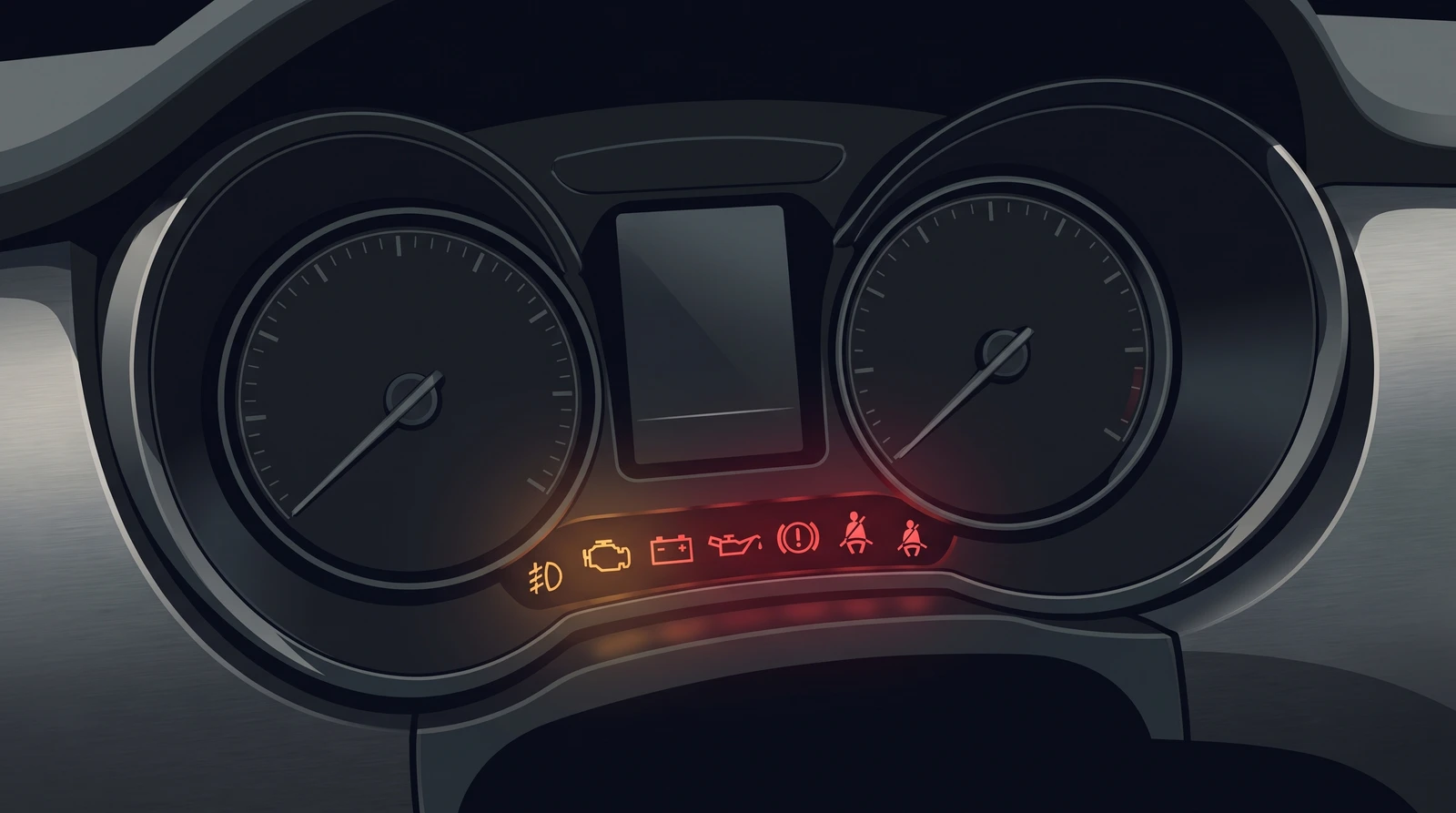
Kia Picanto dashboard warning lights: the symbol table
Kia uses the same colour logic as other makers, and our guide to what dashboard warning lights mean sets it out in full: red to stop or act now, amber for a fault to have checked, green, blue and white for something switched on. Kia adds one note of its own. On some models amber shows as yellow or orange, so read the shade loosely and the symbol closely.
The table is built from Kia UK’s Dashboard Warning Lights guide, which covers the whole range. Lamps Kia marks as model-specific or “if equipped” vary by Picanto version, so yours may lack some rows, and a row with no icon is one we could not match to an exact Kia symbol. Kia also says plainly that its guide is a guide rather than a diagnosis; the fault codes confirm the cause.
Other city cars handle this differently. Our Fiat 500 warning lights guide deals with a dashboard that leans on one generic triangle, and the Ford Ka warning lights guide covers another small car’s set.
| Colour | Symbol | What it means on a Picanto | Is it safe to drive? |
|---|---|---|---|
| Red |  Parking brake and brake fluid | On whenever the parking brake is applied with the ignition on. It should go out once the engine is running and the brake is released; if it does not, the brake fluid may be low. | Not if it stays lit with the brake released. Stop as soon as it is safe and contact a Kia dealer or qualified garage. |
| Red |  Engine oil pressure — an oil can with a drip | Goes out once the engine starts. Lit after starting, or while driving: the engine is not getting the oil pressure it needs. | No. Stop when safe, switch off and check the level. If it stays lit after topping up, do not drive on: Kia warns of severe engine damage. |
| Red |  Coolant temperature — a thermometer in waves | A few seconds at key-on, then out. Staying on: the coolant is above about 120 °C and the engine may be overheating. | No. Stop as soon as it is safe, do not carry on, and call a dealer or your breakdown provider. |
| Red |  Charging system — a battery | Lit from key-on until the engine starts. Still lit afterwards, or lighting on the move: a fault in the alternator or the charging system, battery included. | Only as far as a garage, and as soon as possible. |
| Red |  Airbag (SRS) — a seated figure facing an inflated bag | A few seconds at key-on, then out. A fault if it does not light, stays on past the first 6 seconds, blinks, or lights while driving. | The car drives, but the airbags may not protect you in a collision. Have it checked as soon as possible. |
| Red |   Seat belt and door ajar | Belt: about 6 seconds at every key-on, then on until the driver’s belt is fastened; it blinks if you drive off unbelted. Door: on until every door is properly shut. | Belt up and shut the door before moving off. |
| Red or amber |   Electric power steering (EPS) | Lights at key-on and goes out within a few seconds. Lit or blinking while driving: a steering system fault, and power assistance may be lost. | It still steers, but needs far more effort. Drive with extra care and have it checked as soon as possible. |
| Amber |  ABS | Lights at key-on, out after a few seconds. A fault if it never lights at key-on, or comes on while driving and stays. Normal braking remains, without anti-lock. | With care, to a garage as soon as possible. If the red brake lamp is lit too, stop. |
| Amber |  Stability control (ESP) — a car above skid marks | A few seconds at key-on. Blinking: ESP is working to hold the car. Constantly lit: a fault in the system. | Blinking: ease off. Constant: drive gently and have it checked. |
| Amber |  ESP OFF | Stability control has been switched off; it switches itself back on at the next key-on. Still lit after pressing the button again: a possible fault. | Yes. Kia says only switch ESP off on a flat surface, and never while it is working. |
| Amber |  Engine malfunction indicator — an engine outline | Out a few seconds after the engine starts. Lit with the engine running: a possible emission control fault. Not lighting at key-on is a fault too. | Generally yes, Kia says, but book it in: long driving with it lit can damage the emission control system. |
| Amber |  Tyre pressure — a tyre section with an exclamation mark | Steady: one or more tyres is well under-inflated. Flashing for about a minute then steady, at every start: the monitoring system has a fault and may miss a low tyre. | Steady: slow down, avoid hard cornering, allow longer stopping distances and inflate soon. Flashing: check pressures by hand and have the system checked. |
| Amber |  Low fuel | The tank is nearly empty. | Refuel soon. Running below E can cause misfires and damage the catalytic converter. |
| Amber |  Passenger’s front airbag off (where fitted) | The passenger’s front airbag is switched off. A fault if it does not light at key-on, or only goes out after 60 seconds. | Yes. If either fault sign appears, have the airbag system checked. |
| Amber |   Glow plug and fuel filter (diesel models only) | Glow plug: on while the engine pre-heats; start once it goes out. A fault if it stays on, flashes once warm, or lights while driving. Fuel filter: water has collected in the filter. | Have either checked promptly. Kia warns that water in the filter can damage the engine and fuel system. |
| Amber | Immobiliser indicator | With a key: on until the engine starts. With a smart key: amber for about 30 seconds. Blinking, or a smart-key lamp lit for only about 2 seconds, needs checking; it also blinks if the smart key is absent or its battery is weak. | If the engine starts normally, yes. Otherwise have the system checked. |
| Amber | Smart key warnings: key out, key battery low | Key out blinks when the key is not in the car or a door is open. Key battery low blinks for a few seconds when you switch off. | Yes. Find the key, or fit a new key battery. |
| Amber | Electric parking brake fault (where fitted) | A few seconds at key-on. A fault if it does not light or stays lit. It also lights with a stability control fault, which does not mean the parking brake has failed. | Have it checked. |
| Amber | Adaptive front lighting, AFLS (where fitted) | Flashing or staying on: a fault in the headlamps that swivel and level with steering and speed. | Stop somewhere safe and restart the engine. If it stays lit, have it checked. |
| Green or amber | Auto Stop, Idle Stop and Go (where fitted) | Green: the engine has stopped itself at a standstill. Amber, then out: conditions for Auto Stop are not met. Amber and staying on: a possible fault. | Yes. Book a lamp that stays amber in. |
| Display | Automatic gear position indicator | Shows the selected position on automatic models. Blinking: Kia says the gear system has a malfunction. | For your safety, Kia says, have it checked by a dealer as soon as possible. |
| Green, blue and amber |      Indicators, main and dipped beam, front and rear fog lamps | On as selected: main beam blue, dipped beam and front fog green, rear fog amber. An indicator arrow that stays lit without blinking, blinks faster than normal or does not light is a turn signal fault. | Yes. Have a misbehaving indicator arrow checked. |
| Green, white and others | Icy road, cruise and speed limiter, Auto Hold, Active ECO, tail lights, washer fluid, tailgate open | Mostly status reports. Icy road blinks for 10 seconds with a chime, then stays on, below 4 °C. Auto Hold is white when on, green when holding and amber when faulty. A blinking ‘—’ on the speed limiter is a fault. | Yes. Treat an amber Auto Hold or a blinking speed limiter as a booking, not an emergency. |
The key-on check: what each Picanto lamp should do in the first few seconds
Turn a Picanto’s ignition to ON and, before the engine turns over, the dashboard lights up and then clears. That is not decoration. Kia’s guide describes it lamp by lamp: the airbag, ABS, EPS, stability control and engine lamps each light for a few seconds and go out, while the oil pressure and charging lamps stay lit until the engine is running. A lamp that behaves this way is showing that its system is awake and that the lamp itself can reach you.
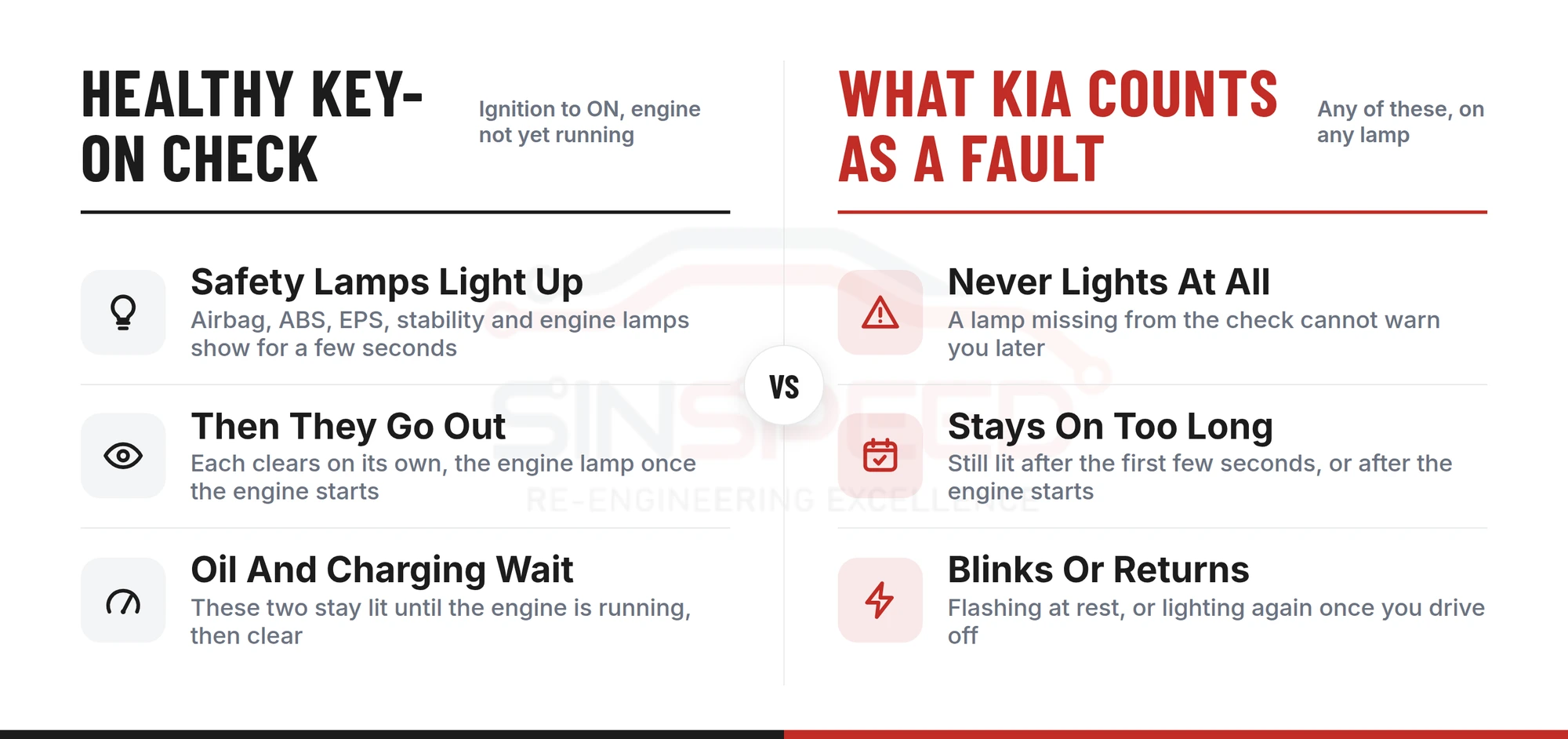
Most drivers go straight through to starting and never watch it. Seeing the sequence once on a healthy car gives you the baseline, and seeing it again when something feels wrong is the cheapest check a Picanto owner has. On a smart-key car, the same check runs when the start/stop button reaches ON.
| Lamp | At key-on, when all is well | What Kia counts as a fault |
|---|---|---|
| Airbag | Lights for a few seconds, then goes out | Does not light; still on after the first 6 seconds; blinks; lights while driving |
| ABS | Lights, then goes out after a few seconds | Does not light; comes on while driving and stays on |
| Engine malfunction indicator | Lights, then goes out a few seconds after the engine starts | Does not light; lights with the engine running |
| Passenger airbag off (where fitted) | Lights for a few seconds when the airbag is switched off | Does not light; only goes out after 60 seconds |
| Electric parking brake (where fitted) | Lights, then goes out after a few seconds | Does not light; stays lit |
| EPS | Lights, then goes out within a few seconds | Lit or blinking while driving |
| Stability control (ESP) | Lights, then goes out after a few seconds | Constantly lit (blinking on the move is ESP at work) |
| Coolant temperature | Lights for a few seconds, then goes out | Comes on and stays on in red |
| Oil pressure | Stays on until the engine starts | Still lit after starting, or lights while driving |
| Charging | Stays on until the engine starts | Still lit after starting, or lights while driving |
| Immobiliser, with a key | Stays on until the engine starts | Blinks at key-on |
| Immobiliser, with a smart key | Amber for about 30 seconds, then out | Lit for only about 2 seconds, or blinks |
Stays on: the fault is live
A lamp that lights at key-on and refuses to go out is the plainest result. The system has checked itself and found something wrong, and for the airbag, ABS and EPS Kia’s instruction is the same: have it checked as soon as possible. For the oil pressure and charging lamps, “staying on” is judged after the engine starts, never before, because both are meant to be lit until it does.
Never lights: the warning cannot reach you
This is the state almost nobody notices, because nothing looks wrong. Kia names a lamp that fails to light at key-on as a fault for five lamps: the airbag, the ABS, the engine malfunction indicator, the passenger airbag off indicator and the electric parking brake indicator. The reasoning is simple. A lamp that cannot light cannot warn you, so a dark airbag or ABS lamp says nothing about whether those systems are working.
For the other lamps, the guide does not say a missing key-on flash is a fault, so this page does not either. If a lamp you normally see has gone missing, mention it when the car is checked: it is a clue, not a verdict. Several lamps missing at once shifts suspicion away from the individual systems and towards the instrument cluster that displays them.
Blinks: sometimes working, sometimes failing
Blinking needs the most care, because on a Picanto it can mean opposite things. The stability control lamp blinks while ESP is braking individual wheels to keep the car on line, which is normal. The airbag lamp blinking is a fault, and so is the EPS lamp blinking on the move, the immobiliser lamp blinking at key-on, and the gear position display blinking on an automatic. The tyre pressure lamp has its own rhythm: about a minute of flashing, then steady, at every start, means the monitoring system has failed rather than a tyre.
So tell the garage which state you saw. The symbol names the system; the state tells them whether it is a live fault, a warning that has gone dark, or the system simply doing its job.
Which Picanto warnings lead back to an electronic unit?
Most lamps in the table report a fluid, a tyre, a bulb or a door. A smaller group report on a control unit: the electronics running the ABS, the steering assistance, the dashboard itself or an automatic gearbox. With these, the fault can sit in the unit rather than the parts around it, and repairing the original unit is an option. Our full range is on what we repair.
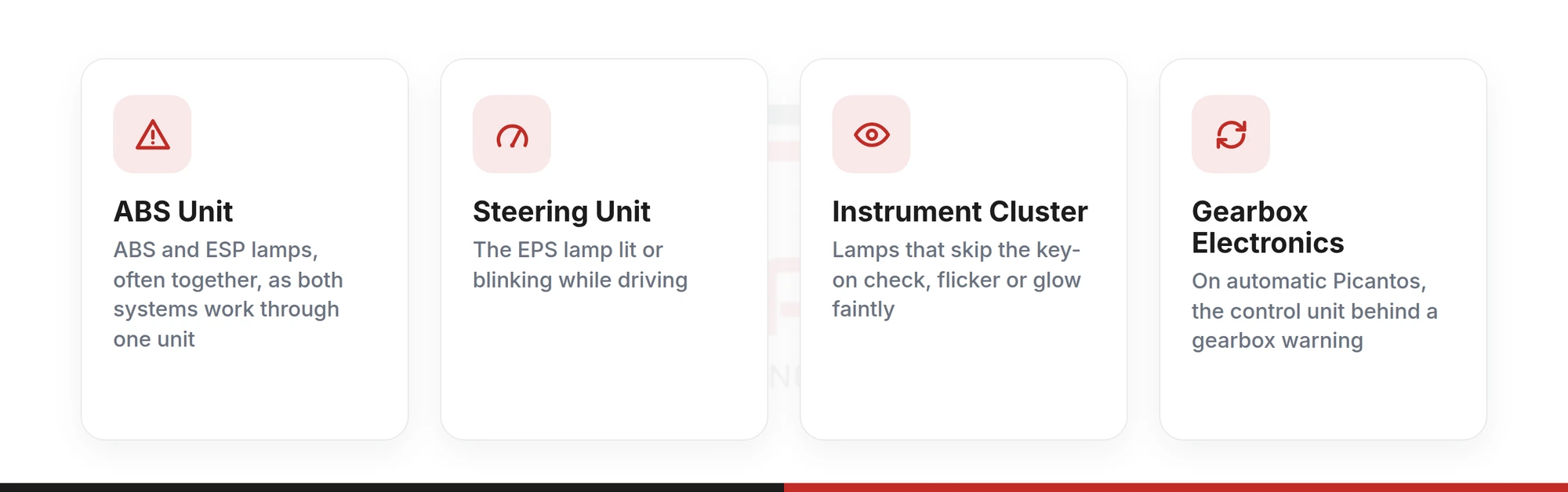
The sections below work by system rather than by part number, because the exact unit behind a lamp depends on the Picanto’s year and specification. Our engineers pin that down from the details you send.
ABS and ESP lamps: the ABS unit
The ABS unit pairs a hydraulic pump and valve block with a control module. Kia describes its job exactly: sense the speed of each wheel and, when one is about to lock, modulate the brake pressure to it repeatedly. The stability system works through the same unit, braking individual wheels, which is why ABS and ESP faults so often arrive together.
A lamp that comes and goes, or both lamps lit at once, usually traces to one of three places: a wheel-speed sensor or its wiring, the power and data connections to the unit, or the unit itself, worn down by heat cycling, vibration and ageing brake fluid. Our guides to diagnosing an ABS wheel-speed sensor, ABS and traction control lights on together and how an ABS pump works take each in turn, and what ESP does covers the stability side.
Clearing the lamp does not clear the fault, as our page on resetting an ABS light explains, and whether an ABS light fails the MOT covers the test. Every ABS unit we handle is under ABS pump and module repairs.
The EPS lamp: electric power steering
Electric power steering uses an electric motor to add effort to the driver’s input, managed by a control unit that reads how hard the wheel is being turned and how fast the car is going. When Kia’s EPS lamp lights or blinks on the move, that help may have gone, and the wheel will need noticeably more effort. It is a fault to have checked as soon as possible, not one to drive around.
The assistance motor draws heavy current, so a weak battery or a charging fault can bring the EPS lamp on as well; if the charging lamp has been lit, start there. Beyond that, the usual suspects are the steering’s torque sensing, its motor or its control unit, which lives with heat and vibration for the whole life of the car. Electric power steering fault symptoms and fixing an EPS warning light go further, and our steering work sits under steering and EPS repairs.
The instrument cluster: when the lamps themselves are wrong
Every lamp on this page depends on the instrument cluster to reach you. When the cluster starts to fail, the warnings stop being reliable: lamps that skip the key-on check, lamps that flicker or glow faintly with nothing wrong, gauges that stick or drop to zero, or a display that goes blank while the car drives normally.
Several unrelated lamps lighting together, with a scan tool reporting modules that will not answer, points at the car’s network rather than each system; lost communication fault codes explains that pattern, and the body control module is worth a look when exterior lights misbehave with good bulbs. A repaired cluster is the car’s own, so the odometer it shows is still the car’s true reading. See instrument cluster repairs.
A blinking immobiliser lamp and a car that will not start
A blinking immobiliser lamp at key-on, with an engine that will not start, means the car has not accepted the key. Kia’s guide sends a blinking lamp for checking, and notes that on smart-key cars the same lamp blinks when the key is missing or its battery is weak. Rule those out first, then read whether a no-start is the immobiliser.
The engine lamp and the automatic gear display
The engine malfunction indicator watches the whole emission control system, so on its own it names no part. When it arrives with a hesitant or flat throttle response, the throttle body is one unit the codes can point at; throttle body fault codes and what a throttle body does explain it, and the repairs are under throttle body repairs.
If your Picanto is an automatic, a blinking gear position display is Kia’s sign of a gear system malfunction, and Kia asks for a dealer check as soon as possible for safety. The transmission control module that runs the gearbox is one of the units behind it: transmission control module fault codes covers what the codes say, and transmission control module repairs covers the work.
Sinspeed · Kia Picanto electronics
Which lamps lingered, and which never lit? Start there.Send us the Picanto’s year, what the dashboard did at key-on and after starting, and any codes a garage has already read. An engineer will reply with the unit most likely behind it and how its repair would run, so your garage knows what it is removing, and why, before it starts.
Electronic and hydraulic engineers on our own staff · Calibrated on dealer-grade diagnostic equipment before dispatch
What to do when a warning lamp lights in your Picanto
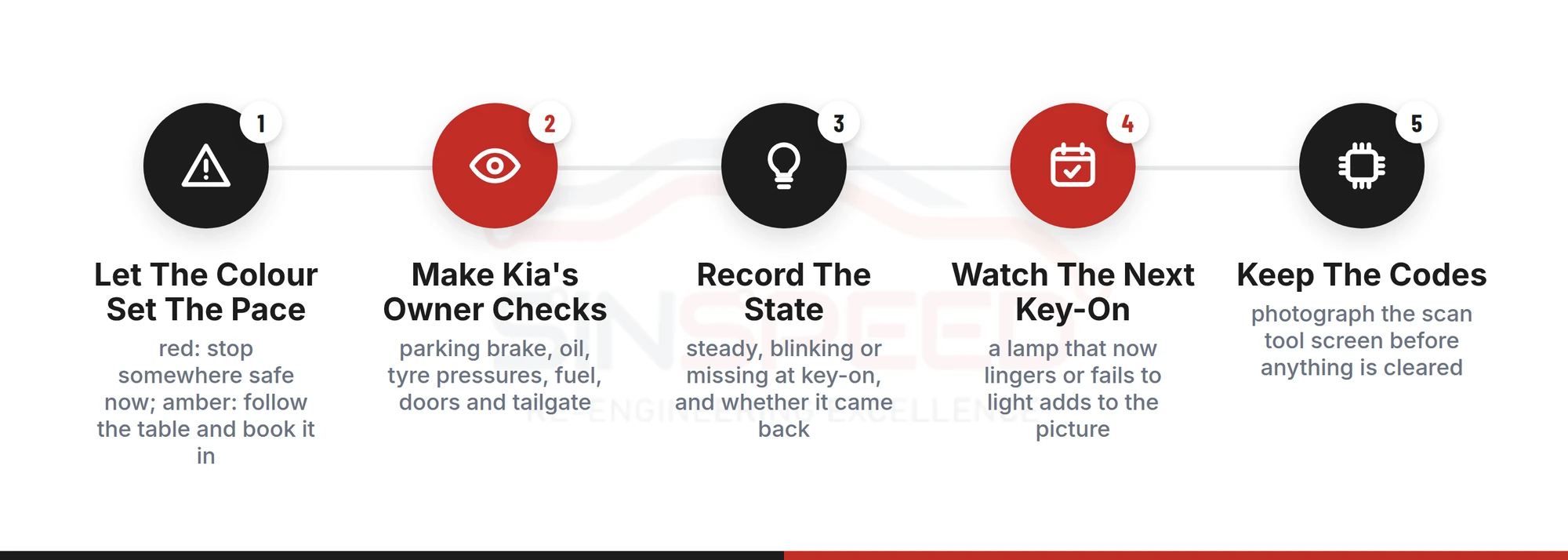
- Let the colour set the pace. Red: find a safe place to stop now; for oil pressure and coolant, Kia says not to carry on. Amber: follow the table’s verdict and book the car in.
- Make the owner checks Kia names. Parking brake fully off, oil on the dipstick once stopped, tyre pressures against the label on the driver’s side centre pillar, fuel, and doors and tailgate shut.
- Record the state, not just the symbol. Steady, blinking or missing at key-on, and whether it came back after a restart.
- Watch the key-on check at the next start. A lamp that now fails to light, or lingers, adds to the picture.
- Keep the codes before anyone clears them. A photo of the scan tool screen will do. A cleared brake, steering or airbag lamp is a hidden fault, not a fixed one.
Kia Picanto warning lights FAQs
What do the warning lights on a Kia Picanto dashboard mean?
They follow a colour code. Red lamps, such as brakes, oil pressure, coolant temperature, charging and airbag, mean a serious fault: stop when it is safe, or for the airbag have it checked as soon as possible. Amber lamps, including ABS, the engine malfunction indicator, stability control and tyre pressure, report a fault to have checked soon. Green, blue and white lamps confirm something is switched on. Kia notes that amber can look yellow or orange, and that lamps vary by version.
Why is the airbag light flashing or staying on in my Kia Picanto?
Kia’s guide lists four signs of a possible fault in the airbag system: the lamp does not light when the ignition goes to ON, stays on after the first 6 seconds, blinks, or comes on while driving. Any of them means the airbags may not protect you as intended in a collision. The car still drives, but have the system checked as soon as possible, and do not have the lamp cleared until the fault is found.
Can I drive my Kia Picanto with the ABS light on?
With care, if the ABS lamp is on by itself. Kia says normal braking still works but without anti-lock, so leave more space, avoid hard braking and have it checked as soon as possible. If the red brake lamp is lit as well, stop as soon as it is safe: that lamp can mean low brake fluid. The ABS lamp should also light briefly at every key-on, and Kia treats it as an ABS fault if it never does.
What does the EPS warning light mean on a Kia Picanto?
EPS is electric power steering. The lamp lights at key-on and should go out within a few seconds. If it lights or blinks while you drive, Kia says the steering system has a malfunction and power assistance may not be available, so the wheel needs much more effort. The car can still be steered, but have it checked as soon as possible, and mention any charging lamp too, as a weak battery can bring it on.
Why is the tyre pressure light flashing on my Kia Picanto?
A lamp that flashes for about a minute, then stays on, and does the same at every start, means the tyre pressure monitoring system itself has a fault. While it is lit the system may not spot a low tyre, so check the pressures yourself; Kia notes that fitting different tyres or wheels is one cause. A steady lamp means one or more tyres is well under-inflated: slow down and inflate to the figure on the driver’s side centre pillar label.
What does it mean if a warning light does not come on when I start my Picanto?
For some lamps, Kia counts it as a fault. Its guide says the airbag lamp, the ABS lamp, the engine malfunction indicator, the passenger airbag off indicator and the electric parking brake indicator should all light when the ignition goes to ON; if one does not, have that system checked. A lamp that cannot light cannot warn you. If several are missing at once, the instrument cluster that displays them is worth checking too.
Why is the key or immobiliser light flashing on my Kia Picanto?
With a conventional key, the immobiliser lamp lights at key-on and goes out once the engine starts; if it blinks instead, Kia says have the system checked. With a smart key it shows amber for about 30 seconds, and lit for only 2 seconds, or blinking, also needs checking. It blinks, too, if the smart key is not in the car or its battery is weak; Kia says you can still start by pressing the start/stop button with the smart key itself.
Sinspeed · mail-in repair
Your Picanto’s own unit, repaired and proven under loadOnce the codes settle on a unit, your garage removes it and posts it to us, and the car waits where it is. The unit goes onto one of our Hardware-in-the-Loop platforms, which puts it through the heat, vibration and electrical load of a working car until an intermittent fault gives itself away. We repair it, run it through the same conditions again to prove it, and send it back ready to go in. Where the car needs a relearn after fitting, that step belongs to the service, not to your garage’s guesswork.
Lifetime warranty with no mileage limit on most remanufactured parts · Benches built to cleanroom standard, with ESD protection
Final thoughts
A Picanto shows you its warning system working for a few seconds every time the ignition goes to ON, and at no other time. Learn what that sequence looks like on a good day and it stops being background: a lamp that lingers, one that never appears or one that blinks when it should not is the car speaking up before any symptom arrives.
When a lamp does break the pattern, the state you saw is worth as much as the symbol. Write it down, keep the codes, and the unit behind the lamp is found sooner, whether it turns out to be the ABS, the steering, the cluster or something far simpler.