
Summary: The control unit on a Ford PowerShift is not the same part on both gearboxes. On the dry DPS6 — Getrag’s 6DCT250 — it is a transmission control module with electric actuators built into it, driving the gear selectors directly, and there is no valve body anywhere in that gearbox. On the wet MPS6 — the 6DCT450 — the control module is permanently attached to the hydraulic body and the two travel as one mechatronic assembly. We rebuild both. Your module comes back with its own software still on it; a replacement arrives blank.
- The dry DPS6 unit: a transmission control module with integrated electric actuators — and no valve body, because the gearbox has no hydraulics at all
- The wet MPS6 unit: control module and hydraulic valve body permanently attached, so the whole mechatronic assembly is the part that moves
- Why it fails: heat, thermal cycling, vibration and moisture at the module — and, on the dry gearbox, an input-shaft seal that puts oil where oil should not be
- Codes worth sending us: P0606, P090B, P0901, P073E, P073F — and anything that returns straight after being cleared
- What comes back: your own module, with its own configuration intact, ready to refit
- The service: mail-in repair and return, UK-wide
What is the PowerShift TCM, and why is it not a valve body?
A gearbox that changes gear without a clutch pedal needs something deciding when to change and how hard. That is the transmission control module, and on a PowerShift it does not only decide — it acts. If you want the general picture first, we have a plain-English explanation of what a transmission control module does.
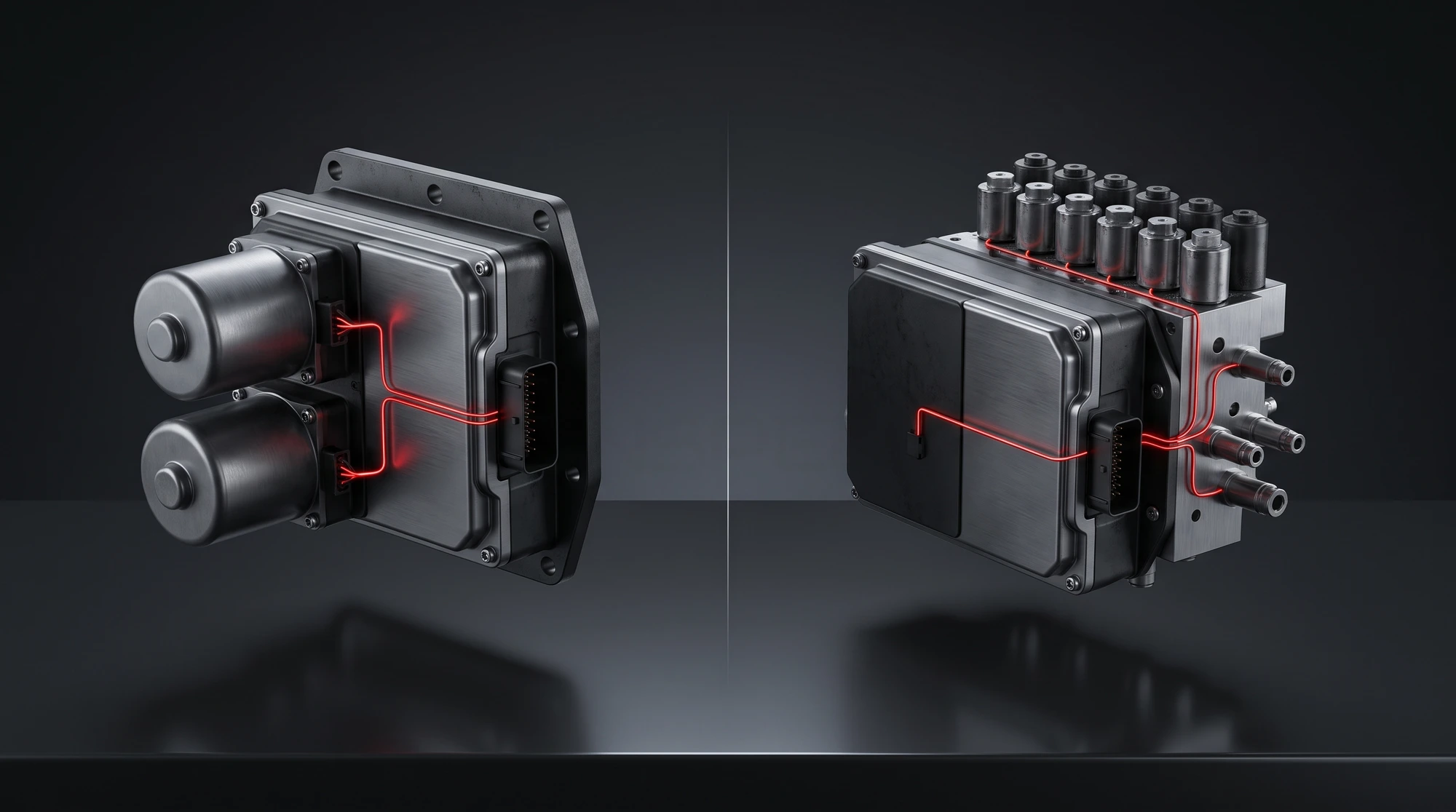
On the dry 6DCT250 — the DPS6 — the module is the actuation. It carries two brushless DC motors that drive the gear selector drums directly. The twin clutches run dry: no oil bath, no pump, no hydraulic pressure circuit anywhere in the gearbox. The correct description of the part is a transmission control module with integrated electric actuators, and that is why it behaves so differently from every other automatic control unit on the market.
Which brings us to the term you have probably already met. “DPS6 valve body” is in wide circulation, and there is no such part. A valve body exists to meter hydraulic pressure to clutches and shift elements. Nothing in a dry PowerShift is under hydraulic pressure, so there is nothing for one to meter. If you have searched for a Ford Focus transmission control module and found yourself looking at listings for whole gearboxes, this is exactly why the naming matters: on this gearbox the part that usually fails detaches on its own.
The wet 6DCT450 — Ford’s MPS6, and the Powershift badge on a long list of Volvos — is the opposite case. Its clutches run in fluid and are applied hydraulically, and its control module is bonded to the hydraulic body for good. Mitsubishi, documenting the same Getrag design in the Evolution X, states it flatly: the valve body and the TCM are permanently attached and cannot be replaced separately. So on that gearbox the control module never travels alone — the mechatronic assembly is the unit. How a hydraulic control body wears and what that does to shift quality is covered on our transmission valve body repair page.
Working out which gearbox is in your Ford is a separate question, and we have answered it in detail on our Ford PowerShift repair page. Everything below is about the control unit itself.
What are the symptoms of a failing PowerShift TCM?
Control-module faults on this family almost always start intermittently and end permanently. The early stage is the one people drive through for months, and it is the stage where the diagnosis is cheapest to get right.
- A transmission malfunction warning or spanner symbol, sometimes with the gear display flashing
- Limp mode — the car restricted to one or two gears, most often once it is warm
- A pause of a second or more after selecting D or R before anything engages
- Harsh, jerky or thumping changes, worst low down and in traffic
- Slipping, with engine speed floating away under load
- Missing gears — reverse and first are usually the first to go
- Complete loss of drive, or the module not answering the scan tool at all
- Codes that reappear the moment they are cleared
That last one is worth taking seriously. A code returning immediately is the module reporting a condition it can still measure, not a glitch that a battery disconnect will tidy away.
The codes are where a vague complaint turns into a decision. These are the ones that point at the control unit rather than past it.
| Code | What the scan tool reports | What it usually points at |
|---|---|---|
| P0606 | Internal control module fault | The module itself — the code a failing or dead PowerShift TCM tends to leave behind |
| P090B / P0901 | Clutch actuator faults | The electric actuator side of the dry DPS6 module, degraded rather than silent |
| P073E | Reverse gear not achieved | Gear selection lost on the reverse side — usually the first gear a DPS6 gives up |
| P073F | First gear not achieved | Selection lost on first, and commonly logged alongside P073E |
| P0750–P0765 | Shift solenoid circuit faults | The hydraulic half of the wet 6DCT450 mechatronic — these are not dry DPS6 codes |
Send us whatever is stored, including anything that looks unrelated; a module losing its grip on one output often logs several codes before it logs the obvious one. Our wider reference is the guide to transmission control module fault codes, and the symptom-level read across this whole family is in Ford PowerShift problems.
Why does a PowerShift control module fail?
Heat comes first, and the dry gearbox makes its own. A dry twin clutch has no fluid circulating through it to carry heat away and no torque converter to absorb slip when the car is crawling. Every low-speed engagement puts that energy into the clutch as heat, and the control module lives in the assembly that is generating it. Stop-start town driving is the hardest duty cycle this gearbox has.
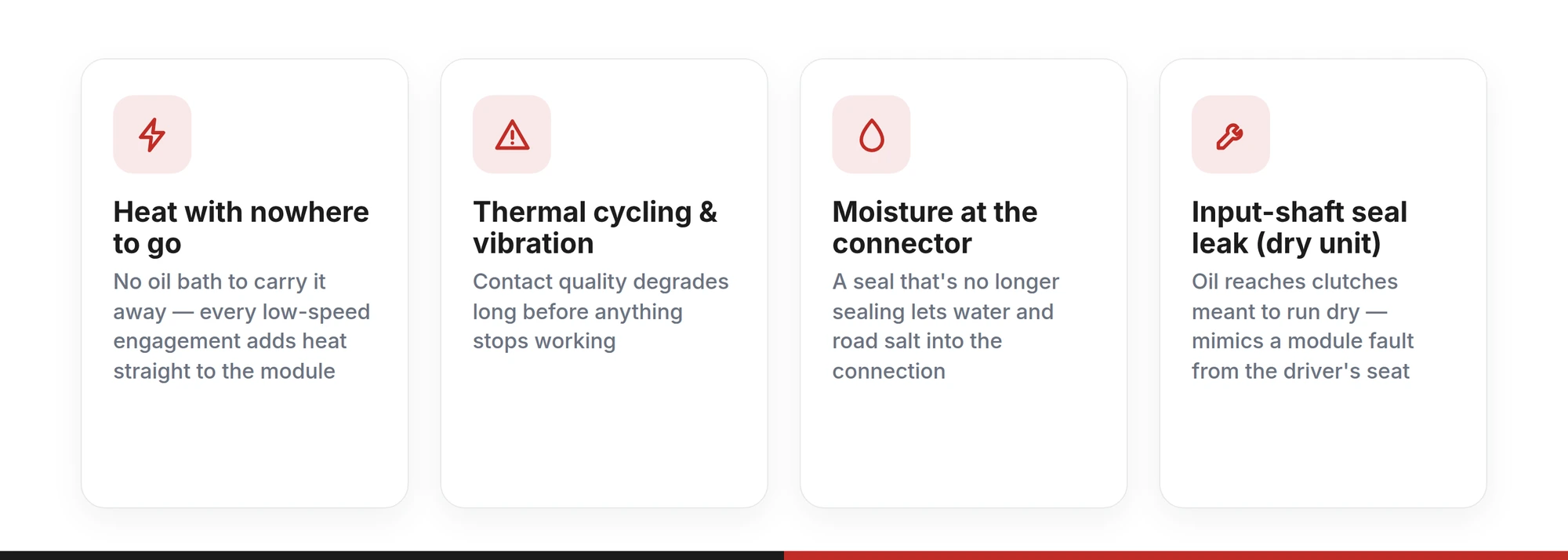
Then thermal cycling and vibration. The module is heated and cooled thousands of times and shaken on every journey, while being expected to hold precise electrical contact throughout. Contact quality degrades long before anything stops working, which is why the early symptoms come and go and why a fault that is obvious on a warm afternoon has vanished by the following morning.
Moisture and contamination take the same route in. Where the loom enters the module, a seal that is no longer doing its job is a path for water, road salt and dirt into a connection that has to stay clean. Once that has happened, the fault tends to track the weather rather than the mileage.
On the dry gearbox there is one more cause that is not a module fault at all but produces the same complaint. When the input-shaft seal leaks, oil reaches the faces of clutches designed to run dry, and the result is the shudder the DPS6 is known for — worst pulling away and through the change from first to second.
Which is the thing worth settling before anything is bought. A module that has lost accurate control of an actuator slips, judders and refuses engagement, and from the driver’s seat that is indistinguishable from a worn clutch. It is how a clutch job ends up being done on a car whose control unit was the problem — and how a module gets condemned on a car whose seal was leaking. Codes narrow it down. Measurement on a bench settles it.
Sinspeed · transmission control module rebuilds
A replacement module arrives blank. Yours does not.Send us the model, the engine and every fault code stored, through the repair form. We will tell you whether the control unit is the fault and what your garage needs to remove — before you commit to anything.
Tested on bespoke in-house Hardware-in-the-Loop platforms under simulated heat, vibration and load
Repair your own module, or fit a replacement?
Both routes end with a gearbox that works. What separates them is what has to happen on the car afterwards, and how much the module knows when it gets there.
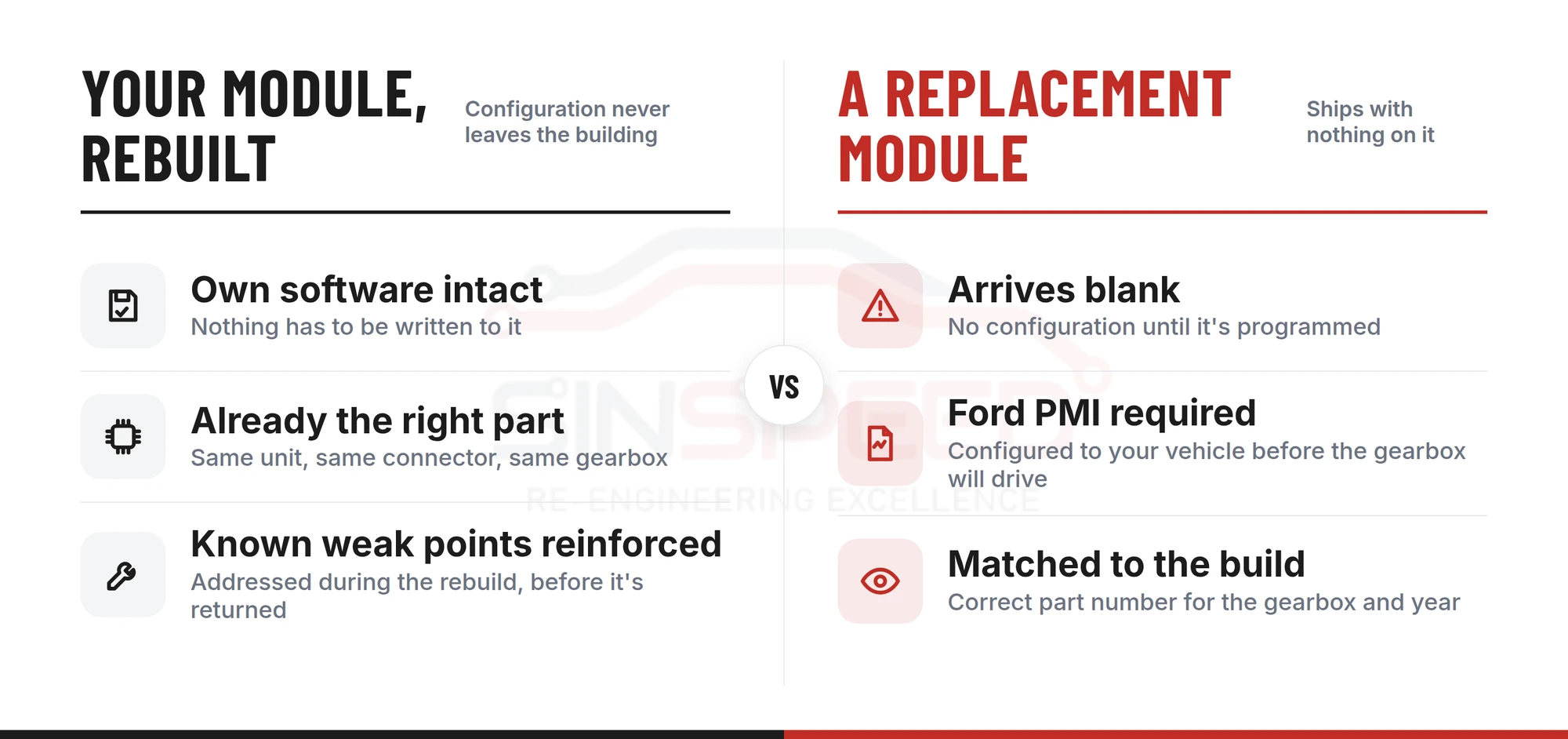
A replacement Ford control module arrives holding nothing. Before the car will drive, it has to be configured to that specific vehicle — Ford’s programmable module installation, with the configuration read out of your old module, or pulled by VIN as as-built data if the old one no longer answers. The wet gearbox is the same story in different packaging: a new mechatronic assembly ships without operating software in its control unit.
| Your own module, rebuilt | A replacement module | |
|---|---|---|
| Software and configuration | Returns with its own software on it — nothing has to be written to it | Ships blank and is configured to the car before the gearbox will drive |
| Where that configuration comes from | It is already in the unit and never left it | Read out of your old module, or pulled by VIN as as-built data if it no longer responds |
| Clutch adaptation after fitting | Carried out on the car, as part of the fitting work | Carried out on the car, from a blank starting point |
| Matching the part to the vehicle | Already the right part — same unit, same connector, same gearbox | Has to be matched to the correct part number for the gearbox and build |
| The original design weakness | Known weak points are reinforced during the rebuild | New stock of the same design |
None of that is an argument against a replacement where one is genuinely needed. It is the argument for rebuilding a module that is still yours: the configuration problem never arises, because the configuration never leaves the building it lives in.
What a PowerShift TCM repair involves
The unit comes off the car at your garage and comes to the workshop by post. From there it is bench work.
- Tell us what it is doing
Complete the repair form with the model, the engine, the year and every stored fault code. If you are not certain which PowerShift you have, describe the car and the symptoms and we will confirm which unit to send.
- The unit arrives
On the dry 6DCT250 that is the control module with its integrated actuators. On the wet 6DCT450 it is the mechatronic assembly, because the two halves do not separate. Either way, taking it off is ordinary workshop work for the garage and the rest is a parcel.
- We measure it rather than guess at it
The unit is stripped in cleanroom-standard, ESD-safe conditions by our own engineers, and its electrical behaviour and actuator movement are measured against known-good data rather than inferred from the symptom. It is then run on our bespoke in-house Hardware-in-the-Loop platforms, which simulate the heat, vibration and load it sees in service — which is how a fault that only shows up warm is made to repeat on a bench.
- It comes back ready to fit
Your module returns with its own configuration intact, so there is nothing to program into it on arrival. The clutch adaptation the gearbox learns afterwards is carried out on the car by whoever refits the unit, and we say so before dispatch rather than leaving it to be discovered.
One request before it is posted: treat it as an electronic assembly rather than a lump of aluminium. An antistatic bag, nothing bearing on the connector pins, and enough padding that it cannot shift inside the box.
Which Fords, and which control units we take
- The dry 6DCT250 control module, with its integrated electric actuators. Fiesta Mk7, the global Focus Mk3, B-MAX, EcoSport, Ka+, Transit and Tourneo Connect and the Transit Courier. The same gearbox is Renault’s EDC in the Clio IV, Captur and Mégane III, and it is fitted to the Dacia Duster and the Mercedes Citan.
- The wet 6DCT450 mechatronic assembly, control module included. Mondeo Mk4 and Mk5, the European Focus, C-Max, S-MAX, Galaxy, Kuga Mk1 and Mk2 and the European diesel Edge, along with the Volvos badged Powershift. Mitsubishi’s TC-SST is the closely related 6DCT470 from the same Getrag family.
One disambiguation for Fiesta owners. The earlier 1.4 with the automated manual is not a PowerShift and has no PowerShift control module — it uses a separate clutch actuator and gear actuator, which we also repair. That work is on our Ford Fiesta 1.4 clutch and gear actuator repairs page.
And one correction worth making, because it sends people down the wrong road: everything reported under the PowerShift name about extended coverage and legal action concerns the dry 6DCT250. It has never applied to the wet unit in a Mondeo, a Kuga or a Volvo.
The one job on the dry gearbox that is not ours is the twin-clutch pack itself, which is clutch work carried out where the car is. The control module is separate work, and it still reaches us by post while that happens. All of it sits under our transmission control module repairs, alongside the rest of the per-make work.
Ford PowerShift TCM repair: FAQs
Can a Ford PowerShift TCM be repaired, or does it have to be replaced?
It can be repaired, and on this family repairing the original has a concrete advantage over fitting another one. Your module already holds the configuration the car expects, and it keeps it through the rebuild — so it goes back on as a direct refit. A replacement arrives blank and has to be configured to your vehicle before the gearbox will drive.
My garage says the module is inside the gearbox housing. Can it still be sent to you?
Yes. Your garage removes the unit, posts it in, and refits it when it comes back. That is the normal route for every transmission control unit we rebuild. Where a unit sits decides who takes it out; it has no bearing on what we can do with it once it is on the bench.
My Fiesta shudders pulling away. Is that the clutch or the control module?
It can be either, which is precisely why it is worth establishing before anything is bought. A leaking input-shaft seal putting oil onto clutches meant to run dry produces that shudder, and so does a module that has lost accurate control of an actuator. The stored codes narrow it down and bench measurement settles it, because the module’s behaviour can be compared against known-good data instead of guessed at from the symptom.
Is there a valve body in a DPS6 PowerShift?
No. The dry 6DCT250 has no oil bath, no pump and no hydraulic pressure circuit, so there is nothing a valve body could do in it. The term gets used for the DPS6 constantly and it is simply the wrong part name. What people mean by it is the transmission control module with integrated electric actuators, which is the part we rebuild. The wet 6DCT450 does have a hydraulic valve body — that is the other gearbox.
The wet PowerShift TCM is built into the mechatronic. Can that still be repaired?
Yes, and the whole assembly is what you send. On the 6DCT450 the control module and the hydraulic body are permanently attached and cannot be separated, so the mechatronic is treated as one unit on the bench — hydraulic behaviour and electrical behaviour measured together. The same applies to the Volvo Powershift, which is the same gearbox under a different badge.
Sinspeed · your module, your software
Your module already knows this car. A new one does not.Send the control module or the mechatronic assembly to the workshop and it is stripped, measured and tested under simulated heat, vibration and load, then returned with its own configuration exactly as it left.
Lifetime, unlimited-mileage warranty on most remanufactured parts · Most units returned ready to fit with no coding required
Final thoughts
The PowerShift control module is one of the few parts on a modern car where the original is the better one to keep, and the reason is unglamorous. It already holds the configuration the car expects. Rebuild it and that never becomes a problem; replace it and it becomes the first problem, before the gearbox has turned a wheel.
So before anything is ordered, have the codes read and send them to us with the model and the engine. If the module is the fault, it comes off, it comes here, and it goes back on with everything it already knew.